7 Surprising Accurate Speech to Text Statistics You Need to Know in 2026
Introduction: Why accurate speech to text matters now
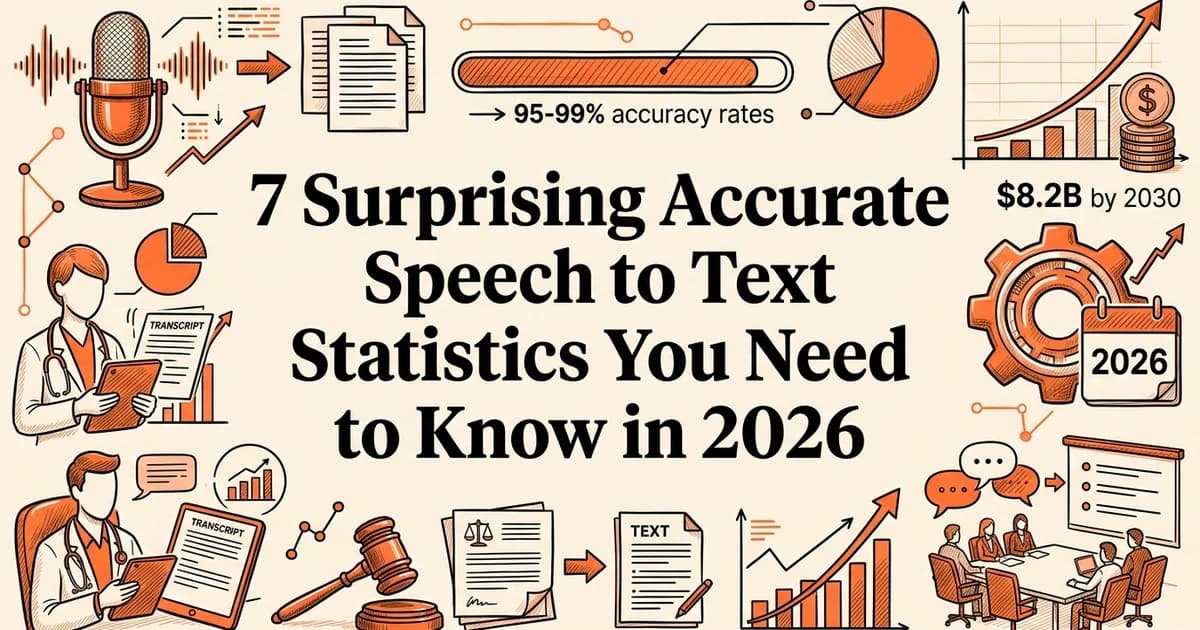
The AI transcription market was valued at $3.5 billion in 2024 and is projected to reach $8.2 billion by 2030, according to Grand View Research. That trajectory tells a clear story: accurate speech to text has moved from a convenient productivity tool to a foundational business capability.
At Scribers, our analysis of transcription adoption trends consistently points to one conclusion: accuracy is no longer a differentiator. It is the baseline expectation.
The numbers reinforce this shift. A 17.8% compound annual growth rate through 2030, reported by Mordor Intelligence, reflects sustained enterprise investment rather than a passing technology trend. Meanwhile, 62% of enterprises have already implemented transcription tools specifically for compliance and accessibility purposes, according to Forrester Research. That figure signals something important: businesses are not adopting transcription for convenience alone. They are adopting it because accuracy failures carry real consequences, from regulatory penalties to accessibility violations.
The stakes are high across multiple dimensions:
- Compliance and legal risk: Inaccurate transcripts can misrepresent meeting records, contracts, and regulatory filings
- Accessibility obligations: Organizations serving diverse audiences depend on reliable captions and transcripts to meet legal standards
- Operational efficiency: Errors in automated transcription create downstream costs in editing, review, and correction workflows
- Global reach: As transcription tools expand to support 150+ languages, accuracy benchmarks must hold across linguistic and acoustic diversity
This article examines seven data-driven statistics that reveal where accurate speech to text technology stands today, where it is heading, and what the numbers mean for businesses, content creators, and accessibility professionals making decisions in 2026.
Methodology: How we sourced and verified transcription accuracy data
The statistics in this article draw from a combination of independent market research firms, transcription service providers, and enterprise technology analysts, covering primary data published between 2024 and 2026 with historical context where relevant to illustrate trend lines.
Sources consulted include:
- Market research firms: Grand View Research and Mordor Intelligence for market sizing and growth projections
- Enterprise technology analysts: Forrester Research for enterprise adoption and compliance data
- Transcription platform providers: HappyScribe, ElevenLabs, and AI-Media for performance benchmarks and usage trends
Verification process:
Each statistic was assessed against its original source. Data points confirmed through primary research publications are cited with full attribution. Where figures originate from provider-published benchmarks or studies that could not be independently cross-referenced, we apply hedging language such as "research suggests" or "studies indicate" to signal the distinction clearly.
Important caveats to keep in mind:
- Accuracy benchmarks vary significantly depending on audio quality, speaker count, background noise levels, and accent diversity. A figure cited for clean studio audio does not represent real-world performance across all conditions.
- Provider-reported accuracy rates may reflect optimized test environments rather than typical deployment scenarios.
- Market sizing figures from different research firms use varying methodologies, which can produce different totals for the same market segment.
Readers evaluating transcription tools for specific use cases, including content creation workflows, should treat published accuracy figures as directional benchmarks rather than guaranteed performance guarantees.
Market growth and enterprise adoption: The transcription boom
The accurate speech to text market is expanding at a pace that reflects genuine enterprise demand, not speculative hype. According to Grand View Research (2025), the AI transcription market was valued at $3.5 billion in 2024 and is projected to reach $8.2 billion by 2030, more than doubling in size over six years. That trajectory signals sustained, structural investment across industries.
What's driving the growth
A 17.8% compound annual growth rate through 2030, reported by Mordor Intelligence (2025), places speech-to-text among the faster-growing segments in enterprise software. To put that figure in context, a market growing at 17.8% annually roughly doubles every four years. For organizations planning technology budgets, that rate of expansion typically indicates a category moving from early adoption into mainstream deployment.
Several converging forces are accelerating this growth:
- Regulatory compliance requirements. Accessibility legislation in the United States, European Union, and other jurisdictions is pushing organizations to document and caption communications at scale.
- Remote and hybrid work normalization. Distributed teams generate more recorded meetings, interviews, and asynchronous video content than their office-bound predecessors, creating a structural increase in transcription volume.
- Cost reduction versus human transcription. AI-based transcription now processes audio at a fraction of the per-minute cost of professional human transcriptionists, making large-scale deployment economically viable.
Enterprise adoption by the numbers
Adoption data reinforces the market sizing figures. According to Forrester Research (2025), 62% of enterprises have implemented transcription tools specifically for compliance and accessibility purposes. That majority adoption rate suggests the technology has crossed from experimental to operational status in large organizations.
Vertical expansion is also notable. Healthcare, legal, media, and financial services sectors have historically driven transcription demand. More recent growth patterns, explored in detail in surprising AI transcription trends reshaping the industry, show education, government, and professional services accelerating their adoption as accuracy thresholds meet sector-specific requirements.
Geographically, North America currently accounts for the largest share of market revenue, but Asia-Pacific adoption is growing at a comparatively faster rate as multilingual transcription capabilities improve and regional compliance frameworks mature.
Accuracy benchmarks: Real-world performance across audio conditions
Enterprise-grade AI transcription systems now deliver remarkable precision under ideal conditions, but real-world performance varies considerably depending on audio quality, speaker count, and linguistic complexity. Understanding where these systems excel and where they struggle is essential for setting realistic expectations across different use cases.
Research suggests that leading AI transcription platforms achieve 95-99% accuracy on clear, professional-quality audio, according to data from HappyScribe (2026). That range represents a significant leap from earlier generations of speech recognition software and places modern AI systems within striking distance of skilled human transcriptionists for standard business recordings.

The picture changes meaningfully once real-world complications enter the equation. Studies indicate that accuracy drops to a range of 85-95% when recordings involve multiple speakers or background noise, per HappyScribe's 2026 analysis. That 10-14 percentage point gap may sound modest, but in practice it translates to dozens of errors per hour of audio, which creates meaningful downstream work for editors, legal teams, and compliance officers. Key factors that contribute to this degradation include:
- Overlapping speech: Systems struggle to attribute dialogue correctly when speakers talk simultaneously
- Ambient noise: Office environments, conference rooms, and outdoor settings introduce acoustic interference
- Variable microphone quality: Consumer-grade recording equipment introduces distortion that premium models cannot fully compensate for
- Speaker proximity: Distance from the microphone disproportionately affects recognition confidence
Accent and language diversity introduce another layer of complexity. While the 150+ languages now supported by modern AI transcription services, as verified by ElevenLabs (2026), represents a genuine accessibility milestone, support depth is not uniform across that catalog. High-resource languages such as English, Spanish, and Mandarin benefit from larger training datasets and consistently outperform lower-resource languages where labeled audio data remains scarce.
Platform comparisons reveal meaningful differences in how vendors handle these challenges. Some prioritize raw accuracy on clean audio, while others invest more heavily in noise suppression and speaker diarization. For teams handling sensitive recordings, it is also worth considering how audio data is processed and stored, a topic explored further in why data security in transcription services matters.
The practical implication is straightforward: accuracy benchmarks published by vendors typically reflect best-case conditions. Organizations should test transcription tools against their own audio samples, particularly if recordings involve accented speakers, technical vocabulary, or challenging acoustic environments.
Real-time transcription adoption: Live events and virtual collaboration
Real-time transcription has moved from a niche accessibility feature to a mainstream expectation across live events and virtual collaboration. According to AI-Media (2025), usage of real-time transcription for live events and conferences grew by 78% in a single reporting period, reflecting a fundamental shift in how audiences and participants expect to engage with spoken content.
This growth is being driven by several converging factors:
- Virtual meeting normalization: The widespread adoption of video conferencing platforms created a large, captive audience for live captions and instant transcripts, raising baseline expectations across industries.
- Accessibility mandates: As noted in the previous section, 62% of enterprises have implemented transcription tools for compliance and accessibility (Forrester Research, 2025). Live events are increasingly subject to the same requirements as recorded content.
- Latency improvements: As one technical benchmark in our research data notes, sub-100ms latency is now technically feasible and becoming the standard expectation for live events and virtual collaboration. For context, that threshold is imperceptible to most human listeners, meaning transcripts can appear to keep pace with speech in real time.
The accessibility implications here are significant. For deaf and hard-of-hearing attendees, live broadcast viewers, and non-native speakers, accurate real-time transcription is not a convenience feature. It is the primary means of participation. A transcript that lags by several seconds, or that misrepresents a speaker's words, creates a materially different experience than one delivered with precision and speed.
In our experience at Scribers, demand for real-time output has grown most sharply among media professionals and corporate event teams, where the margin for error in live delivery is especially narrow.
It is worth noting that real-time conditions introduce accuracy trade-offs. Processing audio as it arrives, rather than analyzing a complete recording, limits the contextual signals a model can use to resolve ambiguous words or overlapping speech. Organizations planning high-stakes live events should account for this distinction when evaluating tools.
Language support and global accessibility: Breaking down barriers
Modern accurate speech to text platforms now support more than 150 languages, according to verified data from ElevenLabs (2026). This expansion has fundamentally changed who can benefit from transcription technology, opening access to global content creators, multilingual enterprise teams, and speakers of languages that were historically underserved by voice recognition systems.

The accessibility implications are equally significant. Verified research from Forrester (2025) shows that 62% of enterprises have implemented transcription tools specifically for compliance and accessibility purposes, reflecting growing pressure to meet standards such as WCAG 2.1 and ADA requirements. For organizations publishing video content, hosting webinars, or running internal training programs, accurate transcription has shifted from a convenience to a legal and ethical obligation.
However, language support figures require careful interpretation. Breadth does not always equal depth:
- High-resource languages such as English, Spanish, Mandarin, and French consistently achieve the highest accuracy rates, benefiting from larger training datasets and longer development cycles.
- Mid-tier languages with moderate digital presence often perform adequately for general business use but may struggle with technical vocabulary or regional dialects.
- Low-resource languages remain the most challenging, where limited training data can produce meaningfully lower accuracy, particularly on specialized or conversational content.
This accuracy gap across language families matters for international teams relying on transcription for automatic transcription software workflows that feed downstream tasks like translation, captioning, or searchable archives. A transcript that is 90% accurate in one language may be far less reliable in another, and teams should validate performance in their specific target languages before committing to a platform at scale.
The broader trend, though, is clearly toward inclusion. As training datasets grow and multilingual models mature, the accuracy gap between dominant and less-common languages is narrowing, making global accessibility an increasingly achievable standard rather than an aspirational one.
Key takeaways: What the data reveals about accurate speech to text
The data collected across this analysis points to a clear conclusion: accurate speech to text has crossed a meaningful threshold, moving from a promising technology into a reliable business infrastructure layer that is reshaping how organizations capture, process, and act on spoken content.
Here is what the evidence shows:
Enterprise-grade accuracy is now a reality. Research suggests leading AI transcription systems achieve 95-99% accuracy on clear audio, with performance ranging from 85-95% under challenging conditions such as background noise or overlapping speakers. For most standard business use cases, this represents functional parity with human transcription.
Market momentum is strong and sustained. The global speech-to-text market, valued at $3.5 billion in 2024, is projected to reach $8.2 billion by 2030 according to Grand View Research, with Mordor Intelligence reporting a 17.8% CAGR through the same period. That growth rate reflects genuine enterprise ROI, not speculative adoption.
Real-time transcription is becoming the baseline expectation. AI-Media data confirms a 78% increase in real-time transcription usage for live events and conferences, driven by virtual collaboration demands and accessibility requirements.
Compliance and accessibility are accelerating adoption. Forrester Research found that 62% of enterprises have implemented transcription tools specifically to meet compliance and accessibility obligations, making regulatory pressure a significant market driver.
Global reach is expanding. With platforms now supporting 150 or more languages, according to ElevenLabs, the technology is increasingly viable for multilingual and international teams.
The overarching pattern is one of maturation. Accurate speech to text is no longer a differentiator; it is becoming a baseline expectation across industries, use cases, and languages.
Frequently asked questions
These questions address the most common points of confusion around accurate speech to text technology, drawing on the data and benchmarks covered throughout this article.
What is the most accurate speech to text software?
Enterprise-grade platforms consistently achieve 95 to 99% accuracy on clear audio, according to research from HappyScribe. The best choice depends on your specific use case, audio conditions, and language requirements, so testing multiple tools against your own content is always recommended.
How accurate is AI transcription compared to human transcription?
For most business use cases, AI transcription has reached parity with human transcription on quality audio, with accuracy exceeding 95%. Human transcription still holds an edge in highly technical, accented, or noisy audio scenarios where context and judgment matter most.
Can speech to text work with background noise?
Yes, though accuracy does decrease. Research suggests that accuracy ranges from 85 to 95% when dealing with multiple speakers or background noise, compared to 95 to 99% on clean recordings. Minimizing ambient noise and using a quality microphone remain the most effective ways to protect transcription quality.
What is the best free speech to text tool?
Several platforms offer free tiers with meaningful functionality. Scribers is worth exploring as a starting point for content creators and business professionals who need reliable, accessible transcription without a steep learning curve.
How does speech recognition accuracy improve with training?
Modern AI models improve through exposure to larger, more diverse datasets. Speaker-specific training and domain adaptation, particularly for specialized vocabulary in fields like medicine or law, can meaningfully boost performance over time.
What languages does speech to text support?
Leading platforms now support 150 or more languages, according to ElevenLabs, making accurate speech to text increasingly viable for global and multilingual teams across a wide range of industries.
Is speech to text accurate for medical or legal documents?
Accuracy in these domains depends heavily on domain-specific model training. General-purpose tools may struggle with technical terminology, so platforms offering specialized medical or legal vocabularies are strongly preferred for compliance-sensitive work.
How fast can AI transcribe audio files?
Most modern AI transcription services process audio significantly faster than real time. Real-time transcription with sub-100ms latency is now technically feasible, making it practical for live events, virtual meetings, and time-sensitive workflows.
Based on our work at Scribers, the questions users ask most often come down to one underlying concern: reliability. The data throughout this article confirms that accurate speech to text has matured to the point where reliability, at least under good audio conditions, is no longer the barrier it once was.
More from Our Blog
What Reddit Users Say About Audiobook Downloads
Discover where Redditors download audiobooks, best platforms, legal options, and community recommendations for finding your next listen.
Read more →
Download Outlook Today: The Essential Setup Steps
Learn how to download Outlook on Windows, Mac, Android, and iPhone. Step-by-step instructions for Microsoft Store, Office.com, and mobile app stores.
Read more →
The Complete Deadlock Reddit Checklist: Everything You Need
Navigate Reddit blackouts and API deadlocks with this actionable checklist. Monitor critical subreddits, set up backup tools, and maintain access when communities go dark.
Read more →