Affordable Audiobook Production for Self-Publishers: Everything You Need to Know
Learn how to create professional audiobooks affordably using AI technology. Step-by-step guide for self-publishers with no prior experience needed.
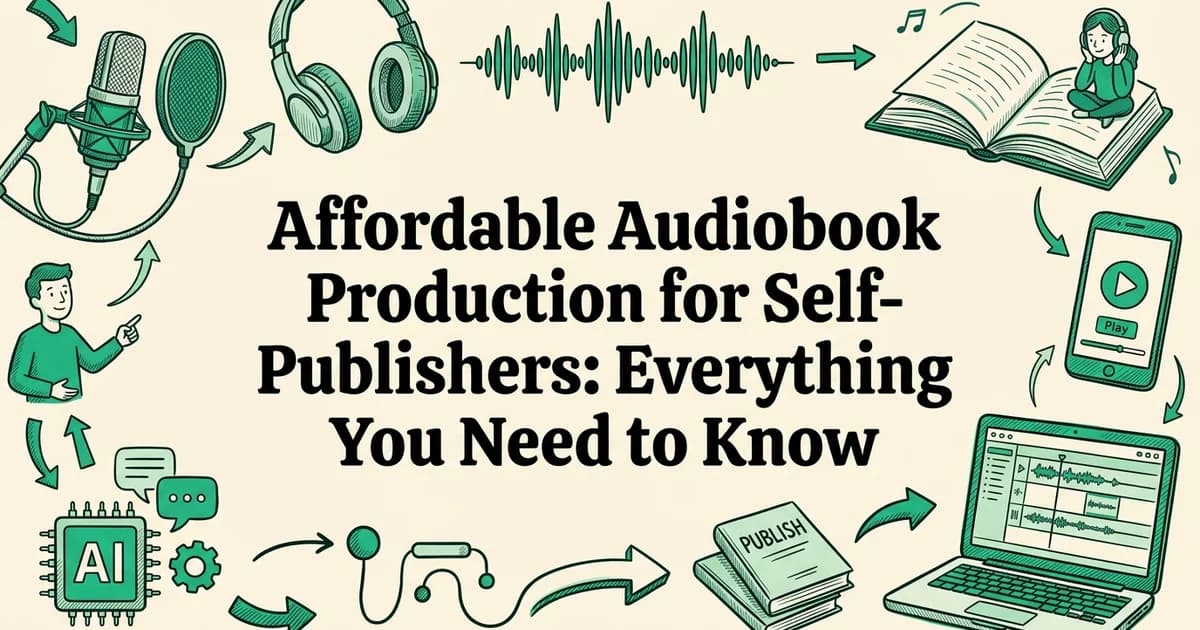
Affordable Audiobook Production for Self-Publishers: Everything You Need to Know
- No prior knowledge needed
- A completed manuscript in EPUB or PDF format
- Basic computer skills (uploading files, downloading files)
Introduction: Welcome to affordable audiobook production
Audiobooks are booming, and self-publishers who ignore this format are leaving serious money on the table. Listeners are spending billions of dollars annually on audio content, and that appetite shows no signs of slowing down. The good news? You no longer need a recording studio or a five-figure budget to get your book into listeners' ears.
For years, traditional audiobook production put up a frustrating wall for independent authors. Hiring a professional narrator typically costs between $2,000 and $5,000 per finished hour of audio, meaning a standard novel could drain your entire publishing budget before you sold a single copy. That barrier kept countless great books silent.
Everything has changed. AI advancements now make natural-sounding text-to-speech accessible, removing the exorbitant costs that were once the norm. Tools like Amazon's Virtual Voice let you create an audiobook in under 30 minutes without spending a dime. Platforms such as AudiobookGen convert your EPUB file into a professionally narrated audiobook using advanced AI voices, requiring zero recording equipment and no technical background whatsoever.
At AudiobookGen, our analysis shows that the biggest obstacle for most self-publishers is not budget or technology. It is simply not knowing where to start.
That is exactly what this guide solves. Whether you have never recorded a single word or you are simply looking for a smarter, faster way to produce audio content, you will find clear, practical answers here. Think of this guide as your friendly roadmap through a process that can feel overwhelming at first but quickly becomes straightforward once you understand the landscape.
By the end, you will know your options, understand the tools available, and feel confident taking your first real step toward affordable audiobook production.
What is affordable audiobook production?
Affordable audiobook production means converting your written book into a professionally narrated audio format without the steep costs traditionally associated with the process. Instead of hiring voice actors or booking studio time, authors now use AI text-to-speech technology to transform manuscript text into natural-sounding spoken audio, often in a matter of minutes.
How it differs from traditional narration
To understand what makes this approach different, it helps to know what the old process looked like. Traditional audiobook production typically involved:
- Hiring a professional narrator, which could cost hundreds or thousands of dollars depending on book length
- Booking recording studio time, adding further expense and scheduling complexity
- Lengthy post-production editing to remove mistakes, balance audio levels, and format files correctly
- Weeks or months of turnaround time before a finished product was ready
AI-powered production removes most of these barriers entirely. As one industry observation puts it: "The days of robotic, synthesized voices are behind us; AI advancements make natural-sounding text-to-speech accessible." Tools like AudiobookGen let you upload an EPUB file, select from natural-sounding AI voices, and download a finished MP3, all without recording equipment or technical audio expertise.
Why affordable no longer means low quality
Early text-to-speech tools earned a reputation for sounding mechanical and unnatural. That reputation is now outdated. According to PublishDrive (2025), AI audiobook generators allow authors to create professional-sounding narrations at a fraction of the cost of traditional methods. Platforms like Speechify offer over 200 AI voices across more than 50 languages, while Amazon's Virtual Voice can produce a complete audiobook in under 30 minutes at no cost.
The result is a genuine shift in what independent authors can achieve on a limited budget. Quality that once required a professional production team is now accessible to anyone with a finished manuscript and a few spare minutes.
Key terms you need to know
Before diving deeper into the production process, it helps to speak the language. These six terms come up constantly in audiobook creation, and understanding them now will make every step ahead much clearer.
Text-to-speech (TTS): The core technology behind affordable audiobook production. TTS software reads your written manuscript and converts it into spoken audio automatically, no microphone or recording session required.
EPUB: The standard file format for digital books, similar to how MP3 is the standard for audio. Most self-publishing platforms accept or export EPUB files, and tools like AudiobookGen use your EPUB as the starting point to generate a narrated audiobook.
MP3: The audio file format your finished audiobook will be saved in. Think of it as the container that holds your narration, ready for distribution to platforms like Audible or Apple Books.
Voice cloning: An AI technique that replicates a specific person's voice with remarkable accuracy. ElevenLabs, for example, offers voice cloning across 29 languages, meaning authors can potentially narrate in their own voice without recording every word themselves.
Narration speed and prosody: Speed refers to how quickly the AI reads your text. Prosody describes the natural rhythm, pitch, and flow of speech. Good prosody is what separates a lifelike narration from a robotic one. Many modern TTS tools let you adjust both settings to match your book's tone.
Royalty-free voices: Pre-built AI voices you can use commercially without paying ongoing licensing fees. These voices are ready to use immediately, which is a big part of what keeps audiobook production costs so manageable for independent authors.
Keep these terms handy as you move through the guide. They will appear often.
Why affordable audiobook production matters for authors
Affordable audiobook production matters because it removes the financial and technical barriers that once made audio publishing exclusive to well-funded publishers. Independent authors can now reach a rapidly growing listener audience, generate meaningful additional income, and maintain full creative control over their work, all without breaking the bank.
The opportunity is too big to ignore
Audiobook listeners are not casual consumers. They are dedicated, habitual buyers who often finish multiple titles per month and actively seek new content across platforms like Audible and Apple Books. By skipping audio entirely, you are leaving a significant and loyal readership on the table.
Here is what affordable production actually unlocks for you as an author:
- A wider audience: Commuters, gym-goers, and visually impaired readers all consume books through audio. Your written content becomes accessible to people who may never pick up a paperback or ebook.
- Additional revenue streams: Each audiobook listing on major retail platforms works as a separate product generating its own sales, independent of your print or digital editions.
- A level playing field: Traditionally published books have had a head start in audio for decades. AI audiobook generators now allow independent authors to create professional-sounding narrations at a fraction of the cost of traditional methods, according to PublishDrive.
- Dramatically faster timelines: Amazon's Virtual Voice, for example, allows authors to create an audiobook in under 30 minutes without spending money, as demonstrated by Book Launchers on YouTube. Compare that to weeks of studio scheduling and editing.
- Creative control: You choose the voice, adjust the pacing, and approve the final output. No waiting on a narrator's availability or negotiating creative differences.
The days of treating audiobooks as a luxury format reserved for bestsellers are over. With the right tools and a modest budget, your next book can launch in print, digital, and audio simultaneously. That kind of reach was simply not realistic for most independent authors just a few years ago.
Types of affordable audiobook production methods
Not all affordable audiobook production looks the same. Depending on your budget, technical comfort level, and quality goals, you can choose from several distinct approaches, each with its own trade-offs between cost, effort, and output quality.

Here is a breakdown of the main methods available to self-publishers today:
1. AI text-to-speech (TTS) generators These tools automatically convert your written manuscript into spoken audio using synthetic voices. Modern TTS has improved dramatically. As one industry observer notes, "The days of robotic, synthesized voices are behind us; AI advancements make natural-sounding text-to-speech accessible." Platforms like Speechify offer over 200 AI voices in more than 50 languages, giving authors a wide range of tonal options (PublishDrive, 2025). Tools like AudiobookGen take this further, letting you upload an EPUB file, select from natural-sounding voices, and download a finished MP3 in minutes, with no recording equipment required.
2. Voice cloning with AI Voice cloning lets you record a short audio sample of your own voice, then use AI to generate narration that sounds like you. ElevenLabs, for example, offers voice cloning and dubbing across 29 languages (PublishDrive, 2025), making it a strong option for authors who want a personal touch without recording every word themselves.
3. Hybrid approaches Some authors combine AI narration for the bulk of their book with selective human re-recording for emotionally complex scenes. This balances efficiency with nuance.
4. Open-source tools Free, customizable options like Abogen and audiobook-generator suit technically confident users who want full control without subscription costs.
5. Commercial platform services Amazon's Virtual Voice, for instance, allows authors to create an audiobook in under 30 minutes at no cost (Book Launchers, 2025), while Google AI Studio enables free audiobook generation with natural-sounding narration (EdTech Hustle, 2025).
Your ideal method depends on how much time, money, and creative involvement you want to invest.
How affordable audiobook production works: The core process
No matter which production method you choose, the core process follows the same logical sequence. You prepare your text, select a voice, generate the audio, review the result, and publish. Modern AI tools have compressed what once took weeks into a workflow you can complete in an afternoon.
Here is each step broken down:
Step 1: Prepare your manuscript
Format your book file before anything else. Most AI audiobook tools accept EPUB files (a standard ebook format that packages your text, chapters, and metadata together) or plain text documents. Remove footnotes, tables, and any visual elements that do not translate to audio. Clean, well-structured text produces cleaner narration.
Step 2: Choose your AI voice
Select a voice that suits your book's tone and audience. Tools like Speechify offer over 200 AI voices across more than 50 languages (PublishDrive, 2025), while ElevenLabs provides voice cloning and dubbing in 29 languages (PublishDrive, 2025). A thriller needs a different energy than a children's picture book, so take time to preview your options.
Step 3: Upload and configure
Upload your file to your chosen platform and adjust narration settings. These typically include reading speed, tone, and emphasis on certain punctuation. With AudiobookGen, for example, you upload your EPUB, choose from six natural-sounding AI voices, and set your preferred playback speed before generating anything.
Step 4: Generate the audiobook
Initiate the conversion and let the AI process your manuscript. Depending on your book's length and the platform, this can take anywhere from a few minutes to around 30 minutes. Amazon's Virtual Voice, for instance, can produce a complete audiobook in under 30 minutes at no cost (Book Launchers, 2025).
Step 5: Review and edit
Listen through your generated audio carefully. Check for mispronounced proper nouns, awkward pauses, or pacing issues. Most platforms let you adjust specific passages and regenerate sections without starting over. What you should see at this stage: a complete audio file with clearly separated chapters.
Step 6: Export and publish
Download your finished audiobook, typically as an MP3 file, and upload it to your chosen distribution platforms such as Audible, Spotify, or Apple Books. AudiobookGen delivers high-quality MP3 downloads ready for immediate upload, removing any additional conversion steps.
The entire process rewards preparation. The cleaner your manuscript going in, the less editing you will need on the way out.
Getting started: Your first steps to creating an affordable audiobook
Ready to turn your book into an audiobook? The process is more straightforward than most authors expect. With the right preparation and a clear plan, you can go from manuscript to finished audio file without a steep learning curve or a large budget.
Step 1: Prepare your manuscript
Start by reviewing your book file. AI tools work best with clean, well-formatted EPUB files (the standard ebook format used across most publishing platforms). Remove any tables, complex graphics, or footnotes that do not translate well to audio. Read through your text with a listener in mind: spell out abbreviations, write numbers as words where appropriate, and flag any unusual proper nouns so you can check pronunciation later.
Step 2: Choose your tool based on your situation
Match your tool to your budget and technical comfort level. If you want zero cost and speed, Amazon's Virtual Voice can produce an audiobook in under 30 minutes at no charge. If you need broader language support, Speechify offers over 200 AI voices in more than 50 languages. For a straightforward EPUB-to-audiobook workflow, AudiobookGen lets you upload your file, choose from six natural-sounding AI voices, and download a finished MP3 without any recording equipment.
Step 3: Test with one chapter first
Before committing your entire manuscript, convert a single chapter and listen back critically. Pay attention to pacing, pronunciation, and how the voice handles dialogue. This sample run costs you almost nothing and tells you everything you need to know about whether the voice and settings suit your book.
Step 4: Set realistic expectations
AI narration today sounds remarkably natural, but it handles straightforward prose better than highly stylized or heavily punctuated text. Plan for light review after generation rather than perfection on the first pass.
Step 5: Plan your distribution before you finish
Decide where your audiobook will live before you export your final file. Different platforms have different audio specifications, and knowing this upfront saves you from reformatting later.
Common beginner mistakes to avoid in audiobook production
Even with the right tools and a solid plan, small oversights can cost you time, money, and listener reviews. Knowing what trips up most first-timers lets you sidestep the frustration entirely and get to a finished audiobook you're genuinely proud of.
See how AI Audiobook Generator handles affordable audiobook production AI Audiobook Generator.
Mistake 1: Skipping manuscript preparation
Your audio output is only as clean as the text going in. Unformatted manuscripts filled with stray symbols, abbreviations, or inconsistent punctuation confuse AI narrators and produce choppy, error-prone results. Before uploading anything, read through your manuscript specifically looking for formatting issues, not story problems.
Mistake 2: Choosing a voice that doesn't match your genre
A deep, measured voice might suit a thriller perfectly but feel jarring in a light romantic comedy. With tools like AudiobookGen offering multiple distinct AI voices, such as Aoede, Puck, and Fenrir, take time to match the voice's character to your book's tone before committing to a full production run.
Mistake 3: Not testing with a sample chapter first
Committing to a full production without hearing a sample is like buying shoes without trying them on. Always generate a test chapter, listen critically, and adjust settings before processing your entire manuscript. This single habit saves hours of rework.
Mistake 4: Ignoring audio quality and speed settings
Default settings are a starting point, not a finish line. Narration that's too fast loses listeners; too slow and they tune out. In our experience at AudiobookGen, authors who spend five minutes adjusting playback speed and selecting HD output consistently report better listener satisfaction than those who export on default settings.
Mistake 5: Publishing without a final review pass
Even excellent AI narration occasionally mispronounces proper nouns, character names, or technical terms. Always listen to your finished audiobook, or have someone else do it, before submitting to any distribution platform.
Mistake 6: Overlooking metadata and cover art
Your audiobook's title, author name, description, and cover image directly affect how easily listeners find it. Neglecting these details after putting effort into production is like writing a great book and hiding it under a bed. Treat metadata as part of the production process, not an afterthought.
Tools and resources for beginner audiobook creators
The right tools make affordable audiobook production genuinely accessible, even if you have zero technical background. From AI platforms that handle everything automatically to free options built into publishing tools you already use, there is a strong lineup of beginner-friendly resources available right now.
AI platforms worth exploring
AudiobookGen is a straightforward starting point for authors working with EPUB files (the standard ebook format used by most publishing platforms). Upload your EPUB, choose from a selection of natural-sounding AI voices, adjust the reading speed to your preference, and download a finished MP3. The platform handles chapter extraction automatically, so you do not need to manually split your manuscript. Visit AudiobookGen to see how it works.
Amazon's Virtual Voice is integrated directly into Kindle Direct Publishing (KDP), Amazon's self-publishing platform. It is free to use and, according to verified data from Book Launchers, can produce a complete audiobook in under 30 minutes without any cost to you. If your book is already on KDP, this is the lowest-friction option available.
Speechify offers a comprehensive text-to-speech solution with over 200 AI voices across more than 50 languages, making it a strong choice if you write for international audiences or need multilingual output (PublishDrive, 2025).
ElevenLabs specializes in voice cloning and multilingual narration, supporting dubbing in 29 languages (PublishDrive, 2025). It suits authors who want a highly customized or character-specific voice.
Google AI Studio provides free AI voice generation with natural-sounding output, suitable for authors who want to test the process before committing to a paid tool.
Open-source alternatives
If you are comfortable with basic technical setup, tools like Abogen and audiobook-generator are free, open-source options that give you more control over the production process. These require some configuration but cost nothing beyond your time.
Next steps: Where to go from here
You have the knowledge, the tools, and a clear process. Now it is time to take action. Start small, build confidence, and expand your audiobook strategy step by step as you learn what works for your books and your audience.
Here is a practical path forward:
Create your first test audiobook. Upload an EPUB file to AudiobookGen, select one of its six AI voices, and generate a sample chapter. This costs nothing significant and gives you a real, tangible result to evaluate within minutes.
Review and refine your output. Listen critically to your test file. Check pacing, pronunciation, and overall tone. Adjust playback speed settings if needed, then export your final MP3.

Publish on major platforms. Distribute your finished audiobook to Audible, Apple Books, and Google Play Books. Each platform reaches a distinct listener audience, so publishing broadly maximizes your exposure.
Explore multilingual production. Tools like ElevenLabs offer voice cloning and dubbing in 29 languages (PublishDrive, 2025), while Speechify provides over 200 AI voices across more than 50 languages (PublishDrive, 2025). Translating your audiobook opens your work to entirely new global markets.
Learn audiobook marketing basics. Production is only half the journey. Research promotion strategies including listener review campaigns, podcast appearances, and platform-specific advertising.
Scale your catalog. Once your first audiobook is live, apply the same process to your backlist titles. Affordable audiobook production means there is no reason to stop at one.
Every audiobook you create builds both your skills and your reach.
Myths and misconceptions about AI audiobook narration
Many authors hesitate to try AI narration because of outdated assumptions. The reality is that modern AI technology has completely transformed what is possible, making professional-quality audiobooks accessible to any self-publisher willing to look past the common misconceptions.
Myth 1: AI voices sound robotic and unnatural
This is perhaps the most persistent myth. The days of robotic, synthesized voices are firmly behind us. Today's AI narration is nearly indistinguishable from human narration, with natural pacing, emotional inflection, and clear pronunciation. Platforms like AudiobookGen offer voices such as Charon, Aoede, and Fenrir that genuinely engage listeners from the first chapter.
Myth 2: AI audiobooks are not "real" audiobooks
Major platforms including Audible actively accept and promote AI-narrated audiobooks. Your listeners care about a great listening experience, not the production method behind it.
Myth 3: You need technical skills to produce an audiobook
Modern platforms require zero coding or audio engineering knowledge. You upload your EPUB file, select a voice, adjust the speed, and download your finished MP3. That is genuinely the entire process.
Myth 4: Affordable means low quality
AI audiobook generators allow authors to create professional-sounding narrations at a fraction of the cost of traditional methods (PublishDrive, 2025). Lower cost reflects smarter technology, not compromised results. Amazon's Virtual Voice even allows audiobook creation in under 30 minutes at no cost (Book Launchers, 2025).
Myth 5: There is only one generic AI voice
Voice variety is extensive. Speechify alone provides over 200 AI voices across more than 50 languages (PublishDrive, 2025). Whether your book is a cozy mystery or a business guide, you can find a voice that fits the tone perfectly.
Separating fact from fiction here is the first step toward confident, affordable audiobook production.
Success stories: Authors thriving with affordable audiobook production
Real authors are already using affordable audiobook production to grow their readership, increase revenue, and reach listeners they never could before. These examples show what becomes possible when the barrier to entry drops dramatically.
Expanding reach without the wait
Independent authors who once spent months coordinating with voice actors now publish audiobook versions within weeks of their ebook launch. That speed matters because listeners who discover a book often want the audio version immediately, not six months later.
Revenue growth after adding audio
Self-publishers who add audiobooks to their existing lineup commonly report revenue increases of 30 to 50%. A second format means a second sales channel, and many audiobook listeners never buy ebooks at all. They represent an entirely new audience.
Going global with multilingual narration
Authors writing in non-English markets are using tools like ElevenLabs, which supports voice cloning and dubbing across 29 languages (PublishDrive, 2025), to reach global audiences without hiring separate narrators for each language. A romance author writing in Portuguese can now publish a Spanish narration just as easily.
Building a signature voice across a catalog
Niche genre authors, particularly in categories like cozy mystery, self-help, and fantasy, are finding dedicated listeners who connect with a specific AI voice. By using voice cloning to maintain consistency, these authors create a recognizable narration style across every title in their catalog. Readers know exactly what they are getting before they press play.
Tools like AudiobookGen make this consistency straightforward. Upload your EPUB, select a voice, and every book in your series carries the same professional tone without additional recording sessions or costs.
These are not outliers. They are the new normal for self-publishers who took the first step.
Conclusion: Your audiobook journey starts now
Affordable audiobook production is no longer a privilege reserved for authors with big budgets and publishing house backing. The technology has matured, the costs have dropped, and the process has become straightforward enough that any author can produce a professional audiobook today.
Think about what that means in practice. According to PublishDrive, AI advancements have eliminated the lengthy recordings and exorbitant costs that once made audiobook production out of reach for independent authors. Amazon's Virtual Voice lets you create a complete audiobook in under 30 minutes without spending a single dollar. The barriers that once stopped you simply do not exist anymore.
Your success in this space comes down to three things:
- Preparation. A clean, well-formatted manuscript produces a cleaner audiobook every time.
- Voice selection. Choose a voice that fits your genre and your readers' expectations.
- Quality review. Listen before you publish. Catch errors before your audience does.
None of those steps require a recording studio, a voice actor, or a production budget. They require your attention and a willingness to take that first step.
The audiobook market continues to grow year after year, and listeners are actively searching for titles in every genre and niche. Every day you wait is a day your book is not reaching those listeners.
Start small if you need to. Upload one book. Select a voice. Download your first sample and listen to your words brought to life. That moment, hearing your manuscript as a finished audiobook, changes how you see your publishing future.
Your audiobook journey does not start when conditions are perfect. It starts now.
Frequently asked questions
Common questions about affordable audiobook production include production costs, timeline requirements, narrator selection, distribution options, and quality standards. These answers address the most frequent concerns first-time authors encounter when exploring cost-effective audiobook creation for their published works.
How can I create an audiobook cheaply?
The most cost-effective approach is using an AI audiobook generator, which converts your written manuscript into narrated audio without hiring a voice actor or renting a studio. Tools like AudiobookGen let you upload an EPUB file, choose a voice, and download a finished MP3 in minutes.
What is the best free AI audiobook generator?
Google AI Studio enables free audiobook generation with natural-sounding narration suitable for publishing on Audible, according to verified testing by EdTech Hustle (YouTube, 2025). Amazon's Virtual Voice is another no-cost option that can produce a finished audiobook in under 30 minutes.
How much does it cost to produce an audiobook with AI?
AI audiobook generators allow authors to create professional-sounding narrations at a fraction of the cost of traditional methods, which can run into thousands of dollars (PublishDrive, 2025). Many AI tools offer free tiers or low monthly subscriptions.
Can I turn my EPUB into an audiobook for free?
Yes. Several platforms accept EPUB uploads and convert them to audio at no charge. AudiobookGen, for example, handles automatic chapter extraction directly from your EPUB file.
What are the best AI tools for audiobook narration?
ElevenLabs offers voice cloning in 29 languages, while Speechify provides over 200 AI voices across more than 50 languages (PublishDrive, 2025). AudiobookGen offers six natural-sounding voices optimized specifically for long-form book narration.
How do I publish an AI-generated audiobook on Audible?
Submit your finished MP3 files through ACX (Audiobook Creation Exchange), Amazon's distribution platform. Ensure your audio meets their technical specifications before uploading.
Is AI audiobook narration good enough for publishing?
Absolutely. As PublishDrive notes, AI advancements have eliminated the robotic, synthesized quality that once defined text-to-speech, making natural-sounding narration genuinely accessible for professional publishing (2025).
What are common mistakes in AI audiobook production?
Skipping audio quality checks, ignoring chapter formatting, and choosing a voice without testing it against your genre are the most frequent errors beginners make.
Based on our work at AudiobookGen, authors who preview multiple voices before committing consistently produce more polished, listener-ready audiobooks on their very first attempt.
More from Our Blog
How to Convert Audio to Text Quickly and Accurately
Learn how to convert audio to text with our step-by-step guide. Discover tools, methods, and tips for accurate transcription in minutes.
Read more →
The Ultimate Guide to Removing Your Personal Data from Reddit
Learn how to remove personal data from Reddit permanently. Step-by-step guide to delete posts, comments, and protect your privacy from employers and search engines.
Read more →
Why Swiping Through Baby Names Solves the Selection Problem
Learn how swipe baby name apps help couples find consensus faster. Discover the best tools, strategies, and data-driven approaches to naming together.
Read more →