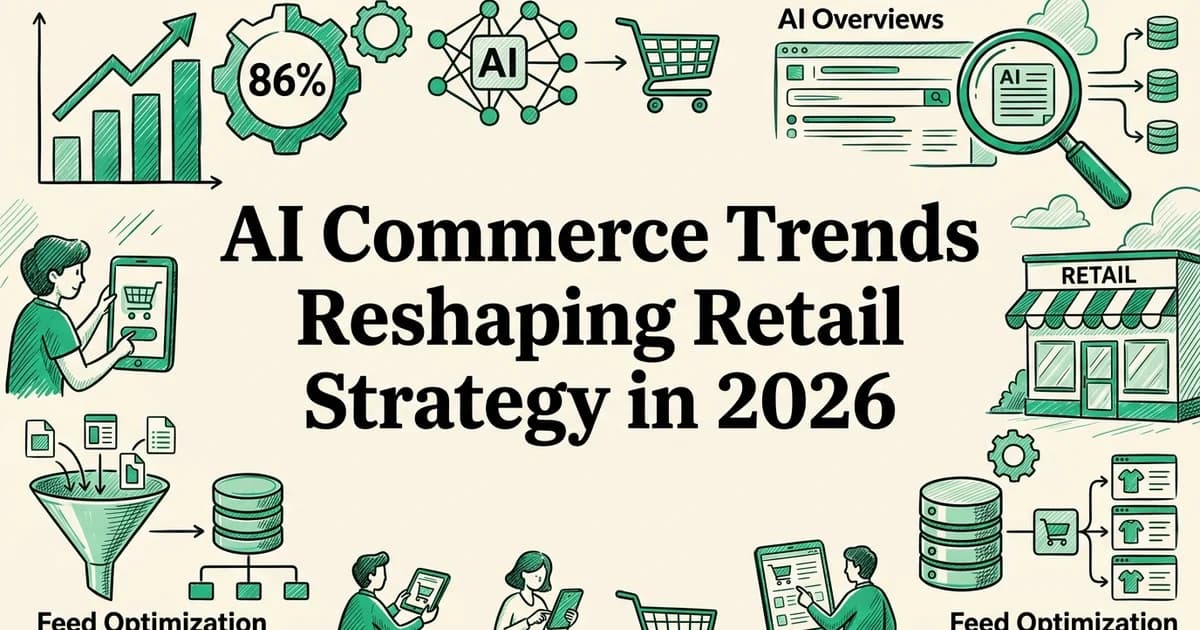
AI Commerce Trends Reshaping Retail Strategy in 2026
Introduction: AI commerce strategy reshaping retail in 2025
A single statistic captures the urgency facing every retailer right now: 86% of major online retailers have already adopted AI SEO technologies, according to Hashmeta.ai's 2025 industry analysis. For the businesses still treating AI commerce strategy as a future consideration, that window has closed.
2025 marks a genuine inflection point, not an incremental evolution. The way shoppers discover products, the way search engines surface retailers, and the way visibility is earned have all shifted in ways that make traditional SEO playbooks increasingly insufficient on their own. At Pickastor, our analysis shows that the retailers gaining ground right now are those treating AI commerce infrastructure as a core operational priority, not a marketing experiment.
The divergence between AI-driven visibility and conventional search performance is one of the most consequential developments in retail right now. These are no longer parallel tracks heading in the same direction. AI-powered discovery operates on different signals, rewards different content structures, and penalizes the same optimization tactics that once drove organic growth. Retailers optimizing exclusively for traditional search rankings are, in effect, becoming less visible to a growing segment of their potential customers.
What makes this moment particularly complex is that the e-commerce sector faces a unique set of challenges within the broader AI search landscape. The same AI overview technology that is reshaping informational search has a notably limited footprint in product queries, creating an uneven competitive environment that demands a more nuanced strategic response.
The trends analyzed in this report reflect an industry in active transition. Some patterns are now established across enterprise retail. Others remain emerging, with significant variation in adoption and outcomes. Together, they form a picture of what a credible ai commerce strategy for retailers looks like heading into 2026: one built on data feeds, earned authority, local visibility, and a clear-eyed understanding of where AI surfaces your products and where it does not.
Trend 1: AI overviews dominate search but miss e-commerce queries
AI Overviews now appear in 25.11% of all Google searches, according to Shero Commerce Jam (2026), making them a dominant force in how users consume search results. Yet for retailers, the more important number is far smaller: AI Overviews appear in just 4% of e-commerce queries. That gap defines where your optimization energy should go.
Why the e-commerce exemption matters
This is not a temporary anomaly. Google's AI Overview system is designed to synthesize informational content, answering questions, summarizing topics, and guiding research. Transactional queries, the kind that drive product sales, operate differently. A shopper searching "buy waterproof hiking boots size 10" needs a product listing, not a generated summary. Google recognizes this distinction, which is why the AI Overview layer largely bypasses commercial intent queries.
The implication for retailers is significant:
- AI Overview optimization is largely irrelevant to direct product sales. Chasing AI Overview placement for product queries is, at present, a misallocation of resources.
- Informational content faces a real threat. Buying guides, comparison articles, and how-to content tied to your brand are at genuine risk. As noted in the research data, informational content shows 35 to 61% lower click-through rates when an AI Overview is present. If your content strategy relies on blog-driven traffic to feed the purchase funnel, that funnel is narrowing.
- Product page performance becomes the priority. With AI Overviews unlikely to disrupt transactional search at scale, well-optimized product pages, structured data, and clean product feeds remain the highest-leverage assets in retail SEO.
The actionable shift
Retailers should audit their content portfolio and separate informational assets from transactional ones. Informational content needs to be evaluated for AI Overview exposure and repositioned where possible. Product pages, on the other hand, should be treated as the core visibility engine.
For a structured approach to this audit, the WooCommerce AI optimization checklist provides a practical framework for aligning product page structure with current search behavior. The 4% figure is not a ceiling to push through. It is a signal about where the real competition is playing out.
Trend 2: AI product feed optimization delivers 139% revenue growth
E-commerce stores using AI feed optimization see a 139% improvement in organic shopping revenue, according to Get-Ryze.ai (2026). That figure alone positions product feed optimization as one of the highest-return applications of an ai commerce strategy for retailers, and the operational benefits compound the financial case significantly.
What AI feed optimization actually changes
Traditional product feed management is labor-intensive and error-prone. Attribute mismatches, outdated pricing, inconsistent categorization, and missing structured data all suppress visibility across Google Shopping, comparison engines, and AI-powered discovery surfaces. AI feed optimization addresses these issues systematically and at scale.
According to Get-Ryze.ai (2026), AI-driven feed management cuts manual feed management time by 85% while increasing product visibility by 3 to 4 times. The time savings alone free up meaningful operational capacity. The visibility gains translate directly into revenue.
The core mechanisms driving these results include:
- Automated attribute enrichment: AI fills in missing or incomplete product attributes using existing catalog data, reducing the gaps that cause listings to be filtered out of results
- Dynamic title and description optimization: Feed titles are restructured to match actual search query patterns rather than internal naming conventions
- Real-time error detection: Feed errors that would previously go unnoticed for days are flagged and corrected automatically
- Category mapping accuracy: Products are matched to the correct taxonomy, improving relevance scoring across shopping channels
Why this is the highest ROI entry point
Unlike content-heavy SEO strategies that take months to show results, feed optimization produces measurable lift within weeks. The 139% revenue improvement reported by Get-Ryze.ai (2026) reflects outcomes across organic shopping placements, not paid channels, making it a compounding asset rather than a recurring cost.
For retailers managing large catalogs, the scale advantage is decisive. Manually optimizing thousands of SKUs is not feasible. AI makes comprehensive optimization the default rather than the exception.
Retailers looking to implement this at the catalog level can explore e-commerce AI feed generation as a practical starting point for structuring feeds that perform across both traditional and AI-influenced discovery surfaces.
Trend 3: 86% of SEO professionals now integrate AI into strategy
AI integration in SEO has crossed from early adoption into established practice. According to SeoProfy's 2026 research, 86% of SEO professionals have now integrated AI into their strategy, confirming that AI-assisted optimization is no longer a competitive edge reserved for well-resourced teams. It is the baseline.
For retailers, this shift carries a direct implication: competitors are almost certainly using AI to optimize the same search surfaces you are targeting.
What the 86% are actually doing
The majority of AI-integrated SEO strategies in retail focus on a core set of applications:
- Content generation and optimization: Scaling product descriptions, category pages, and metadata across large catalogs
- Keyword clustering and intent mapping: Identifying purchase-intent queries at a granularity that manual research cannot match
- Technical auditing: Automating crawl analysis, structured data validation, and page experience monitoring
- Feed and listing optimization: Aligning product data with evolving ranking signals across Google Shopping and AI-driven discovery surfaces
The 35% gap worth examining
SeoProfy's same 2026 research found that 65% of businesses report better SEO results with AI assistance. That leaves a meaningful portion of adopters who have not yet seen measurable gains. The gap typically reflects implementation quality rather than tool capability. Retailers who deploy AI without clean underlying data, clear performance benchmarks, or structured workflows often see limited returns.
The competitive pressure to adopt is real, but adoption alone is not the differentiator. How AI is applied to catalog structure, content strategy, and discovery optimization determines outcomes.
Guidance for retailers still in the adoption phase
If your team is still evaluating where to begin, prioritize use cases with clear, measurable outputs. Feed optimization and on-page content scaling tend to deliver faster, more attributable results than broader strategic applications. Understanding why some e-commerce stores remain invisible to AI is a useful diagnostic starting point before committing to any specific toolset.
Trend 4: Real-time inventory SEO becomes competitive necessity
Real-time inventory SEO has shifted from a technical advantage to a baseline requirement. As AI-powered search systems increasingly surface product availability signals, retailers that fail to synchronize their inventory data with search infrastructure risk losing visibility precisely when purchase intent is highest.

The core mechanism is straightforward: AI systems crawl and interpret structured data signals to determine whether a product is worth surfacing to a searcher. When inventory data is stale or absent, those systems interpret the gap as a relevance risk and deprioritize the listing. The result is a compounding visibility problem. Out-of-stock products lose ranking positions, and even temporarily unavailable items can suffer long-term demotion if the underlying data infrastructure does not communicate availability changes quickly enough.
This is an emerging pattern rather than an established norm, but adoption is accelerating fast. With 86% of major online retailers now using AI SEO technologies, according to Hashmeta.ai (2025), the retailers still relying on batch inventory updates are increasingly competing against systems that refresh availability signals in near real time.
The technical infrastructure required includes:
- Schema markup for availability status, updated dynamically as inventory changes
- API-connected product feeds that push changes to Google Merchant Center and other platforms within minutes, not hours
- Crawl budget management to ensure search engines prioritize high-velocity product pages
- Conditional indexing logic that suppresses or redirects out-of-stock pages rather than leaving them as dead ends
For retailers building toward this capability, a practical implementation roadmap starts with auditing current feed update frequency, then prioritizing schema deployment on top-selling SKUs before scaling across the full catalog. Pairing this with broader AI optimization for e-commerce practices ensures inventory signals work in concert with content and feed quality improvements.
The competitive pressure here will intensify. Retailers that treat inventory synchronization as an operational concern rather than an SEO priority are leaving measurable visibility on the table.
Trend 5: Visual search and AI image recognition reshape product discovery
Visual search has moved from experimental feature to established pattern in retail product discovery. AI image recognition now enables shoppers to photograph a product, upload a screenshot, or point a camera at an item and receive precise purchase matches, fundamentally changing how product data must be structured and presented.
The same 86% AI SEO adoption rate documented among major online retailers by Hashmeta.ai in 2025 reflects growing investment in image-based discovery infrastructure, not just text optimization. Retailers competing on visual search are building a compounding advantage as AI models become more capable of interpreting product imagery with nuance.
Why image quality is now an SEO variable
AI image recognition systems, including those powering Google Lens, Pinterest Lens, and emerging AI shopping assistants, evaluate several image attributes when matching products to queries:
- Resolution and clarity: Low-resolution images reduce matching confidence and suppress visibility in visual results
- Background consistency: Clean, neutral backgrounds improve AI model accuracy when isolating product features
- Multiple angles: Models trained on diverse product views return more accurate matches across varied shopper inputs
- Color accuracy: Precise color representation reduces return rates and improves downstream conversion signals
Structured image data and alt text optimization
Beyond image quality, the metadata surrounding product images carries significant weight. Descriptive, keyword-relevant alt text helps AI systems contextualize what an image depicts. Structured data markup using schema.org/Product with image properties signals product attributes directly to crawlers.
Retailers should treat alt text as a product description in miniature: specific, attribute-rich, and aligned with how shoppers naturally describe items. For example, "navy blue linen blazer, slim fit, two-button closure" outperforms generic filenames or placeholder descriptions.
Understanding how one e-commerce brand approached AI-driven product optimization illustrates how image and content signals work together to improve discovery across both traditional and AI-powered search surfaces.
The trajectory here is clear. As visual search volume grows, retailers without optimized imagery and structured image metadata will face a widening visibility gap that text-based optimization alone cannot close.
Trend 6: Earned media and user-generated content drive 82% of AI citations
AI systems are increasingly bypassing owned product pages in favor of third-party sources when generating citations and recommendations. Research from 2026 suggests that approximately 82% of AI citations originate from earned media and user-generated content rather than brand-controlled pages, fundamentally changing where retailers need to invest their content efforts.
This shift reflects something important about how AI models are trained to evaluate credibility. Owned product pages, by definition, carry inherent bias. AI systems appear to weight third-party validation more heavily precisely because independent sources have no commercial incentive to misrepresent a product. A review on a specialist forum, a mention in an industry publication, or a detailed customer comparison carries a different signal than a brand's own product description.
The practical implications for content strategy are significant:
- Earned media now functions as AI infrastructure. Press coverage, editorial reviews, and influencer content are no longer just brand awareness tools. They are the raw material AI systems draw on when constructing product recommendations.
- UGC depth matters more than volume. Detailed, specific user reviews that address real use cases are more likely to surface in AI citations than generic five-star ratings.
- Brand partnerships require rethinking. Collaborations with publishers, niche communities, and content creators should be evaluated partly on their potential to generate AI-discoverable third-party references.
In our experience at Pickastor, retailers who build systematic programs around earning external mentions, rather than relying solely on optimizing their own pages, are better positioned as AI-driven discovery becomes the dominant channel.
Strategies worth prioritizing include structured outreach to category-specific publications, incentivizing detailed customer reviews that address specific product attributes, and creating genuinely useful content that third-party sites will naturally reference.
The direction of travel here is established, not emerging. Retailers still treating earned media as a secondary channel are likely already losing AI visibility ground to competitors who recognized this shift earlier.
Trend 7: Local retail AI visibility diverges from traditional search rankings
For multi-location retailers, AI visibility introduces a challenge that goes beyond optimizing for a single national presence. Research suggests there is only a 45% overlap between the brands appearing in AI-generated local recommendations and those ranking well in traditional local search, meaning a strong Google Maps presence no longer predicts AI visibility in any reliable way.
The scale of this divergence becomes clearer with one striking data point: studies indicate only 1.2% of locations recommended by ChatGPT in local retail AI visibility analysis align with traditional local rankings (Search Engine Land / SOCi, 2026). That figure signals a near-complete decoupling between the two visibility systems, not a minor gap to close through incremental optimization.
The difficulty of closing that gap is significant. According to SOCi research, AI visibility is three to 30 times harder to achieve than ranking well in traditional local search. For retailers operating dozens or hundreds of locations, that multiplier creates a compounding problem: every location requires its own AI visibility footprint, and the effort required is categorically different from traditional local SEO.
What this means for multi-location retailers:
- Traditional local SEO signals, including proximity, review volume, and citation consistency, carry less weight in AI recommendation systems than previously assumed
- AI models appear to favor locations with richer contextual data, including detailed service descriptions, category-specific content, and third-party editorial mentions
- Retailers who have invested heavily in Google Business Profile optimization may find that investment does not transfer to AI-driven local discovery
Tactics for building local AI visibility:
- Develop location-specific content that addresses hyperlocal queries, neighborhood context, and community relevance rather than generic store information
- Pursue local editorial coverage in city-specific publications, neighborhood blogs, and regional media that AI models draw on for location recommendations
- Enrich structured data at the location level with detailed product categories, services, and attributes that help AI systems understand what each location offers
The strategic implication is direct: local AI visibility now requires its own dedicated workstream, separate from traditional local search, with distinct content, outreach, and measurement frameworks.
What this means for your retail business in 2025
The seven trends covered in this analysis converge on a single, urgent conclusion: retailers who treat AI commerce strategy as optional are already falling behind. With 86% of major online retailers now adopting AI SEO technologies (Hashmeta.ai, 2025), the window for gaining a competitive advantage through early adoption is narrowing fast, and the cost of inaction is rising in direct proportion.

The trends do not operate in isolation. AI Overviews appearing in only 4% of e-commerce queries (Shero Commerce, 2026) creates a short-term search visibility opportunity, but that window will close as Google refines its product query handling. AI product feed optimization delivering 139% organic shopping revenue growth (Get-Ryze.ai, 2026) is already an established pattern, not an emerging one. Visual search, earned media citations, and local AI visibility are all accelerating simultaneously. Waiting for any single trend to "mature" before acting means ceding ground across multiple fronts at once.
How to prioritize by retailer segment:
- SMBs: Start with product feed optimization. The 85% reduction in manual feed management time (Get-Ryze.ai, 2026) frees up resources to invest in UGC and earned media, which drive AI citation visibility without requiring large content budgets.
- Enterprise retailers: The priority is integration. Real-time inventory SEO, local AI visibility, and visual search optimization each require dedicated workstreams. The risk at enterprise scale is fragmented execution, where individual teams optimize for isolated channels without a unified AI commerce framework.
- Agencies and consultants: The 86% of SEO professionals now integrating AI into strategy (SeoProfy, 2026) signals that AI-native service offerings are becoming table stakes, not differentiators. Clients will increasingly expect AI-informed recommendations as a baseline.
The competitive risk of inaction is concrete. Research suggests that only 1.2% of locations receive recommendations from ChatGPT in local retail contexts, meaning visibility in AI-driven local discovery is extraordinarily concentrated. The same concentration dynamic is emerging in product search, citation-based discovery, and visual search. First-movers are capturing disproportionate share, and the structural advantages they build compound over time.
The retailers who will lead in 2026 are not those who adopted every trend at once. They are the ones who built a coherent, prioritized AI commerce strategy in 2025, before the patterns fully hardened.
Predictions and outlook: AI commerce strategy beyond 2025
The trajectory of AI commerce strategy points toward deeper integration, sharper consolidation, and rising regulatory scrutiny. Retailers who treat 2025 as a transition year will find 2026 and beyond increasingly difficult to navigate without the structural foundations already in place.
Where AI commerce is heading
Several developments are likely to define the next phase:
- Multimodal search becomes standard. Text, image, and voice queries will converge into unified AI-driven discovery experiences. Retailers without structured, multimodal-ready product data will face compounding visibility gaps across every channel simultaneously.
- AI tool consolidation accelerates. The current landscape of fragmented point solutions, covering feeds, local visibility, content optimization, and visual search separately, is unlikely to persist. Platform consolidation will reward retailers who have built clean, portable data infrastructure rather than those locked into single-vendor workflows.
- Regulatory pressure increases. The EU AI Act and emerging US frameworks are beginning to address algorithmic transparency in commerce. Retailers using AI for personalization, pricing, and product recommendations should expect disclosure requirements to tighten, particularly in markets with established consumer protection regimes.
- Citation-based visibility hardens. The pattern already visible in local AI discovery, where research suggests only 1.2% of locations receive ChatGPT recommendations according to SOCi analysis, will extend further into product and category search. Early authority signals will become progressively harder to displace.
Future-proofing your AI commerce strategy
Three principles will separate durable strategies from reactive ones:
- Invest in data quality over tool quantity. Clean, structured, frequently updated product and business data is the foundation every emerging AI system depends on.
- Build earned authority continuously. Reviews, user-generated content, and third-party citations compound. Starting late means competing against accumulated signals, not just current ones.
- Monitor regulatory developments proactively. Compliance built into AI workflows early is far less costly than retrofitting it under deadline.
The retailers entering 2026 with coherent AI commerce strategies will not simply be ahead. They will be operating in a structurally different competitive position.
Year-over-year comparison: How AI commerce strategy evolved from 2024 to 2025
Between 2024 and 2025, AI commerce strategy shifted from experimental adoption to operational infrastructure. Retailers moved beyond testing individual AI tools and began integrating them into core workflows, with measurable results separating early movers from late adopters across every major visibility metric.
The adoption curve accelerated sharply
In 2024, AI integration in retail SEO was an emerging trend concentrated among enterprise players with dedicated technical resources. By 2025, it had become an established pattern across the sector. The e-commerce industry now holds an 86% adoption rate of AI SEO technologies among major online retailers, according to Hashmeta.ai (2025), a figure that would have been unrecognizable twelve months earlier.
This acceleration reflected a broader shift: 86% of SEO professionals have integrated AI into their strategy by 2025 (SeoProfy, 2026), and 65% report noticeably better SEO results as a direct consequence.
Strategic focus shifted from content to product data
In 2024, most AI commerce investment targeted content generation and keyword research. By 2025, the strategic center of gravity moved decisively toward product feed optimization. Retailers discovered that structured product data, not editorial content, determined AI visibility in shopping contexts. The 139% improvement in organic shopping revenue reported by e-commerce stores using AI feed optimization (Get-Ryze.ai, 2026) validated this reorientation at scale.
New metrics replaced old benchmarks
Year-over-year, the metrics retailers tracked evolved significantly:
- 2024 focus: Organic rankings, click-through rates, impressions
- 2025 focus: AI Overview inclusion rates, feed visibility scores, citation frequency in AI-generated responses
- Emerging concern: AI Overviews appear in only 4% of e-commerce queries (Shero Commerce, 2026), making product feed presence more valuable than informational content optimization
Practices matured from reactive to systematic
Perhaps the clearest sign of maturation: retailers in 2025 stopped asking whether to adopt AI commerce tools and started building governance frameworks around them. Workflow integration, quality control, and performance attribution replaced the proof-of-concept conversations that defined 2024.
Frequently asked questions
Retailers across segments are asking sharper, more specific questions about AI commerce strategy as adoption matures. The answers below address the most common points of confusion, grounded in current data and practical implementation realities.
How can retailers use AI to improve e-commerce SEO?
Retailers can apply AI to automate product feed optimization, generate structured data at scale, and identify keyword gaps across large catalogs. According to SeoProfy (2026), 65% of businesses have already noticed better SEO results with AI assistance, making adoption a competitive baseline rather than an advantage.
What are the best AI tools for e-commerce product optimization?
The most effective tools combine feed management automation with performance attribution. AI product feed platforms like those analyzed by Get-Ryze.ai (2026) cut manual feed management time by 85% while increasing product visibility three to four times, making them a strong starting point for any ai commerce strategy for retailers.
How does AI affect Google rankings for online stores?
AI Overviews appear in only 4% of e-commerce queries, according to Shero Commerce (2026), meaning traditional ranking signals still dominate product discovery. Structured data quality and feed accuracy remain the highest-leverage ranking factors for online stores.
What AI strategies boost visibility in AI overviews for retailers?
Earned media, third-party reviews, and user-generated content are the strongest signals. Informational content alone is insufficient given the limited AI Overview presence in e-commerce searches.
How to optimize product feeds with AI for shopping ads?
Automated attribute enrichment, real-time price and inventory syncing, and AI-driven title reformatting are the core tactics. Retailers using these methods report a 139% improvement in organic shopping revenue (Get-Ryze.ai, 2026).
What is the AI SEO adoption rate in e-commerce in 2026?
The e-commerce sector has reached an 86% adoption rate of AI SEO technologies among major online retailers (Hashmeta.ai, 2025), making it the most aggressive adopter across all industries.
How to track AI recommendations for retail products?
Monitoring brand mentions across AI platforms, tracking citation sources, and auditing which product pages earn AI-generated references are the primary methods. Based on our work at Pickastor, retailers who build systematic tracking into their workflows, rather than checking manually, identify citation opportunities significantly faster and can act on them before competitors do.
More from Our Blog
The Complete Guide to Instant Document Translation in 2026
Master instant document translation with our comprehensive guide. Learn how AI tools preserve formatting, cut costs by 40-60%, and scale multilingual workflows.
Read more →
Linards vārda diena – Pilnīgs iesācēju ceļvedis
Uzziniet, kad ir Linarda vārda diena, kā to svinēt un kur atrast uzticamus vārda dienu kalendārus. Praktiski padomi vecākiem.
Read more →
50+ Baby Boy Names: Timeless Classics and Modern Discoveries
Discover the best baby boy names for 2025, from trending classics like Liam and Noah to unique options. Find the perfect name for your son.
Read more →