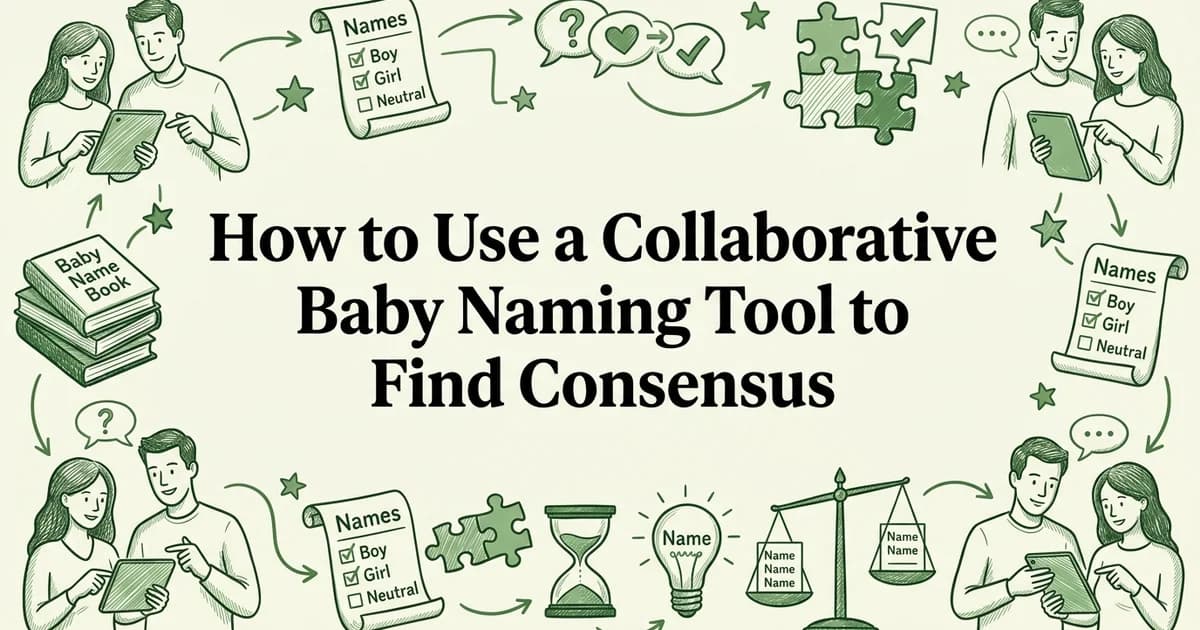
How to Use a Collaborative Baby Naming Tool to Find Consensus
- Both partners should have access to a smartphone or computer with internet connection
- A collaborative baby naming tool or app (such as BumpNames) installed and ready to use
- Willingness to discuss naming preferences, cultural traditions, and family considerations openly with your partner
- Basic agreement on your due date or timeline for making a final name decision
Introduction: Why collaborative baby naming matters for couples
Choosing a baby name is one of the most meaningful decisions expectant couples make together, and it sets the tone for how you'll navigate parenting as a team. Research suggests that 82% of couples say baby naming is a joint decision, yet the process itself is rarely designed with both partners in mind.
The challenge is real. You and your partner may come from different cultural backgrounds, carry different family expectations, and hold completely different ideas about what makes a name beautiful or meaningful. Without a structured way to explore options together, the conversation can quickly turn into a negotiation, or worse, a stalemate.
At BumpNames, our analysis of how couples approach baby naming shows that the biggest obstacle isn't finding good names. It's finding a fair, low-pressure way to discover which names you both love. That's exactly where a collaborative baby naming tool changes the dynamic.
Modern tools address this in several important ways:
- Reducing decision fatigue by breaking an overwhelming database into manageable, bite-sized choices
- Leveling the playing field so neither partner dominates the process
- Surfacing genuine overlap through data-driven matching rather than back-and-forth debate
- Making it enjoyable with gamified, swipe-based interfaces that feel more like a shared activity than a chore
Studies indicate that 72% of US adults now turn to online resources when making baby name decisions. The question is no longer whether to use a digital tool. It's knowing how to use the right one effectively.
What you'll need before getting started
Before diving into your first swipe session, gathering a few essentials will make the entire process smoother and more productive. Having everything in place means you spend your time finding names you love, not troubleshooting logistics.
Technology and access
- A smartphone or computer with a reliable internet connection for each partner
- A free account on BumpNames, a collaborative baby naming tool that supports two-user accounts and syncs both partners' ratings in real time. No credit card required to get started.
Time and headspace
- Set aside at least 20 to 30 minutes when both of you are relaxed and unhurried. Rushed decisions rarely lead to genuine consensus. Research suggests that roughly 90% of expectant parents nickname their baby bump early in pregnancy, which shows how emotionally invested couples already are before a name is even chosen. Match that energy with dedicated, focused time.
Ground rules agreed in advance
- Discuss basic naming constraints before you open the app: cultural background preferences, name length, initials to avoid, and any family naming traditions. Settling these boundaries upfront prevents friction later. For a broader framework on choosing baby names thoughtfully, it helps to align on values before evaluating individual options.
A place to capture notes
- Keep a notebook or shared document nearby to record why a name resonated or fell flat. Context matters when you revisit your matches later.
Step 1: Create accounts and set up your shared naming profile
Open BumpNames on both devices simultaneously. Having both partners set up at the same time prevents the common frustration of one person progressing further and skewing early results.
Download BumpNames on both devices
Visit your device's app store and install BumpNames on both your phone and your partner's phone. This ensures you can both access the app simultaneously without sharing a single device.
Create individual accounts with your email addresses
Each partner should sign up with their own email address. This keeps your preferences separate and allows the app to track individual ratings before syncing mutual matches.
Link your accounts to create a shared naming profile
After both accounts are created, use the 'Link Partner' feature in settings. One partner sends an invite code to the other, which activates your shared profile and enables real-time match notifications.
Verify your due date and basic profile information
Enter your expected due date and any relevant information about your family background or cultural preferences. This helps BumpNames tailor name suggestions to your situation.
Test the connection with a practice swipe
Both partners should rate the same 3–5 practice names to confirm the sync is working. You should see instant notifications when you both like the same name.
Create your individual accounts:
- Visit bumpnames.com on each device or download the app to your phone
- Register using your email address or a social login option
- Choose a display name your partner will recognise when the invite arrives
Link your accounts using the partner invite feature:
Once registered, one partner generates a unique game code inside BumpNames. The other partner enters that code to connect both profiles into a shared session. You should see a confirmation screen showing both names once the link is active. This sync feature means every swipe and rating updates in real time across both devices.
Configure your shared profile together:
- Enter your due date so the app can frame the experience around your timeline
- Select the baby's sex if known, or keep both options open
- Choose your starting database: the curated top 1,000 names or the full 104,819 US baby names with meanings and origins
Set your first filters as a pair:
Agree on name origin preferences, syllable count, and any names to exclude before your first swipe session. For more guidance on finding a tool that fits your dynamic as a couple, the guide on the best baby name apps for couples covers what to look for before committing to a platform.
Step 2: Establish naming preferences and constraints as a team
Before you start swiping, take 15 to 20 minutes to talk through each partner's non-negotiables. This conversation shapes every filter you set and prevents frustration later. Research into perinatal psychology suggests the naming process itself reveals how couples communicate values and priorities, so treat this step as genuinely useful groundwork, not just admin.
Discuss cultural, religious, and family naming traditions
Talk through any names that honor your heritage, family members you want to commemorate, or cultural significance. This 15-minute conversation prevents hours of misaligned swiping later.
Identify absolute deal-breakers for each partner
Be honest about names you strongly dislike or that carry negative associations. These non-negotiables should be set as filters in BumpNames to avoid wasting time on unsuitable options.
Agree on name length, sound, and style preferences
Decide whether you prefer short names or longer ones, trendy or classic styles, and how the first and middle names should flow together. Use BumpNames' style filters to narrow the database.
Set filters in BumpNames based on your preferences
Input your agreed-upon constraints into the app's filtering system. You can filter by origin, meaning, popularity, length, and gender presentation to create a curated list that matches your vision.
Confirm you're both working with the same filtered list
Before you start swiping, verify that both partners see the same filtered name pool. This ensures you're rating from the same set of options and building toward genuine mutual matches.
Document each partner's must-haves and hard limits:
- Names that honor a specific cultural, religious, or family heritage
- Letters or sounds one partner strongly dislikes
- Name length preferences and how they flow with your last name (a three-syllable surname often pairs better with a shorter first name)
- Initials to avoid, particularly combinations that spell unintended acronyms
Once you have a shared list, open BumpNames and apply those agreed constraints using the app's filter settings. You can narrow the suggestion pool by origin, syllable count, and specific names to exclude, which means both partners are swiping through a pool that already reflects your common ground rather than wading through thousands of irrelevant options.
If you are considering names that shorten naturally over time, it is worth reading up on understanding diminutive names before locking in your filters, since a formal name and its everyday nickname may land very differently with each partner.
What you should see: Your active filters displayed on the BumpNames home screen, confirming the database is narrowed before your first rating session begins.
Step 3: Start swiping and rating names together (or separately, then compare)
Begin rating names using whichever session format suits your schedule. Couples can swipe through names simultaneously in a shared session, or each partner can rate independently and sync results afterward. BumpNames supports both approaches through its pause and resume functionality, so there is no pressure to complete everything in one sitting.
Choose your swiping format: simultaneous or independent
Decide whether you'll swipe together in real-time (great for bonding and immediate feedback) or separately at your own pace (better if schedules don't align). BumpNames supports both approaches.
Rate each name honestly using the like/pass/maybe system
Swipe through names without overthinking. Your gut reaction matters more at this stage. Use 'like' for names you genuinely enjoy, 'pass' for ones that don't resonate, and 'maybe' for names you're unsure about.
Aim for 30–50 names rated per partner in the first session
This volume gives the algorithm enough data to surface patterns and mutual matches. Most couples find this takes 20–30 minutes per person, depending on how decisive you are.
If swiping separately, sync your results at an agreed time
Set a specific time to review your combined ratings together. This creates a natural checkpoint and prevents one partner from getting too far ahead in the process.
Celebrate your first mutual matches
When BumpNames notifies you of a name you both liked, take a moment to acknowledge it. These early matches are exciting and set a positive tone for the rest of the process.
Choose your approach before you start:
- Simultaneous session: Both partners open BumpNames at the same time and rate names together, discussing reactions as you go. This works well for couples who enjoy the process as a shared activity.
- Separate sessions: Each partner rates names independently, then compares results. This reduces the influence of one partner's reaction on the other, often surfacing more honest preferences.
Once you begin, BumpNames presents names one at a time using its Tinder-style swipe interface. For each name, you can select like, dislike, or maybe. Do not overthink individual choices. Research suggests that swipe-based decision mechanics, now used by over 42 million people worldwide monthly, are effective precisely because they encourage instinctive, low-pressure responses.
Pay attention to the supporting data. BumpNames displays each name's meaning, origin, and popularity context drawn from its database of 104,819 US baby names. A name that feels right intuitively but has unexpected origins might shift your thinking.
Use the comment feature or a separate notes document to record why a particular name appealed to you or fell flat. These notes become valuable context when you review your matches later.
What you should see: Names appearing one at a time with meaning and origin details visible, and your like, dislike, or maybe selections being recorded as you progress through the session.
Step 4: Review mutual matches and create your shortlist
Open your matches list in BumpNames to see every name where both you and your partner selected "like." These mutual matches are your starting point for a genuine shortlist, names that cleared the first filter without either of you having to compromise.
Sort and evaluate your matches using available data:
- Popularity rank: Check where each name sits within the database. Research suggests parents are increasingly looking beyond the top 100 names, using tools like BumpNames to surface distinctive options they might never have considered otherwise.
- Trend direction: Is the name rising, peaking, or fading? A name climbing steadily may feel fresh now but common by the time your child starts school.
- Uniqueness score: Names with strong meaning and lower usage frequency often resonate with parents seeking something distinctive without being invented.
Discuss what drew you both to each match. Was it the sound, the meaning, a cultural connection, or the way it pairs with your surname? Understanding the "why" helps you distinguish genuine favourites from names that simply seemed fine in the moment.
Narrow your list to 5 to 10 names that both partners feel genuinely excited about, not just neutral on. Use BumpNames' star or favourite feature to mark these top contenders so they stay easy to reference as you move into deeper research.
What you should see: A curated mutual matches list with your starred shortlist clearly separated from the broader pool of liked names.
Step 5: Deep-dive research on your top contenders
Work through each name on your shortlist systematically, gathering enough information to make a confident, informed decision. BumpNames includes meanings and origins drawn from its database of 104,819 US baby names, giving you a solid starting point without leaving the app.
Start with meaning and etymology. Tap any name in your shortlist to access its built-in profile, which covers cultural origins, historical roots, and core meaning. Note whether the meaning resonates with your values or family story, since trend forecasters observe that parents increasingly seek names that feel personal, meaningful, and distinctive rather than simply fashionable.

Test the name aloud with your last name. Say the full name combination at least five or six times in a row. Listen for awkward rhythm, repeated sounds, or initials that spell something unintended. This simple step catches problems no app can flag automatically.
Research the name's popularity trajectory using external tools like the Social Security Administration's baby name database. Data-driven naming tools highlight names that have fallen out of top rankings or are underused, which is useful if you want something distinctive without being invented.
Next, investigate these four areas for each contender:
- Famous associations: actors, athletes, fictional characters, or historical figures who share the name
- Nickname potential: natural shortenings and whether you like them
- Spelling variations: which version feels most intuitive to write and read
- Longevity: picture the name on a child, a teenager, and a professional adult
What you should see: Clear notes beside each shortlisted name that make comparison straightforward when you sit down together to discuss your final choices.
Step 6: Navigate disagreements and reach consensus
When partners disagree on a name, the collaborative baby naming tool becomes your mediator. Rather than debating subjectively, revisit the app's data to understand why you each responded differently. One partner might love a name for its uniqueness while the other worries it's too unusual or difficult to spell. These concerns are valid and worth exploring together.
Use BumpNames' comment or discussion feature to articulate specific concerns beyond "I don't like it." Instead of vague rejection, write detailed notes like "I worry about constant spelling corrections" or "I love the cultural meaning, but I'm concerned about pronunciation." This shifts the conversation from preference to problem-solving.
Consider compromise options that honor both perspectives. A name one partner dislikes as a first name might work beautifully as a middle name. This preserves the name's significance while giving your child flexibility in how they present themselves professionally or socially.
Examine whether you're rejecting a name because you genuinely dislike it or because of family or cultural pressure. Research suggests that the naming process reveals communication styles and values in relationships. Ask yourselves: are we choosing this name for us, or to satisfy external expectations?
Set a firm decision deadline, such as by week 32 of pregnancy. This prevents endless deliberation while giving you adequate time to sit with your top choices. A deadline creates healthy urgency without rushing the process.
What you should see: Clear, documented reasons for each disagreement and at least one compromise option you're both willing to explore before moving forward.
Step 7: Make your final decision and test it out
Narrow your shortlist to two or three names and spend a few days living with them before committing. This low-pressure testing period helps you move from "we like this name" to "this is our child's name," which feels very different once the reality of parenthood sets in.
See how BumpNames - Baby Name Matcher App handles collaborative baby naming tool BumpNames - Baby Name Matcher App.
Live with your shortlist:
- Pull up your BumpNames match list and identify your top two or three mutual matches
- Resist the urge to keep swiping in search of something better. Your matches are already names you both genuinely love
- Give yourself three to five days with each name before making a final call
Test each name out loud:
- Say the full name, first, middle, and last, in a normal conversational tone
- Imagine calling it across a playground or introducing your child at school
- Notice how it feels, not just how it sounds
Try a bump nickname. Research suggests that 90% of expectant parents use a nickname for their baby bump, and 71% continue using that name in some form after birth. In our experience at BumpNames, couples who adopt their top choice as a bump nickname during the final weeks of pregnancy consistently report feeling more confident and connected to their decision. Using a name daily builds genuine emotional attachment.
Share selectively. If you want outside input, choose one or two trusted people and set clear boundaries upfront. You are gathering perspective, not seeking approval.
Once you've agreed, take a moment to celebrate together. Choosing a name is one of the most meaningful decisions you will ever make as a couple, and you made it as a team.
What you should see: A name you both feel genuinely excited to say aloud, one that fits naturally into daily conversation and brings a smile rather than second-guessing.
Common mistakes to avoid when using collaborative naming tools
Even with a great tool and a willing partner, a few common missteps can slow your progress or create unnecessary friction. Recognizing these pitfalls early will help you get the most out of the process.
Starting with filters that are too broad. Opening BumpNames with no filters active means facing tens of thousands of names at once. Start narrow, perhaps with a specific origin or length, and expand only if your match list feels too thin.
Swiping too fast. The gamified interface is engaging, but rushing through names without reading their meanings or origins means missing context that could change your mind. Slow down and let the information inform your rating.
Letting family pressure creep in. Your relatives are not raising this child. If a name feels right to you and your partner but draws pushback from others, that is not automatically a reason to abandon it.
Skipping the full-name test. A name that sounds beautiful in isolation can clash with your last name. Always say the complete name aloud before adding anything to your shortlist.
Chasing trends without thinking long-term. Consider whether a name that feels current today will still suit a 40-year-old. Popularity data in BumpNames can help you spot which names are peaking right now.
Skipping the cultural conversation. If family naming traditions matter to either of you, discuss them before you start swiping, not after you have already fallen in love with a name.
Deciding too early and second-guessing later. Give your shortlist time to breathe. A name that feels perfect at 16 weeks may feel even more right, or less so, by the third trimester.
Troubleshooting: Answers to common questions about collaborative naming
Couples often encounter questions when implementing collaborative naming processes. This section addresses the most frequently asked questions about working together on naming decisions, providing straightforward answers to help clarify common concerns and ensure smooth communication throughout your naming journey.
How long does it usually take to pick a name using an app? Most couples spend two to four weeks actively using a collaborative tool, broken into three to five sessions of around 20 to 30 minutes each. Short, focused sessions tend to produce better decisions than marathon naming nights where fatigue sets in.
What if we cannot agree on any names at all? Go back to your original constraints. You may have set them too narrowly, filtering out hundreds of viable options, or you may have conflicting priorities that need an honest conversation before swiping continues. Revisiting your must-haves versus nice-to-haves often unlocks new possibilities.
Are there apps that show only mutual matches? Yes. Swipe-based tools like BumpNames are built specifically for this. The app only surfaces a name as a match when both partners have independently liked it, so neither person sees one-sided suggestions or feels pressured by the other's enthusiasm.
Can collaborative tools help us find unique or uncommon names? Most modern tools include filters for declining-popularity names and uniqueness scores. BumpNames gives you access to all 104,819 US baby names, well beyond the standard top-1,000 lists, making it much easier to find something distinctive.
Should we shortlist names separately or together? Both approaches have merit. Swiping independently, as BumpNames is designed for, reduces groupthink and keeps each partner's preferences honest. Joint sessions, however, allow real-time discussion and can be a genuinely enjoyable bonding experience. Many couples do both.
What if we disagree on spelling or pronunciation? Use your app's research features to check official spellings and recorded pronunciations, then decide together whether variations feel meaningful or unnecessarily complicated for your child.
Why this collaborative method works for couples
Collaborative naming tools work because they transform a potentially stressful negotiation into a structured, enjoyable process. Research suggests that 82% of couples prefer joint decision-making, and swipe-based mechanics like those in BumpNames normalize exactly that pattern by making each rating feel low-stakes and intuitive.
The mutual-match system is central to why this approach succeeds. Because BumpNames only surfaces names both partners have independently liked, neither person feels overruled or unheard. You advance together, or not at all.

Data-driven features also remove a common source of friction. Instead of debating gut feelings, couples can review verified meanings, origins, and popularity trends from BumpNames' database of 104,819 US names, grounding conversations in facts rather than subjective impressions.
Structured steps prevent the deliberation from stretching indefinitely. Having a clear process, from independent swiping to reviewing matches to shortlisting, helps couples reach a realistic decision before their due date.
There is also a deeper benefit. Research from perinatal psychology indicates that the naming process often reveals underlying communication styles and values. A tool that keeps discussion organised and purposeful helps couples navigate those conversations productively, building confidence in their decision-making as a team.
Alternative methods for collaborative baby naming
A collaborative baby naming tool is not the only path to consensus. Several lower-tech and hybrid approaches can work well depending on your preferences, time constraints, and how much external input you want.
Traditional shortlist: Each partner independently writes down 10 favourite names, then you compare lists and discuss any overlaps. No app required, though the conversation can stall without a structured framework.
Family voting: Share your top 5 names with close relatives and invite their input. This adds useful outside perspective but risks unsolicited opinions becoming a source of conflict.
Name-meaning focus: Research names connected to your family heritage, cultural background, or shared values. Narrowing by meaning rather than sound or popularity often surfaces names you would not have considered otherwise.
Alphabetical elimination: Work through names letter by letter, selecting a top 3 from each group before moving on. Systematic, but time-consuming.
Hybrid approach: Use a tool like BumpNames for the initial swiping phase, letting its 104,819-name database surface matches efficiently, then switch to a face-to-face conversation to make your final call. This combines the speed of a gamified interface with the personal connection of traditional discussion.
Each method has merit. The right choice depends on how you and your partner communicate best.
Real-world example: How one couple used a collaborative naming tool
Sometimes the clearest way to understand a process is to see it in action. Sarah and Marcus, expecting their first child in eight weeks, needed a name that honored both their cultural backgrounds: Nigerian and Irish. With thousands of possibilities and real emotional stakes, they turned to BumpNames to bring some structure to the search.
They started by setting origin filters within the app, narrowing BumpNames' database of 104,819 names down to roughly 300 options that felt culturally relevant and worked naturally alongside their Irish surname. From there, the process fit into their existing routines. Both swiped separately during lunch breaks throughout the week, then sat down together on Sunday evenings to review their mutual matches.
After three weeks, their shared list included Aisha, Zara, Keisha, and Siobhan. All four felt meaningful to both of them. Keisha became a sticking point: Sarah loved it, but Marcus worried about spelling confusion for their daughter later in life. Rather than letting the disagreement stall them, they used BumpNames' comment feature to talk through their concerns directly within the app. The compromise came naturally: Keisha would work beautifully as a middle name.
By week 32, they had their answer: Zara Keisha. Personal, distinctive, and rooted in both heritages.
For the final eight weeks of the pregnancy, they called their bump Zara. By the time their daughter arrived, the name already felt like it had always belonged to her.
Time and cost breakdown for using a collaborative naming tool
Budgeting your time upfront makes the process feel manageable rather than open-ended. Most couples complete the full collaborative naming journey in 4–6 hours spread across 2–4 weeks, with costs ranging from completely free to a modest monthly subscription.
Time investment by phase:
- Setup (15–20 minutes): Creating your BumpNames account, sharing the game code with your partner, and configuring any filters takes less than half an hour
- Active swiping (60–150 minutes total): Plan for 3–5 sessions of 20–30 minutes each, spread comfortably across your timeline
- Deep-dive research (2–3 hours): Budget roughly 30–45 minutes per top contender to explore meanings, origins, and how the name sounds in real life
- Discussion and negotiation (1–2 hours): Expect a few focused conversations to work through your shortlist and reach a final decision
Cost breakdown:
BumpNames is completely free to use, with no credit card required. You get full access to the 104,819-name database and all core matching features at no cost. Some naming apps offer premium tiers ranging from roughly $5–$15 per month, but for most couples, a free tool covers everything they need.
The real return on investment is harder to quantify: fewer arguments, less decision fatigue, and a name you both genuinely love. For a decision you'll live with for 18 or more years, that outcome is worth every minute.
Conclusion: Start your collaborative naming journey today
Choosing a baby name together is one of the first major decisions you will make as a family. Research suggests that 82% of couples prefer joint decision-making, which means the process itself matters just as much as the outcome. Embrace it as a bonding experience rather than a negotiation.
Following the seven steps in this guide, you can move from an overwhelming list of possibilities to a confident, shared decision in as little as two to four weeks. Tools like BumpNames make that journey genuinely enjoyable. By showing only mutual matches, the app removes conflict from the equation and replaces it with something closer to excitement.
There is no objectively perfect name. There is only the name that feels right for your family, your values, and the child you are about to meet.
Start swiping today. Invite your partner with a game code, work through names at your own pace, and let the match notifications do the celebrating for you. Consensus is closer than you think.
Frequently asked questions
How do collaborative baby name apps work for couples?
Collaborative baby naming tools let both partners rate names independently, then surface only the names you both liked. Apps like BumpNames use a swipe-style interface, so each partner works through names privately before instant match notifications reveal shared favourites. This removes pressure and keeps the process genuinely fun.
What is the best way to agree on a baby name without arguing?
Rate names separately before discussing them. When you use a collaborative baby naming tool that only reveals mutual matches, you avoid anchoring bias and defensive reactions. Research suggests 82% of couples treat naming as a joint decision, so having a neutral system helps both voices carry equal weight.
Are there apps where both parents swipe on baby names?
Yes. BumpNames uses a Tinder-style interface where each partner swipes independently across a database of 104,819 US baby names. You only see a match notification when both of you like the same name, meaning no lobbying, no vetoing out loud, and no awkward negotiations.
Can a collaborative baby naming tool help us find unique names?
Absolutely. BumpNames gives you access to all 104,819 US baby names, well beyond the popular top 1,000. As experts note, parents are increasingly looking beyond the top 100, using online tools and data to find names that feel personal, meaningful and still distinctive.
Is it better to shortlist names separately or use a shared list?
Shortlisting separately first produces better results. Independent rating prevents one partner's enthusiasm from influencing the other prematurely. A shared list works best as a second step, once both partners have already identified genuine favourites through a tool like BumpNames.
How long does it take couples to pick a baby name using an app?
Timelines vary widely depending on how decisive each partner is and how large a database you explore. Most couples using BumpNames work through names across several sessions, helped by the pause and resume functionality. Starting early in pregnancy gives you plenty of time without pressure.
What are common mistakes couples make when using baby name generators?
The biggest mistake is discussing names in real time before both partners have rated independently. Other pitfalls include limiting searches to the top 100 names and ignoring meaning or origin data that could make a name more personally significant. Using filters for meaning and origin early helps narrow choices meaningfully.
How can we use name data to choose a baby name together?
Look at popularity trends, meaning, and cultural origin alongside your match results. BumpNames displays meanings and origins for every name in its database, so once a mutual match appears, you can immediately check whether the name carries the significance you want. Based on our work at BumpNames, couples who explore this data together report feeling far more confident in their final choice.
More from Our Blog
How to Get Paid to Transcribe and Start Earning Today
Learn how to get paid transcribing audio files. Step-by-step guide covering equipment, platforms, and earnings strategies for beginners.
Read more →
Audible Download Issues: Solutions That Work
Fix Audible download issues with our step-by-step troubleshooting guide. Resolve stuck downloads, storage problems, and sync errors in minutes.
Read more →
The Epstein Files on Reddit: What People Are Actually Discussing
Analyze Reddit's role in Epstein files discourse: discussion metrics, accuracy of crowdsourced summaries, moderation trends, and AI-powered research tools.
Read more →