
Picking the right SEO keywords isn't about outsmarting Google; it's about understanding people. Before you even think about opening a keyword tool, you have to get inside your customer's head. What words do they actually use when they're trying to solve a problem? Starting with this human-first approach is the secret to building a strategy that connects with real user intent, not just chasing empty search volume.
Start with People Not Just Platforms

I know it’s tempting to fire up your favorite SEO software and start pulling data. But honestly, the best keyword ideas are usually hiding in plain sight. Your first job is to collect a list of "seed" keywords—these are the broad topics and core ideas that come directly from your customers' pain points. Think of them as the foundation you'll build upon later with all the fancy data.
A keyword tool can tell you that 1,500 people per month search for "lightweight running shoes." What it can't tell you is the story behind that search. Is the person a marathon runner? Someone with knee pain? Or just looking for a comfy shoe to wear while traveling? The answers are with your customers, not in the software.
Tapping into Your Internal Experts
Your own team is an absolute goldmine of keyword ideas. They're on the front lines every day, hearing the unfiltered questions, frustrations, and goals of your audience.
Make a point to talk to people in these departments:
- Sales Team: These folks know the exact language prospects use right before they pull the trigger on a purchase. Ask them about common objections or the problems people are trying to solve when they first get in touch.
- Customer Support: Your support agents are problem-solvers. Dig through support tickets and look for recurring themes. You'll find a treasure trove of high-intent keywords hidden in those customer questions.
A support ticket titled "How do I integrate my calendar?" is a massive clue. It tells you that a "calendar integration guide" is something people desperately need and are actively searching for.
Exploring Public Online Communities
Once you've mined your internal resources, it's time to go where your audience hangs out online. This is where you get the raw, unpolished conversations about what they really need.
Forget industry jargon for a moment. Your job is to listen to how real people talk. The language they use in a Reddit thread is far more valuable than the polished copy on a competitor's website. This is where you find the keywords that truly resonate.
Dive into places like Reddit, Quora, and niche Facebook groups. Look for threads where people are asking for advice, complaining about something, or comparing different products. The titles of these posts are often perfect long-tail keywords, framed exactly as a real person would type them into Google.
Before you go any further, it's worth taking a moment to understand the fundamentals of keyword research and why this human-first step is so critical to getting it right.
Let's Find More Keywords with Smart Tools
Okay, you've got your starting list of topics straight from the source—your customers. That's the perfect foundation. Now, it's time to pour some fuel on the fire and use data to uncover the hidden gems. This is where we shift from gut feelings to a real, strategic keyword map.
Keyword research tools are your best friend here. They'll help you find hundreds of keyword ideas you’d never think of on your own.
Let's say you're a small SaaS company and your main topic is "project management software." You pop that into a tool like Ahrefs or Semrush, and suddenly, you've got a goldmine of related phrases people are actually searching for.
We're talking about things like:
- Questions: "what is the best project management software for small teams"
- Comparisons: "trello vs asana for marketing agencies"
- Specific Niches: "project management software for construction companies"
See? These tools don't just spit out random words. They give you a direct window into what potential customers are thinking at every stage of their buying journey. If you want a full walkthrough of this process, our guide on how to do keyword research breaks it all down.
Making Sense of the Data
When you first open up a keyword tool, you're going to see a lot of numbers. It can feel a bit much. Don't worry. You only need to focus on a couple of key metrics to get started.
Let's quickly break down the most important data points you'll see. This table is your cheat sheet for understanding what the numbers mean and how to act on them.
Making Sense of Keyword Metrics
| Metric | What It Really Means | How It Should Influence You |
|---|---|---|
| Search Volume | An estimate of how many times people type this keyword into Google each month. Think of it as potential audience size. | High volume is tempting, but it almost always means high competition. Don't get blinded by big numbers. |
| Keyword Difficulty (KD) | A score (usually 0-100) that predicts how tough it will be to crack the first page of Google. A lower score is better. | For most sites, targeting keywords with a KD below 30 is the sweet spot. This is your reality check. |
| Search Intent | The "why" behind the search. Is the person looking to buy (transactional), learn (informational), or find a specific site (navigational)? | This is HUGE. You must match your content to the user's intent. Selling on an info keyword just won't work. |
| Cost Per Click (CPC) | How much advertisers are willing to pay for a click on an ad for this keyword. | Even if you aren't running ads, a high CPC is a great signal that the keyword leads to sales. It's commercially valuable. |
These metrics work together to tell a story. Your job is to find the keywords with the right combination of volume, difficulty, and intent for your business.
You're looking for that perfect balance. Chasing a term with 50,000 monthly searches and a Keyword Difficulty of 95 is just setting yourself up for failure. A much smarter move is to find a keyword with 500 monthly searches and a KD of 15. That's a win you can actually achieve.
The real magic of keyword research isn't just finding what's popular; it's about finding what's possible. Spotting those lower-competition, high-intent keywords is how you can systematically climb the rankings and attract traffic that actually converts.
This data-backed strategy is non-negotiable. Organic search drives around 53% of all website traffic, so being visible is everything. By 2025, it's estimated that nearly 70% of all clicks will go to the top five organic results. The fight for those top spots is real.
And don't forget about other platforms! If video is part of your strategy, you'll want to dig into the best YouTube keyword research tools to capture your audience there, too. A multi-platform approach means you're meeting people wherever they're searching.
Decode What Your Searcher Really Wants

Alright, so you've got a list of potential keywords. That’s a great start. But here’s where so many people trip up: they completely miss the why behind the search. We call this search intent, and honestly, it’s the single most important piece of the puzzle. Nailing this is how you get keywords that actually drive results, not just a bunch of empty traffic.
Think about it. The person typing "how to fix a leaky faucet" into Google is in a completely different headspace than someone searching for "plumber near me." Understanding that distinction is what separates an okay SEO strategy from one that absolutely crushes it.
The Four Flavors of Search Intent
When you boil it down, search intent really falls into four main buckets. Once you get these, you'll never look at a keyword list the same way again.
Informational Intent: The searcher is in learning mode. They want answers, tutorials, or a simple explanation. These queries often start with "how to," "what is," or just contain a general topic.
Navigational Intent: This one's straightforward. The person knows exactly where they want to go online and is just using Google as a shortcut. Think "Facebook login" or "RankHub pricing page."
Commercial Intent: Now we're getting warmer. The user is in research mode, weighing their options before making a decision. They’re comparing products or services, so you’ll see searches like "best running shoes for flat feet" or "Mailchimp vs ConvertKit."
Transactional Intent: This is the money shot. The searcher has their wallet out and is ready to act—buy, sign up, book an appointment. These are the golden keywords, often including words like "buy," "discount," "near me," or a specific product model.
Here’s the thing: you have to match your content to the intent. It's non-negotiable. If you try to rank a hard-sell landing page for an informational keyword, you're going to fail. I've seen it a hundred times. Google’s whole job is to give people what they want, and its algorithm is scary good at it.
Your job isn’t to guess the intent. It's to see what Google is already rewarding. The top-ranking pages for your target keyword are your cheat sheet. They tell you exactly what kind of content you need to create.
How to Uncover Intent on the SERP
So, how do you figure out the intent for a keyword? It's shockingly simple: you Google it.
Seriously, that's the secret. Open an incognito browser window (so your personal search history doesn't skew the results) and pop your keyword in. Now, just look at what shows up on the first page. What kind of results are you seeing?
A bunch of blog posts and how-to guides? That’s a dead giveaway for informational intent. A search for "how to choose seo keywords" is going to be packed with in-depth articles.
Product pages from e-commerce sites? Bingo. That's transactional or commercial intent. The query "buy Nike Air Force 1" will show you a direct path to purchase.
A map pack and local business listings at the top? This points to a local, transactional need. Someone searching for "italian restaurant open now" wants a place to eat, not a recipe.
A specific brand’s homepage as the #1 result? Classic navigational search.
Just by taking a couple of minutes to analyze the SERP, you can practically read the searcher's mind. This lets you build content that perfectly aligns with what they expect to find, which massively boosts your chances of ranking and, more importantly, connecting with the right people.
Find the High-Converting Long-Tail Keywords That Actually Make You Money
Alright, let's get to the good stuff—finding the search terms that signal someone is pulling out their wallet. It’s easy to get caught up chasing broad, one-word keywords like "strollers," but those mostly attract browsers just kicking tires. The real magic happens with more specific phrases, what we call long-tail keywords.
Think about the intent behind the search. Someone typing in "strollers" is at the very beginning of their research. They're just looking around. But someone who searches for "lightweight stroller for international travel"? That person has a specific problem and needs a solution, fast. They have a trip booked and a credit card itching to be used.
These super-specific phrases are where your conversions will come from. Sure, they have lower search volumes, but the traffic they generate is infinitely more valuable because the user's intent is so clear. Your job is to find these gems and build your content around them.
Digging for Long-Tail Gold
The best part? You don't need a bunch of fancy, expensive tools to start this treasure hunt. Google itself is your best friend here, and it’s totally free.
Start by typing a broad keyword into the Google search bar and just watch what Google Autocomplete suggests. Those aren't random guesses; they're phrases real people are searching for right now.
Next, check out the "People Also Ask" box that pops up in the results. This is basically a cheat sheet of the exact questions your audience is asking. If you can answer those questions directly and thoroughly in your content, you're golden.
Finally, don't forget to scroll all the way down to the "Related Searches" at the bottom of the page. This little section is often a goldmine for long-tail variations you would've never thought of on your own.
- Google Autocomplete: Gives you a real-time pulse on popular search queries as you type.
- People Also Ask (PAA): Literally hands you the questions your potential customers are asking.
- Related Searches: Uncovers different angles and related concepts to expand your keyword list.
Focusing on long-tail keywords isn’t just a neat trick; it’s where modern SEO is heading. By 2025, it's estimated that around 70% of all search traffic will come from these longer, more specific queries. They have way less competition and much higher conversion potential.
Connecting Long-Tail Keywords to Your Bottom Line
Once you've got a solid list of promising long-tail keywords, the last piece of the puzzle is tying them directly to your business goals. For every single keyword, you need to ask: What pain point is this person trying to solve, and how does my product or service fix it?
A search for "best noise-canceling headphones for open offices" isn't just a keyword. It's a desperate plea from a professional trying to focus. Your content needs to speak directly to that pain point, show them exactly how your product is the answer, and make it easy for them to buy. This is the core of learning how to find profitable keywords that don't just bring in traffic—they bring in revenue.
When you line up these high-intent phrases with content that offers a clear solution, you're essentially building a frictionless path from their problem straight to your checkout page.
Analyze Competitors to Find Your Opening
Here’s a little secret I've learned over the years: your competitors have already done a massive chunk of your keyword research for you.
Ethically spying on their strategy is one of the smartest shortcuts to finding proven keywords that your audience is already searching for. This isn't about blindly copying them. It's about learning from their wins and finding the gaps you can swoop in and own.
The heart of this approach is a "keyword gap" analysis. Basically, you use SEO tools to find all the keywords your competitors rank for that you don't. This list is pure gold—a ready-made roadmap of topics resonating in your niche that you're completely missing out on.
Uncovering Their Keyword Blueprint
Let's say you run a boutique coffee roastery. Your biggest rival is a well-established online coffee bean seller. Using a tool like Ahrefs or Semrush, you can pop their domain in and almost instantly see the top keywords driving traffic to their site.
You might discover they're ranking high for phrases like "best single origin coffee for pour over" or "low acid coffee beans." These aren't just random guesses; they're a direct line into what their (and your) customers are actually looking for. This kind of insight lets you skip the guesswork and focus on topics with proven demand.
The point of competitor analysis isn't to replicate what they've done. It's to understand their game plan so you can build something even better. See what's working for them, spot their weaknesses, and then create content that fills those gaps with more value.
This whole process gives you a serious leg up. By zeroing in on these gaps, you're not just learning how to choose SEO keywords; you're finding the exact ones that can help you strategically steal a piece of their market share. For a much deeper dive, you can check out this ultimate guide to competitor analysis in SEO.
Analyzing Top Pages for Strategic Clues
Okay, so finding their keywords is only half the battle. What you do next is just as important: analyze the actual pages that are ranking. This is where you really start to decode their content strategy.
Dig into their top-performing pages and start asking some key questions:
- What's the format? Are they winning with long-form blog posts, detailed video tutorials, simple landing pages, or maybe even interactive tools?
- How deep does the content go? Are they just scratching the surface, or are they providing a truly comprehensive, expert-level resource?
- What are they doing to engage people? Look for things like custom graphics, embedded videos, customer testimonials, or handy calculators.
For instance, if their top page for "how to brew french press coffee" is a 2,000-word guide complete with a step-by-step video, you know a quick 500-word blog post isn't going to cut it. To even get in the game, your content needs to be at least as good, if not better.
By studying what's already successful, you get a clear blueprint for what it takes to win on Google.
How to Prioritize Keywords for Business Impact
You've done the hard part. You’ve dug through customer surveys, spied on competitors, and used all the best tools to pull together a massive list of potential keywords. Now for the moment of truth: figuring out which ones will actually grow your business.
A long list of keywords is just data. A prioritized list? That's a strategy.
It's so easy to get mesmerized by those juicy high-volume keywords, but they often just lead to vanity traffic—lots of visitors, but no new customers. The real goal isn't just getting more traffic; it's about getting the right traffic.
This is where you stop being a researcher and start thinking like a strategist. You need a simple, repeatable way to score your keywords and find the ones that are going to move the needle.
A Practical Scoring Framework
Let's cut through the complexity. I use a simple scoring system built on three core pillars. For every keyword on your list, just give it a score from 1 to 5 on each of these criteria:
- Audience Relevance: How perfectly does this keyword match the problem your ideal customer is trying to solve? A score of 5 means it's a direct hit—you can almost hear your customer typing it in.
- Business Value: Does this search signal someone is ready to buy, or are they just kicking tires? Transactional terms like "emergency plumber near me" get a much higher score than purely informational ones like "how does a sink work?"
- Ranking Potential: Let's be honest. Can you really crack the first page for this keyword in the next 6-12 months? Consider your site's authority and who you're up against.
Once you’ve scored each keyword, just add up the numbers. The terms with the highest totals are your top priorities. This little exercise is a game-changer because it forces you to be brutally honest about each keyword and helps you filter out all the low-impact "nice-to-haves."
Prioritizing isn't about chasing the highest search volume. It's about finding that sweet spot where what your audience wants, what makes you money, and what you can realistically achieve all come together. That's where the growth happens.
This whole strategic approach is laid out in the process flow below. It really drives home the point that picking the right keywords is the foundation for everything that comes after.
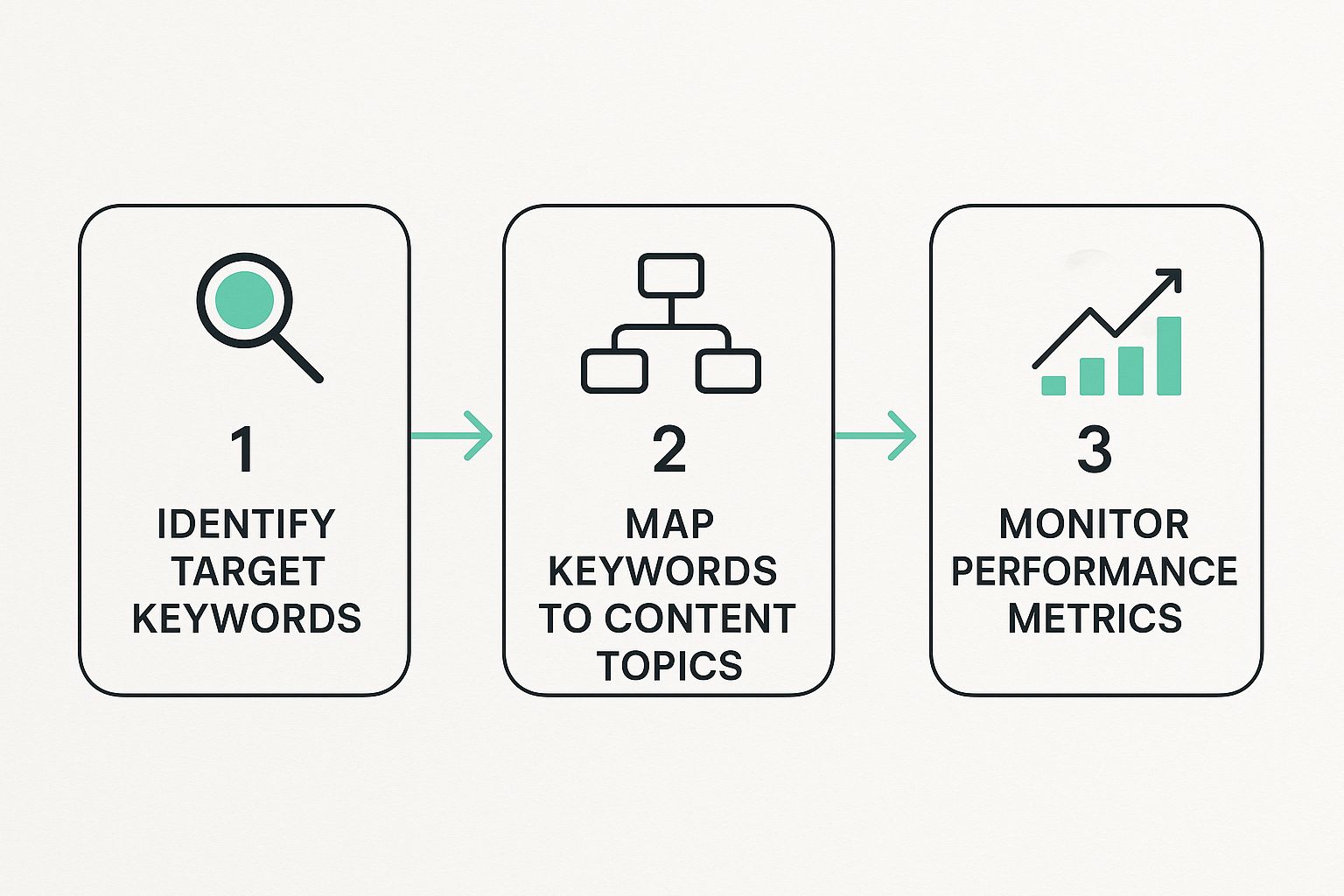
As you can see, successful SEO doesn't start with writing content or measuring clicks. It starts with deliberate, thoughtful keyword selection.
Aligning Keywords with Business Goals
Beyond just scoring, you have to connect your keywords directly to what you're trying to accomplish as a business.
Is your main focus generating leads this quarter? Then you should be prioritizing keywords like "get a quote for [your service]" or "[your product] free trial."
But what if you're trying to build brand awareness? In that case, top-of-funnel informational keywords like "what is [industry concept]" might be the smarter play.
Recent research shows that SEO delivers an average organic lead conversion rate of 2.4%, which blows most traditional marketing channels out of the water. But here's the catch: you can read the full research about SEO ROI and see that getting a positive return often takes 6 to 12 months of consistent work. This is exactly why it's so critical to prioritize keywords that can deliver results within that timeframe.
Your final keyword list should be a mirror of your business goals. When you can map every single term to a specific stage in the customer journey and a tangible outcome, you've turned a simple spreadsheet into a powerful roadmap for attracting traffic that truly matters.
More from Our Blog
Beyond Traditional SEO Services: Better Alternatives for Your Budget
Compare top SEO services platforms: RankHub, Outrank, SEObot & alternatives. Find the best fit for your budget, team size & automation needs.
Read more →
10 Online Business Ideas That Work for Beginners & Entrepreneurs
Discover 9 proven online business ideas for 2025, including startup costs, revenue timelines, and step-by-step validation strategies for solo founders.
Read more →
Building an SEO Career: What You Need to Know to Succeed
Learn how to launch an SEO career with our step-by-step guide covering skills, tools, portfolio projects, and realistic salary expectations for 2025.
Read more →