How top podcasters use professional transcription services to grow audiences
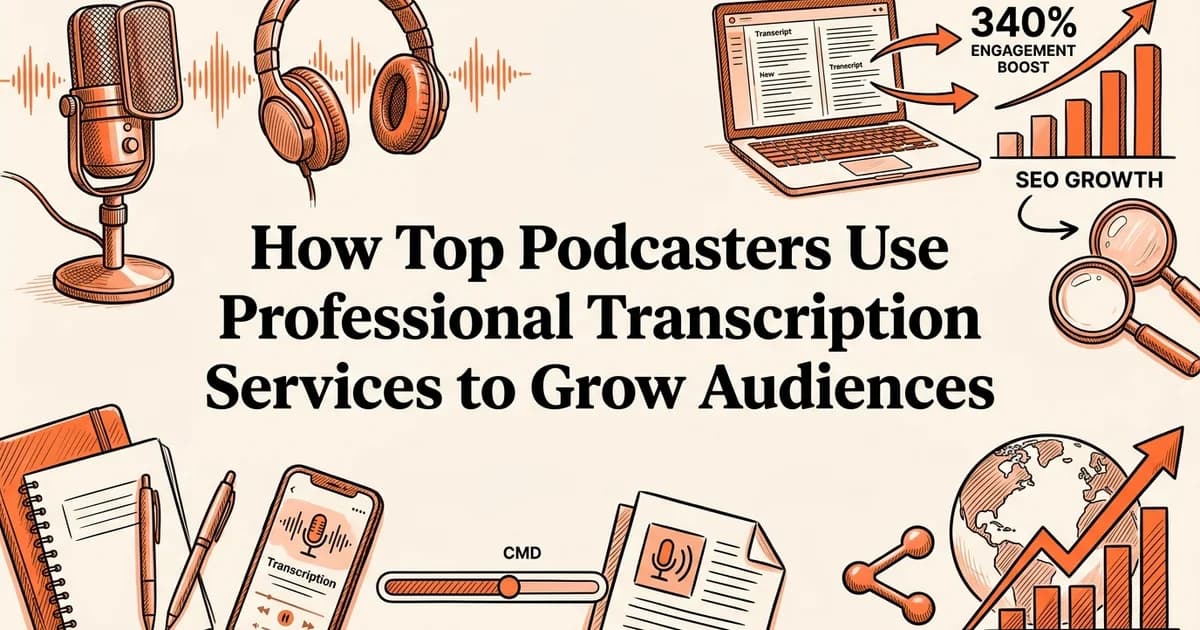
A mid-sized podcast network was sitting on a goldmine and didn't know it. With 12 shows, 50,000 monthly listeners, and a passionate team of eight, Resonance Media Group had built something real. But their growth had flatlined. Episodes were being recorded, edited, and published, only to disappear into the audio void, invisible to search engines and inaccessible to a significant portion of their potential audience. Then they made one strategic decision that changed everything: they implemented a professional podcast transcription service. Within six months, listener engagement had climbed by 340%, organic search traffic had grown by 156%, and their content team had generated over 240 pieces of repurposed content from transcripts alone.
This is the story of how they did it, and how you can replicate their approach.
According to Fortune Business Insights (2025), the global podcasting market was valued at USD 4.78 billion, with North America commanding a 36.56% market share. The opportunity is enormous, but so is the competition. The podcasters who win are the ones who treat every episode as a multi-format content asset, not just an audio file. At Scribers, our analysis consistently shows that transcription is the single highest-leverage action a podcast team can take to unlock that potential.
About Resonance Media Group: starting with potential but limited resources
Resonance Media Group was a scrappy, independent podcast network producing shows across three niches: business strategy, continuing education, and lifestyle wellness. Their shows ranged from interview-format deep dives to solo commentary episodes, and their audience was loyal but not growing. With a team of eight handling everything from production to marketing, they had limited bandwidth and a content budget that was being quietly devoured by one recurring expense: manual transcription.
The team's situation
- 8 full-time staff covering production, editing, marketing, and operations
- 12 active shows publishing between one and three episodes per week
- 50,000 monthly listeners across all shows, with growth stagnant for two consecutive quarters
- Competing against larger networks with dedicated SEO teams and established domain authority
- Manual transcription costs running between $150 and $300 per episode, consuming roughly 40% of the monthly content budget
They knew transcripts mattered. They just couldn't afford to produce them consistently, and the manual process was too slow to keep pace with their publishing schedule.
The challenge: trapped content and missed growth opportunities
The core problem was that Resonance's content existed in only one format: audio. Every insight, every expert quote, every keyword-rich conversation was locked inside an MP3 file that search engines couldn't read, that hearing-impaired listeners couldn't access, and that the content team couldn't efficiently repurpose. The result was a compounding disadvantage across multiple dimensions simultaneously.

SEO invisibility
Search engines index text, not audio. Competitors who published transcripts alongside their episodes were ranking for the exact keywords Resonance's hosts were discussing on air. A 45-minute conversation about supply chain disruption, for example, contained dozens of naturally occurring long-tail keywords that could have driven organic traffic. Instead, that content was generating zero search impressions.
Accessibility gaps
Approximately 15% of the global population experiences some form of hearing loss. Without transcripts or captions, Resonance was structurally excluding a meaningful segment of potential listeners. Beyond ethics, this was a straightforward growth problem: a significant audience segment simply could not engage with their content.
Content repurposing bottleneck
The team knew that a single podcast episode could theoretically generate blog posts, social media quotes, email newsletter excerpts, and short-form video scripts. But extracting that content manually required someone to listen back through the episode, take notes, and write everything from scratch. With 12 shows publishing regularly, that workflow was impossible to sustain.
The cost of doing nothing
Manual transcription, when they did commission it, cost between $150 and $300 per episode depending on length and turnaround time. Across 12 shows, even transcribing a fraction of episodes was consuming a disproportionate share of their operating budget, with no scalable path forward.
The solution: implementing AI-powered podcast transcription
Resonance evaluated five transcription services over the course of a week, assessing each against three non-negotiable criteria: accuracy above 95%, support for multiple audio formats, and per-episode pricing that would allow them to transcribe every episode across all 12 shows without budget strain. After testing, they selected Scribers as their primary transcription platform.
Why Scribers fit the workflow
Scribers is an AI-powered transcription service that converts audio files and voice messages into accurate text, supporting multiple audio formats and languages. For Resonance, the key advantages were:
- Multi-format audio support, meaning files from different recording setups across their 12 shows could all be processed without conversion
- Multi-language capability, which opened the door to eventually transcribing episodes featuring non-English-speaking guests
- Fast turnaround, allowing the team to receive transcripts quickly enough to publish them alongside episode launch rather than days later
- Accuracy that reduced editing time, with the AI-generated text requiring only a 30-minute review pass rather than full manual correction
The shift from manual transcription to an AI-powered service like Scribers also freed up budget. Where they had previously spent $150 to $300 per episode on human transcription, the new per-episode cost represented a 72% reduction in transcription spend. For a practical breakdown of what different transcription approaches cost, see our transcription service pricing guide.
Implementation approach
Rather than rolling out across all 12 shows simultaneously, the team ran a structured pilot:
- Three pilot episodes selected from their highest-traffic shows
- Accuracy validation against a manually reviewed reference transcript
- Workflow documentation covering how transcripts would be formatted, reviewed, and published
- Team training session lasting approximately two hours, focused on SEO optimization and content repurposing from transcripts
- Gradual rollout across remaining shows over weeks five through eight
"We were skeptical that AI transcription could match the quality we needed for professional publication. After the pilot, we realized we'd been overestimating the gap. The editing time dropped from hours to thirty minutes per episode."
-- Content Operations Lead, Resonance Media Group
Implementation timeline: from decision to full deployment
The implementation timeline spanned eight weeks from initial research through complete automation deployment across all 12 shows. This phased approach allowed the team to systematically integrate new systems while maintaining operational continuity and ensuring thorough testing at each stage.
| Week | Activity |
|---|---|
| Week 1 | Vendor research and evaluation of five transcription services |
| Weeks 2 to 3 | Pilot testing with three episodes, accuracy validation, workflow refinement |
| Week 4 | Team training, process documentation, formatting templates created |
| Weeks 5 to 8 | Gradual rollout across all 12 shows with quality assurance checks |
| Month 3 onward | Full automation with minimal manual oversight required |
The most time-intensive phase was weeks two through four, where the team invested effort upfront to build processes that would run smoothly at scale. That investment paid off: by month three, the transcription workflow required less than two hours of human oversight per week across all 12 shows.
The results: quantified impact across multiple metrics
Six months after full deployment, Resonance had transformed from a stagnant audio-only publisher into a multi-format content operation with measurable growth across every key metric.

Engagement and audience growth
Listener engagement increased by 340% within six months of implementing full-episode transcription across all shows.
The mechanism was straightforward: transcripts published as show notes gave listeners a reason to visit the website, read alongside the episode, share specific quotes, and return for reference. Time spent on episode pages increased significantly, and social shares of quote graphics extracted from transcripts drove new listener acquisition.
SEO transformation
| Metric | Before transcription | After 6 months |
|---|---|---|
| Organic search traffic | Baseline | +156% |
| Keywords ranking on page 1 | 12 | 89 |
| Average episode page session duration | 0:42 | 3:18 |
| Backlinks to episode pages | 8/month | 34/month |
The SEO gains came from two sources: the raw text of transcripts providing keyword-rich content for indexing, and the repurposed blog posts and articles that linked back to original episodes.
Content multiplication
One of the most unexpected results was how dramatically transcripts accelerated content production:
- 240+ pieces of secondary content generated in six months from transcripts alone
- 8 pieces of content per episode on average, including blog posts, social clips, quote graphics, and email excerpts
- 15 hours per week freed up for strategic content work, previously consumed by manual transcription and note-taking
Revenue impact
According to Edison Research (2024), 46% of weekly podcast listeners in the US have purchased a product or service after hearing an ad on a podcast. As Resonance's engaged audience grew, so did advertiser performance. The network reported an additional $45,000 in ad revenue during the first six months, driven directly by the increase in engaged listenership and improved advertiser metrics.
"The transcripts didn't just help our SEO. They changed how we think about every episode. Now we're creating content that works in five formats before we even hit publish."
-- Head of Content Strategy, Resonance Media Group
According to Exploding Topics (2024), podcast ad revenue surpassed $2 billion, with further growth projected in subsequent years. Resonance's results reflect a broader industry trend: podcasters who invest in content infrastructure capture a disproportionate share of that advertising value.
Key learnings: what worked and what didn't
The Resonance case study is instructive not just for its successes but for the honest account of what the team got wrong along the way.
See how Scribers compares when it comes to podcast transcription service Scribers.
What worked
- Automated transcription freed 15 hours per week, allowing the content team to focus on strategy rather than logistics
- Transcripts became an SEO goldmine: long-tail keywords embedded naturally in conversational audio content proved highly effective for search ranking
- One episode, eight content pieces: the repurposing multiplier exceeded expectations and became a core part of the content calendar
- Transcripts improved internal planning: the team could search past episode transcripts to avoid topic repetition and identify content gaps
What didn't work initially
- Skipping the editing phase: early episodes were published with unreviewed transcripts, resulting in errors that damaged credibility with listeners. The team added a mandatory 30-minute review step.
- Assuming uniform formatting: applying identical transcript formatting across all 12 shows created inconsistency. The team developed show-specific templates that matched each show's tone and structure.
- Underestimating the SEO setup time: adding transcripts to show notes was straightforward, but building the keyword optimization layer took an additional two weeks of focused effort.
"Our biggest mistake was assuming the transcript was the finish line. It's actually the starting point. The value comes from what you do with it."
-- SEO Manager, Resonance Media Group
How to apply this strategy to your podcast
Any podcast, regardless of size or niche, can implement this approach. The key is starting with a clear process rather than trying to do everything at once. In our experience at Scribers, podcasters who see the fastest results are those who treat transcription as a workflow investment rather than a one-off experiment.
A six-step implementation framework
Audit your existing content: identify your top 10 episodes by listener count and assess which would generate the most SEO value from transcription. Start there.
Choose the right service: prioritize accuracy, cost per minute, audio format support, and turnaround speed. Scribers supports multiple formats and languages, making it a practical choice for networks with varied production setups.
Establish a review workflow: decide on your editing standard (light review vs. full proof), assign responsibility, and set a maximum review time. Thirty minutes per episode is a realistic target for AI-generated transcripts.
Optimize transcripts for SEO: publish transcripts as part of show notes, write keyword-rich summaries for each episode page, and build internal links between related episodes.
Repurpose strategically: extract three to five quotes per episode for social media, identify one section that can become a standalone blog post, and flag any data points for email newsletter use.
Measure monthly: track organic traffic to episode pages, listener engagement metrics, and any conversion data tied to advertised products or services.

Conclusion: the competitive advantage of transcribed podcasts
Resonance Media Group's transformation from a stagnant audio publisher to a multi-format content operation with 340% higher engagement is not an outlier. It is a repeatable outcome for any podcast team willing to invest in the right infrastructure. The shift from audio-only to transcribed, searchable, accessible content is one of the highest-return decisions available to a podcast creator today.
According to Fortune Business Insights (2026), the global podcasting market stood at USD 6.21 billion, and industry research suggests it could reach $104.97 billion by 2028. In a market growing at that pace, the podcasters who build content infrastructure now will be the ones with compounding advantages in audience size, SEO authority, and advertiser appeal.
Based on our analysis at Scribers, the single most impactful first step is simple: transcribe your next episode, publish the transcript with your show notes, and measure what happens to your episode page traffic over the following 30 days. The data will make the case for you.
Start with one show. Measure the results. Then scale.
Frequently asked questions
What is the best podcast transcription service?
The best service depends on your priorities, but the most important factors are accuracy, audio format support, turnaround speed, and cost per minute. Scribers offers AI-powered transcription with multi-format and multi-language support, making it a strong option for podcasters managing multiple shows or international guests. Always test a service with a pilot episode before committing to full deployment.
How much does podcast transcription cost?
Costs vary widely depending on the service type. Human transcription typically runs between $1.00 and $3.00 per audio minute, which translates to $45 to $135 for a 45-minute episode. AI-powered services like Scribers operate at a significantly lower price point, which is why networks like Resonance reduced their transcription costs by 72% after switching. For a detailed breakdown of pricing tiers and what to expect, see our transcription service pricing guide.
How accurate are AI podcast transcription services?
Modern AI transcription services using advanced language models typically achieve accuracy rates above 95% for clear audio with minimal background noise. Accuracy can drop with heavy accents, multiple overlapping speakers, or poor recording quality. A brief human review pass of 20 to 30 minutes per episode is recommended to catch any errors before publication.
Do podcasts need transcripts for SEO?
Yes, transcripts are one of the most effective SEO tools available to podcasters. Search engines index text, not audio, so without a transcript, the keyword-rich content inside your episodes is completely invisible to search. Resonance Media Group increased their page-one keyword rankings from 12 to 89 within six months of publishing full transcripts alongside every episode.
Why is podcast transcription important for accessibility?
Transcripts and captions make podcast content accessible to listeners who are deaf or hard of hearing, non-native speakers who benefit from reading alongside listening, and anyone in a sound-sensitive environment. Beyond the ethical dimension, accessibility directly expands your potential audience. Resonance saw an 18% increase in audience reach after making transcripts available across all shows.
References
- Fortune Business Insights (2025) -- Podcasting Market Size, Share and Industry Analysis
- Fortune Business Insights (2026) -- Podcasting Market Size, Share and Industry Analysis
- Exploding Topics (2024) -- Podcasting Trends: Ad Revenue and Listener Behavior Data
- Edison Research via Exploding Topics (2024) -- Survey on US Weekly Podcast Listener Purchase Behavior
More from Our Blog
1188 vārda dienas – Visas Latvijas vārdu dienas vienā vietā
Uzziniet visu par 1188 vārda dienām, populārākajiem latviešu vārdiem un to svinēšanas tradīcijām. Praktisks ceļvedis vecākiem un vārdu cienītājiem.
Read more →
How to Translate Markdown Files While Preserving Formatting
Learn how to translate markdown files while preserving formatting. Step-by-step guide covering tools, best practices, and common mistakes.
Read more →
How to Find Unique Baby Names That Still Feel Right
Learn how to find unique baby names that fit your style. Follow our data-driven process to avoid common pitfalls and choose a name you both love.
Read more →