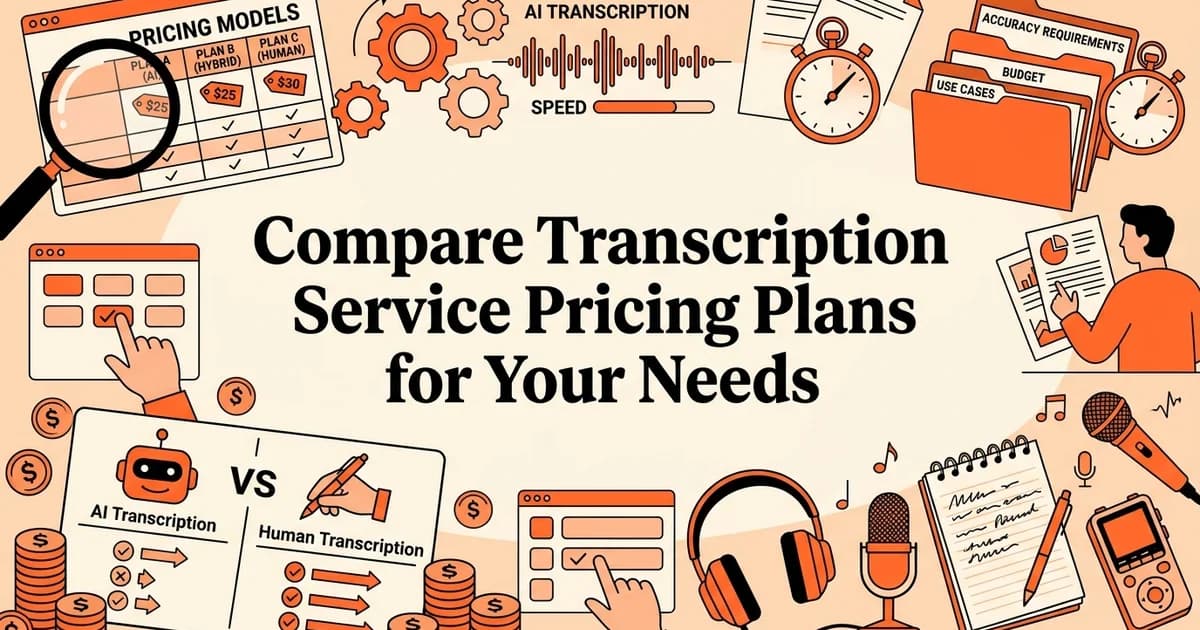
Compare transcription service pricing plans for your needs
Introduction: Understanding transcription service pricing in 2025
Transcription service pricing in 2025 spans a surprisingly wide range, from lean AI-powered tools starting around $39 per month to specialized medical and legal platforms exceeding $300 per provider monthly. Choosing the wrong plan can mean overpaying for features you never use, or underpaying for a service that costs you far more in corrections and wasted time.
At Scribers, our analysis shows that most buyers focus too narrowly on the headline price and miss what actually drives value: the pricing structure itself. A flat monthly subscription works beautifully for high-volume users, while per-minute pricing suits teams with unpredictable workloads. Getting that match right is often the difference between a tool that pays for itself and one that quietly drains your budget.
This guide compares nine transcription services and pricing models, covering:
- Per-minute and pay-as-you-go plans for flexible, low-volume needs
- Tiered subscription models for growing teams and content creators
- Seat-based enterprise pricing for organizations managing multiple users
- Specialized medical and legal tiers where accuracy requirements push costs higher
Speaking of specialization: context matters enormously. Generic transcription tools serve podcasters, students, and business professionals well at accessible price points. Medical AI scribe tools, however, typically cost between $49 and $299 per provider per month, reflecting the clinical accuracy, compliance features, and workflow integrations those environments demand.
To make this comparison genuinely useful, each service is evaluated against four criteria:
- Accuracy across accents, audio quality, and domain-specific vocabulary
- Speed of turnaround for both automated and human-reviewed transcription
- Features including language support, format flexibility, and integrations
- ROI relative to the time and cost of manual transcription
Whether you are a journalist on deadline, a medical professional documenting patient notes, or a podcaster repurposing episodes into written content, the right pricing plan is out there. This guide helps you find it.
1. Scribers: AI-powered transcription with flexible per-minute pricing
Editor's Pick. Scribers earns the top spot on this list by striking a balance that most transcription services struggle to achieve: genuinely high accuracy, broad format support, and pricing that scales with how much you actually use it. For anyone tired of paying flat monthly fees for a tool they use sporadically, that flexibility matters.
Scribers
AI-powered transcription with flexible per-minute pricing. Offers high accuracy, broad format support, and scalable pricing that balances cost with performance for users of all sizes.
What Scribers does
Scribers is an AI-powered transcription service that converts audio files and voice messages into accurate, readable text. It supports multiple audio formats and languages, making it a practical choice for teams and individuals working across different workflows and regions.
The core experience is straightforward. Upload your file, select your language, and receive a transcript. No technical setup, no steep learning curve.
Pricing model
Scribers offers per-minute pricing alongside subscription options, which means you pay closer to what you actually consume. This structure suits:
- Podcasters and content creators who produce episodes on irregular schedules
- Students and educators transcribing lectures or interviews in bursts around academic calendars
- Business teams handling meeting notes without committing to enterprise-tier contracts
As the market has shifted toward low-entry plans, often under $50 per month, Scribers fits neatly into that accessible tier without sacrificing capability.
Key strengths and weaknesses
Pros:
- High transcription accuracy across varied audio quality and accents
- Multi-language support, addressing a common gap in competitor tools
- Flexible per-minute pricing reduces waste for occasional users
- Fast turnaround suitable for deadline-driven workflows in media and journalism settings
- No technical knowledge required to get started
Cons:
- Per-minute pricing can accumulate costs for very high-volume users who would benefit more from unlimited subscription tiers
- Advanced workflow automation and AI note-generation bundling, increasingly common across the industry, may be more limited compared to enterprise-focused platforms
ROI framing
Manual transcription typically takes three to four times the length of the original audio. For a podcaster producing two hours of content weekly, that translates to six or more hours of labor. At competitive per-minute rates, Scribers can reduce that burden to minutes, freeing time for editing, publishing, and audience growth.
2. Freed AI: Ultra-affordable starter plans for budget-conscious users
Freed AI positions itself firmly at the affordable end of the transcription service pricing spectrum, making it a practical choice for solo clinicians, small practices, and individual content creators who need reliable note generation without committing to enterprise-level budgets.
Freed AI
Ultra-affordable starter plans beginning at $39/month with unlimited note generation at the Core tier ($79/mo). Ideal for solo clinicians, small practices, and budget-conscious content creators.
Pricing overview:
- Starter plan: $39/month billed annually, covering up to 40 notes per month
- Core plan: $79/month for unlimited note generation
- Free trial: Available to test core functionality before committing
For context, budget-oriented AI scribe options for solo clinicians and small practices can cost roughly $45 to $100 per month, compared to $300 or more for full-featured enterprise platforms. Freed AI sits comfortably within that accessible range.
Key strengths:
- Genuinely low entry point for individual users
- Unlimited notes at the Core tier removes anxiety around usage caps
- Clean, straightforward interface with minimal learning curve
Notable limitations:
- The 40-note ceiling on the starter plan can feel restrictive during busy periods
- Advanced workflow integrations and team collaboration features are limited compared to platforms built for larger organizations
- Primarily optimized for clinical note-taking rather than broader transcription use cases
ROI snapshot: A solo practitioner spending three to four hours weekly on manual documentation could reclaim that time entirely at the Core plan's $79/month rate. That works out to roughly $20 per week, far below typical hourly administrative labor costs.
For users whose needs extend beyond clinical notes into audio files, podcasts, or multilingual content, a more flexible tool may serve better. Platforms like Scribers support multiple audio formats and languages, which broadens the use case considerably. You can explore that approach further in our guide on how to start converting audio to text for free.
3. Sunoh.ai: Mid-range per-provider pricing with enterprise scale
Sunoh.ai sits comfortably in the middle of the transcription service pricing spectrum, charging $149 per user per month for its AI medical scribe platform. That price point reflects a deliberate balance between affordability and enterprise-grade capability, making it a strong contender for small to mid-size practices that need reliable multi-user support.
Sunoh.ai
Mid-range AI medical scribe platform at $149 per user per month. Serves 90,000+ providers with enterprise-scale capabilities and balanced pricing for growing healthcare organizations.
Who it's built for: Practices with multiple providers who each need dedicated transcription support, particularly those already stretched thin on administrative resources.
Key features at $149/month:
- Real-time clinical transcription during patient encounters
- Automated note generation formatted for common EHR systems
- Integration support across major practice management platforms
- Multi-provider account management for team-based care settings
The scale Sunoh.ai has achieved is notable. The platform reports serving over 90,000 providers globally, which signals both reliability and a product refined through substantial real-world use. That kind of adoption tends to translate into better specialty-specific language models and faster iteration on accuracy issues.
The value comparison that matters most:
Human medical scribes typically cost $300 or more per month per provider, sometimes significantly more when factoring in training, scheduling, and turnover. At $149/month, Sunoh.ai cuts that cost roughly in half while eliminating the logistical overhead entirely. Research suggests AI medical scribes broadly range from $49 to $299 per provider per month depending on features and specialty support, placing Sunoh.ai squarely in the mid-tier but well within reach for most practices.
Strengths: Proven scale, competitive pricing against human alternatives, solid EHR integration Weaknesses: Focused specifically on clinical use, limited utility for non-medical transcription needs
For teams handling audio content beyond clinical settings, such as recorded interviews, podcasts, or multilingual files, a general-purpose tool like Scribers may complement or replace this approach. You can also compare broader options in our complete guide to finding affordable transcription services.
4. Heidi Health: Premium pricing with documented ROI for healthcare organizations
Heidi Health sits firmly in the premium tier of transcription service pricing, with plans ranging from $99 to $600+ per month. For healthcare organizations, that cost is rarely questioned once the numbers are laid out: some report recouping over $10,000 in clinical time every single month.
Who it's built for: Hospitals, multi-provider clinics, and healthcare networks that need more than basic transcription. Heidi Health targets organizations where accuracy is non-negotiable and compliance failures carry real financial risk.
Key strengths:
- Documented ROI: The math is compelling. At a 900% or more return on implementation costs, even the highest pricing tier becomes a straightforward business case for administrators
- Multi-speaker handling: Clinical environments involve physicians, nurses, and patients speaking simultaneously. Heidi Health's architecture is designed specifically for this complexity
- Compliance-first design: HIPAA-aligned workflows, audit trails, and role-based access controls justify the premium over general-purpose tools
- Advanced integrations: Deep EHR connectivity and custom workflow support reduce manual data entry across departments
- Priority support: Enterprise tiers include dedicated account management, which matters when downtime affects patient care
Weaknesses:
- The pricing ceiling is steep for smaller independent practices or solo providers
- Overkill for organizations outside healthcare, where domain-specific compliance features add cost without value
- Onboarding complexity can extend implementation timelines
Pricing snapshot: $99/month entry-level, scaling to $600+ for multi-provider enterprise configurations. Some vendors in this vertical do offer permanent free tiers, worth confirming directly.
The vertical-specific pricing model reflects a broader industry pattern: when domain accuracy, compliance, and multi-speaker handling are required, price bands rise accordingly. For healthcare organizations, that premium is typically absorbed within the first month of reclaimed physician hours.
For content that lives outside clinical walls, such as recorded interviews or podcast audio, a flexible tool like Scribers or an OpenAI Whisper-based solution may offer better value without the healthcare-specific overhead.
5. Per-minute pricing models: Best for variable usage and pay-as-you-go flexibility
Per-minute pricing charges you only for the audio you actually submit, making it a natural fit for anyone whose transcription needs fluctuate month to month. Rather than committing to a recurring fee, you pay as you go, which keeps costs tightly aligned with real workload.
Typical rates fall between $0.10 and $0.25 per audio minute, with the spread reflecting differences in accuracy, turnaround time, and human review involvement. To put that in practical terms: a one-hour podcast episode costs roughly $6 to $15 under a per-minute model. For a freelancer producing two episodes a month, that is a manageable, predictable outlay with no wasted spend.

The break-even comparison with subscription plans is worth running before you commit. If a monthly subscription costs $30 and covers unlimited transcription, you would need to process more than two to five hours of audio per month before per-minute pricing becomes the more expensive option. Below that threshold, pay-as-you-go almost always wins.
Per-minute pricing works best for:
- Freelancers handling occasional client interviews or recordings
- Students transcribing lectures or research interviews one semester at a time
- Content creators with irregular publishing schedules
- One-off projects such as conference recordings or legal depositions
It is worth noting that the broader industry has been shifting toward tiered subscription and seat-based models, particularly as AI transcription tools mature. That shift can disadvantage low-volume users who end up paying for capacity they never use.
Editor's Pick: Scribers
Scribers is an AI-powered transcription service built for users who need accurate results without a steep learning curve or a bloated subscription. It supports multiple audio formats and languages, making it genuinely useful for multilingual content creators and international teams.
| Feature | Detail |
|---|---|
| Transcription method | AI-powered |
| Format support | Multiple audio formats |
| Language support | Multi-language |
| Best for | Freelancers, students, content creators |
Strengths: Fast turnaround, broad format compatibility, no technical setup required, strong multilingual support that outpaces many competitors.
Weaknesses: Less suited to enterprise teams needing seat-based access controls or deep workflow integrations.
For creators who want to explore how API-based transcription compares, the transcription API alternatives guide breaks down six professional options worth considering alongside pay-as-you-go services.
6. Subscription-based tiered plans: Predictable costs for regular users
Subscription-based tiered pricing has become the dominant model for teams and creators who transcribe consistently every month. Rather than tracking per-minute costs, users pay a flat monthly fee, typically ranging from $49 to $299/month, and receive a defined bundle of features, usage allowances, and support levels.
The industry has shifted noticeably toward seat-based and tiered subscription structures, where AI transcription tools are sold per user per month rather than by audio hour. This mirrors how SaaS software broadly operates and makes budgeting far more straightforward for finance teams and solo operators alike.
Typical tier structure looks like this:
- Starter ($49/month): Core transcription, limited hours or file uploads, basic export formats, email support
- Professional ($99–$149/month): Higher usage caps, priority processing, speaker identification, integrations
- Enterprise ($199–$299/month): Unlimited usage, team seats, API access, dedicated support, compliance features
Cost comparison example: A podcaster transcribing 10 hours of audio monthly at $0.25/minute (per-minute pricing) pays roughly $150. A Professional subscription at $129/month covers the same volume and adds features, delivering clear savings with consistency.
There has also been meaningful expansion of permanent free tiers and low-entry plans under $50/month, designed specifically to capture students, solo creators, and small teams who need reliable transcription without committing to enterprise contracts.
Best suited for: podcasters with regular episode schedules, content marketing teams, educators managing lecture recordings, journalists, and any business with predictable monthly transcription volume.
Who to consider:
Scribers (scribers.app) sits comfortably in this category with accessible entry-level pricing that works well for solo creators and small teams. Its AI-powered engine handles multiple audio formats and languages, removing the friction of format conversion before upload.
- Strengths: High accuracy across languages, broad format support, fast turnaround, genuinely easy onboarding with no technical knowledge required
- Weaknesses: Teams needing granular seat-based access controls or deep enterprise workflow integrations may find it better suited as a complement to larger platforms
7. Vertical-specific pricing: Medical, legal, and media services command premium rates
Specialized industries pay significantly more for transcription because the stakes are higher. When a missed word in a medical record or a misquoted legal deposition carries real liability, generic accuracy rates simply are not good enough. Premium pricing in these verticals reflects compliance requirements, domain-specific vocabulary, and the cost of getting it wrong.
Why vertical pricing diverges from standard rates
Generic meeting or podcast transcription tools optimize for convenience and speed. Vertical-specific services optimize for something harder to achieve: domain accuracy under regulatory pressure. That difference shows up directly in the price.
Medical transcription sits at the higher end of the spectrum. AI medical scribes typically cost between $49 and $299 per provider per month, depending on features, specialty support, and usage volume. More comprehensive platforms with EHR integration, HIPAA compliance infrastructure, and specialty-specific terminology support can push costs to $600 or more per month. The pricing reflects liability exposure as much as technology.
Legal transcription commands premiums for different reasons:
- Verbatim accuracy requirements, including false starts and filler words
- Chain-of-custody documentation for court admissibility
- Familiarity with jurisdiction-specific terminology
- Turnaround windows tied to filing deadlines
Media and journalism pricing reflects a third set of demands. Broadcast-quality transcripts require clean multi-speaker identification, tight turnaround for live or near-live content, and formatting standards that differ from a simple interview transcript.
The ROI framing that justifies the cost
For compliance-driven buyers, premium pricing is genuinely an investment rather than an overhead. A single regulatory violation or inadmissible court document can cost far more than a year of specialized transcription fees. Accuracy and compliance reduce downstream legal and regulatory risk in ways that are difficult to quantify but easy to justify.
For content creators and business teams whose work does not carry those compliance burdens, general-purpose tools remain the smarter choice. Understanding which category your work falls into is the first step toward choosing the right pricing tier.
8. Bundled transcription and workflow automation: Justifying premium pricing through feature integration
Bundled transcription platforms combine raw audio-to-text conversion with downstream tools like note generation, summaries, action items, and workflow templates. This packaging shifts the value conversation away from per-minute cost and toward total productivity gain, which often justifies significantly higher monthly fees.
Explore what Scribers offers for transcription service pricing Scribers.
Why bundling changes the pricing equation
The trend is straightforward: vendors recognized that transcription alone is a commodity, so they layered adjacent features on top. Today's leading platforms offer:
- AI-generated summaries that condense hour-long meetings into digestible paragraphs
- Action item extraction that automatically identifies tasks and assigns owners
- Clinical note templates that turn physician-patient conversations into structured documentation
- Custom workflow integrations that push outputs directly into CRMs, project tools, or EHR systems
When you price each capability separately, the bundled monthly cost often looks like a bargain. A standalone transcription tool, a summarization add-on, and a workflow integration layer can easily exceed the cost of a single bundled subscription.
Who benefits most from bundled pricing
Healthcare providers, legal teams, and enterprise operations teams see the clearest return. AI scribes that generate clinical notes directly from patient conversations, for example, can save physicians several hours of documentation work each week. Legal teams benefit from structured summaries that feed directly into case management systems.
In our experience at Scribers, users who initially come for straightforward audio transcription frequently discover that accurate, fast conversion is the foundation everything else depends on. A bundled workflow is only as strong as the transcript it starts with, which is why core accuracy remains the non-negotiable baseline before any automation layer adds value.
The bottom line: If your team relies on transcription outputs across multiple downstream tasks, a bundled platform almost always delivers better cost efficiency than assembling standalone tools.
9. Free and freemium transcription tools: Accuracy trade-offs and feature limitations
Free and freemium transcription tools offer an accessible entry point for low-volume users, but they come with meaningful trade-offs. Most permanent free tiers cap usage, limit export formats, and deliver noticeably lower accuracy than paid alternatives, making them best suited for casual or exploratory use rather than professional workflows.
The accuracy gap is the most critical consideration. Sonix reports its automated AI transcription can reach up to 99% accuracy, while competing tools are often capped around 85%. That 14-point difference may sound modest, but in practice it means manually correcting roughly one word in seven, which quickly erodes any savings from avoiding a paid plan.

Feature gating is the other major limitation. Free tiers from most major vendors routinely lock away:
- Speaker identification, which is essential for interviews and multi-participant recordings
- Real-time transcription, typically reserved for mid-tier and premium plans
- Export format variety, with free users often limited to plain text only
- Advanced language support, restricting non-English speakers to paid tiers
Here is how the main options compare for budget-conscious users:
Editor's Pick: Scribers Scribers delivers AI-powered transcription with strong accuracy across multiple audio formats and languages, addressing the core pain point that most free tools fail on. It supports voice messages, podcast files, and standard audio formats without requiring technical setup. For students, solo creators, or anyone testing before committing to a larger platform, Scribers offers a practical starting point. Visit scribers.app to explore current options.
Best for: Students, hobbyists, and anyone evaluating transcription service pricing before upgrading.
Warning: Free tools are rarely appropriate for medical, legal, or compliance-sensitive transcription, where accuracy and audit trails are non-negotiable requirements.
How to choose the right transcription service for your budget and use case
Choosing the right service means matching your actual workflow to the pricing model that rewards it. Work through these five steps before committing to any plan, and you will avoid overpaying for features you never use or under-buying accuracy you genuinely need.
Step 1: Assess your monthly volume
Start with a realistic estimate of how many audio hours you produce each month. Under two hours? Pay-as-you-go rates make sense. Over ten hours regularly? A subscription almost always wins on unit cost.
Step 2: Determine your accuracy threshold
- 99% accuracy or higher: Required for medical records, legal depositions, and compliance documentation. Human-reviewed or hybrid services are non-negotiable here.
- 85-95% accuracy: Sufficient for podcast show notes, meeting summaries, and educational content, where minor errors are correctable in editing.
Step 3: Calculate your break-even point
Compare the per-minute rate against a monthly subscription at your expected volume. Research suggests most users cross the subscription break-even point somewhere between eight and fifteen hours per month, though exact thresholds vary by provider.
Step 4: Evaluate the features you will actually use
Consider which of these matter to your workflow:
- Speaker identification (essential for interviews and multi-person meetings)
- Real-time transcription (useful for live events and accessibility)
- API or software integrations (critical for teams embedding transcription into existing tools)
- Export formats such as SRT, VTT, or DOCX
Step 5: Factor in ROI, not just cost
Calculate the hourly rate of whoever would manually transcribe your content. If that person earns $25 per hour and transcription takes four times the audio length, one hour of audio costs $100 in labor. A service charging $15 for the same hour pays for itself immediately.
Quick decision matrix
| Priority | Best fit |
|---|---|
| High volume, tight budget | Subscription plan |
| Occasional use, varied formats | Pay-as-you-go, such as Scribers |
| Medical or legal accuracy | Human-reviewed service |
| Multiple languages | AI platforms with broad language support |
Bonus tips: Maximizing transcription service value and minimizing costs
Once you've identified the right service, a few smart habits can stretch your transcription budget significantly further. Small adjustments to how and when you submit files, combined with strategic use of free tiers and integrations, can translate into meaningful savings over time.
Six practical ways to reduce your transcription spend:
Batch your submissions strategically. Grouping multiple files into a single upload session often qualifies for bulk pricing. Many platforms, including AI-powered tools like Scribers, process larger batches efficiently, reducing per-minute costs compared to submitting files one at a time.
Test free tiers before committing. Most reputable services offer free minutes or trial periods. Use them to evaluate accuracy on your specific audio type, whether that's a podcast recording, lecture, or business meeting, before paying for a full plan.
Negotiate volume discounts. Teams and enterprise users should always ask. Research suggests volume agreements commonly deliver 20 to 40 percent savings compared to standard rates, particularly for monthly commitments exceeding several hundred audio hours.
Layer free and paid tools. Run a rough draft through a free tool first, then use a paid service for final polish. This hybrid approach preserves accuracy where it matters while keeping routine transcription costs low.
Activate platform integrations. Connecting your transcription service to tools like Notion, Slack, or your CMS eliminates manual copy-paste steps, saving hours of administrative work each month.
Track your ROI consistently. Log time saved per week, multiply by your hourly rate, and compare that figure against your monthly subscription cost. If the math favors the service, scaling up makes clear financial sense.
Common mistakes to avoid when selecting transcription services
Even with a solid understanding of transcription service pricing, it is easy to make decisions that cost you more in the long run. These six common pitfalls trip up buyers across every industry, from podcasters to legal professionals.
Choosing based on price alone. The cheapest option rarely accounts for accuracy thresholds or compliance requirements. Medical and legal professionals, in particular, face serious liability if transcripts contain errors or are processed by non-compliant platforms.
Underestimating your transcription volume. Many buyers start with per-minute pricing only to discover their actual usage far exceeds initial estimates. Running the numbers on realistic monthly volume before committing can reveal whether a subscription plan saves significantly more.
Ignoring integration requirements. A service that does not connect with your existing tools, whether that is a CMS, project management platform, or communication app, creates friction that quietly erodes the time savings you expected.
Using free tools for professional purposes. Research suggests free AI transcription tools carry meaningful accuracy gaps compared to paid services, and many lack data privacy protections. For medical, legal, or accessibility use cases, this is a genuine liability risk, not just an inconvenience.
Skipping the ROI calculation. Before committing to any plan, estimate the hours saved weekly, multiply by your effective hourly rate, and compare that against the monthly cost. Services like Scribers are worth evaluating here because their AI-powered, multi-format transcription can replace hours of manual work at a fraction of human transcription rates, which typically run five to ten times higher than automated alternatives.
Failing to test on your actual audio. Accuracy benchmarks mean little if they were measured on studio-quality recordings. Always run a sample of your real audio, including your speaker accents and background noise levels, before purchasing.
Tools and resources for comparing transcription service pricing
Finding the right transcription service pricing plan is far easier when you have the right tools in hand. These six resources help you cut through marketing language, run real numbers, and make a confident, evidence-based decision.
Editor's Pick: Scribers pricing calculator and free trial (scribers.app) Scribers offers an AI-powered transcription service that supports multiple audio formats and languages, making it a practical starting point for any comparison. Its straightforward pricing lets you model per-minute costs against your actual volume before committing. Strengths: high accuracy, broad format and language support, no technical setup required. Weaknesses: best suited for audio-first workflows rather than live captioning.
Per-minute vs. subscription spreadsheet calculators. Downloadable templates let you input your monthly audio hours and instantly compare pay-as-you-go against flat-rate plans across multiple providers.
Free trial guides for major platforms. Curated walkthroughs explain exactly what each platform unlocks during its trial period, so you can test apples-to-apples.
ROI calculators for healthcare and enterprise users. Research suggests businesses switching from human to AI transcription can reduce costs by up to 80 percent. These calculators quantify that gap for your specific use case.
Independent accuracy benchmarks and reviews. Third-party word-error-rate tests give you objective data beyond vendor claims.
Integration compatibility matrices. Side-by-side charts show which services connect natively with Zapier, Slack, and Microsoft Teams, preventing costly workflow surprises.
Published case studies. Real-world examples document measurable cost savings and productivity gains across industries, grounding your decision in proven outcomes.
Conclusion: Making the right transcription investment for your needs
Choosing the right transcription service comes down to understanding what you actually need, then matching that need to a pricing model that delivers genuine return on investment. Across the services reviewed here, pricing ranges from roughly $39 per month for entry-level AI tools to $600 or more for enterprise and human-assisted plans. That spread reflects real differences in accuracy, turnaround time, and workflow depth.
The most important shift in mindset is moving away from raw cost comparisons toward ROI thinking. Calculate the hours your team currently spends on manual transcription, factor in compliance risk or accessibility obligations, and the monthly fee of even a premium plan often pays for itself within days.
Modern AI tools have genuinely democratized access to professional-grade transcription. Services like Scribers demonstrate this clearly: AI-powered accuracy, multi-language support, and broad audio format compatibility are now available at a fraction of what human transcription once cost. For content creators, journalists, students, and business teams alike, the barrier to entry has never been lower.
The smartest next step is a practical one. Start with a free trial or a low-cost monthly plan, run your real audio through it, and measure the output quality against your actual standards. Avoid committing to annual contracts before you have firsthand data.
Transcription technology is ready to reclaim hours from your workflow this week. The pricing options exist at every budget level. The only remaining decision is choosing to start.
Frequently asked questions
How much does transcription cost per minute in 2025?
AI transcription services typically cost between $0.10 and $0.25 per minute, while human transcription ranges from $1.00 to $3.00 or more per minute. Transcription service pricing varies based on turnaround time, audio complexity, and the provider you choose.
What is the difference in price between human and AI transcription?
Human transcription can cost ten times more than AI alternatives, making it a significant budget consideration for high-volume users. AI tools like Scribers offer fast, accurate results at a fraction of the cost, which suits most everyday transcription needs.
Why do some services charge per minute while others charge monthly?
Per-minute pricing suits occasional users who need flexibility, while monthly subscriptions offer better value for consistent, high-volume work. Choosing the right model depends on how frequently you transcribe.
Are free transcription tools accurate enough?
Free tools can handle simple, clean audio reasonably well, but they often struggle with accents, multiple speakers, or background noise. Paid services generally deliver meaningfully higher accuracy for professional use cases.
How do bulk or team plans affect transcription pricing?
Team and bulk plans typically reduce the per-minute or per-hour cost considerably. Businesses processing large audio volumes can save significantly by committing to a higher-tier plan upfront.
What factors influence transcription costs most?
Audio quality, number of speakers, turnaround speed, and language complexity all affect pricing. Poor audio or specialist terminology often requires human review, which increases cost.
Based on our work at Scribers...
we consistently find that users switching from manual or human transcription to AI-powered tools save both time and money without sacrificing the accuracy their work demands.
More from Our Blog
The Most Interesting Reddit Updates You're Missing
Discover the best Reddit monitoring and cleanup tools for 2024. Compare features, pricing, and performance to protect your online reputation.
Read more →
Your Complete Guide to Using a Voice Reader for Newsletters
Learn how to convert your newsletters to audio with our complete guide. Set up a voice reader in minutes and listen to newsletters while commuting or multitasking.
Read more →
5 Proven Templates for Converting EPUB Files to High-Quality Audio
Discover 8 customizable templates for converting EPUB files to audio. Step-by-step structures with placeholders for independent authors, publishers, and content creators.
Read more →