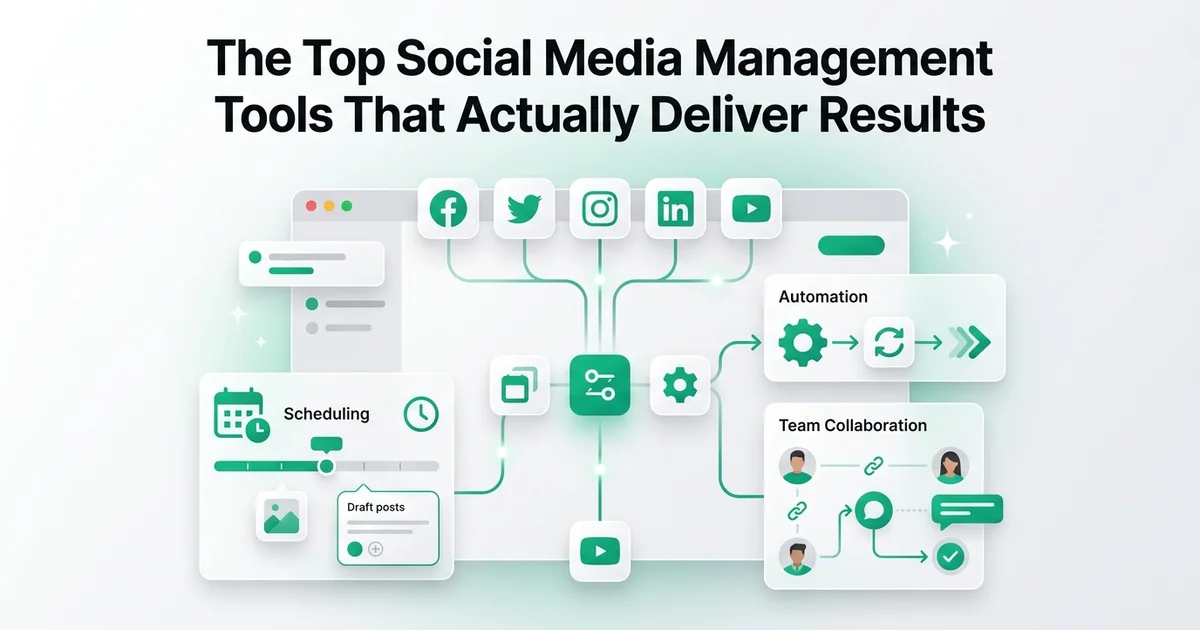
The top social media management tools that actually deliver results
Introduction: why social media management tools matter
Managing social media without the right tools is like navigating without a map. You might eventually get somewhere, but you will waste significant time and energy along the way. The best social media management tools exist to solve exactly this problem, and the data confirms that teams are taking notice.
According to Hootsuite (2024), 91% of social marketers now use dedicated platforms as a core part of their tech stack. That near-universal adoption is not coincidental. Teams that consolidate their workflows into a single, centralized platform are 2.3x more likely to describe their social strategy as "very effective" compared to those juggling disconnected tools.
The efficiency gains are equally compelling. Automation features alone save marketers an average of 6 to 8 hours per week, time that can be redirected toward creative work, strategy, and actual audience engagement.
At RankHub, our analysis shows that the platforms delivering the strongest results in 2026 share one defining characteristic: deeply embedded generative AI. Research suggests that more than 60% of leading platforms will integrate AI-native content and scheduling features by 2026, making intelligent automation the new baseline rather than a premium add-on.
The tools covered below have been evaluated against these exact standards.
Our top picks: quick summary of the best social media management tools
With scheduling features adopted by 83% of social media teams and automation prioritized by 68% of marketers, choosing the right platform comes down to fit, not just features. Here is a ranked overview of the tools that consistently deliver.
| # | Tool | Best for | Price range |
|---|---|---|---|
| 1 | RankHub Autopilot | Integrated SEO and social automation | $$ |
| 2 | Hootsuite | Enterprise-scale scheduling and analytics | $$$ |
| 3 | Buffer | Solo founders and lean teams | $ |
| 4 | Sprout Social | Collaboration-heavy marketing teams | $$$ |
| 5 | Later | Visual content planning and Instagram-first brands | $$ |
| 6 | Publer | SMBs needing affordable multi-channel publishing | $ |
Each tool above has been assessed on automation depth, AI integration, reporting quality, and value for money. For founders also thinking about organic search growth alongside social, our guide to Small Business SEO Automation: 10 Questions Answered covers the overlap worth understanding before committing to a platform.
RankHub: best for integrated SEO and social automation
RankHub stands out in this list because it does something most social media tools do not: it connects SEO content creation directly to social publishing in a single, coherent workflow. For solo founders and small teams who need organic search growth and social presence without managing two separate platforms, that integration is genuinely valuable.
RankHub
Fully automated SEO content platform that integrates social publishing directly into your content workflow. Best for teams that want to connect keyword research, article creation, and social distribution in one coherent system.
Unified SEO and social publishing in one platform
RankHub Autopilot is built around the idea that blog content and social content should not live in separate silos. The platform lets you create SEO-optimised articles and automatically distribute them across social channels, removing the manual step of reformatting and reposting content. This blog-to-social pipeline is particularly useful for small teams where one person often handles both functions.
According to Buffer (2024), the majority of marketers cite time savings as the primary reason for adopting social media management tools. RankHub addresses this directly by automating the handoff between content creation and distribution.
AI-powered ideation and auto-publishing workflows
The platform uses AI to suggest content ideas based on keyword opportunities, then schedules and publishes across channels without manual intervention. For founders who want to stay consistent without hiring a dedicated content team, this kind of end-to-end automation reduces the operational load significantly. If you want to understand how these workflows fit into a broader growth strategy, the guide to proven tactics for using SEO automation to grow your business is worth reading alongside this.
Automated reporting and performance tracking
RankHub includes built-in reporting that tracks both search rankings and social engagement in one dashboard. Rather than reconciling data from multiple tools, users get a consolidated view of how content performs across channels.
Best for: Solo founders, content-led SMBs, and marketing teams managing SEO and social simultaneously. Pricing: Tiered plans suited to small and growing teams.
Hootsuite: best for multi-channel scheduling and team collaboration
Hootsuite is one of the most established platforms in this space, supporting 20+ social networks including TikTok, Instagram Reels, and LinkedIn. It is built for teams that need structured workflows, broad channel coverage, and reliable analytics, making it a strong fit for growing SMBs and marketing departments managing multiple brands.
Hootsuite
Established multi-channel platform supporting 20+ social networks including TikTok, Instagram Reels, and LinkedIn. Built for teams that need structured workflows, approval processes, and comprehensive reporting across channels.
Scheduling and content calendar
Hootsuite's bulk scheduling and visual content calendar give teams a clear overview of what is publishing, when, and where. Approval workflows mean content can move through review stages before going live, reducing errors and keeping brand messaging consistent. According to Hootsuite's Social Media Trends report (2024), 83% of social media managers have adopted scheduling features as a core part of their workflow, and automation saves teams an estimated 6 to 8 hours per week.
Team collaboration and permissions
Role-based permissions allow managers to assign specific access levels to team members, keeping sensitive account settings protected while giving contributors the access they need. This structure works particularly well for agencies and in-house teams handling multiple clients or product lines.
Analytics and ROI reporting
Hootsuite's analytics suite tracks performance across all connected channels, offering ROI reporting that ties social activity to measurable business outcomes. For teams also managing content strategy, pairing these insights with a structured planning process like an SEO content calendar can sharpen overall results.
Best for: Marketing teams, agencies, and SMBs managing multiple channels with collaborative workflows. Pricing: Premium plans with tiered pricing based on user seats and features.
Buffer: best for small businesses and consistent posting
Buffer is built around one core promise: making it easy to show up consistently on social media without a steep learning curve or a bloated feature set. For solo founders and small teams who need a straightforward tool that works, Buffer delivers a clean, intuitive experience that removes friction from daily posting.
Buffer
Purpose-built for simplicity and consistency. Offers straightforward scheduling, basic analytics, and an intuitive interface without feature bloat. Ideal for solo founders and small teams who need reliable posting without complexity.
Simplified interface and AI-powered assistance
Buffer's interface strips away complexity, letting users schedule posts, preview content, and manage multiple profiles from a single dashboard. Its AI-powered caption suggestions help users overcome the blank-page problem, while built-in recommendations for optimal posting times take the guesswork out of timing.
Consistent posting and measurable results
Consistency is where Buffer genuinely earns its place among the best social media management tools. According to Buffer's State of Social Media (2024), users are 3.5x more likely to post five or more times per week when using a dedicated scheduling tool. That kind of cadence compounds over time, building audience trust and organic reach.
Buffer's built-in analytics dashboard tracks engagement metrics, so small teams can see what content performs and adjust accordingly, without needing a data analyst on staff.
Pricing and ideal fit
Buffer offers genuinely affordable pricing tiers aimed at solo creators and small teams, making it accessible without requiring a significant budget commitment.
Best for: Solo founders, small businesses, and early-stage marketing teams prioritising simplicity and posting consistency. Pricing: Free plan available; paid plans scale affordably with team size and feature needs.
Sprout Social: best for enterprise teams and advanced analytics
Sprout Social sits at the more sophisticated end of the best social media management tools spectrum. It is built for teams that need more than scheduling, offering deep analytics, structured workflows, and cross-channel visibility that scales with organisational complexity.

Social listening and sentiment analysis
Sprout Social's listening tools monitor brand mentions, competitor activity, and audience sentiment across platforms in real time. This moves social media from a publishing exercise into genuine market intelligence, giving larger teams the context they need to make faster, better-informed decisions.
ROI reporting tied to business outcomes
The platform's reporting suite connects social activity to measurable business results. According to Hootsuite (2024), marketers with robust analytics practices are 2.3x more likely to describe their social strategy as very effective. Sprout Social's detailed attribution and benchmarking tools are designed precisely to close that gap.
Advanced team workflows and compliance
Approval chains, role-based permissions, and compliance controls make Sprout Social particularly well suited to agencies and enterprise marketing departments managing multiple stakeholders. Teams that have already explored scaling content operations, as outlined in this guide on SEO automation for content teams, will recognise the value of structured, repeatable workflows.
Pricing and ideal fit
Sprout Social carries a premium price point that reflects its enterprise focus.
Best for: Agencies, large marketing departments, and brands requiring advanced analytics, compliance controls, and cross-channel campaign management. Pricing: Paid plans only; pricing scales with seat count and feature tier.
Later: best for visual content creators and Instagram optimization
Later is purpose-built for visual platforms, making it a natural fit for brands whose social strategy lives and dies by imagery and video. Where Sprout Social prioritises data depth and team governance, Later prioritises the visual experience of planning, publishing, and measuring content.
Visual-first scheduling and content calendar
Later's drag-and-drop visual calendar lets you see exactly how your feed will look before anything goes live. This is particularly valuable for Instagram, Pinterest, and TikTok, where aesthetic consistency directly influences follower growth and engagement.
Shoppable posts and e-commerce integration
For product-led brands, Later supports shoppable posts that connect social content directly to purchase journeys, reducing friction between discovery and conversion.
Analytics for visual performance
Later's analytics focus on the metrics that matter most to visual creators: best posting times, top-performing media types, and engagement rates by format.
Best for: E-commerce brands, lifestyle businesses, and solo founders running visual-first social strategies. Pricing: Free plan available; paid tiers unlock deeper analytics and additional profiles.
Comparison table: feature breakdown of top social media management tools
With so many tools available, a side-by-side view makes it easier to match the right platform to your specific needs. According to Buffer (2024), 83% of social media managers prioritize scheduling features, while 68% consider automation capabilities essential to their workflow.
| Tool | Scheduling | Automation | AI features | Analytics | Starting price | Best for |
|---|---|---|---|---|---|---|
| Hootsuite | ✓ | ✓ | ✓ | ✓ | ~$99/mo | Large teams |
| Buffer | ✓ | ✓ | ✓ | ✓ | Free tier | SMBs, solo founders |
| Sprout Social | ✓ | ✓ | ✓ | ✓ | ~$249/mo | Marketing teams |
| Later | ✓ | ✓ | ✗ | ✓ | Free tier | Visual creators |
| RankHub Autopilot | ✓ | ✓ | ✓ | ✓ | Varies | Content-led growth |
In our experience at RankHub, the tools that deliver the most consistent results combine strong automation with AI-driven content suggestions, reducing the manual lift for lean teams managing multiple channels simultaneously.
How we chose these social media management tools
Every tool in this list earned its place through a structured evaluation process, not vendor relationships or sponsored placements. We assessed each platform across six core criteria: scheduling reliability, automation depth, AI capabilities, analytics quality, team collaboration features, and pricing transparency.
Our evaluation criteria
We weighted each criterion based on what actually moves the needle for real teams. Scheduling reliability matters most for solo founders who cannot afford missed posts. Automation depth and AI capabilities matter most for agencies juggling multiple client accounts. Analytics quality and collaboration features matter most for marketing teams reporting upward to stakeholders.
How we gathered data
Our shortlist draws on user reviews published between 2024 and 2026 across G2, Capterra, and Trustpilot, focusing on verified reviews from business accounts rather than individual users. According to Buffer's State of Social Media (2024), consistent publishing and time savings are the two outcomes marketers most frequently cite when evaluating management tools, so we prioritised platforms that demonstrably deliver both.
We also conducted hands-on testing of core workflows including scheduling, reporting, and third-party integrations across each platform, covering use cases relevant to solo founders, SMBs, agencies, and enterprise teams.
What to look for in a social media management tool
Not every tool that promises results will actually deliver them for your specific situation. Before committing to a platform, it pays to evaluate a short list of criteria that separate genuinely useful tools from feature-bloated dashboards you will rarely open.

Scheduling and bulk publishing
Look for native scheduling across every network you actively use, plus bulk upload functionality so you can plan weeks of content in a single session rather than returning to the dashboard daily.
Automation that reduces manual work
According to Hootsuite (2024), 68% of marketers rank automation as a top priority when choosing a management platform. Queue-based posting, auto-republishing of evergreen content, and triggered responses all reduce the operational load significantly.
Generative AI for content creation
Research suggests that more than 60% of social media platforms will embed generative AI by 2026. Prioritize tools that use AI for caption writing, content ideation, and post optimization rather than bolting it on as an afterthought.
Analytics tied to business goals
Vanity metrics are easy to find. What matters is whether the reporting connects engagement data to pipeline, conversions, or revenue so you can justify spend.
Team collaboration and approval workflows
For SMBs and agencies especially, built-in review and approval flows prevent costly publishing errors and keep brand voice consistent across contributors.
Integration depth
A tool that connects cleanly with your CRM, ad manager, and SEO stack compounds its value considerably. Shallow integrations that require constant manual exports will cost you time you do not have.
Pricing transparency and scalability
Choose a platform whose pricing tiers reflect how your team actually grows, with clear feature gates rather than surprise add-ons as your account scales.
Honorable mentions: other solid social media management tools
Not every capable tool earned a top-five spot, but a few deserve recognition for specific use cases. These platforms serve real needs, just with narrower scope or steeper pricing that may not suit every team.
Outrank focuses heavily on SEO-driven content workflows, making it a strong fit for content marketers who prioritize search visibility alongside social distribution. Its social features, however, feel secondary to its core offering.
SEObot similarly leans into automation for search-focused teams but offers a smaller social feature set compared to full-suite platforms, which limits its appeal for teams managing high-volume, multi-channel social calendars.
Budget options: best free and affordable social media management tools
Tight budgets don't have to mean compromised results. Several top platforms offer free tiers or low-cost starter plans that give solo founders and small teams genuine value before they need to upgrade.
Free tiers worth trying
Buffer's free plan supports up to three channels and basic scheduling, making it a practical starting point. Hootsuite's free tier is more limited but still useful for testing workflows. According to Buffer (2024), a growing number of small businesses rely on free-tier tools as their primary social management solution.
When to upgrade
Free plans typically cap post volume, remove analytics, and restrict team collaboration. Once you're managing more than two or three channels consistently, a paid starter plan, usually between $15 and $50 per month, delivers a meaningful return on that investment.
Conclusion: choosing the right social media management tool for your needs
The best social media management tools save time, sharpen strategy, and scale with your goals. According to Hootsuite (2024), teams using dedicated management platforms are 2.3x more likely to rate their social strategy as "very effective," and most recover 6 to 8 hours per week in the process.
Matching the right tool to your situation
- Solo founders and entrepreneurs benefit most from lightweight, affordable tools with strong scheduling and AI-assisted content features.
- SMB marketing teams need collaborative workflows, approval queues, and multi-channel analytics.
- Agencies require white-label reporting, client management, and scalable seat pricing.
Your next step
Start with a free trial before committing. Testing a tool inside your actual workflow reveals fit faster than any feature list. RankHub Autopilot is worth exploring if automated content and SEO-driven publishing are priorities for your team.
Frequently asked questions
What is the best social media management tool for small businesses in 2025?
The best choice depends on your budget and workflow, but tools offering scheduling, basic analytics, and a simple interface tend to win for small businesses. According to Buffer (2024), small businesses using an integrated dashboard are 3.5x more likely to post consistently across their key networks.
Which free social media management tools offer scheduling for Instagram, Facebook and TikTok?
Buffer and Later both offer free tiers with limited scheduling across these platforms. Free plans typically cap monthly posts and restrict analytics depth, so upgrading becomes necessary as your audience grows.
What is the difference between Hootsuite, Buffer and Sprout Social?
Hootsuite suits larger teams needing broad platform coverage and deep integrations. Buffer is streamlined and affordable, making it popular with solo creators. Sprout Social targets enterprise and mid-market teams with advanced analytics and CRM-style engagement features, at a significantly higher price point.
What social media management tools work best for solo entrepreneurs?
Solo founders benefit most from tools with simple interfaces, affordable pricing, and AI-assisted content creation. According to Hootsuite (2024), automation saves marketers 6 to 8 hours per week, which is especially valuable when you are a team of one.
Which social media management platform has the best analytics and reporting features?
Sprout Social consistently ranks highest for analytics depth, offering audience demographics, competitor benchmarking, and custom report builders. Hootsuite Analytics is a strong runner-up for teams needing cross-channel performance data in one view.
What is the most affordable social media management tool for agencies?
Agency pricing varies widely. Tools like Metricool and Sendible offer competitive agency plans with white-label reporting and client seat management at lower entry costs than Sprout Social or Hootsuite.
How do AI-powered social media management tools compare to traditional tools?
AI-powered tools accelerate content ideation, caption writing, and optimal scheduling, reducing manual effort significantly. Traditional tools still handle publishing and monitoring well, but
More from Our Blog
Top Content Optimization Tools to Improve Your Rankings
Compare the best content optimization tools for SEO. We reviewed 8 top platforms with pricing, features, and rankings to help you choose.
Read more →
How to Build an SEO Content Strategy That Ranks
Learn how to build an effective SEO content strategy from scratch. Follow our 7-step process to plan, create, and optimize content for organic search success.
Read more →
How to Choose the Right Digital Marketing Platform for Your Small Business
Step-by-step guide to selecting and setting up a digital marketing platform that automates content, social, and SEO for small businesses.
Read more →