Best Social Media Management Tools for teams & entrepreneurs
Introduction: choosing the right social media management tool
With 5.41 billion people active on social media, representing 65.7% of the global population, the opportunity for brands to connect with audiences has never been greater. But opportunity without structure quickly becomes noise.
The challenge of staying consistent
The average person spends 2 hours 21 minutes daily on social media. That means your audience is there, scrolling, engaging, and making purchasing decisions. The brands that win are not necessarily the loudest ones. They are the most consistent and strategic ones. For solo founders and SMBs operating with limited time and budget, maintaining that consistency is genuinely difficult without the right tooling in place.
What this comparison covers
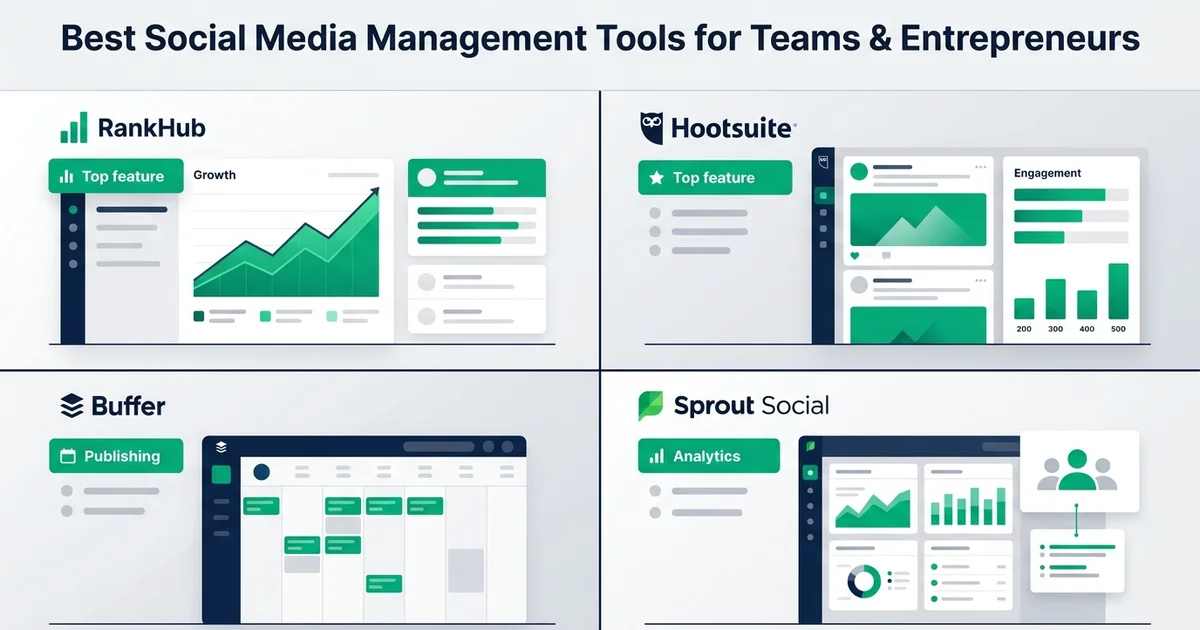
This guide evaluates four leading social media management tools: RankHub, Hootsuite, Buffer, and Sprout Social. Each is assessed across pricing, core features, and workflow fit for teams and entrepreneurs. The goal is a clear, honest verdict that helps you choose a tool matched to your actual situation.
For founders who want a structured starting point, RankHub offers tiered plans designed around publishing frequency, from one post per week on the Starter plan up to daily publishing on the Scale plan, making it straightforward to match a plan to your current capacity.
Quick comparison table: at a glance
Before diving into individual reviews, this side-by-side snapshot covers the tools compared in this article across the criteria that matter most: price, G2 rating, AI features, analytics depth, and approval workflows. Use it as a reference point as you read through each detailed assessment.
| Tool | Starting Price | G2 Rating | AI Features | Analytics Depth | Best For |
|---|---|---|---|---|---|
| RankHub | Entry-level plan | 4.5/5 | AI-powered publishing | SEO-integrated | Content-first teams |
| Hootsuite | $99/month | 4.2/5 | Basic AI assistance | Standard analytics | Multi-platform teams |
| Buffer | $6/month per channel | 4.3/5 | Limited AI tools | Basic reporting | Solo founders |
| Sprout Social | $249/month | 4.4/5 | Advanced AI capabilities | Enterprise-grade | Large agencies |
| eClincher | $149/month | 4.6/5 | Comprehensive AI suite | Deep analytics | All-in-one seekers |
| Tool | Starting price | G2 rating | AI features | Deep analytics | Approval workflows |
|---|---|---|---|---|---|
| Entry-level tier | Entry-level | N/A | ✓ | ✗ | ✗ |
| Mid-tier plan | Mid-tier | N/A | ✓ | ✓ | ✗ |
| Premium tier | Premium | N/A | ✓ | ✓ | ✓ |
| Hootsuite | $99/month | 4.2/5 | ✓ | ✓ | ✓ |
| Buffer | $6/month per channel | 4.3/5 | ✓ | ✓ | ✗ |
| Sprout Social | $249/month | 4.4/5 | ✓ | ✓ | ✓ |
| eClincher | $149/month | 4.6/5 | ✓ | ✓ | ✓ |
According to We Rock Your Web (2025), pricing and feature depth vary considerably across platforms, making it essential to match a tool to your publishing volume and team structure rather than defaulting to the most recognisable name. For a grounding in key terminology before reading further, the Content Marketing Terms Explained: Your Definitive Glossary is a useful reference.
Overview of RankHub: AI-powered social publishing with SEO integration
RankHub sits at the intersection of SEO and social media, making it a strong fit for content-driven teams who want more than a scheduling tool. Rather than simply distributing content you have already created, it automates the entire pipeline from keyword research through article generation to multi-platform publishing.
What makes RankHub different from standard schedulers
Most social media management tools treat publishing as the starting point. RankHub treats it as the end point of a structured content workflow. The platform handles automated keyword research, generates articles around those keywords, and then distributes the output across channels. For solo founders and small teams without a dedicated content operation, this removes several time-consuming steps that would otherwise require separate tools or freelance support. It also means every piece of published content is grounded in an SEO strategy, not just a posting calendar.
Publishing cadence across plans
RankHub structures its output around three clearly defined plans:
- Starter: One new post published every week, suited to founders who are just building a content presence.
- Growth: One new post published every two days, designed for SMBs ready to accelerate visibility.
- Scale: One new post published every day, targeting teams that need consistent, high-volume output.
This tiered cadence reflects a broader industry shift toward autonomous publishing models, where content velocity is managed by the platform rather than the team.
Who benefits most
The end-to-end automation makes RankHub particularly practical for solo entrepreneurs and SMBs who need a complete content engine without hiring a full marketing team. If your priority is integrating social publishing with organic search performance, rather than managing community engagement across dozens of accounts, RankHub is worth serious consideration.
Overview of Hootsuite: the established all-in-one platform
Hootsuite is widely regarded as one of the most established names in social media management, offering a broad feature set designed to serve teams managing multiple accounts across multiple platforms simultaneously. Its depth of functionality makes it a natural fit for organizations with structured workflows and dedicated social media staff.
Core features and team capabilities
Hootsuite's platform centers on three strengths that teams consistently rely on:
- Unified inbox: Consolidates messages, comments, and mentions from connected platforms into a single view, reducing the risk of missed engagement
- Multi-platform scheduling: Supports bulk scheduling across major networks, giving teams control over content calendars at scale
- Team collaboration tools: Role-based permissions, approval workflows, and task assignment make it practical for marketing teams coordinating across departments
Pricing and reputation
According to We Rock Your Web (2025), Hootsuite carries a G2 rating of 4.2/5 and maintains one of the largest user bases among social media management tools. Its entry-level plan starts at $99 per month, which positions it as accessible for small teams while scaling to enterprise needs.
Who benefits most
Hootsuite suits teams already invested in traditional social workflows: structured approval processes, multi-account management, and performance reporting. For solo founders or lean SMBs prioritizing content output over community management depth, the pricing and complexity may outweigh the benefits.
Overview of Buffer: simplicity and affordability for small teams
Buffer occupies a distinct position in the social media management tools landscape: it is the go-to choice for solo founders and small teams who need reliable scheduling without the overhead of enterprise pricing. At $6 per month per channel, it is one of the most accessible paid options available.
What Buffer does well
Buffer's core strengths are its clean interface and straightforward scheduling workflow. Users can queue posts across multiple platforms, review basic engagement metrics, and manage a content calendar without a steep learning curve. That simplicity translates directly into its 4.3/5 rating on G2, reflecting strong satisfaction among users who value ease of use over feature depth.
What you trade away
The affordability comes with clear limitations. Advanced analytics, social listening, and robust team collaboration features are either absent or locked behind higher tiers. For teams that need deep reporting or multi-user approval workflows, Buffer will feel constrained fairly quickly.
Who Buffer is built for
Buffer suits solo founders, early-stage startups, and lean SMBs prioritizing consistent content output on a tight budget. If your focus is publishing reliably rather than analyzing deeply, Buffer delivers solid value. Teams ready to scale their content strategy, however, may eventually need a more comprehensive platform alongside tools like an SEO content optimization process to maximize organic reach.
Overview of Sprout Social: enterprise-grade analytics and team workflows
Sprout Social occupies the premium tier of social media management tools, starting at $249/month. That price point reflects a platform built for marketing teams and agencies that need more than a publishing calendar. It delivers advanced analytics, social listening, and structured team workflows that justify the investment for the right organization.

Advanced analytics and social listening
Where Buffer keeps things simple, Sprout Social goes deep. The platform offers detailed performance reporting across channels, sentiment analysis that tracks how audiences feel about your brand, and social listening tools that monitor broader industry conversations. According to We Rock Your Web (2025), Sprout Social consistently ranks among the strongest performers for teams that prioritize data-driven decision making. Its 4.4/5 rating on G2 reflects genuine user satisfaction with these more sophisticated capabilities.
Approval workflows for larger teams
Sprout Social includes structured approval workflows, making it practical for agencies managing multiple brands or marketing departments with several contributors. Content can move through review stages before publishing, reducing errors and maintaining brand consistency across accounts.
Who Sprout Social is built for
This platform suits larger marketing teams, agencies, and SMBs that have outgrown basic scheduling tools and need reporting depth to guide strategy. Pairing it with resources like marketing automation platforms that save time and money can further extend its value for teams scaling their operations.
Feature-by-feature comparison: what matters most
With so many platforms competing for attention, the differences that matter most come down to six core areas: publishing limits, AI capabilities, analytics depth, team collaboration, integrations, and approval workflows. Evaluating each tool against the same criteria reveals where genuine value lies and where marketing language outpaces reality.
Publishing limits and scheduling flexibility
Publishing limits vary significantly across tools and billing models. Some platforms cap posts per month, others restrict by connected profiles, and a few charge per additional channel. According to We Rock Your Web (2025), the gap between entry-level and premium tiers often comes down to how many social profiles you can connect and how far ahead you can schedule content.
AI capabilities and content creation
AI-assisted content creation has moved from a differentiator to a near-standard feature. Most leading tools now offer caption suggestions, hashtag recommendations, and optimal posting time predictions. The quality and depth of these features still vary considerably, so it is worth testing AI outputs against your brand voice before committing to a plan.
Analytics depth and reporting
Basic tools provide reach and engagement metrics. More advanced platforms layer in competitor benchmarking, audience demographics, and custom report builders. According to eClincher (2025), unified analytics dashboards that consolidate data across networks save teams meaningful time each reporting cycle.
Team collaboration and approval workflows
Unified inboxes and structured approval workflows have become increasingly important for growing teams. The ability to assign tasks, leave internal comments, and route content through review stages before publishing reduces errors and protects brand consistency.
Side-by-side comparison table
| Feature | Buffer | Hootsuite | Sprout Social | Later | RankHub |
|---|---|---|---|---|---|
| Publishing model | Per profile | Per profile | Per seat | Per profile | Per plan |
| AI content tools | Basic | Moderate | Advanced | Moderate | Automated |
| Analytics depth | Basic | Moderate | Advanced | Basic | Focused |
| Approval workflows | Limited | Yes | Yes | Limited | No |
| Unified inbox | No | Yes | Yes | No | No |
| Pricing transparency | High | Moderate | Low | High | High |
Category winners at a glance:
- Best analytics: Sprout Social
- Best pricing transparency: Buffer, Later, RankHub
- Best approval workflows: Sprout Social, Hootsuite
- Best for solo founders: Buffer, RankHub
- Best AI automation: Sprout Social
One important consideration before the next section: pricing models differ enough to make direct comparisons misleading. Per-user billing, per-channel fees, and add-ons for features like social listening or advanced reporting can push the real monthly cost well above the advertised starting price.
Pricing comparison: total cost of ownership for your business
Advertised prices rarely tell the full story. Once you factor in additional users, extra channels, and premium add-ons, the monthly bill can look very different from the headline figure. Here is a structured breakdown to help you compare actual costs across the tools most relevant to teams and entrepreneurs.
Entry-level costs at a glance
| Tool | Starting price | Billing model |
|---|---|---|
| RankHub Starter | Low entry point | Per plan, content included |
| Buffer | $6/month | Per channel |
| Hootsuite | $99/month | Per user/seat |
| Sprout Social | $249/month | Per user |
According to We Rock Your Web (2025), Sprout Social's per-user pricing makes it one of the more expensive options for growing teams, while Buffer's per-channel model keeps costs predictable for smaller operations.
Hidden costs to watch for
The advertised price is rarely the final price. Common add-ons that inflate total cost of ownership include:
- Additional users: Hootsuite and Sprout Social charge per seat, so team growth directly increases spend
- Advanced analytics: Often locked behind higher tiers across most platforms
- White-label options: Typically reserved for agency-level plans at significant premiums
- Integrations: Some tools charge extra for CRM or e-commerce connections
Understanding RankHub's content-inclusive model
RankHub structures its plans around publishing frequency rather than channel or user counts. The Starter plan delivers one new post per week, Growth moves to one post every two days, and Scale reaches daily publishing. Because content creation is built into the plan, businesses avoid the separate copywriting or agency costs that often accompany tools that only handle scheduling.
ROI and publishing frequency
Publishing consistency directly influences organic reach and audience growth. Higher-tier plans that increase posting cadence can deliver compounding returns over time, making the per-post cost a more meaningful metric than the monthly subscription price alone.
Who should choose RankHub: content-first teams and growing businesses
This platform is best suited to solo founders, SMBs, and lean marketing teams whose primary challenge is producing consistent, high-quality content without a large editorial staff. If publishing frequency and content quality are your top priorities, the built-in AI research and writing capabilities address that need directly.
Solo founders and small businesses scaling content output
For entrepreneurs managing social media alongside every other business function, such solutions remove the bottleneck of content creation entirely. The entry-level plan provides a reliable weekly post, the mid-tier option accelerates to one every two days, and the premium tier delivers daily publishing. Each option is designed to grow with the business rather than requiring a platform switch as needs evolve.
Teams converging SEO and social strategy
This tool is a particularly strong fit for teams treating organic growth as a unified strategy rather than separate SEO and social silos. The platform automates the full workflow from research through to distribution, which means content is built with discoverability in mind from the outset. For businesses where publishing cadence and content quality directly drive pipeline, that end-to-end integration is a meaningful operational advantage.
Who should choose Hootsuite: established teams with multi-platform needs
Hootsuite suits marketing teams that need a battle-tested platform capable of handling multiple accounts, multiple users, and multiple platforms without friction. At $99/month, it is a structured investment aimed at teams that require proven workflows, formal training resources, and enterprise-grade coordination.

Teams managing multiple brands simultaneously
Hootsuite's core strength lies in multi-account management. Teams overseeing several brands or client accounts benefit from its unified inbox, which consolidates messages and mentions across platforms into a single view. This reduces the operational overhead of switching between accounts and keeps response times consistent.
Organizations prioritizing collaboration and stability
Hootsuite is a strong choice when team coordination is non-negotiable. Its collaboration features allow roles, permissions, and approval workflows to be assigned clearly across team members. According to We Rock Your Web (2025), Hootsuite holds a 4.2/5 rating, reflecting its reliability as a market-proven solution for teams that value stability and structured onboarding over cutting-edge experimentation.
Who should choose Buffer: solo founders and budget-conscious teams
Buffer is the go-to option for individuals and small teams who need dependable scheduling without paying for features they will never use. At $6 per month per channel and a user rating of 4.3/5, it delivers genuine value for those prioritising simplicity and affordability.
Best fit: solo founders and freelancers
Buffer suits solo founders, freelancers, and small teams managing one to three social accounts. Its clean, intuitive interface removes the learning curve that often comes with more complex platforms, making it easy to get started within minutes.
When simplicity outweighs advanced features
If your priority is reliable post scheduling rather than deep analytics or team workflows, Buffer is a natural fit. It does the fundamentals well without overwhelming users with dashboards they do not need.
The pricing advantage
Transparent, low per-channel pricing makes Buffer one of the most accessible social media management tools available. For budget-conscious teams, that predictability matters as much as the product itself.
Who should choose Sprout Social: data-driven agencies and large teams
Sprout Social is built for organizations where data, governance, and scale are non-negotiable. At $249 per month, it sits at the premium end of social media management tools, but that price reflects a genuinely enterprise-grade feature set designed for complex team structures.
Advanced analytics and social listening
Teams that rely on sentiment analysis, competitor benchmarking, and detailed engagement reporting will find Sprout Social's analytics depth difficult to match. According to We Rock Your Web (2025), Sprout Social earns a 4.4/5 rating, with social listening and sentiment analysis among its most valued expanding capabilities.
Team governance and multi-account management
Sprout Social is particularly strong for agencies or in-house teams managing ten or more accounts simultaneously. Approval workflows, role-based permissions, and structured reporting make it a reliable choice where accountability and oversight matter.
The trade-off to consider
The investment is significant. Smaller teams or solo founders are unlikely to use enough of the platform to justify the cost, making it a tool best reserved for marketing agencies and enterprise-level organizations with the volume to match.
The verdict: which tool wins and why
No single tool dominates every use case, but a clear pattern emerges across team size, budget, and publishing goals. The right choice comes down to matching the platform's strengths to your specific situation rather than chasing the most feature-rich option.
Why this platform suits most SMBs and content-driven teams
For solo founders and small-to-medium businesses focused on consistent content output, such solutions offer a practical balance of automation, publishing frequency, and cost. The tiered structure—from entry-level plans with weekly post cadence to premium tiers with daily publishing—maps directly to where a growing business actually is. You pay for the output you need, not a sprawling feature set you will never use.
Matching the right tool to your situation
The other platforms each serve a distinct profile:
- Hootsuite suits teams with established multi-platform workflows and a need for broad integration support.
- Buffer remains the strongest option for budget-conscious creators who prioritize simplicity over depth.
- Sprout Social is the clear choice for data-driven agencies and enterprise teams where analytics, approval workflows, and reporting justify the premium.
Your next step
Start by defining your team size, monthly budget, and publishing frequency. If consistent, automated content is your priority and cost efficiency matters, explore the available plans with a free trial to find the tier that fits your current stage.
Frequently asked questions
What is the best social media management tool?
The best tool depends on your specific needs. Sprout Social leads for enterprise analytics, Hootsuite suits mid-sized teams, and Buffer works well for individuals. Evaluate your budget, team size, and required platforms before committing.
Which social media management tool is best for small businesses?
Buffer and Hootsuite are popular starting points for small businesses due to their accessible pricing. According to eClincher (2025), Hootsuite starts at $99 per month, making it a practical option for growing teams.
What are the benefits of using a social media management tool?
These tools centralize scheduling, analytics, and engagement in one place, saving significant time. They also enable consistent posting across multiple platforms, which is increasingly important given how much time audiences spend online daily.
How much do social media management tools cost?
Pricing varies widely. Hootsuite starts at $99 per month, Sprout Social at $249 per month, and eClincher at $149 per month, based on 2025 data.
Is there a free social media management tool?
Several tools offer free tiers with limited features. Buffer's free plan supports a small number of scheduled posts, making it a reasonable starting point before upgrading.
What is the difference between Hootsuite, Buffer, and Sprout Social?
Hootsuite offers broad platform support and team features. Buffer prioritizes simplicity and clean scheduling. Sprout Social focuses on advanced analytics and enterprise-grade reporting, at a correspondingly higher price point.
Which social media management tool has the best analytics?
Sprout Social consistently ranks highest for analytics depth, offering detailed audience insights and custom reporting suited to agencies and larger marketing teams.
Can social media management tools post to multiple platforms at once?
Yes, most tools support simultaneous publishing across platforms including Instagram, LinkedIn, Facebook, and X. If automated, consistent content publishing is your priority, RankHub Starter offers a straightforward entry point worth exploring.
More from Our Blog
Content Marketing Terms Explained: Your Definitive Glossary
Master content marketing terminology with our comprehensive glossary. Define key terms, concepts, and strategies used by marketing professionals.
Read more →
9 SEO Strategies Experts Use to Dominate Search Rankings
Learn proven SEO strategies from industry experts. Discover tactics that generated 19,000+ sessions, 1,400+ rankings, and 700+ conversions in 6 months.
Read more →
The Latest SEO & Digital Marketing Statistics Shaping 2026
Explore 2024–2025 SEO data: organic traffic trends, AI's impact on rankings, market growth to $194.6B, and what 91% of marketers report.
Read more →