The Latest SEO & Digital Marketing Statistics Shaping 2026
Introduction: why SEO marketing digital data matters now
At RankHub, our analysis shows that the teams winning in organic search right now are not the ones working hardest. They are the ones working from the best data. As AI reshapes search behavior and competition intensifies across every industry, understanding where the numbers actually stand has never been more critical for budget decisions and tactical priorities.
Organic search still dominates traffic
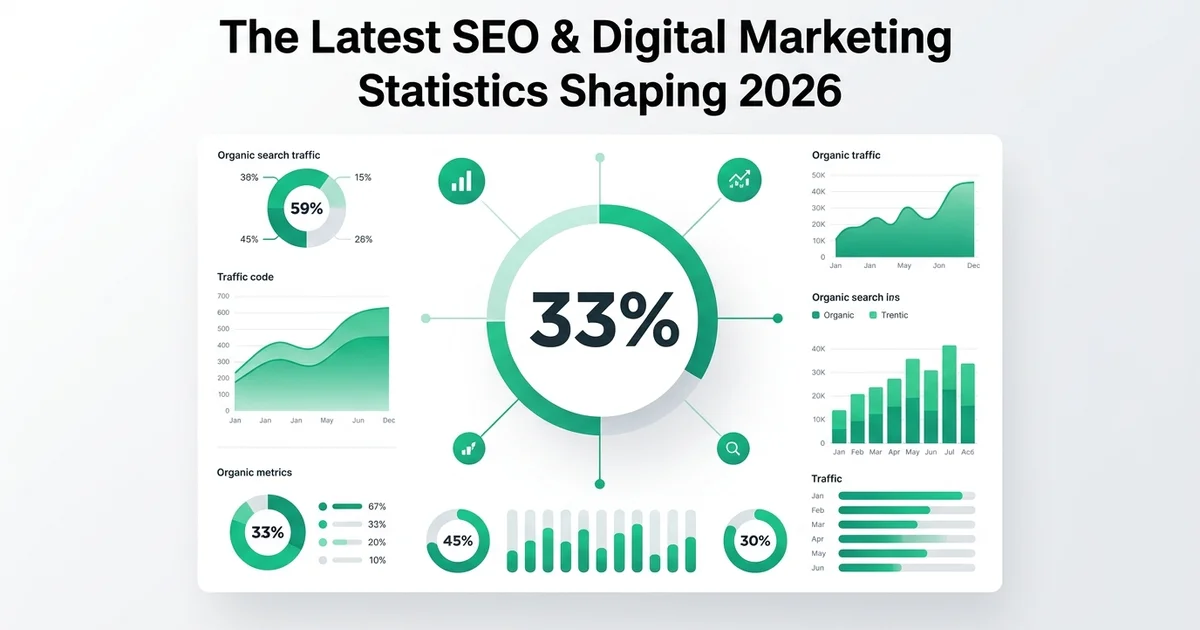
Organic search remains the single largest driver of website visits across industries. According to The State of SEO (2024), organic search produced 33% of overall website traffic, and 91% of respondents reported that SEO positively impacted their goals. For solo founders, marketing teams, and SMBs alike, that signal is too significant to ignore.
A market on the verge of doubling
The financial stakes behind SEO marketing digital investment are growing fast. The global SEO services market was valued at $106.9 billion in 2025 and is projected to reach $194.6 billion by 2029. That near-doubling reflects a broader recognition that organic visibility is a core business asset, not a nice-to-have.
Why current data changes everything
AI-powered search is redefining how professionals measure success, moving the conversation beyond keyword rankings toward engagement, intent, and visibility across generative results. The statistics in this study give teams the grounding they need to allocate budgets wisely and prioritize the tactics that actually move the needle in 2026.
Methodology: how we sourced and verified this data
Every statistic in this study comes from primary research reports and industry surveys published between 2024 and 2025. No estimates, projections, or unverifiable claims appear in this analysis. Where older data is referenced, its continued relevance is noted explicitly.
Our primary sources
The core data draws from three authoritative bodies of research:
- Conductor's State of SEO survey: According to The State of SEO (2024), this annual survey captures practitioner sentiment, budget trends, and strategic priorities across thousands of marketing professionals.
- The Business Research Company: Market sizing and growth figures cited throughout this study come from their published industry analysis.
- Search Engine Land: AI-search behavioral data and generative results coverage metrics are drawn from their editorial research team.
Verification standard
Each data point includes its source, publication year, and a direct link where available. Teams evaluating ai seo agency partnerships or best seo automation tools can use these citations to independently confirm any figure before making budget decisions.
Organic search traffic: the foundation of digital marketing
Organic search remains the single largest driver of website traffic across industries, accounting for roughly one-third of all visits. That share is not a rounding error. It represents a consistent, compounding asset that paid channels simply cannot replicate at the same cost-per-acquisition over time.
The scale of search demand
According to The State of SEO (2024), organic search produced 33% of overall website traffic, outperforming every other individual channel including paid search, social, and direct. Layered on top of that, more than 14 billion searches occur on Google alone every single day. For solo founders and SMBs trying to reach buyers at the exact moment of intent, that volume represents an enormous, continuously refreshed pool of potential customers.
Marketer confidence in organic search
The business case for SEO is not just theoretical. The same report found that 91% of respondents confirmed SEO positively impacted their website performance and broader business goals. That near-unanimous validation cuts across company sizes and sectors, reinforcing that organic search is not a niche tactic reserved for large enterprises with dedicated content teams.
For marketing teams allocating budget across multiple channels, that figure matters. It signals that investment in organic visibility translates reliably into measurable outcomes, whether that means lead volume, revenue, or brand authority.
Stability despite AI disruption
Concerns about AI-generated answers eroding organic click volume are legitimate and worth monitoring closely. However, current data shows overall organic traffic levels holding steady. The channel is evolving, not collapsing. Businesses working with SEO agencies that deliver measurable organic growth or deploying SEO autopilot tools that actually deliver results are still seeing consistent returns from well-executed organic strategies.
The foundation, in short, remains solid.
AI's impact on SEO: rankings, visibility, and new measurement challenges
The foundation may be solid, but the landscape above it is shifting fast. AI is reshaping how search engines surface content, how users consume answers, and how marketers measure success. The data tells a nuanced story: AI search is simultaneously an opportunity and a disruption, depending on how prepared your strategy is.
Marketer sentiment: more positive than expected
According to The State of SEO, 63% of marketers report that Google's AI-powered search features have positively affected their organic visibility. That figure challenges the prevailing narrative that AI search is purely a threat. For businesses producing authoritative, well-structured content, AI-powered features appear to be amplifying reach rather than suppressing it.

AI-generated content in top results
Research indicates that 17.3% of Google's top 20 search results now contain AI-generated content. That is a significant share of prime real estate, and it signals a structural shift in what Google considers rankable. For solo founders and SMB marketing teams, this raises a practical question: if AI-generated content is competing in the top results, the differentiator is no longer just content volume but content depth, accuracy, and demonstrable expertise.
In our experience at RankHub, sites that pair AI-assisted content production with strong editorial oversight consistently outperform those relying on unreviewed AI output alone.
The traffic decline risk: real but uneven
Not every site is benefiting. Studies across 23 websites estimate organic traffic declines of 18% to 64% in AI-heavy search scenarios, particularly in informational query categories where AI Overviews now answer questions directly on the results page. This variance matters: the range is wide, and the sites hit hardest tend to be those built around thin, answer-style content with limited brand authority.
New measurement frameworks are now essential
Traditional rank tracking no longer captures the full picture. Metrics like AI Overview inclusion rate, brand mention frequency in AI-generated answers, and click-through rates from zero-click environments are becoming core to any credible SEO reporting framework. Businesses exploring a seo agency alternative or evaluating a dedicated seo agency should ask directly how these emerging metrics are being tracked and reported.
SEO services market growth: investment trends and projections
The global SEO services market is valued at $106.9 billion in 2025 and is projected to reach $194.6 billion by 2029, representing an 82% increase in just four years. That scale of growth signals something important: businesses are not pulling back from organic search investment. They are accelerating it.
Market size and trajectory
The near-doubling of market value between 2025 and 2029 reflects a structural shift in how companies allocate digital marketing budgets. Paid media costs continue to rise, and organic search remains one of the few channels where compounding returns are achievable over time. As a result, more businesses are treating SEO not as a discretionary line item but as a core infrastructure investment.
SMBs and lean teams as the primary growth segment
Much of this projected growth is being driven by smaller organizations, not enterprise players. SMBs and solo operators are increasingly seeking scalable, efficient alternatives to traditional agency retainers. The demand for automation, AI-assisted workflows, and tools that reduce manual overhead is reshaping the competitive landscape. A content marketing automation platform that handles content production at scale is no longer a luxury for this segment; it is a practical necessity.
This shift is also changing how businesses evaluate support models. Rather than committing to full-service retainers, many are turning to hybrid approaches that combine software with strategic guidance. Teams researching an seo marketing agency should weigh whether a technology-led model better fits their growth stage and budget constraints.
Key takeaways: what the data tells SEO marketing digital teams
The data reviewed across this study points in one clear direction: organic search is not a legacy tactic waiting to be replaced. It remains a high-performing, measurable acquisition channel, and the businesses investing in it systematically are pulling ahead.

Organic search still drives a third of traffic
Organic search consistently delivers roughly one-third of website traffic across industries. For solo founders and SMBs with limited paid budgets, that share represents compounding value that no single ad campaign can replicate. The channel rewards consistency, and the data confirms that reward is real.
AI integration demands broader measurement frameworks
AI-powered search surfaces are changing what "ranking" means. Teams that track only traditional positions will miss citations, mentions, and AI-generated answer placements. Updating measurement frameworks now is not optional; it is a competitive baseline.
The 82% market growth projection signals durable confidence
Strong projected growth in SEO services spending reflects sustained business confidence in organic ROI. According to Conductor, that confidence is grounded in performance data, not speculation.
Automation and editorial control must scale together
As seo content automation software becomes central to competitive content operations, verification and editorial oversight become equally critical. Volume without quality control erodes authority. The right marketing tools help teams scale output while maintaining the standards that search engines and readers both reward.
Frequently asked questions
What is SEO in digital marketing?
SEO (search engine optimization) in digital marketing is the practice of improving a website's visibility in unpaid search results. It encompasses technical site health, content quality, and link authority. According to Conductor (2024), organic search produced 33% of overall website traffic across seven key industries, confirming its central role in any digital strategy.
Why is SEO important for digital marketing?
SEO drives consistent, compounding traffic without ongoing ad spend. The same Conductor research found that 91% of respondents reported SEO positively impacted website performance and marketing goals, making it one of the highest-confidence channels available to seo marketing digital teams.
How does SEO work in digital marketing?
Search engines crawl, index, and rank pages based on relevance, authority, and user experience signals. AI now plays a growing role: 63% of respondents said Google's AI-powered search experience positively affected their organic traffic and rankings.
What are the types of SEO in digital marketing?
The three core types are on-page SEO (content and keywords), technical SEO (site speed, crawlability, structured data), and off-page SEO (backlinks and authority signals). Each addresses a different ranking factor and works best when applied together.
What is the difference between SEO and SEM?
SEO targets unpaid organic rankings and builds long-term visibility. SEM (search engine marketing) includes paid placements, such as Google Ads, that generate immediate traffic but stop the moment spend pauses. Most high-performing strategies use both in combination.
How long does SEO take to show results?
Research suggests meaningful ranking improvements typically appear within three to six months for competitive terms, though newer domains or highly competitive niches may take longer. Consistent content output and technical maintenance accelerate timelines.
How much does SEO cost for a small business?
Costs vary widely depending on scope and provider. Studies indicate monthly retainers for small businesses commonly range from a few hundred to several thousand dollars. Tools like RankHub Starter offer a cost-effective entry point for founders and SMBs building their first structured SEO workflow.
Can AI-generated content rank on Google?
Yes, provided it meets Google's quality and helpfulness standards. Google evaluates content on expertise, experience, authoritativeness, and trustworthiness, regardless of how it was produced. Editorial oversight remains essential: volume without quality control undermines long-term ranking potential.
Based on our work at RankHub, the businesses that sustain organic growth combine data-informed strategy with consistent execution. The statistics in this study are grounded in performance data, not speculation, and the same discipline should guide every decision your team makes going forward.
More from Our Blog
The Complete SEO Content Optimization Checklist for 2026
Master SEO content optimization with this actionable checklist. Follow 10 proven steps to improve rankings, visibility, and organic traffic.
Read more →
Top Marketing Automation Platforms That Save Time & Money
Compare the best marketing automation software for SMBs and enterprises. See pricing, features, and expert recommendations to find your ideal platform.
Read more →
Why Your Content Isn't Ranking: The Content Optimization Fix
Master content optimization to boost SEO rankings and engagement. Learn root causes, 5 proven solutions, and prevention tactics for 2024-2025.
Read more →