7 Hidden SEO Agency Alternatives for Budget-Conscious Businesses
Introduction: why businesses are ditching traditional SEO agencies
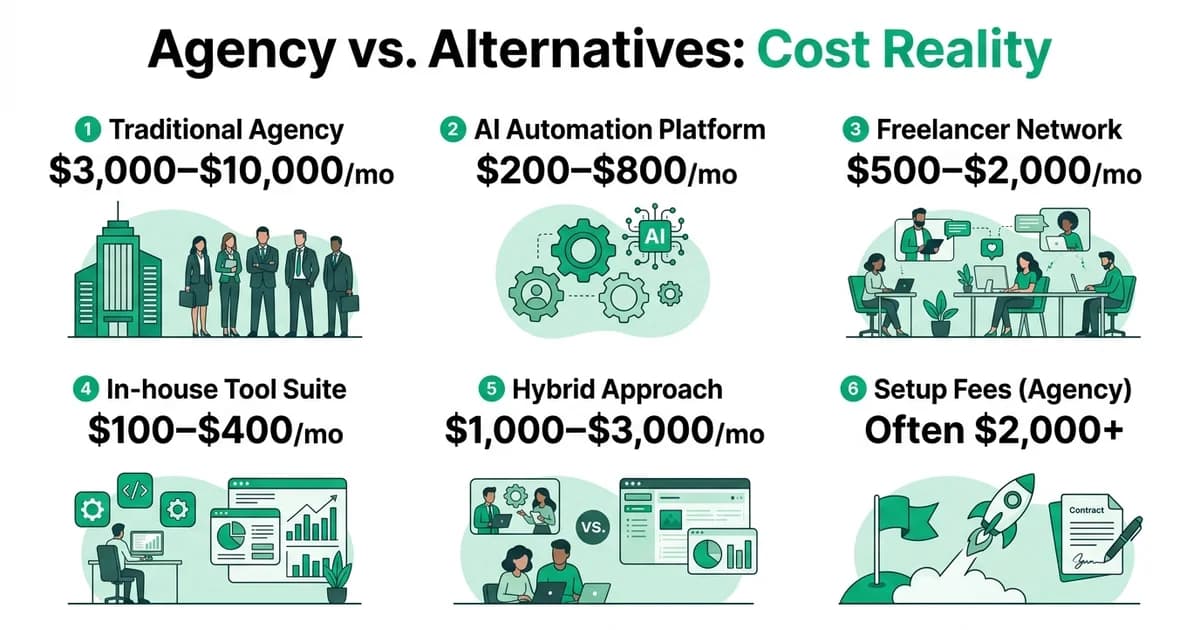
Traditional SEO agencies are expensive, and for many small businesses, the math simply does not add up. Monthly retainers routinely run between $3,000 and $10,000, with no guaranteed rankings and limited transparency into what work is actually being done. For solo founders and lean marketing teams, that kind of spend demands serious justification.
The cost problem is getting harder to ignore
The global SEO industry is booming. Research suggests the market sits somewhere between $75 and $85 billion in 2025, growing at an estimated 11 to 17% annually. Agencies are capturing a significant share of that spend, but businesses are increasingly questioning whether they are getting proportional value in return.
AI is changing what is actually possible
According to Swetrix (2026), AI-powered SEO automation has matured rapidly, with 56% of marketers already incorporating AI tools into their SEO stack. Platforms like RankHub SEO Autopilot now handle everything from keyword research to article generation and automated publishing, compressing what once required an entire agency team into a fraction of the cost.
At RankHub, our analysis shows that most SMBs and solo founders need consistent, quality content output far more than they need a six-figure agency relationship. The alternatives covered below are built precisely for that reality.
Quick comparison table: SEO agency alternatives at a glance
Before diving into each option in detail, this table gives you a fast, honest snapshot of the main SEO agency alternatives available in 2026. Use it to quickly filter by budget, setup time, and how much you want automation to do the heavy lifting.
| Tool/Service | Best for | Monthly cost | Setup time | Automation level | Verdict |
|---|---|---|---|---|---|
| RankHub SEO Autopilot | SMBs and founders wanting full SEO automation | Low-mid range | Hours | Very high | Best all-round pick for consistent, hands-off content growth |
| Freelancers | Custom, one-off content needs | Variable | Days to weeks | Low | Good for flexibility, but inconsistent at scale |
| In-house hire | Businesses with long-term SEO budgets | High (salary) | Months | Low | Best for large teams with dedicated resources |
| DIY tools | Technically confident marketers | Low | Moderate | Medium | Cost-effective but time-intensive |
| Hybrid approach | Growing businesses scaling output | Mid range | Moderate | Medium-high | Smart option when pairing best seo automation tools with human oversight |
With 56% of marketers now incorporating AI into their SEO workflows, automation-first platforms like RankHub are increasingly the practical default rather than the exception.
Why look for SEO agency alternatives?
Traditional SEO agencies present a compelling pitch, but the reality for budget-conscious businesses is often frustrating. Retainer fees, slow timelines, and limited visibility into what is actually happening with your strategy push many founders and marketing teams to explore other options.
The cost problem is real
Monthly agency retainers routinely run into thousands of dollars, with no guaranteed outcomes attached. For SMBs operating on tight margins, that recurring expense is difficult to justify, especially when results can take six months or longer to materialize.
Transparency and control gaps
Many agencies treat their processes as a black box. You receive a monthly report but rarely understand the strategic decisions being made on your behalf. This lack of visibility makes it nearly impossible to course-correct quickly.
Speed and flexibility matter more than ever
Businesses today need the ability to pause, scale, or redirect spending without navigating lengthy contract terms. Automation-first platforms, including SEO autopilot tools that actually deliver results, offer precisely this kind of adaptability. According to IrisScale (2026), the shift toward AI-driven SEO reflects a broader demand for scalable, hands-off solutions that grow alongside the business rather than billing ahead of it.
RankHub: AI-powered SEO automation platform
For solo founders and SMBs who want consistent organic growth without hiring an agency or managing a content team, RankHub delivers a fully automated pipeline from keyword research through to published content. According to Swetrix (2026), AI-powered SEO autopilot tools are gaining serious traction as 56% of marketers now integrate AI into their SEO stack.
What RankHub automates
RankHub SEO Autopilot handles the entire content workflow across 15 automated steps each month. It scans your website and sitemap, identifies keyword opportunities, writes SEO-optimized articles complete with featured images, and publishes them directly via webhook integration. There is no manual writing, editing, or scheduling involved.
A particularly practical feature is automated keyword cannibalization avoidance. The platform tracks which keywords your existing content already targets, preventing new articles from competing against your own pages. This is a problem that frequently goes unnoticed until rankings start cannibalizing each other.
Pricing and predictability
RankHub uses transparent, fixed monthly pricing, which makes budgeting straightforward for small teams. Compare this to agency retainers, which often carry setup fees, minimum commitments, and scope creep. For a deeper look at how this stacks up, see how affordable SEO content services compare.
Who it suits best
RankHub works best for:
- Solo founders who need hands-off execution with no content team
- SMBs scaling organic traffic without expanding headcount
- Marketing teams that want to redirect effort toward strategy rather than production
For most budget-conscious businesses wanting consistent, automated SEO output, RankHub is the strongest starting point. However, if you need highly customized strategy or niche technical audits, a freelance specialist may complement it well.
Freelance SEO specialists: flexible and cost-effective
Freelance SEO specialists offer a practical middle ground between full-service agencies and doing everything yourself. You hire individual contractors for exactly what you need, whether that is keyword research, content writing, or link building, and pay only for the work delivered.
What freelancers typically cost
Hourly rates for freelance SEO specialists generally fall between $25 and $75, compared to agency retainers that often start at $1,500 to $3,000 per month. For businesses with irregular or project-based SEO needs, this flexibility can translate into meaningful savings. The total cost of ownership, however, includes your own time spent briefing, reviewing, and coordinating work across multiple contractors.
Where freelancers add the most value
Freelancers shine when you need:
- Specialist depth in a single area, such as technical audits or outreach
- Direct communication without account manager layers
- Scalable engagements that expand or contract with your budget
The coordination trade-off
The main drawback is overhead. Managing several freelancers requires project management discipline and consistent quality oversight. Without that internal capacity, output can become inconsistent. Businesses with a strong content strategy already in place tend to get the most from freelance arrangements.
Best for: Businesses with an in-house coordinator who can manage workflows and maintain quality standards across contractors.
In-house SEO hire: long-term control and consistency
Hiring a dedicated SEO specialist or junior marketer brings a different kind of value than freelancers or agencies. A full-time employee learns your brand deeply, aligns SEO decisions with broader business goals, and builds institutional knowledge that compounds over time. This makes the in-house model particularly appealing for mid-sized companies with predictable, stable SEO budgets.

The case for full-time commitment
Continuity is the defining advantage here. An in-house hire attends your team meetings, understands your product roadmap, and can analyze keyword competition with direct input from sales and customer success teams. That cross-functional context is genuinely difficult to replicate with external partners.
The real cost of going in-house
The trade-off is financial and operational. Beyond salary, you are committing to benefits, tools, and ongoing training. SEO evolves quickly, so professional development is not optional. Scaling output also takes time since one person has a fixed capacity.
Where automation bridges the gap
Some businesses pair an in-house hire with a platform like RankHub SEO Autopilot to extend their reach. Rather than spending 40-plus hours monthly on content production, the specialist focuses on strategy while RankHub handles keyword research, article generation, and automated publishing. It is a practical way to get institutional knowledge and consistent output without doubling headcount.
Best for: Mid-sized businesses with stable budgets that prioritize brand alignment and long-term organic growth over rapid scaling.
DIY SEO tools and software: maximum control, steep learning curve
Taking SEO fully in-house with dedicated tools gives you the deepest visibility into your site's performance, but it demands real expertise and consistent time investment. This route works best when someone on your team already understands SEO fundamentals or is genuinely committed to learning them.
Keyword research and analytics platforms
Platforms like Semrush, Ahrefs, and Moz form the backbone of any DIY SEO stack. They surface keyword opportunities, track rankings, audit technical issues, and reveal competitor strategies. The data is rich and actionable, but only if you know how to interpret it. Expect a meaningful onboarding period before you extract consistent value.
Pairing tools with AI content creation
According to SEO Tool Alternatives 2026 (2026), 56% of marketers are now incorporating AI tools into their SEO stack. Combining analytics platforms with AI writing tools like ChatGPT or Jasper can accelerate content production considerably. If you are building out a broader content strategy for ecommerce, this pairing can cover both research and execution.
The honest trade-off: stitching multiple tools together manually is time-consuming. Platforms like RankHub SEO Autopilot consolidate keyword research, article generation, and automated publishing into a single workflow, removing the coordination overhead that makes pure DIY approaches exhausting at scale.
Best for: Marketers with existing SEO knowledge, or founders willing to invest significant time in building that expertise before expecting results.
Hybrid approach: combining tools, freelancers, and automation
The hybrid model sits between full-service agencies and pure DIY, giving growing businesses the flexibility to automate repetitive tasks while reserving human expertise for the work that genuinely requires it. For most budget-conscious teams, this balance delivers the strongest return on both time and money.
Automating the foundation with AI tools
Platforms like RankHub SEO Autopilot handle the high-volume, repeatable work: keyword research, article generation, cannibalization avoidance, and automated publishing. According to Swetrix (2026), AI-assisted SEO stacks that pair automation with senior strategists are emerging as a best practice for modern teams that want scale without proportional cost increases.
Bringing in freelancers for high-value tasks
Once automation covers your content pipeline, freelance specialists become far more affordable to deploy selectively. A freelance strategist can review your keyword priorities quarterly. A UX consultant can audit page experience. A PR specialist can pursue link-building opportunities. Understanding how many keywords to target per page is exactly the kind of strategic decision worth paying a specialist to get right.
Why this model works
The hybrid approach succeeds because it separates execution from strategy. Automation handles volume and consistency. Humans handle judgment, quality control, and holistic integration across content, UX, and PR.
Best for: Growing teams and SMBs that want flexibility, quality, and a cost structure that scales with results rather than retainer fees.
Feature comparison matrix: side-by-side evaluation
Choosing the right SEO approach is easier when you can see all the variables side by side. The table below compares six common approaches across the criteria that matter most to budget-conscious businesses: cost, speed, automation, content quality, scalability, and ease of entry.
Learn more about how RankHub SEO Autopilot can help with seo agency alternative RankHub SEO Autopilot.
Side-by-side comparison
| Criteria | RankHub | Freelancers | In-house | DIY Tools | SEO Agency | Hybrid |
|---|---|---|---|---|---|---|
| Cost per month | $$ | $$-$$$ | $$$$ | $ | $$$$ | $$-$$$ |
| Setup time | Hours | Days | Weeks | Days | Weeks | Days |
| Automation level | ⭐⭐⭐⭐⭐ | ⭐ | ⭐⭐ | ⭐⭐⭐ | ⭐⭐ | ⭐⭐⭐⭐ |
| Content quality | ⭐⭐⭐⭐ | ⭐⭐⭐⭐⭐ | ⭐⭐⭐⭐⭐ | ⭐⭐⭐ | ⭐⭐⭐⭐⭐ | ⭐⭐⭐⭐ |
| Scalability | ⭐⭐⭐⭐⭐ | ⭐⭐ | ⭐⭐ | ⭐⭐⭐ | ⭐⭐⭐ | ⭐⭐⭐⭐ |
| Learning curve | Low | Low | High | Medium | None | Medium |
| Cannibalization risk | ✅ Avoided | ❌ Manual | ❌ Manual | ❌ Manual | ✅ Managed | ⚠️ Partial |
| Publishing automation | ✅ Full | ❌ | ❌ | ⚠️ Partial | ❌ |
How to choose the right SEO agency alternative for your business
The comparison matrix above gives you the data. Now the real question is: which option actually fits your situation? The right choice depends on four practical factors: your budget, your team's capacity, your growth stage, and how much control you want over the process.
Assess your budget and true cost of ownership
Sticker price rarely tells the full story. A freelancer charging $500 per month sounds affordable until you factor in briefing time, revision rounds, and project management overhead. According to SEO Tool Alternatives 2026 (2026), businesses switching from agencies to automated tools often recoup their investment within the first two to three months once time costs are included in the calculation.
Evaluate your in-house expertise and available time
If your team has strong SEO knowledge but limited hours, a high-automation tool like RankHub SEO Autopilot handles the repetitive execution while your team focuses on strategy. If you have neither expertise nor time, a fully managed option makes more sense despite the higher cost.
Match the tool to your growth stage
- Early-stage startups: Prioritize low cost and speed to results. Automation tools with minimal setup win here.
- Scaling SMBs: Look for scalability and cannibalization controls, both areas where RankHub performs strongly.
- Established businesses: Content quality and brand voice consistency become more critical, making hybrid or freelancer models worth the premium.
Switching guide: how to migrate from your current agency
Migrating away from an SEO agency carries real risk if handled carelessly. A structured transition protects your rankings, preserves institutional knowledge, and ensures the replacement solution hits the ground running rather than spending weeks catching up.
Audit your current SEO performance first
Before cancelling any contract, document where you stand. Pull keyword rankings, organic traffic trends, and top-performing pages from Google Search Console and Analytics. Note which content drives conversions, not just clicks. This baseline tells you what the new solution must protect.

Secure your assets and access
Transfer ownership of all analytics accounts, Google Search Console properties, and the CMS. Export your backlink profile using a tool like Ahrefs or Semrush. Request your content calendar, any keyword mapping documents, and existing briefs. Agencies sometimes retain these by default, so ask explicitly.
Maintain momentum during the handover
The transition window is when rankings are most vulnerable. Keep publishing on your existing schedule while onboarding the replacement resource. Tools like RankHub SEO Autopilot are particularly useful here because automated keyword research and publishing can begin within days, reducing the gap between agency exit and consistent content output. Prioritise your highest-traffic pages for early attention to avoid ranking slippage.
Free and low-cost SEO alternatives
For bootstrapped startups with more time than budget, a well-chosen stack of free tools can cover the fundamentals of SEO without any monthly spend. The trade-off is hands-on effort, but the cost savings are substantial compared to agency retainers.
Google Search Console and Google Analytics
Both tools are free and genuinely powerful. Search Console surfaces keyword impressions, click-through rates, and indexing errors. Google Analytics shows how organic traffic behaves once visitors land on your site. Together, they give you the data foundation that paid platforms charge hundreds of dollars to replicate.
Ubersuggest free tier
Ubersuggest offers limited but useful keyword research at no cost, including search volume estimates and basic competitor analysis. It suits early-stage businesses validating a content strategy before committing to paid tools.
AI writing tools for content drafts
ChatGPT and similar free AI tools can accelerate content drafting significantly. They work best as a starting point rather than a finished product, requiring human editing for accuracy and brand voice.
Community SEO resources
Forums like Reddit's r/SEO and communities such as Search Engine Roundtable provide current, practitioner-level advice at zero cost. They are particularly valuable for staying current with algorithm changes.
Best for: Bootstrapped founders willing to invest 10 or more hours per week in learning and execution. When time becomes the constraint, a low-cost automation tool like RankHub SEO Autopilot bridges the gap between fully manual effort and full agency spend.
Enterprise SEO alternatives: solutions for large organizations
Enterprise SEO operates at a fundamentally different scale. Large organizations need solutions that handle thousands of pages, integrate with complex marketing tech stacks, and coordinate multiple specialized functions simultaneously. The right approach combines purpose-built platforms with dedicated in-house expertise.
Dedicated enterprise platforms
Platforms like Conductor, BrightEdge, and Siteimprove are built for Fortune 500 and mid-market companies managing large, complex websites. They offer advanced reporting, cross-team workflows, and integrations with CRM and analytics systems that smaller tools simply cannot match.
In-house specialized teams
Rather than a single generalist, enterprise SEO typically requires distinct roles: an SEO strategist, a technical SEO specialist, and dedicated content producers. This structure supports holistic SEO that integrates across channels, from paid search to content marketing to PR.
Custom tech stack integration
Enterprise environments demand seamless connections between SEO tooling and existing platforms such as Salesforce, Adobe Analytics, or custom CMS solutions.
Best for: Mid-market and enterprise companies with complex site architectures, large content teams, and budgets to match. Smaller organizations should look at scalable automation tools like RankHub SEO Autopilot before committing to enterprise-tier pricing.
What we don't recommend: common pitfalls to avoid
Not every SEO agency alternative delivers genuine value. Some approaches actively damage your rankings or waste months of effort. Before committing to any strategy, be aware of these common traps.
Cheap content mills that ignore E-E-A-T
Low-cost content services often prioritize volume over quality, producing generic articles that fail Google's Experience, Expertise, Authoritativeness, and Trustworthiness standards. This is especially risky with AI-generated content that lacks human editorial oversight. According to LlamaRush (2026), automation without quality controls consistently underperforms in competitive search environments.
Tools promising fully hands-off results
Autopilot tools that require zero human involvement are rarely reliable. According to Swetrix (2026), the best-performing SEO automation platforms still incorporate human review checkpoints. RankHub SEO Autopilot, for instance, automates the heavy lifting while keeping you in control of strategic decisions.
Other pitfalls worth avoiding
- Agencies with no transparent reporting: If you cannot see exactly what work is being done, walk away.
- Switching strategies too frequently: SEO requires consistency. Give any approach at least three to six months before evaluating results.
- Neglecting technical SEO: Content alone cannot compensate for slow page speeds, broken links, or poor site architecture.
Conclusion: finding your ideal SEO agency alternative
The right SEO agency alternative depends entirely on your budget, technical comfort, and growth goals. Whether you lean toward AI-powered autopilot tools, freelance specialists, in-house talent, SEO software suites, or content marketplaces, each category offers a genuine path to organic growth without traditional agency fees.
Matching the approach to your situation
For most SMBs and solo founders, RankHub SEO Autopilot offers the strongest balance of automation, consistency, and cost. It handles keyword research, content creation, cannibalization avoidance, and publishing automatically, saving 40+ hours every month at a fraction of agency pricing. However, if you need deep technical audits, a specialist freelancer or dedicated tool may serve you better.
The case for acting now
The SEO automation market is expanding rapidly, and early movers capture compounding organic traffic advantages. According to SEO Tool Alternatives 2026, B2B SaaS businesses see average SEO returns of 702 to 748%, making even modest investment worthwhile.
Your next steps
- Audit your current SEO gaps and monthly content output.
- Set a realistic budget and timeline, targeting at least three to six months.
- Test one alternative thoroughly before committing long-term.
- Measure rankings, traffic, and conversions consistently.
Start small, measure honestly, and scale what works.
Frequently asked questions
What is the best SEO agency alternative for small businesses?
The best seo agency alternative depends on your budget, technical comfort, and content needs. AI-powered platforms like RankHub SEO Autopilot suit businesses that need consistent content output without hiring staff. Freelancers or SEO consultants work better when strategy and link building take priority over volume.
Can AI SEO tools replace a traditional SEO agency?
AI tools handle content creation, keyword research, and publishing at scale, but they do not replace the strategic judgment an experienced agency provides. According to LLaMaRush (2026), tools like Outrank and SEObot reduce the manual workload typically handled by agencies, making them strong complements rather than complete replacements.
Is it cheaper to use SEO software instead of an SEO agency?
Yes, significantly. Most SEO software subscriptions cost a fraction of typical agency retainers, which commonly run into thousands of dollars monthly. Platforms like RankHub automate 15 steps per month, compressing what agencies charge for into a predictable, lower monthly cost.
Should I hire an in-house marketer or use an SEO agency alternative?
An in-house hire makes sense once your content operation scales beyond what automation handles alone. For early-stage businesses, combining an affordable SEO automation tool with occasional freelance support delivers strong results without the overhead of a full-time salary.
Do tools like Outrank or SEObot really grow organic traffic on autopilot?
They can, but results depend on niche competitiveness, site authority, and content quality. Based on our work at RankHub, consistent automated publishing combined with smart keyword selection reliably compounds organic traffic over three to six months when the fundamentals are in place.
More from Our Blog
Windstream Email Setup and Common Problems Solved
Fix Windstream email problems with step-by-step solutions. Learn server settings, setup issues, and how to recover access to your Kinetic email account.
Read more →
Regnārs vārda diena: Kādas tendences dominē svinēšanā 2026. gadā
Uzzini visu par Regnāra vārda dienu 2025. gadā: datumu, vārda izcelsmi, nozīmi un kā apsveikt Regnāru. Aktuāla informācija un praktiski padomi.
Read more →
What Is an AI Document Translator? Everything Beginners Need to Know
Learn how AI document translators work, choose the right tool, and translate files while preserving formatting. Complete beginner's guide with step-by-step instructions.
Read more →