
Let's get straight to it: there is no magic number of keywords you should cram onto a single page. That's old-school thinking. Modern SEO is all about topical relevance, not just counting keywords. Your focus should be on one core primary keyword, a handful of secondary keywords, and a whole bunch of related terms that cover your subject from every angle.
The Shift From Counting to Covering

The question "seo how many keywords per page" is a fossil from a much simpler time in search engine history. Back in the day, keyword stuffing could actually get you somewhere. Now? Not so much. Google's algorithms have grown up, and they're smart enough to favor content that actually answers a person's question thoroughly, not just the page that repeats a phrase the most.
Think of it like you're cooking a meal. Your primary keyword is the main dish—the steak or the pasta that everything else is built around. Your secondary keywords are the key sides, like roasted potatoes or a fresh salad, that make it a complete meal. Then, you have all the related semantic terms, which are like the herbs and spices. They add depth, complexity, and flavor, turning a simple dish into something truly satisfying for your audience.
Focusing on Topical Authority
Instead of getting hung up on a specific number, your real goal is to build topical authority. You want to create the single most helpful, in-depth resource for a particular search. It’s about being the best answer.
A solid, modern keyword strategy usually looks something like this:
- One Primary Keyword: This is your North Star. It’s the main topic and the exact search query you’re targeting.
- Two to Four Secondary Keywords: These are closely related variations or subtopics that support your primary. They provide context and help you show up for a wider range of searches.
- A Variety of LSI Keywords: These are basically synonyms and conceptually related terms. Search engines use these to get the bigger picture of what your page is about. Think "car," "automobile," "vehicle," and "driving."
The true skill in keyword optimization isn’t about hitting a quota. It's about naturally weaving a rich tapestry of related concepts that proves your expertise on a subject—to both your readers and the search engines.
At the end of the day, the right number of keywords is however many it takes to cover your topic completely without sounding like a robot. A quick product description will naturally have fewer keywords than a massive 3,000-word ultimate guide, and that's perfectly okay. It's all about context.
Why Counting Keywords Is a Thing of the Past

Back in the wild west days of SEO, ranking was all about playing a numbers game. You wanted to rank for "blue widgets"? Simple. You just crammed that exact phrase onto your page as many times as you could. This clumsy tactic, which we now call keyword stuffing, actually worked for a while. Search engines just weren't very smart yet.
But those days are long, long gone. Search algorithms have grown up. They've gone from being simple word counters to something more like a highly intuitive librarian. They don't just tally up how often a keyword appears; they work to understand the meaning and context of your entire page.
This massive leap forward is all thanks to two big ideas: semantic search and natural language processing (NLP).
From Matching Words to Understanding Ideas
Imagine the old search engine model as a librarian who could only read the titles of books. If you asked for something on "cars," they'd only pull books with the literal word "cars" on the cover. You’d miss out on amazing, relevant titles like "The Complete History of the Automobile" or "A Beginner's Guide to Driving." It was a flawed system.
Today's search engines are like a far more brilliant librarian—one who has read every book, understands the concepts inside, and knows how all those ideas connect. That's the heart of semantic search. It looks past the specific keyword to get the big picture.
Key Takeaway: Google is trying to figure out what a searcher really wants (their intent), not just match the words they typed. A page wins when it covers a topic from top to bottom, using all the natural language that comes with it, not by hitting some magic number of keywords.
This sophisticated understanding is exactly why keyword stuffing will get you penalized today. When you force keywords into your text, it reads terribly. It creates a clunky, unnatural experience for your reader, and that’s a huge red flag for Google.
The Power of Natural Language
So, how do search engines pull this off? They use something called Natural Language Processing (NLP). It’s a field of AI that gives computers the ability to understand human language—the nuance, the synonyms, the subtopics, and the relationships between ideas.
Let's say you're writing an article about "baking bread." NLP helps Google recognize all the related concepts it expects to see in a truly helpful guide.
- Ingredients: Flour, yeast, water, salt
- Processes: Kneading, proofing, scoring, baking
- Equipment: Ovens, mixing bowls, baking stones
- Related Concepts: Sourdough, gluten, crust
A page that naturally weaves in these terms proves its expertise and authority way more than one that just repeats "baking bread" a dozen times.
Your job isn't to please a robot by hitting a keyword quota. It's to create the absolute best, most thorough resource for a human being. When you do that, you're giving the algorithm exactly what it's looking for.
To really nail this, you need to understand the 'why' behind a search. Our guide on what is search intent breaks this down perfectly. Once you master intent, you'll stop worrying about how many keywords to use per page and start creating content that genuinely earns its top spot.
Finding Your Content's Keyword Sweet Spot

So, if counting keywords is out, what should you be doing instead? Simple. Let your content’s purpose and length guide your keyword strategy, not the other way around. It’s all about finding the natural scope for each piece you create, rather than chasing some magic number.
I like to think of it like packing for a trip. You wouldn't stuff a giant suitcase full of gear for a quick weekend getaway; a small carry-on with the essentials is all you need. But for a two-week international vacation? That requires a much bigger bag packed for all sorts of scenarios. Your content works the same way—its size and purpose determine how much it can naturally hold.
A punchy, 500-word product page is your carry-on. Its goal is super specific: describe a product and get someone to click "buy." Trying to cram dozens of keywords in there would just feel clunky and forced. On the flip side, a massive 3,000-word guide is your large suitcase. It has all the room in the world to explore a topic from every angle, answer tons of questions, and weave in a whole bunch of related terms without breaking a sweat.
Matching Keyword Scope to Content Type
The number of keywords a page can comfortably handle is a direct reflection of how deep it goes. A company's homepage, for example, has a very narrow focus and usually only needs about three to five main keywords to do its job.
But then you have long-form blog posts. These deep dives can easily and naturally include anywhere from 15 to 30 keywords or more. This isn't just a theory; it's what the data shows. A shorter 500-word page might target five to seven phrases, while a beast of a 3,000-word guide could easily handle 20+.
Let's break it down with a couple of real-world examples:
Service Page (e.g., "Residential Plumbing Repair"): This page has one clear job. It's built around its main term, but it will naturally pull in related phrases like "emergency plumber," "leaky pipe fix," and "clogged drain service." The focus here is tight and transactional.
In-Depth Blog Post (e.g., "The Ultimate Guide to DIY Home Plumbing"): Now we're talking broad and educational. This content has the space to cover everything from "how to choose a wrench" and "fixing a running toilet" to "winterizing your pipes." It can organically rank for dozens of different keywords because its scope is just that massive.
The real goal isn't to force keywords into your text. It's to create content so genuinely thorough that it can't help but include the terms your audience is searching for. When you cover a topic completely, the keywords just fall into place.
Building Your Keyword Universe
Instead of fixating on a number, your time is better spent on a more holistic approach to how to optimize content for SEO effectively. A fantastic way to start is by grouping related search terms together.
This is where techniques like keyword clustering come in. By grouping keywords that share the same user intent, you can map out exactly what terms belong on a single page. This ensures your content covers a subtopic from all sides, making it way more comprehensive. If you want to get good at this, our guide on https://rankhub.ai/blog/keyword-clustering-tools is the perfect place to start.
This whole approach shifts your thinking from a rigid formula to a much more intuitive process. Once you let the content's purpose dictate its depth, you'll find that keyword "sweet spot" every single time.
Using Primary, Secondary, and Semantic Keywords
If you want to get modern SEO right, you have to stop thinking about a single keyword and start thinking in layers. The real magic isn't in hitting a certain number, but in building your content around a powerful trio: primary, secondary, and semantic keywords. Nailing this mix is how you create pages that people actually want to read and that Google loves to rank.
Think of it like you're building a solar system. Your primary keyword is the sun. It's the massive, central star that everything else orbits. This is the single most important search query for your page—the absolute core of your topic.
Defining Your Keyword Tiers
Once your sun is in place, you need to add the planets. These are your secondary keywords. They're terms that are super closely related to your primary, often just slight variations or subtopics. For example, if your primary keyword is "home workout routines," your secondary keywords might be "at-home fitness plan" or "bodyweight exercises for beginners." They add a ton of context and help you cast a wider net to catch similar searches.
Finally, you have all the moons, asteroids, and comets that make the universe feel complete. These are your semantic keywords. They're all the words and phrases that are conceptually tied to your main topic. For that home workout article, this would include terms like "dumbbell," "resistance bands," "cardio," "strength training," and even "nutrition." Sprinkling these in proves to search engines that you're not just scratching the surface—you're covering the topic like an expert. You can dive deeper into this idea in our guide on what is semantic SEO.
Putting It All Together in Practice
Okay, so what does this actually look like in a real article? Let's break it down with an example.
- Primary Keyword: "small apartment decorating ideas"
- Secondary Keywords:
- "studio apartment layout"
- "how to furnish a small space"
- "multifunctional furniture"
- Semantic Keywords: "storage solutions," "color palettes," "lighting," "area rugs," "wall art," "space-saving"
When you build your content this way, you naturally create a rich, comprehensive resource that answers a whole bunch of related questions at once. You're no longer just asking "how many keywords per page," but instead focusing on creating genuine topical authority.
This tiered strategy isn't just a "nice-to-have" anymore; it's essential. Google’s algorithms are incredibly sophisticated, looking way beyond exact-match phrases to understand concepts and user intent. That’s why a healthy keyword density is now seen as being between 1% and 2%, using a natural mix of primary, secondary, and related terms to signal relevance without looking spammy.
The image below breaks down the key things to look for when you're picking out these keywords.
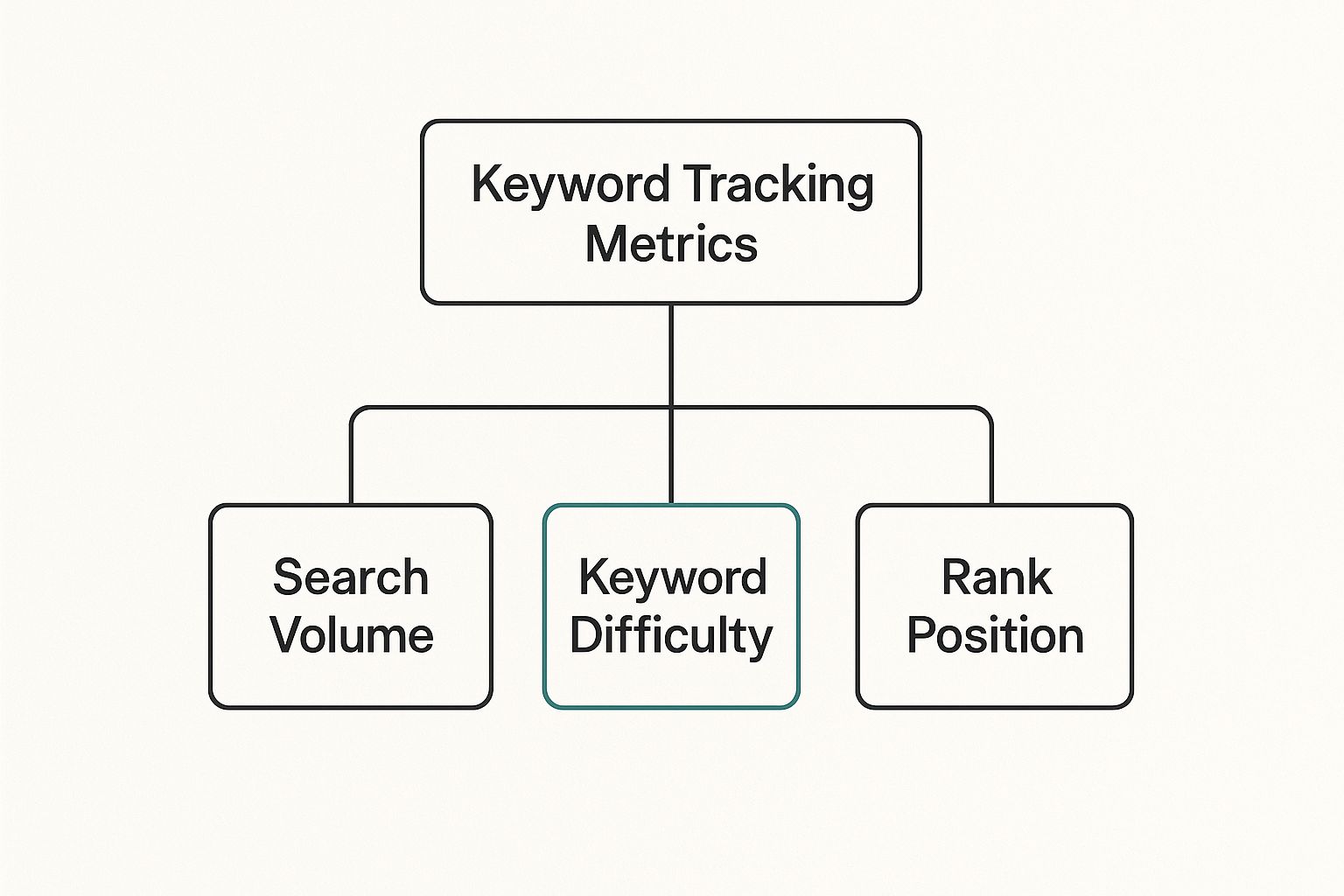
As you can see, a smart strategy isn't just about grabbing the highest volume term. It’s a balancing act between search volume, difficulty, and where you already stand.
How to Avoid the Keyword Stuffing Penalty
https://www.youtube.com/embed/D9xrXnMPgIs
It’s surprisingly easy to cross the line from smart SEO into over-optimization territory. The biggest tripwire here is keyword stuffing, a black-hat tactic from a bygone era that will absolutely tank your rankings today.
So, what is it? Think of it as trying to manipulate search engines by cramming a page full of keywords. It’s the digital equivalent of a salesperson who just keeps repeating the product name over and over again in every sentence. It’s annoying, clumsy, and a huge red flag for both your readers and for Google.
Keyword stuffing can show up in a few different ways, but they all share one thing in common: they make for a terrible user experience.
Common Signs of Keyword Stuffing
Once you know what to look for, the most obvious examples of keyword stuffing stick out like a sore thumb. They almost always feel unnatural and forced, basically screaming "low-quality content" to Google.
Keep an eye out for these red flags:
- Unnatural Repetition: Repeating the same words or phrases so much that it sounds robotic. Think: "We sell the best blue widgets. Our blue widgets are high-quality blue widgets." Nobody talks like that.
- Lists Without Context: Just dropping a block of keywords, phone numbers, or city names onto a page without any real sentences to give them meaning.
- Forcing in Irrelevant Terms: Shoving keywords into your content that have nothing to do with the topic, just in the hopes of ranking for them.
Here’s a simple test: read your content out loud. If it doesn't sound like something a real person would actually say, you’re probably overdoing it.
Is Keyword Density a Ranking Factor?
This brings up a classic question: what's the deal with keyword density? While Google doesn't use it as a direct ranking signal, it’s a pretty good "canary in the coal mine." A ridiculously high density is a massive hint that your writing is low-quality and you're likely stuffing.
Interestingly, a 2025 case study found that pages in the top 10 on Google had a really low average keyword density—around 0.04%. The pages that ranked much lower often had much higher densities. This tells us that Google cares a lot more about high-quality, natural-sounding content than it does about keyword repetition.
While there's no magic number, anything over 7% is generally seen as way too much and puts you in the danger zone.
At the end of the day, your North Star should always be creating real value for the reader. If you want to steer clear of penalties and build something that lasts, focus on solid white hat SEO tactics that put the user first.
Got Questions About Keywords? Let's Get Them Answered
Even when you think you've got a handle on keyword strategy, a few tricky questions always seem to come up. Let's walk through the most common ones I hear so you can stop second-guessing and start applying these concepts with confidence.
Should Every Single Page Have Its Own Main Keyword?
Yes, one hundred percent. Every important page on your website needs its own, unique primary keyword. This is the golden rule to avoid a nasty, self-inflicted wound called keyword cannibalization.
Keyword cannibalization is what happens when two or more of your own pages are fighting to rank for the same keyword. It’s like sending two of your players to catch the same fly ball—they just end up confusing Google, and both pages will likely rank lower as a result.
Treat each page like a specialist. It has one core job to do. By giving each page a distinct primary keyword, you’re sending a crystal-clear signal to Google about what that page is for, making it way easier for the right page to show up in search results.
Where Should I Actually Put My Keywords on the Page?
Okay, so we know stuffing keywords is a big no-no. But some spots on a page definitely pack more of a punch than others. Think of these as prime real estate for signaling your page's topic to search engines.
Here are the heavy hitters you should always prioritize:
- The Page Title (Title Tag): This is the big one. It's the clickable blue link in the search results and your most powerful signal to Google.
- The Meta Description: While it won't directly boost your rank, a compelling meta description with the keyword practically begs users to click on your result over the others.
- The Main H1 Heading: This is the headline on your actual page. It should tell visitors and Google exactly what they've landed on, and your keyword should fit naturally here.
- The First 100 Words: Sprinkling your keyword into the opening paragraph confirms the topic from the get-go. No mystery, just relevance.
After you've covered those bases, it's also smart to work your keyword and its variations into subheadings (H2s, H3s), image alt text, and the page's URL. Think of these as supporting evidence that reinforces your page's main idea.
The Bottom Line: It's not about how many times you can say a word. It’s about placing your keywords in these high-impact zones where they do the most good. Be strategic, not spammy.
Do I Really Need to Pay for an SEO Tool?
Look, you can do keyword research without a dedicated tool, but it's like trying to navigate a new city without a map. Sure, you might get there eventually, but you'll probably get lost a few times. Modern tools like Ahrefs, SEMrush, or SurferSEO are essential for making smart, data-backed decisions.
These tools don't just spit out a magic number for "how many keywords per page." What they do is give you incredible competitive intelligence. They show you exactly what the top-ranking pages are doing—what related terms they're using and what subtopics they're covering.
This insight helps you figure out the topical depth needed to even have a chance at ranking. You stop thinking about keyword counts and start thinking about creating a genuinely comprehensive resource. Use these tools as your guide, not as a strict set of rules to be followed blindly.
Ready to stop guessing and start strategizing? RankHub takes the manual labor out of keyword research by analyzing your entire site to find high-value opportunities you're missing. Get your tailored keyword strategy in under a minute. Discover your keywords with RankHub.
More from Our Blog
Zoho Marketing Automation Explained: Is It Right for You?
Compare Zoho Marketing Automation vs HubSpot on pricing, features, ease of use, and automation depth. See which wins for small teams and solo founders.
Read more →
Looking for an SEO Company? Here Are Your Best Options
Compare top SEO companies, AI platforms, and agencies. Find the best fit for your budget, from $49/month tools to full-service retainers.
Read more →
Marketing AI Tools Compared: Which Delivers Real Results?
Compare top marketing AI tools for SEO content creation. See pricing, features, and which tool fits solo founders, SMBs, and marketing teams.
Read more →