
So, what exactly is semantic SEO? Put simply, it’s about creating content around topics and context, not just stuffing in a bunch of individual keywords. It’s a smarter way of doing things, where we try to understand the meaning and intent behind what someone is searching for, so we can give them the best possible answer.
Going Beyond Keywords With Semantic SEO
Ever feel like you’re just playing a guessing game with Google? You’ve done your keyword research, placed them perfectly, and checked all the technical boxes, but your content just isn't ranking. It's a common frustration, and it happens because search engines have gotten way smarter than just matching words on a page. This is where truly understanding semantic SEO can be a complete game-changer for your strategy.
Let's think about it like you're planning a big dinner party. With traditional SEO, your whole focus was on the main dish—the keyword. But a truly great dinner party is so much more than that. It’s about the entire experience you create.
The Dinner Party Analogy
Semantic SEO is all about thinking like a great host. You don't just plop down the main course and call it a day. You consider everything that will make the evening memorable for your guests.
- The Main Dish: This is your primary topic or core keyword. It's still the star of the show.
- Appetizers & Desserts: Think of these as all the related subtopics and follow-up questions your audience might have.
- The Guest List: These are the key entities—the specific people, places, or concepts—that are essential to the conversation around your topic.
- Ambiance & Music: This is the overall context. It's the vibe that ties everything together into a cohesive, satisfying experience.
When you provide a complete experience, you don't just make your guests (your readers) happy; you also seriously impress the ultimate critic (Google).
Why Context Is the New Keyword
This shift toward a more intelligent, context-aware search isn't exactly new. It all started back in 2013 with Google's Hummingbird update. That was the moment Google really started trying to understand language the way humans do, moving away from just counting how many times a keyword appeared on a page.
A piece of content that's properly optimized for semantic SEO doesn't just answer the user's initial question. It anticipates and answers all the related questions they'll have after reading your content.
This strategy is all about predicting what your reader needs next and establishing your site as an authority on the entire topic. Before you can master this, though, you need a solid grip on the fundamentals. A good starting point is understanding What is Search Engine Optimization (SEO), as it provides the foundation for how search engines work today.
At the end of the day, it all comes down to satisfying the user's complete journey, and that begins with understanding their motivation. To really nail this, you need to understand the 'why' behind the search, which is why we have a whole guide on https://rankhub.ai/blog/what-is-search-intent.
Traditional SEO vs Semantic SEO at a Glance
To make this crystal clear, let's break down how the old way of thinking stacks up against this more modern, effective approach.
| Aspect | Traditional SEO (Keyword-Focused) | Semantic SEO (Context-Focused) |
|---|---|---|
| Primary Focus | Matching specific, exact-match keywords. | Understanding user intent and the topic's context. |
| Content Strategy | Creating one page for every keyword variation. | Building comprehensive topic clusters around a core idea. |
| Goal | Rank for a single keyword. | Become an authority on an entire subject matter. |
| Metric for Success | Keyword rankings and organic traffic. | Topical relevance, user engagement, and satisfying the entire user journey. |
As you can see, the difference isn't just a minor tweak—it's a fundamental shift in how we approach content creation for search engines. Semantic SEO is about depth, breadth, and creating real value.
Why Search Engines Started Thinking Like People
Back in the early days of the internet, search engines were pretty dumb. Think of them as giant, digital filing cabinets. You’d type in a word, and the engine would just pull up every document containing that exact word. The more times the word appeared, the higher the page ranked. It was a simple system, but it had a massive, glaring flaw: it had no clue what you actually meant.
This clunky, keyword-matching system gave birth to a whole decade of "keyword stuffing." SEOs and website owners would just cram their target phrase into a page over and over again to game the system. It made for some truly awful, unreadable content that somehow managed to rank well, even though it offered a terrible experience for real people. Search engines quickly realized this model was broken.
The real tipping point, though, came from us. The way we search changed. We stopped typing like robots ("best laptop 2024") and started asking questions like we would a friend ("what's the best lightweight laptop for a college student under $1000?"). These longer, more conversational searches are full of intent and context that simple keyword matching could never figure out.
The Dawn of a Smarter Search
To keep up with our more human way of searching, Google had to teach its algorithm how to understand language—not just count words. This was the start of the big shift toward semantic search. Two updates, in particular, completely changed the game.
Hummingbird (2013): This wasn't just a tweak; it was a total engine rebuild. Hummingbird was designed to focus on the meaning behind our searches. Suddenly, Google could grasp synonyms, related ideas, and the relationships between words. The era of exact-match keywords was officially over.
BERT (2019): BERT (which stands for a mouthful: Bidirectional Encoder Representations from Transformers) was another huge leap. It uses natural language processing to nail the subtle nuances in our conversational queries. For example, BERT helps Google understand how a tiny word like "to" or "for" can completely change what a searcher is looking for.
These updates were a direct response to how we, as users, were evolving. Google knew that to give us the answers we wanted, it had to stop thinking like a machine and start understanding language more like a person.
By focusing on the intent behind the words, search engines could finally deliver results that truly satisfied the user's needs, not just match a string of characters. This fundamental change in philosophy is the core reason what is semantic SEO has become so critical today.
This evolution completely flipped the script for anyone creating content online. The old tricks stopped working overnight. The new goal wasn't to optimize for a single keyword anymore, but to prove you had a deep, comprehensive understanding of an entire topic. This requires a much smarter approach, one that accounts for the many complex search engine ranking factors that signal real authority to Google.
The Three Pillars of Your Semantic SEO Strategy
When you get right down to it, semantic SEO isn't some dark art. It’s a repeatable framework. Forget the confusing jargon for a minute and think of it as a strategy built on three solid pillars: User Intent, Context, and Topic Authority.
Get these three right, and you'll stop guessing what Google wants and start confidently giving it exactly what it's looking for.
This diagram is a great way to visualize how these pieces fit together. Everything flows from the central idea to create a strategy that's strong from the ground up.
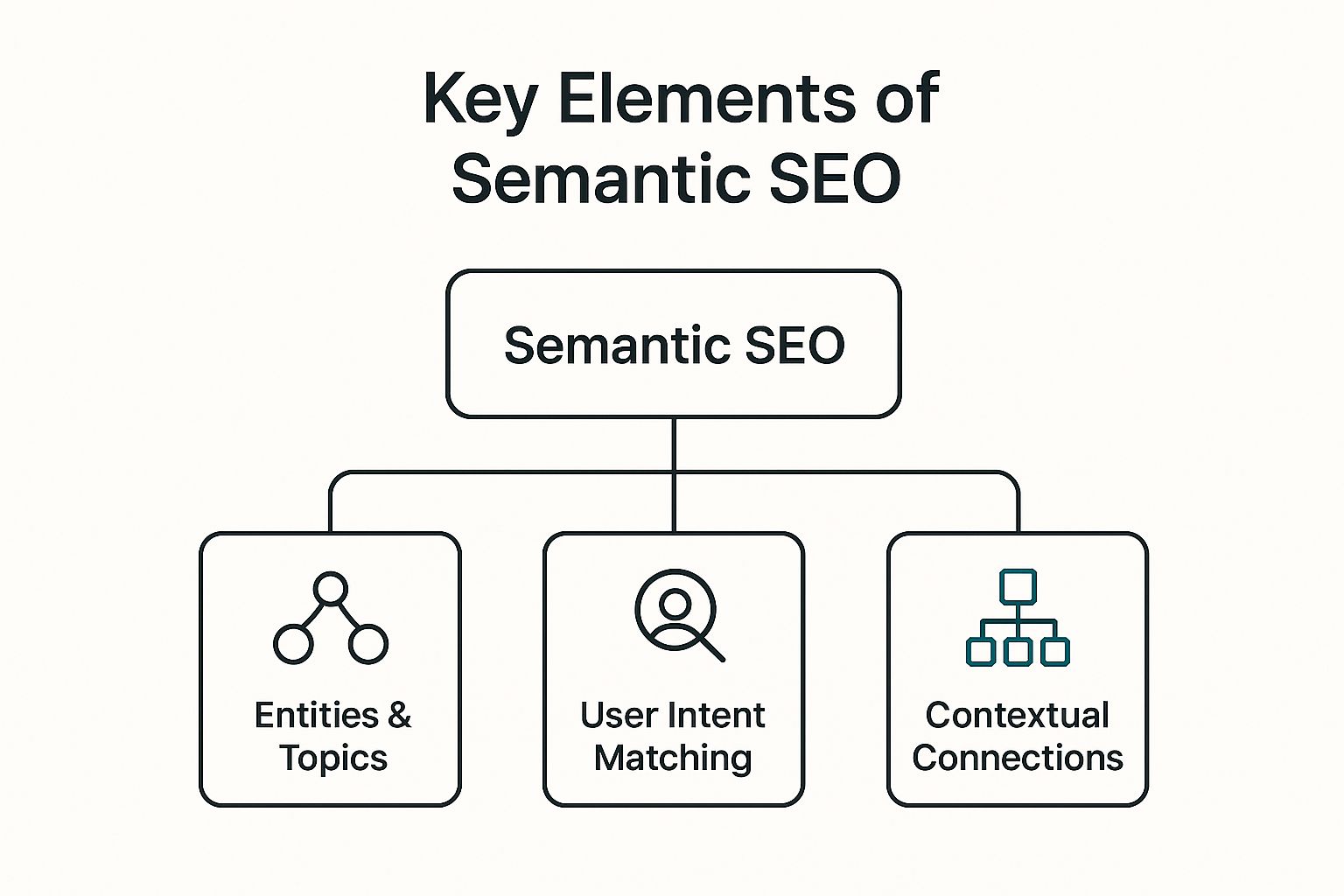
As you can see, understanding intent and building context are the foundations. Master those, and you're well on your way to building real topic authority that search engines can't ignore.
Pillar 1: Cracking the Code of User Intent
First up, and honestly the most important, is user intent. This is all about the "why" behind every search. What is someone really trying to do when they type a query into that little white box?
Get this wrong, and nothing else you do matters. You could write a masterpiece, but if it doesn’t match what the user is actually trying to accomplish, it's dead in the water. It just won't rank.
There are four main types of intent you'll run into:
Informational Intent: The user wants an answer. They're looking to learn something. Think queries like "how to fix a leaky faucet" or "what is the capital of Australia." Blog posts, how-to guides, and tutorials are perfect here.
Navigational Intent: The user is trying to get to a specific place online. They already know their destination. Searches like "Facebook login" or "YouTube" fall into this bucket. You're not really optimizing for this unless it's for your own brand name.
Transactional Intent: The user has their wallet out and is ready to buy. These searches are direct and product-focused, like "buy Nike Air Max 90" or "Grammarly premium discount." Your product and service pages are the heroes for this intent.
Commercial Investigation: The user is planning to buy, but they're still kicking the tires and comparing their options. You'll see queries like "best CRM for small business" or "Ahrefs vs SEMrush." Comparison articles, in-depth reviews, and "best of" lists are your best bet here.
When you correctly identify the intent, you can create the exact type of content that solves the user's problem. That's the #1 thing search engines want to see.
Pillar 2: Weaving a Rich Web of Context
The second pillar is all about context. Once you know why someone is searching, you need to build a comprehensive world of information around that topic. Search engines have grown up; they don't just count how many times you use a keyword anymore. They analyze all the related words, phrases, and concepts on a page to figure out how deep your knowledge really goes.
Think of it this way: if you're writing about "baking bread," a page that just repeats that phrase over and over is pretty weak. But a page that naturally mentions "yeast," "proofing," "flour," "kneading," and "sourdough starter" signals to Google that you actually know what you're talking about. This is a huge part of modern SEO.
This approach is perfectly suited for the rise of AI in search. We’ve seen firsthand that websites focusing on this kind of topic-based content see way better engagement and rank higher for all those long-tail, question-based searches. It's a proven way to boost your organic traffic, as detailed in this guide on increasing rankings with semantic SEO on Vazoola.com.
Pillar 3: Becoming the Go-To Topic Authority
The final pillar is Topic Authority. This is where you prove to Google and users that you're a genuine expert on an entire subject, not just a one-trick pony for a single keyword. The best way to do this is by creating topic clusters.
Here's the basic recipe:
Start with a Pillar Page: This is your big, cornerstone piece of content covering a broad topic from A to Z. For instance, a pillar page could be "The Ultimate Guide to Digital Marketing."
Create Cluster Content: These are shorter, more focused articles that dive deep into the specific subtopics you touched on in your pillar page. Think of articles like "A Beginner's Guide to SEO," "How to Run Your First PPC Campaign," or "Email Marketing Best Practices."
Link Them All Together: This is the magic step. You link from your main pillar page out to each of the cluster articles. Just as importantly, each of those cluster articles links back to the pillar page.
This interconnected web of content sends an unmistakable signal to Google: "Hey, we don't just know a little about digital marketing—we've got this topic completely covered." You're not just a page; you're a resource.
Putting Your Semantic Strategy Into Action

Alright, we’ve talked a lot about the what and why of semantic SEO. Now for the fun part: putting it all into practice. This is where the theory gets real, and we start building a content plan that actually gets results.
It's time to roll up our sleeves. This isn't about throwing keywords at a wall and seeing what sticks. It's about following a clear, repeatable process to show Google you're the go-to expert in your field.
First things first: forget about individual keywords for a minute. Let's think bigger. What are the core topics your business truly owns? If you run a local coffee shop, your main subjects might be things like "specialty coffee brewing methods," "espresso-based drinks," or "sourcing ethical coffee beans." These are your starting points.
Once you have those big-picture topics, we'll break them down into all the related subtopics and questions people are actually searching for. This is how you build the deep, meaningful context that search engines are hungry for.
Building Your Content Map
Imagine your main topic is the sun. All the related subtopics are the planets orbiting around it. Your job is to map out this entire content solar system. This approach guarantees you cover a subject from every angle, leaving no questions unanswered for your audience or for Google.
So, how do you do it? Start by putting yourself in your customer's shoes and asking:
- What are the basic, foundational questions? For "specialty coffee brewing," this could be "what is a pour-over?" or "how does a French press work?"
- What are the comparison questions? People love a good showdown. Think "pour-over vs. drip coffee" or "AeroPress vs. French press."
- What are the problem-solving questions? Get into the nitty-gritty with common frustrations like "why is my coffee bitter?" or "how to clean a coffee grinder."
These questions become the skeleton of your content plan. You can find a goldmine of ideas just by looking at Google's "People Also Ask" boxes and the "Related Searches" at the bottom of the page.
A well-executed semantic strategy shifts the focus from simply matching keywords to truly understanding and answering the intent behind a search. This approach is proven to deliver better visibility in today's search environment.
This isn't just a small tweak—it's a huge shift in how we do SEO. In fact, sites that embrace semantic SEO have seen up to twice as many featured snippet placements. And consider this: Google reportedly rewrites over 60% of title tags to better match user intent. That's proof positive that context now beats exact-keyword matching every time.
Finding Semantic Keywords and Entities
With your content map sketched out, it’s time to find the exact words and phrases your audience uses. This means digging up both semantic keywords (related terms and synonyms) and entities (specific people, places, brands, or concepts).
Let's go back to our coffee shop. For the topic "pour-over," your semantic keywords might include "V60 dripper," "gooseneck kettle," "coffee bloom," and "filter paper." The entities could be specific roasters like "Stumptown" or brewing device brands like "Hario." Weaving these terms into your content naturally shows you really know your stuff.
There are some fantastic tools out there to help with this research. To get a handle on organizing everything you find, check out our guide on the best keyword clustering tools. They make it so much easier to group related ideas together.
Weaving It All Together With Links and Data
Creating amazing content is just one piece of the puzzle. The final step is connecting all the dots so search engines can clearly see how your pages relate to each other.
Strategic Internal Linking: This is absolutely non-negotiable. Every time you publish an article about a subtopic (a cluster page), you must link it back to your main guide (your pillar page). You should also link out to other relevant articles on your site. This creates a powerful web of context that screams "authority" to Google.
Using Structured Data (Schema Markup): Think of this as adding secret labels to your content that only search engines can read. For a recipe, you can use Schema to explicitly point out the ingredients, cook time, and calorie count. It’s a simple step that can help you snag those eye-catching rich snippets in the search results.
And remember, these ideas aren't just for blog posts. They apply to everything you create. For example, applying the latest podcast SEO best practices can make a huge difference in how many people discover your audio content.
By combining deep topic mapping, smart keyword integration, and a few technical signals, you'll build a powerful strategy that’s perfectly in sync with how modern search engines think.
The Real-World Payoff of Thinking Semantically
So, is all this extra effort actually worth it? Absolutely. The payoff for adopting a semantic approach is huge, and it’s about so much more than just jumping up a few spots in the search results. You're building a real, long-term asset for your business.
When you stop obsessing over a single keyword and start thinking about the entire topic, something amazing happens. You'll find yourself ranking for a whole constellation of long-tail keywords and questions you never even intended to target. It just happens naturally because search engines see your comprehensive coverage and recognize you as the go-to expert on the subject.
This brings in better traffic, too. Instead of people looking for a quick, one-word answer, you attract an audience that's genuinely trying to solve a problem or learn something. These are the people who are far more likely to stick around and trust what you have to say.
Building Unshakeable Brand Authority
One of the most powerful outcomes here is building topical authority. When you consistently publish in-depth, interconnected content, you’re basically screaming quality at Google. You stop being just another website and start becoming a landmark resource.
Think about it: by covering a topic from every conceivable angle, you’re practically handing Google the perfect answers for its "People Also Ask" boxes. And with a reported 43% of all searches now featuring a PAA box, this is a massive opportunity for visibility.
This authority doesn't just work on search engines; it builds genuine trust with your audience. When someone sees you have the answers to all their follow-up questions right there, they have no reason to leave. They stay longer, bounce rates drop, and that engagement is a direct line to brand loyalty and, you guessed it, more conversions.
Future-Proofing Your Content for Good
Maybe the biggest win of all is that a semantic approach essentially future-proofs your content. We all know the panic that comes with a major algorithm update, especially for sites relying on old-school, keyword-stuffing tricks. But Google’s core mission hasn't changed: they want to give people the best, most helpful answers.
When your entire strategy is built around that same goal, you make your content resilient. Your articles stay relevant and valuable because they’re built on the solid foundation of what users actually want. This isn’t just an SEO tactic; it's an investment in sustainable, organic growth that will pay you back for years.
Clearing Up Common Semantic SEO Myths

Just like any popular strategy in our field, a ton of myths and bad advice have started swirling around semantic SEO. It’s easy to get led astray, so let’s set the record straight and separate the facts from the fiction. Once we bust these myths, you’ll have a much clearer path to doing what actually works.
Let's start with the big one: "keywords are dead." You've probably heard it a dozen times. It's dramatic, but it's just not true. Keywords haven't gone anywhere; their job has just changed. They're no longer the solo rockstar on stage—now they’re part of a full band providing the harmony and context.
Think of it this way: your main keyword is the central theme of a conversation. All the related phrases and entities are the specific examples and details that make the conversation feel complete and natural. So yes, keywords still matter. A lot. They just have a much bigger team to work with now.
It's More Than Just LSI Keywords
Another common misconception is that semantic SEO is just a fancy new term for stuffing your content with LSI (Latent Semantic Indexing) keywords. While related terms are part of the equation, they're only one small piece of a much, much larger puzzle.
A true semantic SEO strategy is about comprehensively understanding and covering a topic from every angle. It's about figuring out what a user really wants, structuring your content logically with things like topic clusters, and using structured data to spoon-feed search engines the context they need.
It’s not about sprinkling in a few synonyms and calling it a day. It’s about building an entire web of content that screams, "We are the experts on this subject!" Just focusing on LSI is like trying to bake a cake with only flour—you're missing the most important ingredients.
Semantic SEO Is for Everyone
Finally, there’s this idea floating around that semantic SEO is too complex and expensive for small businesses or solo entrepreneurs. This might be the most harmful myth of all because it scares people away before they even start. The truth is, this approach is completely scalable.
You don't need a huge budget or a team of data scientists to get started. At its core, it's just about thinking more deeply about what your audience is trying to accomplish.
You can absolutely start small:
- Map out one topic cluster: Pick your most important product or service. Build one solid pillar page for it and then write just a few articles that link back to it.
- Answer "People Also Ask" questions: Google literally tells you what your audience wants to know. Grab those questions and create content that gives them a direct, helpful answer.
- Beef up your internal linking: Go through your existing posts and make sure related articles are linked together. This helps both users and search engines see the connection.
The best part is that this strategy builds on itself. Every single piece of context-rich content you create adds a little more authority to your site, making it an incredibly powerful long-term play for any business, no matter the size.
Got Questions About Semantic SEO?
Alright, even after diving deep into the concepts, you probably have a few practical questions buzzing around. That's totally normal. Let's clear the air on some of the most common ones so you can get started.
Think of this as the "final check" before you confidently put your semantic SEO plan into action.
Topic Clusters vs. Semantic SEO: What's the Real Difference?
This is a great question, and it's easy to see why people mix them up. The two are definitely related, but they aren't the same thing.
Here's the simplest way to think about it: topic clusters are the tactic, and semantic SEO is the strategy.
Semantic SEO is the whole mindset—the big-picture approach of creating content that covers a subject from every angle, focusing on user intent and context. A topic cluster, with its main pillar page and all the supporting articles, is one of the best ways to actually build that topical authority and show Google you know your stuff.
You can't really build a good topic cluster without a semantic mindset, and it's tough to do semantic SEO well without organizing your content into clusters. They go hand-in-hand.
So, How Long Does This Actually Take to Work?
Let's set some realistic expectations right away. Semantic SEO is a long game, not a "get rich quick" scheme for traffic. You're building a library of genuinely helpful content to establish real authority, and that just doesn't happen overnight.
Generally, you can start to see some positive movement—like your long-tail keywords climbing the ranks—within three to six months. But to really dominate the conversation and rank for those big, competitive head terms? That can easily take a year or more.
The upside is that the growth you get is solid and way more stable. You'll be less likely to get knocked around by the next big Google algorithm update.
Remember, you're not just trying to rank. You're trying to become the go-to resource for your topic. Building that kind of trust with both people and search engines takes time.
What are the Best Free Tools for This?
Good news! You don't need a wallet full of cash to get started. Some of the best tools for understanding semantic context are baked right into Google and cost you absolutely nothing.
Here are a few of my favorites to get you going:
- Google's "People Also Ask" (PAA): This is pure gold. It literally shows you the next questions people have after their initial search. Weaving these answers into your content is a killer way to add semantic depth.
- Related Searches: Scroll to the bottom of any search results page. That list gives you a direct look into other paths people take when researching a topic, helping you find all the related subtopics you should be covering.
- AnswerThePublic: This tool is fantastic for brainstorming. It takes your keyword and spins it into a web of questions and phrases, giving you a visual map of all the content ideas you could possibly need.
Using just these freebies, you can collect a massive amount of intel to build a content plan that’s rich, relevant, and ready to rank.
Ready to stop guessing and start building real topic authority? RankHub uses AI to analyze your entire website, uncover high-value keyword opportunities, and map out your content strategy in minutes. Ditch the manual research and get the actionable insights you need to dominate your niche. Start your journey with RankHub today.
More from Our Blog
7 Content Writing Tools That Boost Your SEO Rankings
Discover the top 9 SEO content writing tools to automate drafting, optimization, and publishing. Boost rankings with AI-assisted workflows.
Read more →
Zoho Marketing Automation Explained: Is It Right for You?
Compare Zoho Marketing Automation vs HubSpot on pricing, features, ease of use, and automation depth. See which wins for small teams and solo founders.
Read more →
Looking for an SEO Company? Here Are Your Best Options
Compare top SEO companies, AI platforms, and agencies. Find the best fit for your budget, from $49/month tools to full-service retainers.
Read more →