
Tired of staring at a massive spreadsheet of keywords, wondering where to even begin? We've all been there. You've done the research, but now you're left with a jumbled mess that doesn't feel actionable. That's where keyword clustering comes in. It’s the game-changing strategy that groups related keywords into tight, relevant topics based on search intent, transforming your keyword chaos into a clear content roadmap.
Instead of targeting one-off phrases, you can create comprehensive content that answers multiple user questions at once, establishing topical authority and skyrocketing your rankings. The evolution of this process is fascinating, mirroring broader trends in AI for knowledge management by turning raw data into structured, strategic insights. Thankfully, you don't have to do this manually.
In this guide, we're diving deep into the 12 best keyword clustering tools that automate this entire process, saving you countless hours. We'll explore each platform's key features, pricing, and ideal use cases, complete with screenshots and direct links. Our goal is simple: to help you find the perfect tool to make your content strategy smarter, not just harder. Let's find the right fit for your needs.
1. RankHub
RankHub stands out as our featured choice for its sheer speed and intelligent automation, making it a powerhouse for anyone looking to streamline their keyword research and content strategy. It moves beyond traditional tools by using AI to analyze your entire website, understand its context, and deliver highly relevant keyword clusters in about 60 seconds. This platform effectively automates the tedious, manual parts of keyword research, like brainstorming seed terms and filtering out irrelevant phrases.
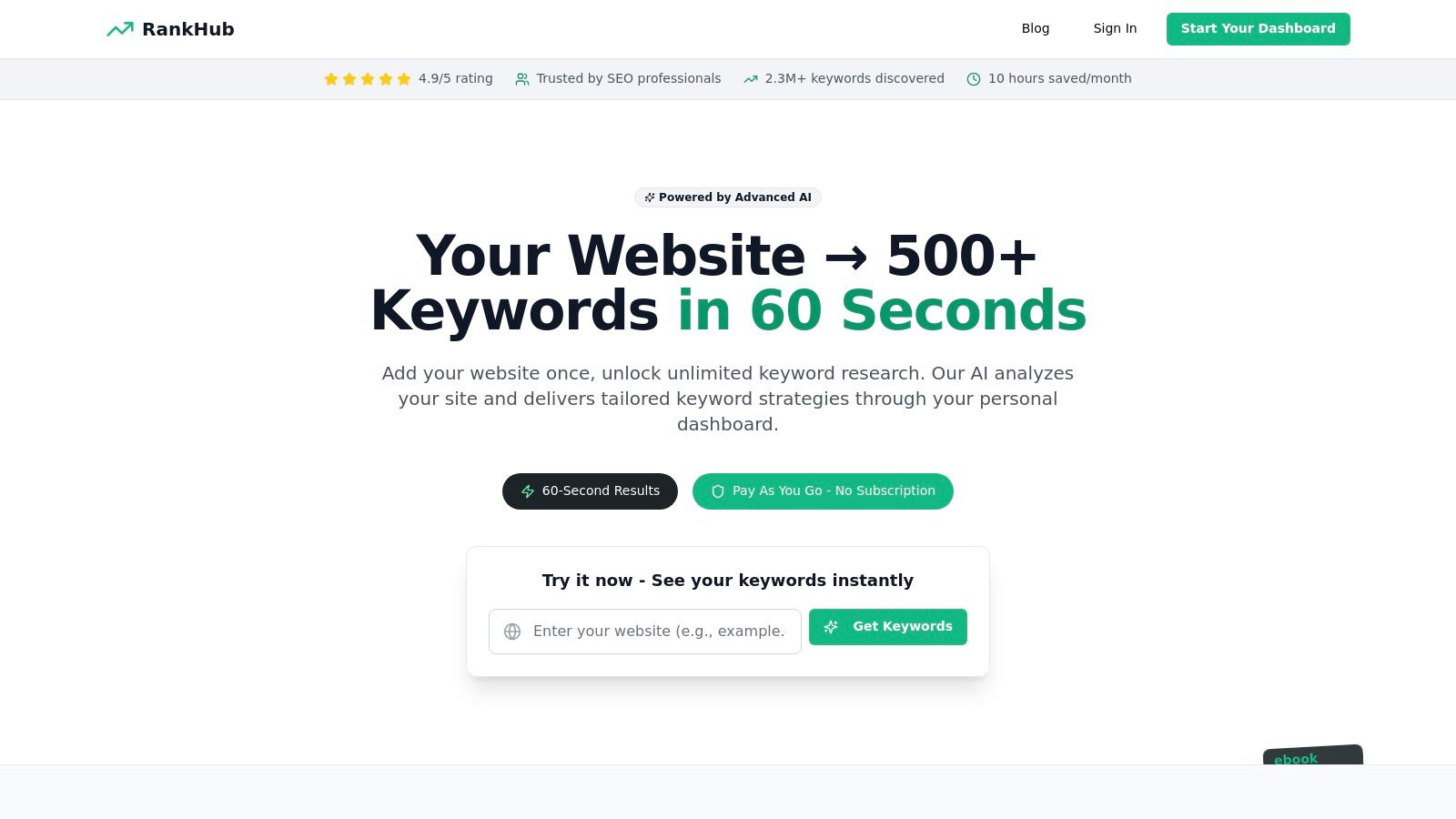
What truly sets RankHub apart is its dual-mode approach to research. The Auto Research feature is perfect for getting a comprehensive overview of your site’s opportunities, automatically identifying competitor gaps you can exploit. For more focused campaigns, the Keyword Research mode allows you to input specific terms and get targeted clusters. This flexibility makes it an exceptional keyword clustering tool for both beginners who need guidance and seasoned SEOs who need to accelerate their workflow.
Key Strengths & Use Cases
RankHub's design is centered on efficiency and actionable results. The central dashboard is intuitive, allowing you to manage multiple client or personal websites seamlessly. From there, you can track research history, export data for content briefs, and monitor your progress without getting lost in complex menus.
- Best For: SEO agencies, in-house marketing teams, and e-commerce managers who need to produce high-quality keyword strategies at scale without a massive time investment.
- Pro Tip: Use the "Auto Research" function when onboarding a new client. It provides a comprehensive baseline analysis of their domain and key competitors in minutes, allowing you to demonstrate value from day one.
- Standout Feature: The AI-driven competitor gap analysis is a game-changer. It doesn’t just group your keywords; it actively finds profitable terms your competitors rank for but you don't, giving you a direct roadmap for content creation.
Pricing & Access
RankHub operates on a flexible pay-as-you-go model, which is a breath of fresh air in a market dominated by monthly subscriptions. You purchase credits that never expire, allowing you to control costs and only pay for what you use. Packages start at $9.99 for 100 credits.
| Pros | Cons |
|---|---|
| AI generates clusters and competitor analysis in under a minute. | Credit usage requires monitoring to avoid running out unexpectedly. |
| Flexible pay-as-you-go model with no recurring fees. | Advanced SEOs may want more granular manual control options. |
| Manages multiple websites from one central dashboard. | |
| Two research modes cater to different user needs and skills. |
Website: www.rankhub.ai
2. SEMrush
While SEMrush is a massive, all-in-one SEO suite, its power as a keyword clustering tool often flies under the radar. It doesn't have a dedicated, single-click "cluster" button like some specialized tools. Instead, it offers a more manual yet deeply insightful approach through its Keyword Magic Tool. After you enter a seed keyword, SEMrush automatically groups thousands of related terms into topic-based subgroups on the left-hand navigation pane. This method is brilliant for understanding user intent and building out pillar pages and topic clusters.
What makes it stand out is the integration. You're not just getting clusters; you're getting them enriched with SEMrush's massive database of difficulty scores, search volumes, and competitive data. This allows you to prioritize which clusters to target based on a holistic view of the SERP landscape. It's less about raw processing speed and more about strategic depth.
Key Info & Pricing
- Best For: Marketers who already use SEMrush and want to integrate their keyword research and clustering into a broader SEO workflow.
- Pricing: Access to the Keyword Magic Tool is available on all paid plans, starting with the Pro plan at around $129.95/month.
- Standout Feature: The powerful filtering and grouping based on semantic similarity and shared keywords, all within a comprehensive SEO ecosystem.
Link: SEMrush Website
3. Ahrefs
Similar to its main competitor, Ahrefs isn't a dedicated keyword clustering tool, but its Keywords Explorer is a powerhouse for achieving the same goal. The standout feature here is its "Parent Topic" grouping. When you analyze a keyword, Ahrefs identifies the main topic it belongs to, allowing you to see all the variations that rank for the same top-level term. This approach is phenomenal for understanding search intent and building authority around a core concept, as it groups keywords based on real-world SERP overlaps, not just semantic similarity.
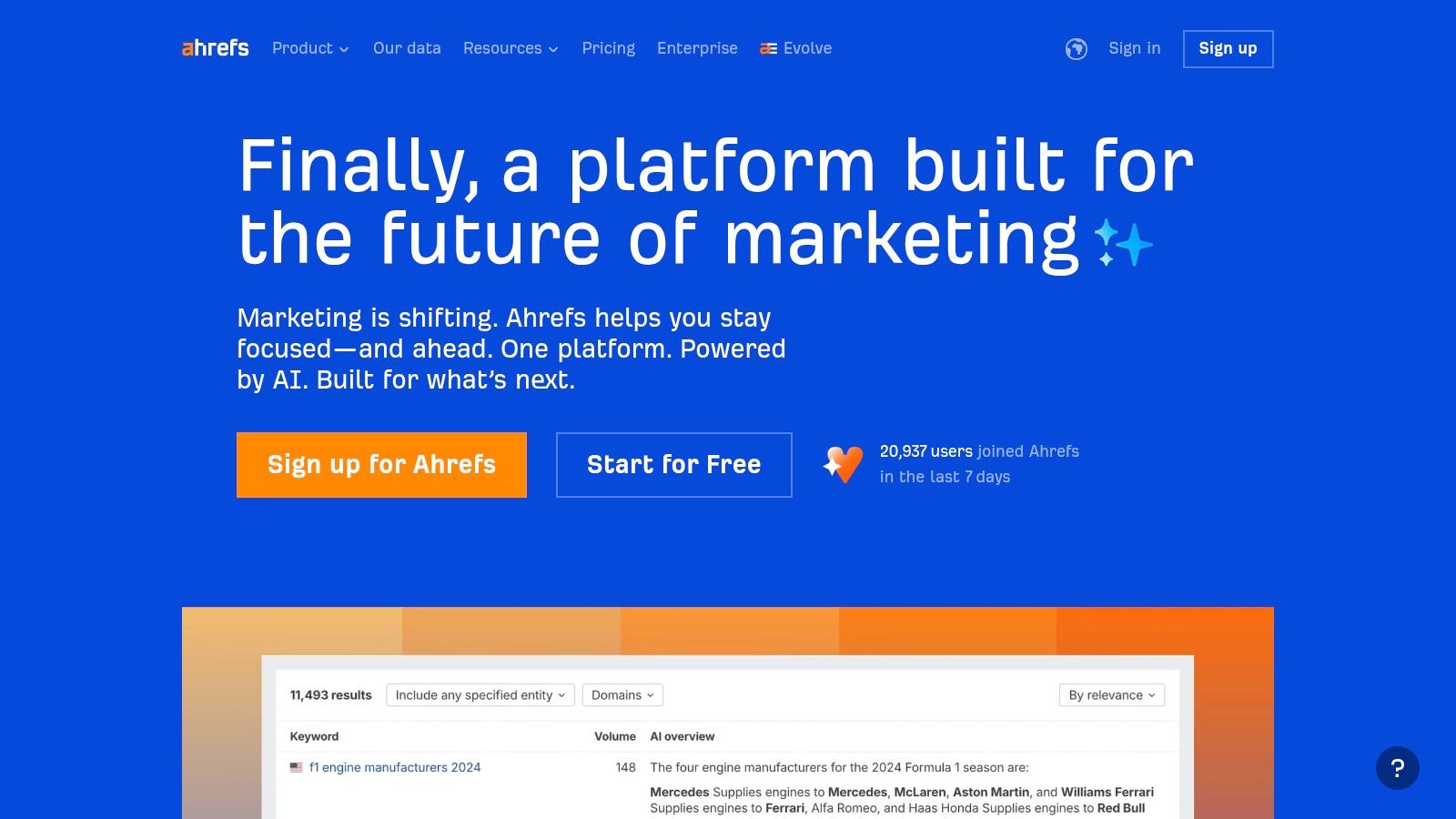
What truly sets Ahrefs apart is the quality and depth of its data. You get clusters backed by industry-leading metrics like keyword difficulty, traffic potential, and detailed SERP analysis with click-through rate estimates. This turns the process from simple grouping into a strategic planning session. You're not just finding clusters; you're finding the most valuable, attainable clusters to target, all within one of the most respected SEO platforms available.
Key Info & Pricing
- Best For: SEO professionals and agencies who need top-tier data accuracy and want to integrate their keyword clustering efforts with competitor and backlink analysis.
- Pricing: Access to Keywords Explorer is included in all paid plans, which start at $99/month for the Lite plan.
- Standout Feature: The "Parent Topic" feature, which automatically groups keywords by the top-ranking page, providing highly practical and SERP-proven topic clusters.
Link: Ahrefs Website
4. SE Ranking
SE Ranking is another all-in-one SEO platform that packs a surprisingly powerful and direct Keyword Grouper tool. Unlike platforms where clustering is a background feature, SE Ranking puts it front and center. You can paste a list of keywords, and the tool uses live SERP data to group them based on how many overlapping URLs appear in the top 10 search results. This SERP-based method is highly practical for building pages that can rank for multiple, semantically related queries at once.
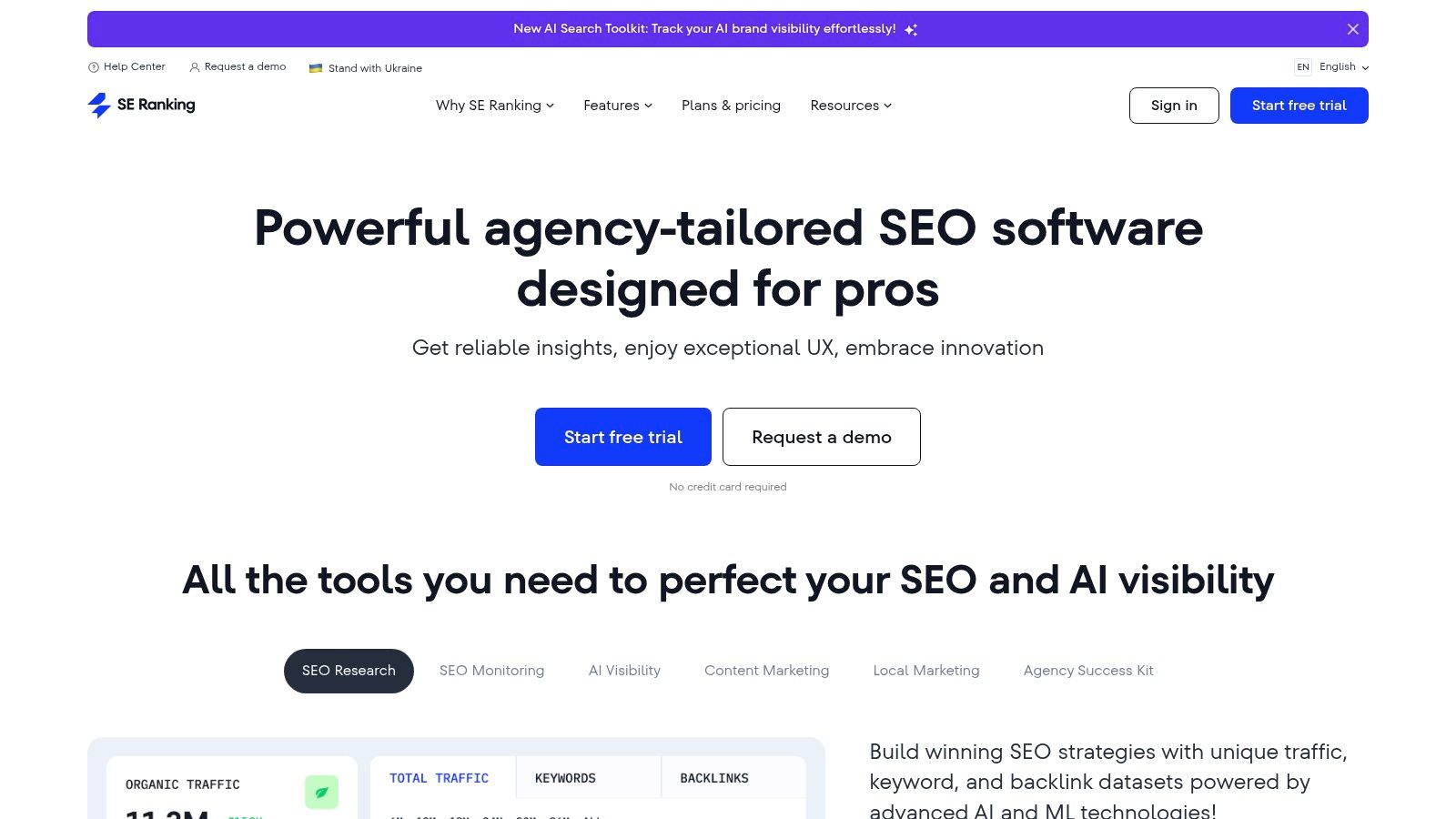
What makes it a great choice is the level of control it offers. You can set the "grouping accuracy" from a soft to a hard connection, determining how many URLs must overlap for keywords to be clustered together. This flexibility, combined with its affordability and integration into a wider SEO toolkit, makes it an excellent value proposition for freelancers and small businesses. If you're managing keyword research for a small business, its straightforward approach is a massive time-saver.
Key Info & Pricing
- Best For: Small to medium-sized businesses and SEO agencies looking for an affordable, full-featured suite with a dedicated keyword clustering tool.
- Pricing: The Keyword Grouper is available on all plans, with the Essential plan starting around $55/month. Pricing is credit-based for checks.
- Standout Feature: The ability to customize grouping accuracy based on the number of overlapping SERP results, giving users fine-tuned control over cluster relevance.
Link: SE Ranking Website
5. Keyword Cupid
Keyword Cupid takes a highly analytical and visual approach to keyword clustering. Instead of just relying on lexical similarity, it uses a neural network and analyzes real-time SERP data from the top 100 results for your keywords. This means your clusters are based on which keywords are already ranking together on Google, providing a roadmap for creating pages that can rank for multiple terms simultaneously. It's a powerful way to reverse-engineer Google's own understanding of topic relevance.
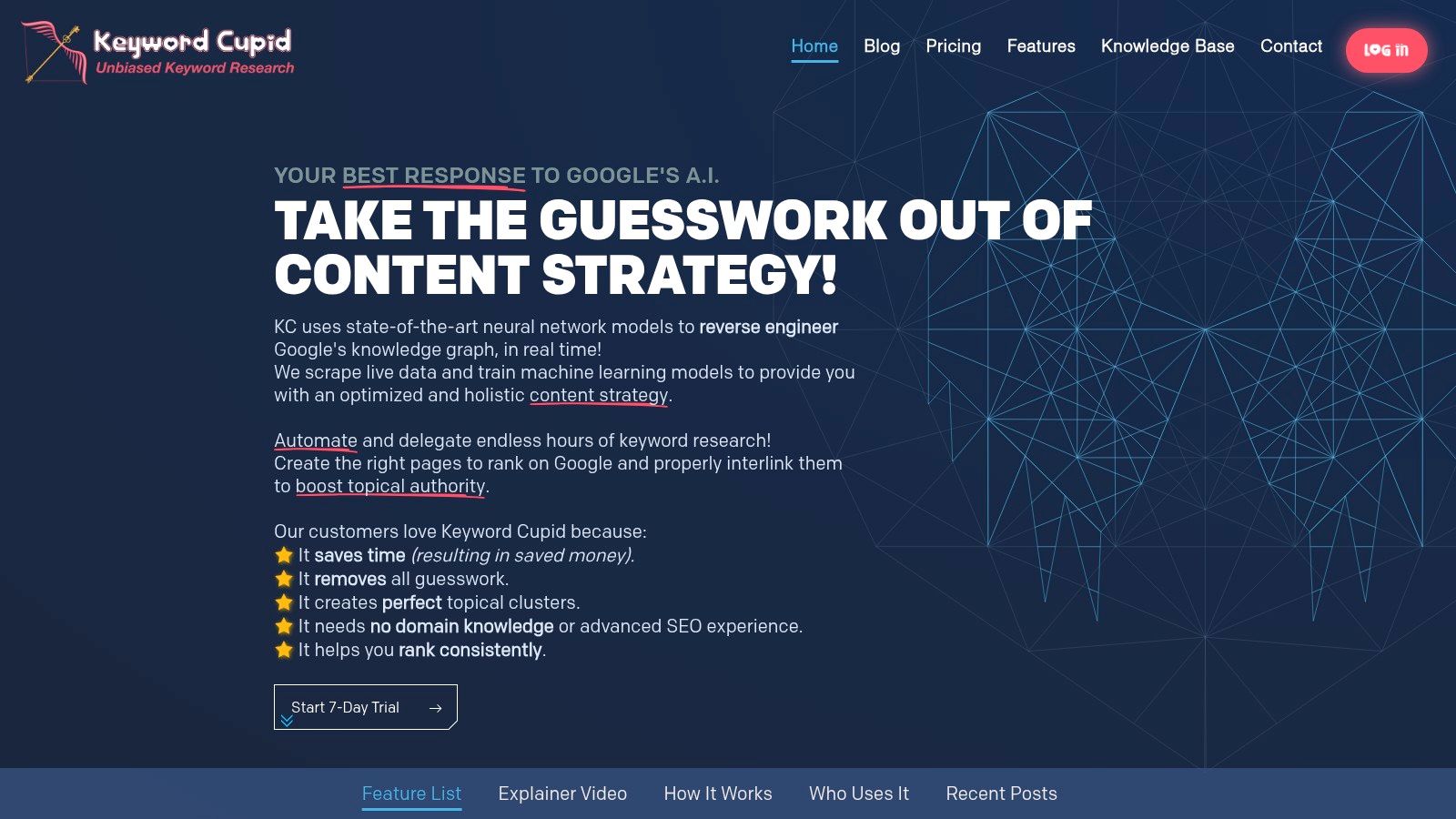
The platform's standout feature is its interactive mind maps. These visuals make it incredibly easy to understand the relationships between different clusters and sub-topics, which is fantastic for planning site architecture and content strategy. While the interface can feel a bit dated and it lacks native keyword research tools, its core function as one of the most accurate keyword clustering tools is undeniable, especially for large-scale projects.
Key Info & Pricing
- Best For: SEO professionals and agencies who need highly accurate, SERP-validated clusters and a visual way to plan content architecture.
- Pricing: Uses a flexible credit-based system. You purchase credits and use them per keyword analyzed, starting from $9.99 for 1,000 credits.
- Standout Feature: The use of neural networks and live SERP data to create hyper-relevant clusters, presented in interactive and easy-to-understand mind maps.
Link: Keyword Cupid Website
6. Keyword Insights
Keyword Insights is a powerful, AI-driven tool that excels at turning massive, messy keyword lists into actionable content plans. It moves beyond simple lexical grouping and instead analyzes the live SERPs for each keyword. If multiple keywords bring up similar search results, Keyword Insights groups them together, providing a data-backed understanding of how Google perceives user intent for those queries. This SERP-based approach makes it one of the most accurate keyword clustering tools for planning content that matches what users and search engines want to see.

What makes it a favorite among content strategists is its ability to not just cluster but also detect search intent and help you find content gaps. After clustering, it generates content briefs and identifies keyword variations you can target within a single article. For agencies and in-house teams managing huge keyword datasets, this tool is a massive time-saver, helping them organize their content strategy efficiently and find profitable keywords with confidence.
Key Info & Pricing
- Best For: SEO agencies and content teams who need to process large keyword lists and generate data-driven content outlines quickly.
- Pricing: Uses a credit-based system. Plans start at around $59/month for 5,000 keyword credits, scaling up based on volume.
- Standout Feature: Its core clustering algorithm is based on SERP similarity, which provides a highly accurate grouping of keywords based on search intent.
Link: Keyword Insights Website
7. Thruuu
Thruuu takes a SERP-first approach to keyword clustering that is both refreshingly simple and highly effective. Instead of relying solely on keyword text similarity, it analyzes the top Google search results for each keyword you provide. If multiple keywords share a significant number of the same ranking URLs, Thruuu groups them into a cluster. This method ensures that your clusters are not just semantically related but are also aligned with Google's understanding of user intent.
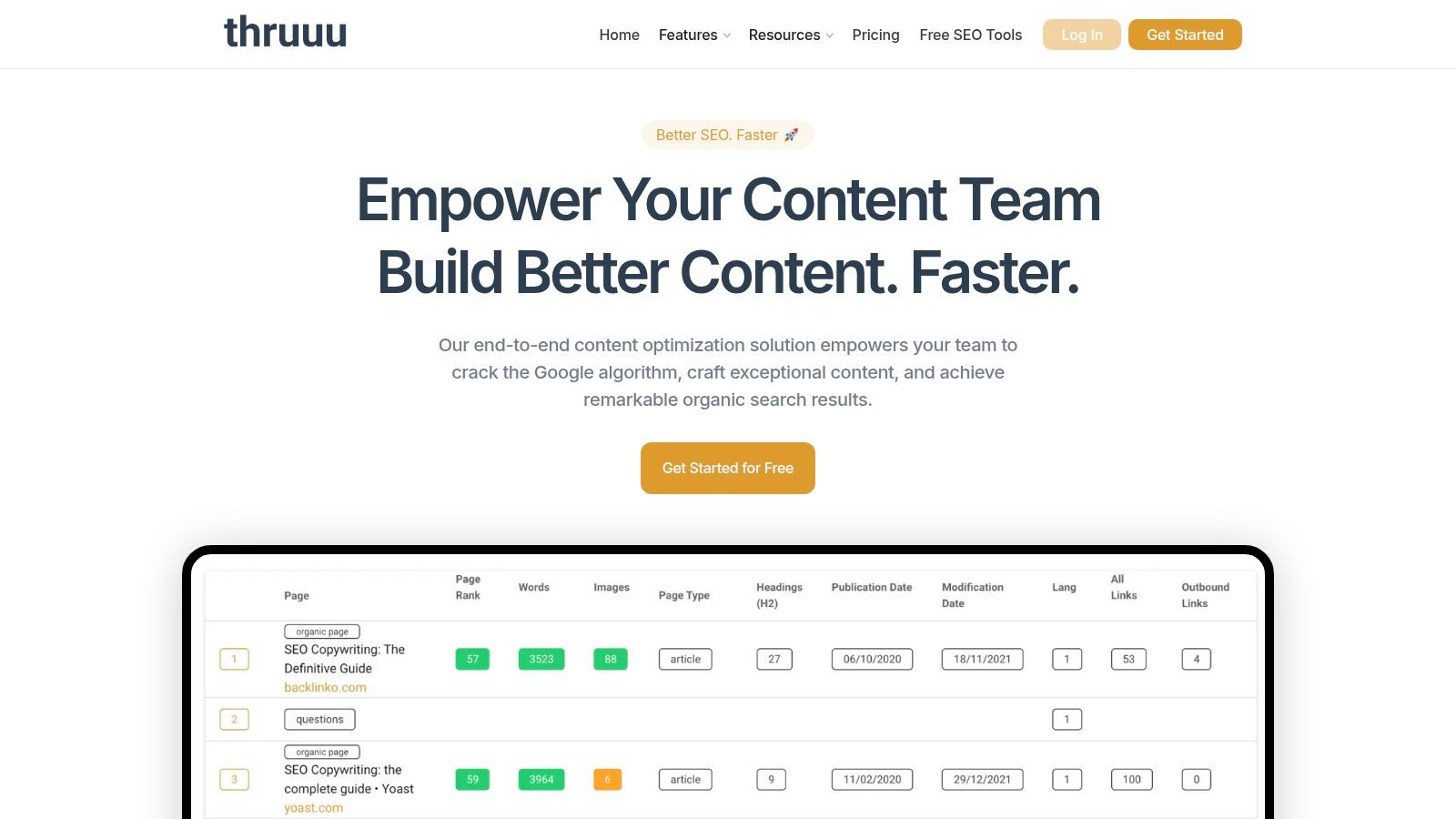
What makes it a fantastic tool for content creators is its seamless integration with content planning. After clustering, Thruuu can generate detailed, AI-powered content briefs based on the SERP analysis for that specific cluster. This bridges the gap between keyword research and actual content creation, providing a clear roadmap for writers. It’s one of the best keyword clustering tools for those who want to turn data directly into actionable content outlines.
Key Info & Pricing
- Best For: Content strategists and SEOs who need to quickly move from keyword grouping to creating detailed, SERP-informed content briefs.
- Pricing: A free plan is available for basic analysis. Paid plans with more credits and advanced features start at around $19/month.
- Standout Feature: The direct-to-brief workflow, which uses real-time SERP data to build both your keyword clusters and the content outlines needed to rank for them.
Link: Thruuu Website
8. Surfer SEO
Surfer SEO is primarily known for its on-page optimization and content editing capabilities, but its Content Planner feature is a powerful tool for building keyword clusters. When you input a broad, head-term keyword, Surfer analyzes top-ranking pages to generate dozens of topic clusters. Each cluster comes with a list of relevant keywords, all grouped by shared search intent. This approach is built for action, helping you map out an entire content hub or pillar page strategy in minutes.
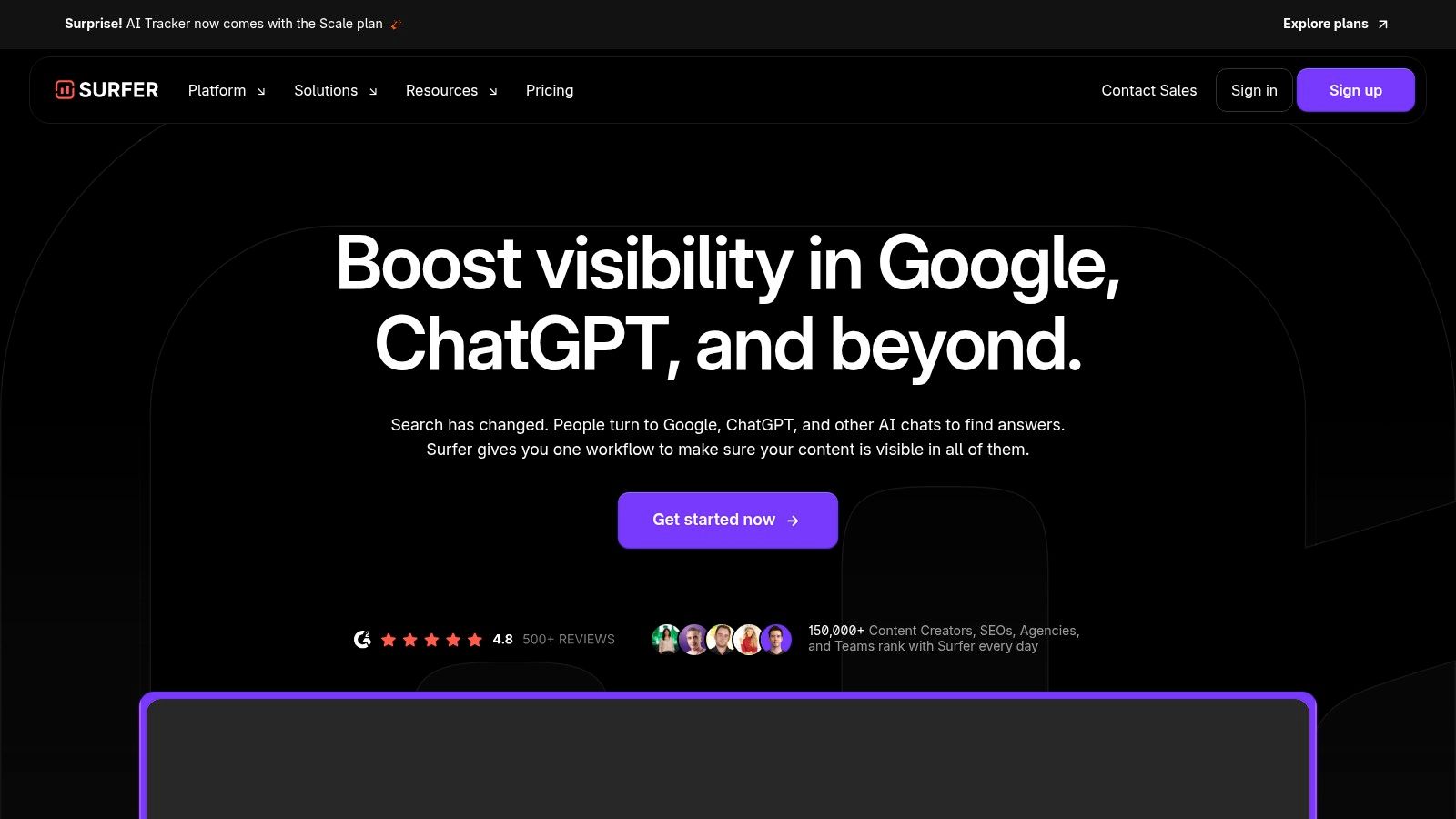
What makes Surfer's method unique is its direct connection to content creation. It doesn't just give you clusters; it creates a content brief for each one, complete with competitor analysis, keyword density recommendations, and structural outlines. This makes it one of the most practical keyword clustering tools for teams focused on immediate content production rather than just theoretical research. It bridges the gap between keyword strategy and writing.
Key Info & Pricing
- Best For: Content marketers and SEOs who want to go directly from cluster analysis to content creation within a single, streamlined workflow.
- Pricing: Access to the Content Planner is included in all paid plans, which start at around $89/month when billed monthly.
- Standout Feature: The seamless integration between the Content Planner's keyword clusters and the Content Editor, which provides real-time writing guidance.
Link: Surfer SEO Website
9. Cluster AI
Cluster AI is a purpose-built tool designed for one thing: processing massive keyword lists and turning them into clean, SERP-based topic clusters. It's a no-frills, highly efficient platform that strips away the complexities of all-in-one suites. You simply paste your keyword list, which can be exported from tools like Ahrefs or SEMrush, and Cluster AI analyzes the top 10 search results for each term to group them based on overlapping URLs.
What makes it stand out is its simplicity and pay-as-you-go model. You're not locked into a monthly subscription, making it perfect for agencies or freelancers who need to run large-scale clustering projects periodically. The output is a straightforward, exportable file that shows which keywords belong on the same page, providing a clear roadmap for content creation. While it doesn't offer advanced content planning, its core function as one of the most direct keyword clustering tools is exceptionally reliable. For a deeper dive into how this approach fits into a modern strategy, you can learn more about using AI for SEO.
Key Info & Pricing
- Best For: SEOs and agencies needing to process huge keyword lists (10,000+) quickly without a recurring subscription.
- Pricing: Pay-as-you-go model, typically charging a few cents per keyword. For example, processing 1,000 keywords costs around $39.
- Standout Feature: The sheer speed and accuracy of its SERP-based clustering for bulk lists, combined with a simple, cost-effective pricing structure.
Link: Cluster AI Website
10. Zenbrief
Zenbrief takes a different approach by tightly integrating keyword clustering directly into the content creation workflow. Rather than just giving you a list of grouped keywords, it uses its AI to analyze the SERP for a primary topic and then automatically clusters relevant keywords and entities. This process is designed to feed directly into its core function: generating comprehensive, SEO-optimized content briefs. It’s less of a pure research tool and more of a strategic content-planning assistant.
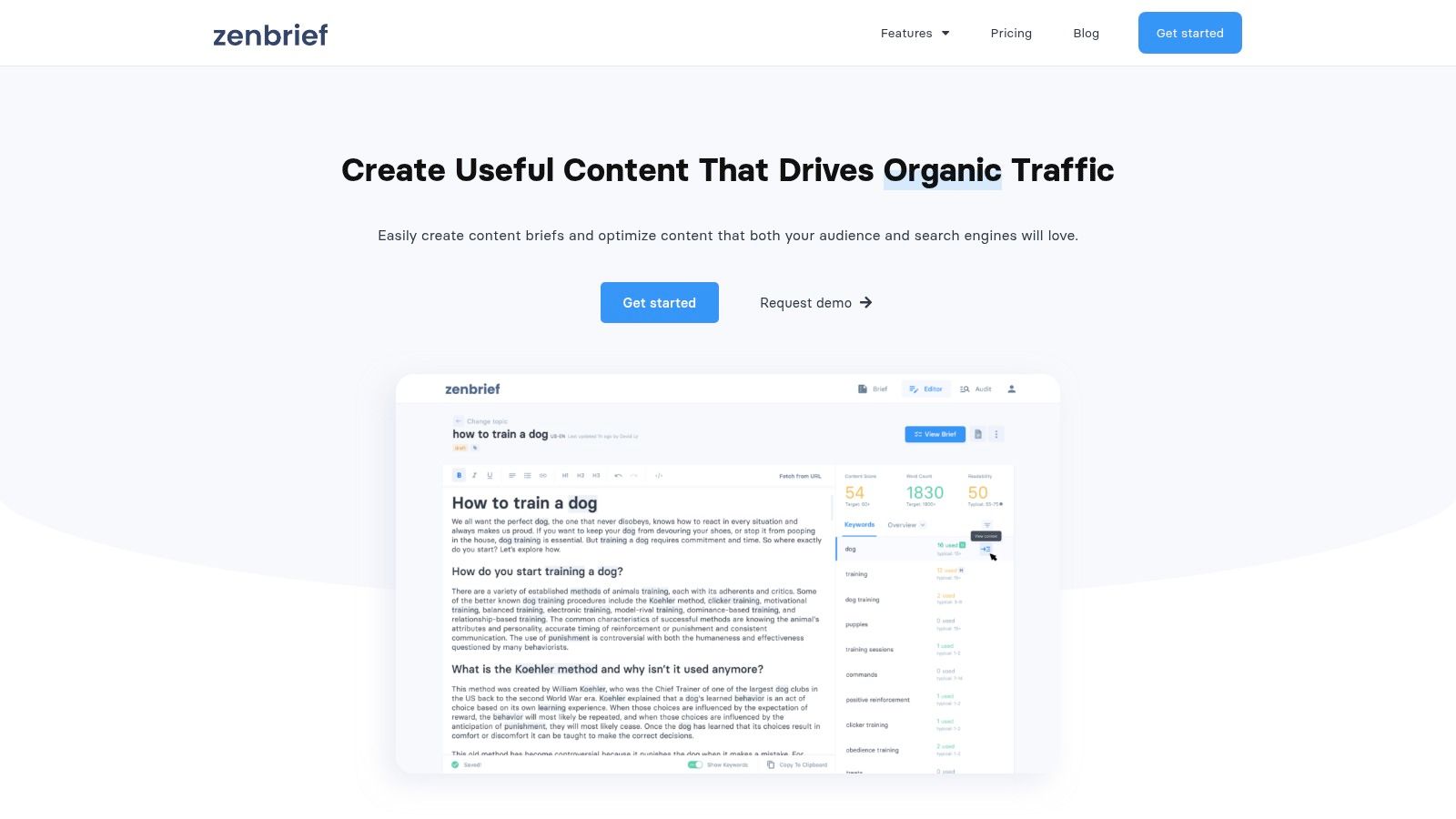
What makes it stand out is this direct pipeline from SERP analysis to a structured content outline. Zenbrief analyzes top-ranking pages to identify common headings, questions, and related topics, using these insights to form its clusters. This makes it one of the most actionable keyword clustering tools for writers and content managers who need to go from idea to a ready-to-write brief quickly. The focus is on immediate content performance and covering a topic with the depth Google expects.
Key Info & Pricing
- Best For: Content teams and SEOs who want to streamline the process from keyword clustering to creating data-driven content briefs.
- Pricing: Plans are credit-based, with the Starter plan beginning at $49/month for 5 content briefs.
- Standout Feature: The seamless integration of AI-powered keyword clustering with SERP analysis and automated content brief generation.
Link: Zenbrief Website
11. Scalenut
Scalenut is an AI-powered content and SEO platform that has fully embraced the topic cluster model from the ground up. Its approach is less about giving you a list of keywords to cluster yourself and more about doing the heavy lifting for you. When you run its Keyword Planner for a primary topic, Scalenut automatically analyzes the SERPs and generates ready-made keyword clusters, complete with primary and secondary terms for each. This makes it one of the most beginner-friendly keyword clustering tools available.
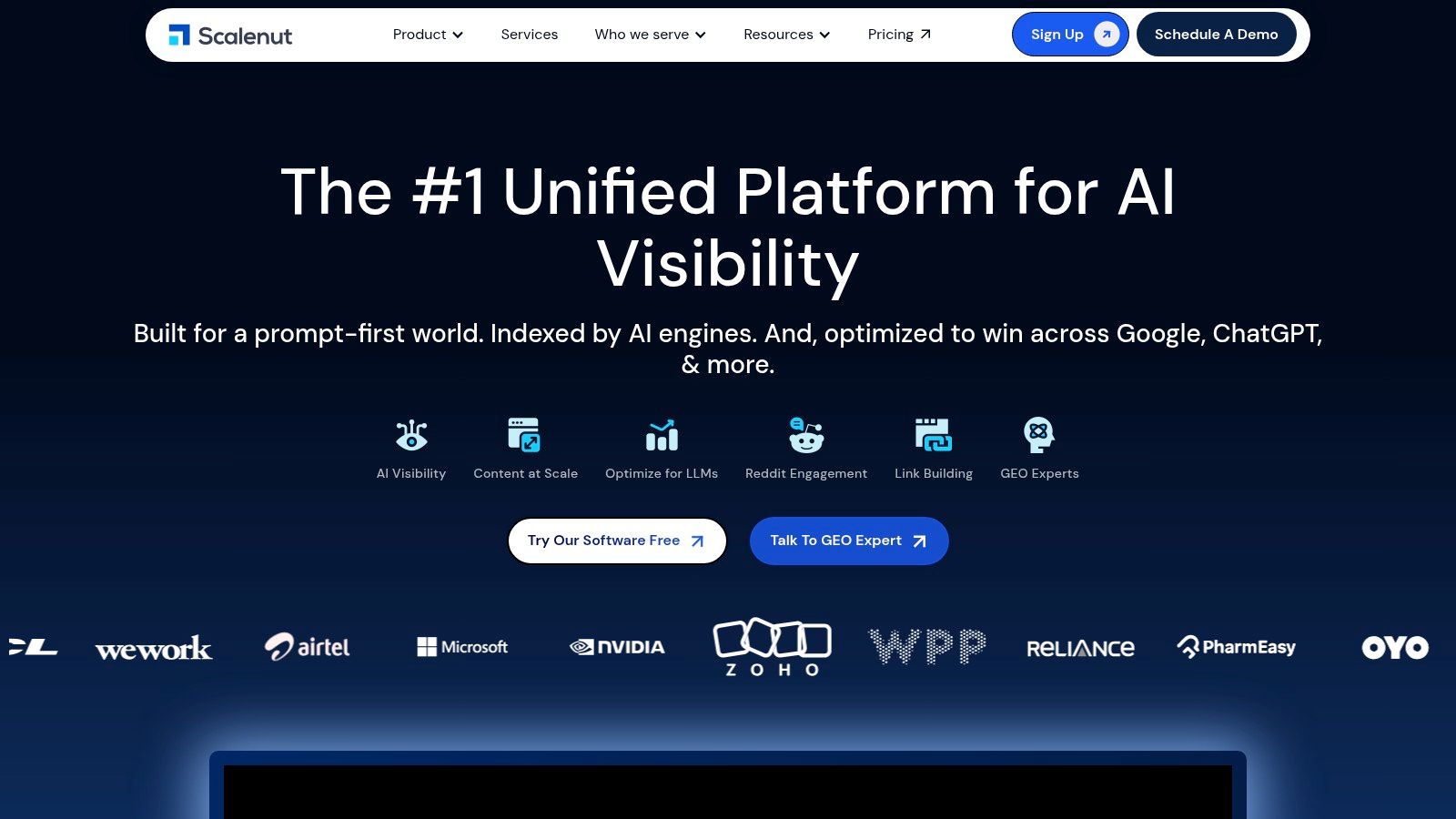
What sets Scalenut apart is its direct integration with content creation. Once you have your clusters, you can generate an AI-powered content brief or even a full first draft for any cluster with a single click. This seamless workflow, from research to clustering to writing, is designed to rapidly build out pillar pages and their supporting content, making it a fantastic tool for content marketers focused on scaling their output based on a solid topical authority strategy.
Key Info & Pricing
- Best For: Beginners, solopreneurs, and content marketers who want a streamlined, automated process from keyword research to content creation.
- Pricing: Clustering features are available on paid plans, which start at approximately $39/month. Higher tiers offer more credits and advanced features.
- Standout Feature: The one-click functionality to generate an entire topic cluster, complete with relevant keywords and search volume data, fully automated by AI.
Link: Scalenut Website
12. Keyword Tool
While not a traditional keyword clustering tool with automated grouping, Keyword Tool earns its spot by providing an exceptional source of long-tail keywords perfect for manual clustering. It scrapes Google Autocomplete data to generate hundreds, sometimes thousands, of keyword variations from a single seed term. This is incredibly useful for discovering what real users are actually searching for, especially question-based queries and hyper-specific long-tail phrases that other tools might miss.
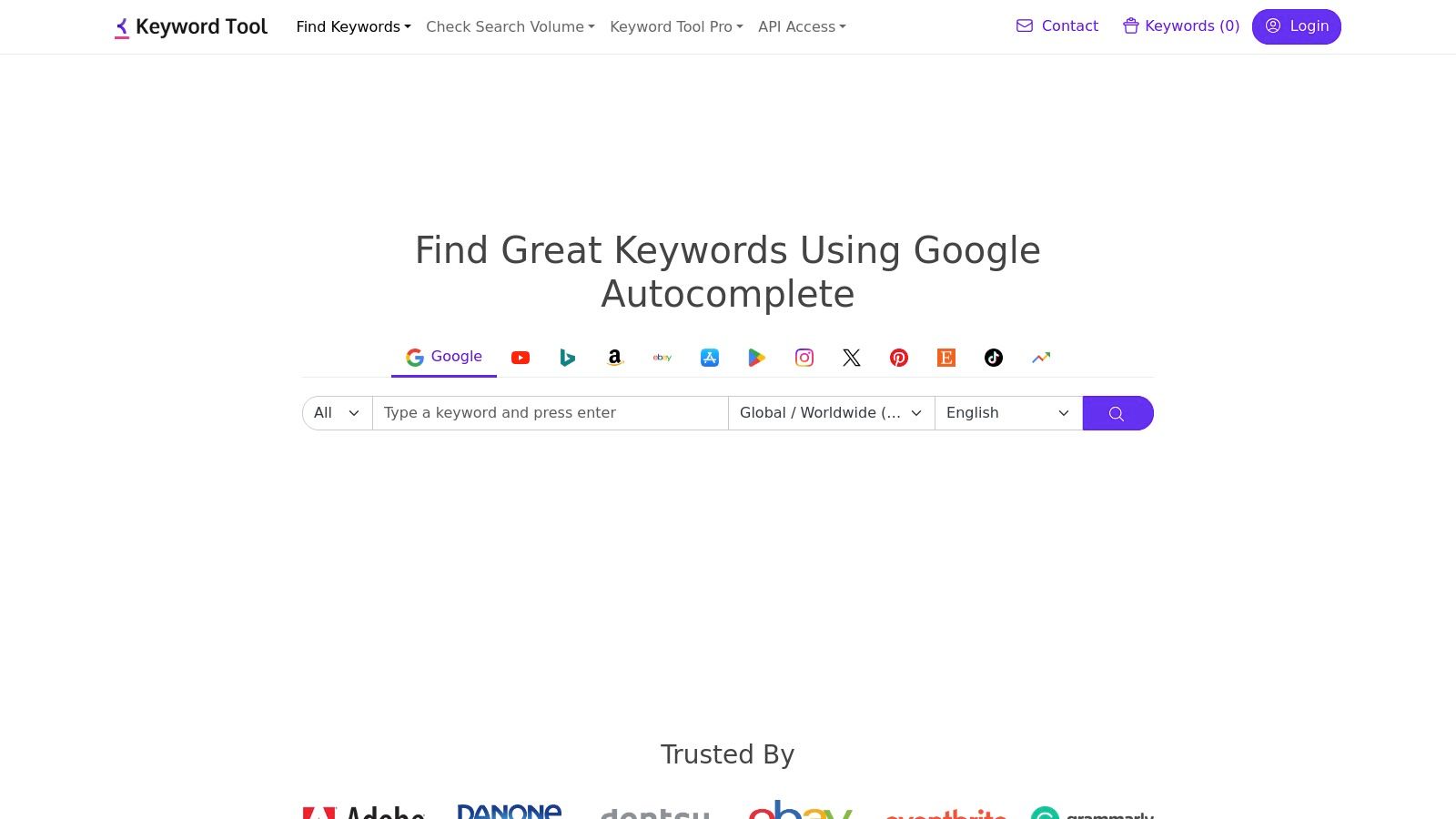
The platform’s strength lies in its simplicity and multi-platform support. You can pull keyword ideas not just from Google, but also from YouTube, Bing, Amazon, and even Instagram. After exporting the extensive list, you can use a spreadsheet or another tool to group these semantically related terms. It excels at the "data gathering" phase, giving you a rich, user-intent-driven dataset to build your clusters from.
Key Info & Pricing
- Best For: SEOs and content creators who need a massive list of long-tail and question-based keywords to manually build topic clusters.
- Pricing: A generous free version is available with limitations. Paid plans (Keyword Tool Pro) start at $69/month (billed annually) to unlock search volumes and other data.
- Standout Feature: Its ability to generate keyword ideas from multiple search engines and platforms, uncovering unique, low-competition opportunities.
Link: Keyword Tool Website
Keyword Clustering Tools Feature Comparison
| Tool | Core Features / Research Modes | User Experience & Quality ★ | Value Proposition 💰 | Target Audience 👥 | Unique Selling Points ✨ | Price Points 💰 |
|---|---|---|---|---|---|---|
| 🏆 RankHub | AI-powered keyword & competitor analysis; 2 research modes; multi-site dashboard | ★★★★★ Fast, intuitive, 24/7 support | Pay-as-you-go, no subscription fees; credits never expire | SEO pros, agencies, SMBs, freelancers | AI analyzes full site in 60s; competitor gap ID; scalable & flexible | From $9.99/100 credits |
| SEMrush | Keyword clustering; extensive SEO suite | ★★★★☆ Beginner-friendly, comprehensive | Subscription-based, higher priced | Agencies, marketers, SEO experts | Integrated tools; frequent updates | $$$ Subscription required |
| Ahrefs | Keyword & backlink analysis; SERP insights | ★★★★☆ Accurate data, detailed analysis | Premium pricing, no free trial | SEO professionals, agencies | Large database; deep competitor analysis | $$$ Subscription required |
| SE Ranking | Keyword Grouper; customizable groups | ★★★★☆ Easy to use, multi-language | Affordable pricing | Agencies, SMBs, marketers | Language-specific clustering; full SEO toolkit | $-$$ Multiple plans |
| Keyword Cupid | ML-based clustering; interactive maps | ★★★☆☆ Advanced AI, UI a bit outdated | Credit-based, flexible pricing | SEO pros needing large-scale clustering | Neural net clustering; visual keyword maps | Credit packs |
| Keyword Insights | AI-driven clustering; intent & content planning | ★★★★☆ User-friendly, efficient | Volume-based pricing | Content planners, SEO specialists | Search intent detection; content gap ID | Paid plans |
| Thruuu | SERP-based clustering; AI content briefs | ★★★★☆ Accurate data, free plan | Free tier + paid upgrades | Freelancers, small teams | Real-time SERP data clustering; content briefs | Free + Paid plans |
| Surfer SEO | Content planner; intent analysis; density | ★★★★☆ Easy, quick suggestions | Subscription with add-ons | Content marketers, SEOs | Keyword density & competitor insights | $$ Subscription |
| Cluster AI | Bulk clustering; exports; SEO tool integrations | ★★★☆☆ Efficient for large lists | Pay-as-you-go | Agencies managing large datasets | Simple SERP-based clustering; integrations | Credit packs |
| Zenbrief | AI clustering; content briefs; competitor analysis | ★★★☆☆ AI insights, not standalone | Higher priced | Content strategists, SEO experts | Combines clustering with content optimization | $$$ Subscription or plans |
| Scalenut | Automated keyword grouping; content integration | ★★★☆☆ Beginner-friendly | Affordable pricing | Beginners, content marketers | Hands-free clustering; content creation tools | $-$$ Plans |
| Keyword Tool | Multi-platform keyword research; question-based | ★★★☆☆ Free tier; limited searches | Freemium model | Content creators, multi-platform marketers | Focus on long-tail & question keywords | Free + Paid tiers |
Choosing the Right Tool to Build Your Content Empire
And there you have it, a deep dive into the best keyword clustering tools available today. We've navigated the landscape from comprehensive SEO suites like SEMrush and Ahrefs to specialized, AI-powered platforms like RankHub and Keyword Cupid. The single most important takeaway is that the days of manually grouping keywords in spreadsheets are officially over. It's not just inefficient; it's strategically shortsighted.
By adopting one of these tools, you're not just saving countless hours. You're gaining a data-driven map of your audience's search intent, allowing you to build topical authority with precision. This strategic shift moves you from creating individual articles to building a comprehensive content ecosystem that Google and your readers will love. You can finally stop guessing and start building a content strategy that systematically covers every facet of a topic, leaving no gaps for competitors to exploit.
How to Pick Your Perfect Match
So, how do you choose the right tool from this list? It all comes down to your specific context. Don't just chase the tool with the most features; pick the one that solves your biggest bottleneck.
Consider these factors:
- For Agencies and Consultants: Your priority is likely efficiency, scalability, and client reporting. Tools like SE Ranking or Keyword Insights offer a great balance of power, collaboration features, and cost-effectiveness for managing multiple projects.
- For In-House SEO Teams: You need a tool that integrates seamlessly into a broader marketing stack. The clustering features within an all-in-one platform like SEMrush or Ahrefs might be the most logical choice, as they connect directly to your rank tracking and site auditing workflows.
- For Solopreneurs and Small Businesses: Budget and ease of use are paramount. A pay-as-you-go model like ClusterAI or a freemium tool like Thruuu provides a low-risk entry point into the world of automated keyword clustering.
- For Content-Focused Strategists: If your primary goal is to perfect your content briefs and on-page SEO, a tool like Surfer SEO or Scalenut that combines clustering with content optimization is a perfect fit.
Putting Your Tool to Work
Remember, a tool is only as good as the strategy behind it. Once you’ve made your choice, the real work begins. Focus on turning those clusters into a tangible content plan. Use the groups to map out your pillar pages and supporting cluster content. This structured approach is what truly drives organic growth.
While a dedicated keyword clustering tool is a game-changer for content planning, a successful strategy relies on a full toolkit. For a broader look at what else you should have in your arsenal, check out this guide to other essential SEO tools to round out your capabilities. Now, it's your turn. Pick the tool that aligns with your goals, start building those powerful topic clusters, and get ready to watch your content empire rise.
Ready to experience the power of hyper-accurate, AI-driven keyword clustering? RankHub was designed to give you SERP-based topic clusters in minutes, not hours. See for yourself how easy it is to build a dominant content strategy by trying RankHub today.
More from Our Blog
40 Sweet S Names That Stand Out for Your Baby
Discover 11 adorable S names for babies, from classic Sophia to unique Stellan. Compare styles, meanings, and popularity with data-backed recommendations.
Read more →
7 Content Writing Tools That Boost Your SEO Rankings
Discover the top 9 SEO content writing tools to automate drafting, optimization, and publishing. Boost rankings with AI-assisted workflows.
Read more →
5 Pro Tips for Creating Outstanding Audiobooks with ElevenLabs
Master ElevenLabs audiobooks with expert tips on production, distribution, quality control, and monetization. Learn from industry professionals.
Read more →