
To really get a handle on keyword competition, you have to look past the obvious stuff like search volume. The real story is in the authority of the domains already ranking, the quality of their content, and what people are actually looking for—the search intent behind the query. This means firing up your favorite SEO tools to check out metrics like Domain Authority and backlink profiles, but it also means getting your hands dirty and manually digging into the SERPs to see what Google is actually rewarding.
Why Keyword Competition Analysis Is Your Secret Weapon

Jumping into an SEO campaign without analyzing the competition first? That’s like trying to sail across the ocean without a map. Sure, you might get lucky, but you’re far more likely to waste a ton of time and money fighting against currents you never had a chance of beating. A deep dive into the competitive landscape is, without a doubt, the foundation of any smart SEO strategy.
When you truly understand your rivals' strengths and weaknesses, you gain a massive upper hand. It’s how you sidestep the unwinnable battles and, more importantly, pinpoint those golden opportunities where you can actually rank and pull in traffic.
Moving Beyond Simple Metrics
So many people get hung up on one thing: search volume. It’s an exciting number, but it's a vanity metric if you can't realistically crack the top 10. Real success comes from focusing on ROI and smart market positioning, and that requires a much more detailed approach. I always think of this process as my pre-flight check; it ensures my content marketing efforts are cleared for takeoff from day one.
A proper analysis helps you:
- Find Achievable Targets: You'll uncover keywords where you have a real shot at ranking, instead of just chasing terms dominated by household names.
- Spot Content Gaps: It becomes obvious what topics your competitors are crushing, but even better, you'll see what they’re completely missing.
- Shape Your Content Strategy: You'll learn what type of content is already winning for a query, whether it's long-form blog posts, videos, or product pages.
The goal isn't just to find keywords; it's to find your keywords. These are the terms that align perfectly with your business goals, match what your audience is searching for, and offer a clear path to landing on page one of Google.
The Real-World Impact
Let's make this real. Imagine you run a small e-commerce shop selling artisanal coffee beans. Targeting a massive term like "coffee" is a recipe for disaster. You'd be up against global brands with marketing budgets bigger than your entire company's revenue. It's just not going to happen.
However, a solid competitive analysis might reveal a gem like "single origin Ethiopian coffee for French press." This is where the magic happens. This long-tail keyword is far less competitive and has sky-high purchase intent.
By focusing your efforts there, you attract a super-qualified audience that’s much closer to buying. Suddenly, you’re not a tiny boat in a vast ocean; you're the big fish in a smaller, much more profitable pond. This strategic pivot, born from smart competition analysis, is what separates the businesses that thrive from those that just spin their wheels in organic search.
Getting to Grips with the SEO Metrics That Actually Matter
When you first dive into keyword competition, it’s easy to get lost in a sea of acronyms and scores. SEO tools are notorious for throwing a dozen different metrics at you, but which ones really tell you if you stand a chance of ranking?
The secret is to look beyond the big, flashy numbers and understand the full story they're telling together.
A lot of people start (and stop) with metrics like Domain Authority (DA) from Moz or Domain Rating (DR) from Ahrefs. These are basically a website’s overall "strength" score, graded on a 1 to 100 scale. A high score usually signals a tough competitor, but it's definitely not the end of the story.
Don't Let a High Domain Score Scare You Off
I’ve seen it a hundred times: a site with a DA of 40 outranking a behemoth with a DA of 75. How? The smaller site’s page was a masterpiece of optimization. It had incredibly relevant backlinks pointing right to it and absolutely nailed what the user was looking for.
A high domain score gives a site a head start, for sure, but it doesn't mean they automatically win the race for every keyword.
This is exactly why you have to get more granular. Forget the overall domain for a second and focus on the specific page that's holding that top spot. Here's what I look at to get the real picture:
Referring Domains: How many different websites are linking to that specific page? A page with links from 50 unique, relevant sites is far more powerful than one with 200 links from just a couple of spammy-looking domains.
Backlink Quality: Where are those links coming from? You need to check if they're from trusted, authoritative sites in your niche. One single link from a major industry blog can be worth more than a hundred from low-quality web directories.
Page-Level Authority: Tools like Ahrefs also have page-specific scores (they call it URL Rating or UR). This metric tells you how strong the exact URL you're up against is, which is often way more insightful than the domain-wide score.
Key takeaway: You're not competing against an entire website; you're competing against one specific page. A huge, authoritative domain can still have plenty of weak pages, and those are your golden opportunities.
A Quick Guide to Core Competition Metrics
To make this easier, here’s a quick-reference table breaking down the essential metrics. Think of this as your cheat sheet for sizing up the competition on the search results page.
Key Keyword Competition Metrics Explained
A quick reference guide to the essential metrics for analyzing keyword competition and what they indicate about your chances to rank.
| Metric | What It Measures | Why It Matters | Tool to Find It |
|---|---|---|---|
| Domain Authority/Rating (DA/DR) | A website's overall authority and backlink strength. | Gives a general idea of a site's power, but can be misleading. | Moz, Ahrefs, Semrush |
| Page Authority/URL Rating (PA/UR) | The authority and backlink strength of a specific page (URL). | More accurate for assessing the direct competitor you're facing. | Moz, Ahrefs |
| Referring Domains (to Page) | The number of unique websites linking to a specific page. | Shows the diversity of the page's backlink profile. | Ahrefs, Semrush, Majestic |
| Content Quality & Relevance | How well the content satisfies the user's search intent. | The ultimate tie-breaker; Google prioritizes helpful content. | Manual Review, SurferSEO |
This table isn't exhaustive, but it covers the heavy hitters you should be looking at every single time. It helps you move from a gut feeling to a data-backed strategy.
Putting It All Together for a SERP Takedown
Thinking like a seasoned SEO means pulling all these data points together to build a complete picture. The competition is no joke—the global SEO market was valued at a whopping $82.3 billion in 2023 and is on track to hit $143.9 billion by 2030.
With around 53% of all website traffic coming straight from organic search, mastering this analysis is non-negotiable.
So, when you see a competitor with a high DA, don't see it as a stop sign. See it as a signal to start digging. Go investigate their backlink profile. Pick apart their on-page SEO. Actually read their content.
More often than not, you'll find the chinks in their armor—maybe the information is outdated, the user experience is clunky, or they're missing those truly high-quality backlinks. These weaknesses are your way in. To get a better sense of what Google is really looking for, check out our guide on the most important search engine ranking factors. This is how you stop just measuring the competition and start strategically outsmarting them.
Your Toolkit for Smart Competitor Research
You can't just rely on a spreadsheet and a gut feeling to figure out keyword competition. To really get the lay of the land, you need the right tools to act as your eyes and ears on the search results page. And while the big-name platforms offer incredible depth, you can still pull a ton of valuable intel without spending a dime.
The heavy hitters in the SEO world, like Ahrefs and Semrush, are industry standards for a good reason. They give you a firehose of data, letting you pick apart a competitor's backlink profile, find their best-performing content, and see the exact keywords bringing them traffic. This is where you get the hard numbers on things like referring domains and page-level authority.
The Power of Premium SEO Tools
For any serious keyword analysis, these platforms are your mission control. The sheer volume of data they handle is mind-boggling. For instance, Ahrefs' keyword database shot up from 20.8 billion keywords in 2024 to an incredible 28.7 billion by March 2025. That explosion tells you just how vast the search landscape is and why you need a powerful tool to make sense of it all.
With a tool like this, you can start answering the really important questions:
- Which specific pages on a competitor's site are pulling in the most organic visitors?
- How strong are the backlinks pointing to their top-ranking articles?
- Are there any "keyword gaps"—terms they're ranking for that you haven't even thought of yet?
If you're trying to figure out which platform is right for you, check out our guide on the https://rankhub.ai/blog/best-keyword-research-software. It breaks down the options to help you choose based on your needs and budget.
My Personal Tip: Don't get fixated on the overall domain metrics. Always, always drill down to the specific URL that's actually ranking. You'll often discover that a site with a high domain rating is ranking with a surprisingly weak page. That's your opening.
Don't Overlook Free Resources
While the premium tools are game-changers, you don't need a paid subscription to get started. There are plenty of free resources that can give you a solid high-level view.
The MozBar is a must-have. It’s a simple browser extension that overlays key metrics like Domain Authority (DA) and Page Authority (PA) right on top of the search results. It’s perfect for a quick, at-a-glance assessment to see if a keyword is even worth digging into further.
And of course, the most powerful free tool you have is Google itself. Actually looking at the SERP for your target keyword is non-negotiable. Pay attention to the types of content ranking—are they blog posts, videos, product pages? Note the featured snippets and "People Also Ask" boxes. This manual review is how you uncover the search intent Google is trying to serve.
Remember, keyword research is just one piece of the puzzle. To really understand what your rivals are up to, you need to look at their overall strategy. Learning how to conduct competitive analysis will help you connect the dots and turn all this keyword data into a winning game plan.
Reading the SERP to Figure Out Search Intent

Metrics like Domain Authority and keyword difficulty scores are great for a first pass, but they don't tell the whole story. Not even close. The real craft of keyword analysis comes from rolling up your sleeves and digging into the search engine results page (SERP) yourself. It’s the only way to see what Google actually thinks searchers are looking for.
This manual check is an absolute must-do. Why? Because it’s where you uncover the all-important search intent behind the keyword. Google's algorithm has gotten insanely good at knowing if someone's looking to buy, learn, or find a specific site. What's already ranking is basically Google showing you its hand.
What Kind of Content is Winning?
First thing's first: look at the types of content that are already on page one. Is it a wall of long-form blog posts? A grid of e-commerce product pages? A bunch of videos? The answer gives you a massive clue about what you need to create to even be in the running.
Let's say you search for "best running shoes for beginners" and the top five results are all "Top 10" listicles. If you try to rank a single product page for that term, you're just setting yourself up for failure. Google has clearly decided that searchers in this moment want comparisons and detailed reviews, not just a "buy now" button.
This kind of qualitative deep-dive is your secret weapon. It’s how you spot the content gaps and find opportunities to create something that’s genuinely better, more thorough, or hits an angle everyone else has missed.
Don't just stop at the format, either. Scan the page titles and meta descriptions for common themes. What angles are your competitors using to hook people in? Are they all focused on price? Speed? Simplicity? Spotting the dominant angle lets you decide if you should follow suit or, even better, come in with a completely fresh take that grabs attention.
Finding Your Opening
This hands-on SERP analysis is your best defense against wasting time and money. You might find that a keyword that looks easy on paper is completely owned by YouTube videos or Reddit threads. That tells you loud and clear that for this topic, users want to see it in action or get advice from a community.
Use what you learn to find your unique opening. If the entire first page is filled with "10-Step Guides," maybe there's a huge opportunity for a detailed case study or a "Complete Beginner's Guide" that breaks things down even further. Honing your ability to read these nuances is a huge part of the game. If you're new to the concept, learning more about what is search intent will seriously sharpen your strategy.
Ultimately, you're trying to answer a few simple questions:
- What content format is working? (Blog posts, product pages, videos, etc.)
- What's the main hook or angle? ("Cheap," "fast," "for beginners," "in 2024")
- Are there any special SERP features? (Featured Snippets, People Also Ask boxes, image packs)
Once you have these answers, you've moved beyond just looking at numbers on a spreadsheet. You now have a real, actionable plan for creating content that doesn't just compete on authority, but wins by actually being more helpful to the person searching.
Building a Repeatable Keyword Analysis Workflow
Having a solid process for analyzing keyword competition is what separates the pros from the amateurs. It’s the difference between consistent wins and just taking shots in the dark. What you need is a system—a reliable framework you can lean on every single time you’re sizing up a new keyword.
This isn't about some rigid, cookie-cutter formula. Think of it more as a flexible loop that takes you from a messy list of keywords to a clear "go" or "no-go" decision. This way, you stop chasing vanity metrics like search volume and start strategically picking battles you can actually win.
Start with a Simple Scoring System
The best way I’ve found to bring some order to the chaos is by using a simple scoring system. It’s a lifesaver for comparing keywords objectively, especially when you’re staring at a list of hundreds.
I just use a basic spreadsheet to score each keyword across three main areas:
- Relevance Score (1-5): How perfectly does this keyword match what we offer? A 5 means it’s a direct hit for our ideal customer. A 1 is a long shot.
- Difficulty Score (1-5): Based on all the data (DA/DR, referring domains) and my own gut check of the SERP, how hard will this be? A 1 means it’s wide open, while a 5 is a fortress I’m not ready to storm.
- Value Score (1-5): What’s the real business potential? A keyword with obvious buying intent gets a high score. Something purely informational gets a lower one.
Just add up those three numbers, and you've got a total score for each keyword. This simple math instantly pushes your best opportunities to the top and lets the duds sink to the bottom. It gives you a prioritized action plan in minutes.
Combining Hard Data with Your Gut Feeling
Your scoring system provides the structure, but your experience and intuition are what make it work. As you start filling out your spreadsheet, you’ll begin to notice patterns. A keyword might have a low difficulty score, which looks great on the surface, but if its relevance score is also a 1, it's a dead end. Easy to rank for, but for the wrong audience.
On the other hand, a highly relevant keyword with a big value score might be worth going after even if the competition is stiff. The framework doesn't make the final call for you; it just organizes the information so you can make a smarter one, faster.
This is especially powerful for unearthing valuable long-tail keywords. The global market for keyword research tools is now worth around $1.2 billion for a reason—these tools are incredible at finding less competitive terms that convert like crazy.
Making the Final Call
Once your list is scored and sorted, the last step is simple.
Keywords with a high total score are your top priorities. Get them into your content calendar immediately. The ones with really low scores? Archive them. They aren't worth the effort right now.
The terms stuck in the middle are your "maybes." You can circle back to them later or try to find a different, more creative angle. This entire process can be streamlined even further by mastering automated keyword research.
By turning this into a repeatable habit, you transform a messy, unpredictable task into a strategic part of your SEO machine.
Common Questions About Keyword Competition
Even with a solid workflow, some questions always seem to pop up when you're digging into keyword competition. That's just how SEO works. The data can feel a bit fuzzy sometimes, and you’re left having to make a judgment call. Let's tackle a few of the most common head-scratchers I hear all the time.
A big one is, "What if my SEO tools show totally different difficulty scores?" This happens constantly. You’ll see one tool flag a keyword as "easy" while another calls it "hard."
The thing to remember is that every tool—whether it's Ahrefs, Semrush, or another—uses its own secret sauce to calculate that score. They all weigh things like backlink profiles and domain ratings a little differently. So, instead of treating one score as the absolute truth, think of them as directional hints. If two major tools agree a keyword is a beast, it probably is. If they disagree, that’s your cue to roll up your sleeves and do a deeper manual SERP analysis yourself.
How Do I Deal with High-Authority Competitors?
Another classic question: "Can I really outrank a behemoth like Wikipedia or Forbes?" The short answer is yes, but you have to be smart about it. You're not going to win a head-to-head fight on authority, so you have to win on specificity and user intent.
For instance, if a massive site has a 5,000-word general guide, you can swoop in with a hyper-specific piece of content that serves a slice of that audience perfectly. Think "for small e-commerce stores" or "for beginners in 2024." Your goal is to become the absolute best answer for a much more focused query.
The trick is to reframe the problem. Stop asking, "How can I beat them?" and start asking, "What part of this audience are they failing to serve perfectly?" That's where you'll find your opening.
This flow chart breaks down the process, moving from broad metrics to a detailed look at the actual competition.
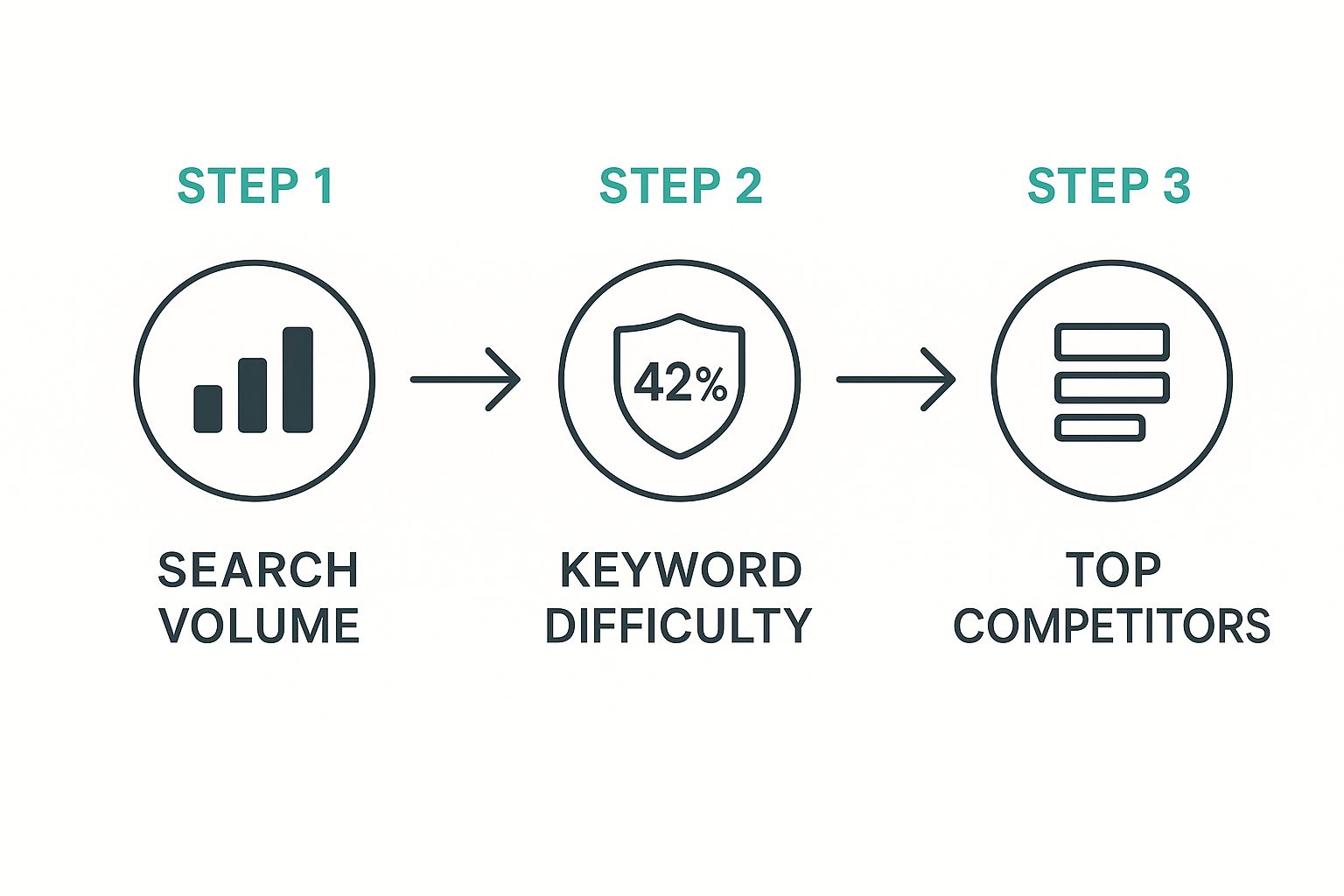
Following this path ensures you aren't just chasing big volume numbers. It forces you to confirm that a keyword is actually attainable by checking out who you'd be up against.
What if I Can't Find Any "Easy" Keywords?
It's easy to feel discouraged when it seems like every keyword you find is locked down by heavy hitters. When this happens, it usually just means it's time to get more creative with your long-tail strategy. You need to dig deeper than the obvious head terms and start thinking about the real questions your customers are asking.
Try these angles to uncover some less-contested terms:
- "Vs" Keywords: These are fantastic for comparison posts (e.g., "ahrefs vs semrush for competitor analysis").
- "Alternative To" Keywords: You can position your content as the go-to solution for people looking to make a switch (e.g., "mozbar alternative for chrome").
- Use-Case Keywords: Get super specific by focusing on how a product or service is used in a particular scenario (e.g., "how to analyze keyword competition for a local business").
These longer, more specific phrases almost always have lower search volume, but they make up for it with much higher conversion intent. These are the hidden gems that a solid competition analysis helps you find, letting you build momentum even in a super crowded space.
More from Our Blog
Market Research Platforms in 2026: What the Data Shows
Explore the latest data on online market research platforms: market size, AI adoption, mobile trends, and what researchers are investing in now.
Read more →
Affiliate Marketing for Beginners: Everything You Need to Know to Start
Learn affiliate marketing from scratch. Discover how to choose a niche, join programs, create content, and earn your first commission today.
Read more →
7 Proven Strategies SEO Experts Use for Content Marketing
Learn proven SEO content marketing strategies from experts. Discover AI-assisted tactics, content refresh techniques, and measurement frameworks that drive 29-169% growth.
Read more →