
Ever wondered what separates an ecommerce store that just exists from one that consistently grows and pulls in new customers? It's not luck. It's a solid ecommerce content strategy.
Think of it as your brand's game plan. Instead of just randomly posting on social media or throwing up a blog post here and there, a strategy gives every piece of content a specific job to do. It’s the difference between shouting into the void and having a real conversation with people who actually want to buy what you're selling.
Why Bother With an Ecommerce Content Strategy?

In today's jam-packed online world, just having products on a page is a surefire way to get ignored. A smart content strategy is what makes your brand stand out. It’s how you go from hoping for traffic to building a reliable engine that brings your ideal customers right to your digital doorstep.
Without a plan, your marketing is basically a guessing game. You might get a sale here and there, but you won't know why. A documented strategy gives you a roadmap, making sure every product description, video, and email has a clear purpose tied to a real business goal. This is huge, because modern shoppers want more than a simple transaction—they're looking for answers, help, and a brand they can actually connect with.
It's About Relationships, Not Just Transactions
The best strategies focus on solving your customers' problems first. Let's say you sell high-end running shoes. Your potential customer probably isn't searching for your specific product model. Instead, they’re Googling things like "how to prevent shin splints" or "best shoes for marathon training."
By creating content that answers those questions, you become a trusted expert, not just another online store. You're building trust way before they're even thinking about pulling out their credit card. When they are ready to buy, guess who they'll remember? The brand that already helped them out.
A documented content strategy lets you be proactive, not reactive. You stop guessing what to create and start following a plan that meets customers exactly where they are, from the moment they start researching to the day they click "buy."
This shift turns your content from a line item in your budget into a genuine business asset that works for you 24/7, driving organic traffic and sales. Ultimately, a great content strategy for ecommerce builds a community around your brand, creating loyal fans who keep coming back and telling their friends.
Here's what you stand to gain:
- More Organic Traffic: When you create content that answers real questions, search engines notice. You start attracting qualified visitors without paying for every single click.
- Greater Customer Trust: Being genuinely helpful makes people see you as an authority. That confidence makes it much easier for them to decide to buy from you.
- Higher Conversion Rates: Good content answers questions and removes doubts, smoothing out the path to purchase and leading to more completed checkouts.
- Stronger Brand Loyalty: A steady flow of valuable content keeps your brand on your customers' minds, encouraging them to stick around long after their first purchase.
The Pillars of a Powerful Content Strategy
To build an ecommerce content strategy that actually sells, you need a rock-solid foundation. Think of it like building a house—you don't just start throwing up walls and hope for the best. You need a blueprint, and that blueprint is supported by a few key pillars. These pillars make sure every single piece of content you create has a purpose and pushes you closer to your business goals.
Let's break down what holds up a winning strategy. Each of these elements is what turns your marketing from a shot in the dark into a predictable growth engine. Without them, you're just adding to the noise.
Understand Your Ideal Customer
Before you write a single word, you have to know who you’re talking to. Seriously. A huge mistake I see all the time is brands defining their audience with vague demographics like "women, ages 25-40." That’s nowhere near specific enough. You need to dig way deeper and build a detailed buyer persona.
A buyer persona is basically a character sketch of your perfect customer. Give them a name, a job, and most importantly, real problems and goals.
- What are their biggest frustrations? Maybe it's, "I can't find durable workout gear that's also stylish."
- What are they trying to achieve? Something like, "I want to feel confident and comfortable during my morning runs."
- What questions are they actually typing into Google? For instance, "best leggings for high-intensity training."
Once you truly get their pain points and dreams, you can create content that genuinely helps them. That's how you build trust long before they even think about clicking "add to cart."
Perform Smart Keyword Research
Okay, so you know who you're talking to. Next up: figuring out what they're searching for online. This is where keyword research comes in, and it's not about stuffing your website with jargon. It’s about uncovering the exact words and phrases your customers use every day.
Think of keywords as the bridge connecting your customer's problem to your product. Using tools to find the right search terms helps you show up exactly where your audience is already looking—on Google. This lets you create blog posts, guides, and product pages that directly answer their questions, making you the obvious choice when they're ready to buy.
A great content strategy is built on empathy. It starts by deeply understanding your customer's world and then uses data like keyword research to connect with them in a meaningful way. This turns your brand from a simple seller into a trusted advisor.
Set Clear and Measurable Goals
A strategy without goals is just a wish. If you want to know if your content is actually doing anything, you have to define what success looks like right from the start. These goals, often called Key Performance Indicators (KPIs), need to be specific, measurable, and tied directly to what you want your business to achieve.
Don't just aim for "more traffic." Get specific with targets like these:
- Increase organic traffic to our blog by 20% in the next quarter.
- Generate 500 new email subscribers per month from our how-to guides.
- Achieve a 5% conversion rate on our top 10 product pages.
Tracking these KPIs tells you what's working and what's a waste of time. It allows you to double down on your wins and tweak your approach as you go, transforming your content from a creative hobby into a measurable business driver.
The infographic below shows how all the different content formats can work together in this strategy.
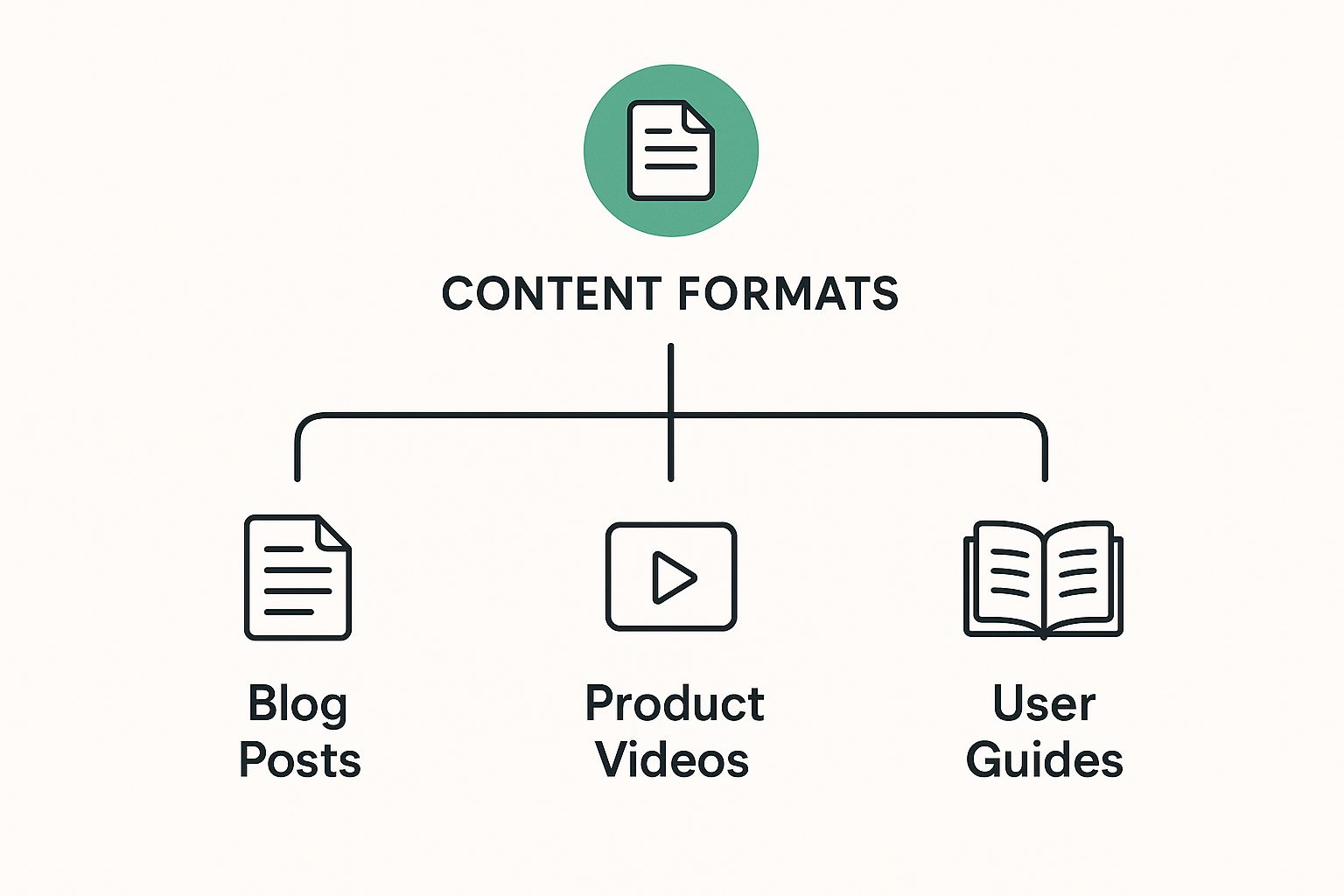
As you can see, things like blogs, videos, and guides all form a cohesive plan to support your bigger goals.
Map Content to the Customer Journey
Finally, you have to map your content to the entire customer journey. Not everyone who lands on your site is ready to buy on the spot. Your content needs to guide them through the different phases: awareness, consideration, and decision.
With global retail eCommerce sales projected to hit a staggering $7.95 trillion by 2027, there are millions of potential customers at every stage of this journey. To capture their attention, you need the right message at the right time. For example, a whopping 87% of consumers say product description quality is the most important factor—which shows just how critical that decision-stage content is. You can check out more compelling ecommerce marketing stats to see what I mean.
- Awareness Stage: The customer has a problem but might not know your brand exists. This is where you create helpful, educational blog posts or social media content.
- Consideration Stage: Now they're actively researching solutions. This is the time for product comparisons, in-depth guides, and case studies to build their trust.
- Decision Stage: They're ready to pull the trigger. Your product pages need to be on point with amazing photos, crystal-clear descriptions, and glowing customer reviews to seal the deal.
By planning your content for each stage, you create a smooth path that nurtures visitors from their very first click all the way to becoming a loyal, repeat customer.
Creating Content That Converts at Every Stage

A great ecommerce content strategy isn’t just about churning out blog posts and social media updates. It's about a much more human approach: creating the perfect piece of content for the right person at the exact moment they need it.
Think about it. A shopper who just realized they have a problem needs something totally different from someone who's already got your product sitting in their cart.
Imagine you're guiding someone through a physical store. You wouldn't hit them with a hard sell the second they walk in. You'd ask questions, help them figure out what they need, show them a few options, and then help them make the final call. Your online content needs to do that same job, leading customers smoothly from one stage to the next.
Let's walk through how to create content that builds real trust and actually drives sales, from that first "hello" to the final click.
Top of the Funnel: Attracting Newcomers
This is the "awareness" stage. People here have a problem or a need, but they might not even know your brand exists. Your goal isn't to sell—it's to be genuinely helpful.
The content you create at this stage should be all about solving problems, answering nagging questions, and educating your audience. You’re aiming to become the go-to, trusted resource in your space.
Here’s what works best:
- Helpful Blog Posts: Write articles that directly address the pain points your ideal customers are facing. If you sell high-end blenders, you could create posts like, "5 Superfood Smoothie Recipes for a Morning Energy Boost" or "How to Pick a Blender That Won't Wake Up the Whole House."
- Shareable Social Media Content: Jump on platforms like Instagram, TikTok, or Pinterest with visually engaging content. Think quick video tips, slick infographics, or inspiring stories from other customers. This stuff is designed to be shared, introducing your brand to a whole new crowd.
The whole point here is to offer real value with zero strings attached. That's how you build that initial flicker of trust and get your brand on their radar long before they’re even thinking about buying.
Middle of the Funnel: Building Trust and Confidence
Okay, so they know who you are and they're starting to look for solutions. Welcome to the "consideration" stage. Now they're actively researching, comparing options, and trying to figure out who to trust.
Your content's job now is to build on that initial trust and prove that your product is the best possible solution for them. You’re shifting from being a helpful guide to being a trusted expert.
At this middle stage, your content needs to bridge the gap between education and conversion. It's where you demonstrate your expertise and build the confidence a shopper needs to move forward.
Content that nails this includes:
- Detailed How-To Guides: Show people exactly how to solve their problems using your products. A brand selling gardening tools could create an in-depth guide on "How to Start Your First Vegetable Garden," naturally featuring their tools in action.
- Product Comparison Articles: Don't be afraid to compare your product to competitors or even different models in your own lineup. An honest, transparent comparison shows you're confident in your product and builds incredible credibility.
- Customer Stories and Case Studies: Let your happy customers do the selling. A story about how your ergonomic office chair helped someone finally get rid of their back pain is way more powerful than a dry list of features.
Bottom of the Funnel: Sealing the Deal
We've made it to the "decision" stage. The customer is on the verge of buying, but they just need that final nudge of reassurance to hit "Add to Cart." Bottom-of-the-funnel content is all about knocking down any last-minute doubts and making the purchase feel like a total no-brainer.
Every word, image, and button here should be laser-focused on conversion, reinforcing your product's value and making the shopper feel great about their choice.
Here’s what you need to lock it in:
- Conversion-Focused Product Pages: These pages are your final sales pitch. They need stunning images and videos, persuasive copy that speaks to customer desires, and crystal-clear calls to action. To really make them shine, learn how to write an SEO product description that doesn't just rank but also sells.
- User-Generated Content (UGC): Sprinkle in customer reviews, photos, and video testimonials. This is powerful social proof. Seeing real people using and loving your product instantly reduces risk. In fact, over 70% of consumers say they trust reviews from other customers far more than brand-created content.
- Clear and Simple FAQs: Head off common questions about shipping, returns, or product details by putting the answers right on the page. Answering these questions upfront stops shoppers from leaving your site to go searching for information—and potentially getting distracted.
To help you visualize this entire process, here's a breakdown of content ideas mapped to each stage of the customer's journey. Think of this as a cheat sheet for planning your own strategy.
Content Ideas for Each Stage of the Ecommerce Funnel
| Funnel Stage | Customer Goal | Content Type Examples |
|---|---|---|
| Top of Funnel (Awareness) | "I have a problem/need, but I'm just starting to research." | Blog Posts, Social Media (videos, infographics), Checklists, Quizzes, Educational Guides |
| Middle of Funnel (Consideration) | "I'm comparing different solutions and brands to solve my problem." | Product Comparison Guides, How-To Videos, Case Studies, Webinars, Expert Interviews |
| Bottom of Funnel (Decision) | "I'm ready to buy, but I need to be sure this is the right choice." | Product Pages, Customer Reviews & Testimonials, UGC, FAQs, Free Trials/Demos |
Using a mix of these content types ensures you're meeting your customers where they are, building a relationship from the very first click all the way through to a happy purchase and beyond.
Getting Your Content Seen by the Right People
So you've created some fantastic content. That’s great, but it's only half the battle.
If no one ever sees it, did it even really happen? Moving beyond the old "publish and pray" approach is where your ecommerce content strategy truly starts to shine. It's time to build a smart, intentional system for getting every single piece in front of the right eyeballs.
This means you can't just create content; you have to actively push it out through the channels where your ideal customers are already hanging out. A solid distribution plan ensures all your hard work actually translates into website traffic, new leads, and real sales. Think of it as the engine that powers your entire content machine.
Build Your Foundation with SEO
Search Engine Optimization (SEO) is the absolute cornerstone of any long-term ecommerce content plan. Think of it as setting up your digital storefront on the busiest street in the world—Google. When you optimize your content, you're making it incredibly easy for search engines to find, understand, and show it to people who are actively searching for what you sell.
This isn't about paying for every single click. It's about earning a steady stream of free, organic traffic from people who already have their wallets out. By weaving in the keywords you researched earlier, you can attract customers with a specific problem you can solve. This builds a predictable, reliable flow of highly qualified visitors, month after month.
Nurture Relationships with Email Marketing
Once you get someone to your site, the last thing you want is for their first visit to be their last. This is where email marketing becomes your secret weapon for building relationships and driving repeat business. It's one of the only marketing channels you truly own, totally free from the unpredictable whims of social media algorithms.
The goal is simple: convince visitors to join your email list. You can do this by offering something valuable in return, like a first-time discount or an exclusive guide. From there, you can send useful content, company updates, and special promotions directly to their inbox. This keeps your brand top-of-mind, turning one-time buyers into loyal fans who come back again and again.
Building an email list is like having a direct line to your most engaged customers. It's the perfect place to share your best content and build a community that feels genuinely connected to your brand.
Create a Community with Social Media
Social media is so much more than a billboard for your sales. For any modern ecommerce brand, it’s a powerful tool for building a genuine, thriving community. The key is to stop broadcasting and start engaging. Share content that’s actually useful, entertaining, or inspiring, and make a real effort to interact with your followers.
- Share Behind-the-Scenes Content: Show off the people and processes that bring your products to life. It builds a much more human connection.
- Encourage User-Generated Content (UGC): Feature photos and reviews from real customers. Nothing builds trust and social proof faster.
- Run Polls and Ask Questions: Get your audience involved in conversations and make them feel like a real part of the brand.
For a deeper dive into tactics designed to get people talking and buying, checking out some tips on ecommerce social media marketing that sells is a great next step. This approach can turn passive followers into passionate advocates for your business.
Amplify Your Reach with Paid Ads
Finally, don't overlook the sheer power of paid advertising to give your best content an extra push. Paid ads on platforms like Facebook, Instagram, or Google can put your most valuable blog posts and guides in front of a brand new, highly targeted audience you might never reach otherwise.
This isn’t just about running product ads. It's about "content amplification." You can use ads to promote a super helpful guide to people interested in your niche, warming them up to your brand long before you ask for a sale. It’s a smart way to fill the top of your sales funnel with qualified leads. If you want to get into the nitty-gritty, our guide on effective content distribution strategies offers a more detailed look.
Using AI to Supercharge Your Content Workflow

Let's be real—pumping out fantastic content day after day is a huge time sink. Between dreaming up new blog posts and crafting dozens of unique product descriptions, it's easy for any ecommerce team to feel totally underwater.
This is where AI completely changes the game. Don't think of it as a robot coming to replace you. Instead, picture it as a super-smart assistant that takes all the tedious, repetitive stuff off your plate. This frees up your team to think about big-picture strategy and connect with your customers on a human level.
Bringing AI into your workflow means you can create more high-quality content, way faster than before. It’s a seriously powerful way to make your entire content strategy for ecommerce more efficient.
Speeding Up Content Creation from Start to Finish
One of the most immediate wins with AI is how much it can speed everything up. Forget staring at a blinking cursor on a blank page. AI tools can give you a massive head start.
These platforms can spit out ideas, outlines, and even rough first drafts in seconds. For instance, you could feed it a target keyword and get a list of blog titles, or ask for five different takes on a product description to A/B test. This is how you scale up content without letting quality slide.
AI isn’t about replacing your team; it’s about augmenting their skills. Think of it as a creative partner that helps you bust through writer's block and find fresh angles for your content.
This isn't just a future-is-now idea; it's already happening. Over 80% of marketers are already using AI in their content and digital marketing efforts. It's what allows small, nimble teams—sometimes just two to five people—to handle a content workload that used to require a much larger department.
Practical Ways to Put AI to Work
So, how can you actually start using this stuff? The applications are incredibly down-to-earth and can slot right into your current workflow.
Here are a few specific things AI can help with:
- Brainstorming Blog Topics: AI can look at search trends and what your competitors are doing to suggest topics your audience is actually searching for.
- Writing Compelling Product Descriptions: You can generate unique, benefit-focused copy for hundreds of products in the time it would normally take to do a handful.
- Optimizing SEO Headlines: AI can create multiple headline options designed to grab attention and rank higher in search results. Our own guide on using AI for writing articles dives deeper into this.
Finding the Right Tools for Your Team
The market is buzzing with amazing tools built to help you get your content plan done more efficiently. From all-in-one platforms to single-task apps, there's an AI solution for just about every part of your workflow.
To really level up your team's output and quality, it's worth exploring the best AI tools for content creators out there. They can help you spot opportunities, analyze what's working, and find content gaps you didn't even know you had. By adding these tools to your arsenal, you're not just asking your team to work harder—you're empowering them to work smarter.
So, How Do You Know If Any of This Is Actually Working?
Creating awesome content feels great, but how can you be sure it's actually doing its job? A solid content strategy for ecommerce isn't just about churning out blog posts and feeling productive—it's about seeing a real, tangible return on your time and money. Measuring your success is what separates wishful thinking from a predictable growth machine.
Think about it like this: you wouldn't launch a new product, stick it on your virtual shelf, and just cross your fingers. You’d obsessively track sales, read customer reviews, and see how it’s affecting your bottom line. Your content deserves that exact same level of attention.
Figuring Out What to Track (Your KPIs)
Before you can measure anything, you have to decide what success even looks like. That’s where Key Performance Indicators (KPIs) come in. These are the specific, no-fluff metrics that tell you if your content is hitting the mark. Instead of drowning in a sea of data, you can zero in on the numbers that actually move the needle.
For any ecommerce business, your content KPIs will usually fall into three main buckets:
- Traffic Metrics: This is all about eyeballs. How many people are you bringing to your site? Keep an eye on organic traffic, unique visitors, and the ratio of new vs. returning users. A steady climb in these numbers is a great sign that your content is doing its job attracting people.
- Engagement Metrics: Okay, so people are showing up. But are they sticking around? Track things like time on page, bounce rate, and pages per session. High engagement means your content is genuinely interesting and valuable to your audience, not just clickbait.
- Conversion Metrics: This is where the rubber really meets the road. You need to know if your content is turning browsers into buyers. Monitor your conversion rate (the holy grail), add-to-cart rate, and even smaller wins like lead generation from email signups. These are the numbers that tie your content directly to cash in the bank.
Getting a Handle on Content ROI
Sooner or later, someone (maybe even you) will ask the big question: what's our return on investment (ROI)? While it can feel a little fuzzy to calculate for content, a simple framework can connect the dots between your efforts and your revenue. It's how you justify your budget and prove your worth.
At its heart, the formula is simple. You just compare the revenue generated from your content with what you spent to create and promote it. This shows you exactly how every dollar you invest in content is fueling the growth of your business.
A data-driven content strategy takes the guesswork out of the equation. It gives you the confidence to double down on what’s working, cut what isn’t, and build a system that delivers reliable results.
And the data backs this up. Recent surveys show a clear line between measuring content and seeing success. Nearly 29% of marketers who measure their efforts rate them as extremely or very successful. And for every $1 spent on a core content channel like email marketing, businesses see an average ROI of $36. You can dig into more of these content marketing statistics to get the full picture.
Using Analytics Tools to Get the Real Story
To keep track of all these metrics without losing your mind, you need the right tools. For most of us, Google Analytics is the undisputed champ. It’s free, incredibly powerful, and gives you a panoramic view of how people find your site and what they do once they get there.
Don't just look at the default reports. Set up custom dashboards in Google Analytics to keep your most important KPIs front and center. You can build reports to see how individual blog posts are performing, which channels are sending you the best traffic, and even trace a customer's path from a piece of content all the way through to checkout. This data isn't just for reporting—it's your roadmap for making smarter decisions every single day.
Got Questions About Ecommerce Content? We've Got Answers.
Jumping into an ecommerce content strategy can feel a bit like staring at a giant puzzle. You know all the pieces are there, but figuring out where to start can be daunting. Let's tackle some of the most common questions that trip people up.
Think of this as your cheat sheet. You don't need to get everything right on the first try—the important thing is to just get started.
How Often Should I Be Publishing New Stuff?
Everyone wants a magic number here, but the honest answer is that consistency beats frequency every single time. It’s so much better to publish one fantastic, deeply researched blog post every week than to drop three so-so articles and then disappear for a month.
Find a rhythm you can actually stick with. For most stores just starting out, aiming for one or two quality pieces of content per week is a great, sustainable goal. It's enough to get Google's attention and give your audience a reason to check back, all without burning yourself out.
What Metrics Should I Actually Care About Right Now?
When you’re the new kid on the block, don't get hung up on trying to tie every blog post directly to a sale. That's a recipe for discouragement. Instead, look for the early signs that prove you're building momentum and connecting with people.
These are the metrics that show you're on the right path:
- Organic Traffic Growth: Is your overall search traffic trending up month over month?
- Keyword Rankings: Are you starting to pop up on Google for the phrases you're targeting?
- Email List Signups: Is your content good enough that people are willing to hand over their email address for more?
These are the breadcrumbs that lead to future sales. Nail these, and the revenue will follow.
I Have No Time! How Can I Possibly Create All This Content?
Let's be real—time is the one resource nobody has enough of. The trick isn't to work more hours; it's to get more out of the hours you have. The easiest way to do this is by repurposing what you've already created.
That blog post that did really well? Chop it up into a quick video for Instagram. Those awesome stats from your latest guide? Turn them into a shareable infographic. All those common questions you get in your customer service inbox? That's a perfect, ready-made FAQ page.
This "create once, distribute many times" mindset lets you multiply your output without multiplying your effort. You don't need a huge team, just a smart process.
Ready to stop guessing and start ranking? RankHub uses AI to analyze your entire website and build a data-driven keyword strategy in under a minute. Get your tailored roadmap at https://www.rankhub.ai.
More from Our Blog
AI in Marketing: A Practical Guide for Teams Just Getting Started
Learn how AI transforms marketing with our beginner's guide. Discover practical uses, tools, and first steps to implement AI in your marketing strategy today.
Read more →
Market Research Platforms in 2026: What the Data Shows
Explore the latest data on online market research platforms: market size, AI adoption, mobile trends, and what researchers are investing in now.
Read more →
Affiliate Marketing for Beginners: Everything You Need to Know to Start
Learn affiliate marketing from scratch. Discover how to choose a niche, join programs, create content, and earn your first commission today.
Read more →