
Think of your SEO product description as your best salesperson—the one who works 24/7, pulling customers in from Google and sealing the deal right on the page. It’s so much more than a boring list of features. It’s expertly crafted copy that uses the right keywords to show up in search results while also connecting with a real person's wants and needs.
The entire point is to get found by the right people and then give them every reason to feel confident hitting that "Add to Cart" button.
Why Your Product Description Is a Sales Magnet
Your product description is often the very last thing a potential customer reads before they decide whether to buy from you or click away. It’s a critical moment. A bland, generic description plants a seed of doubt, but a compelling one can create an instant connection and close the sale.
This isn't just about dumping a list of technical specs on the page. You have to translate those specs into real-world benefits. For instance, don't just say "water-resistant coating." Instead, try something like, "Caught in an unexpected downpour? No problem. Our innovative water-resistant coating keeps you dry and confident, no matter what the weather throws at you." See the difference? You’re directly answering the customer’s unspoken question: "What's in it for me?"
Building Trust Beyond the Transaction
A fantastic product description does more than just sell a single item; it builds the kind of trust that creates loyal customers. In eCommerce, shoppers can't touch, feel, or test out your product. Your words and photos have to do all the heavy lifting to bridge that physical gap. That’s why a well-written seo product description is absolutely essential.
Don't just take my word for it—the data backs this up. According to consumer research, a staggering 87% of shoppers rate product content as extremely important when making a purchase decision. You can dig into more of these stats over at AIOSEO.com. When they can't see the item in person, your description becomes their primary source of information.
An effective product description gets ahead of a customer's worries. It answers questions about quality, durability, and value before they even have a chance to ask, removing any friction that might stop them from buying.
Key Elements of a High-Converting Description
To nail this, you need to blend a few key ingredients. Here's a quick look at the core components that make a product description work for both search engines and shoppers.
| Component | Why It Matters | Quick Tip |
|---|---|---|
| Benefit-Oriented Language | It translates features into solutions, answering "What's in it for me?" | Instead of "500-thread count," say "Sink into luxurious, silky-soft sheets for a better night's sleep." |
| Target Keywords | Helps your ideal customers find your product on search engines like Google. | Use your main keyword in the title, first paragraph, and naturally throughout the text. |
| Brand Voice | Creates a memorable personality that connects with your specific audience. | Are you fun and witty or sophisticated and professional? Let your brand's personality shine. |
| Scannable Format | Makes it easy for busy shoppers to quickly find the information they need. | Use bullet points, short paragraphs, and bold text to highlight key details. |
| Social Proof | Builds trust by showing that other people love and use your product. | Include a short testimonial or a link to customer reviews directly in the description. |
Getting these elements right is the secret sauce to turning a simple product page into a powerful conversion tool.
Turning Good Descriptions into Great Traffic Drivers
A persuasive description is a great start, but it won't do you much good if nobody ever sees it. That's where the SEO part comes in. By weaving the right keywords into your copy, you transform your product pages from static sales pitches into powerful magnets that actively draw in new customers.
This means getting inside your customers' heads and figuring out the exact words and phrases they type into Google when they're looking for what you sell. When your description perfectly matches their search, you're telling Google that your page is a top-tier result. This beautiful blend of persuasive writing and smart SEO is what drives a truly successful online store. An optimized description doesn’t just convert the visitors you already have—it goes out and finds new ones for you.
Finding Keywords Your Customers Actually Use

Before you even think about writing your SEO product description, you have to get inside your customer's head. The first step is figuring out the exact words and phrases they're typing into Google.
Let’s be clear: this isn’t about chasing the highest-volume keywords. It’s about finding the ones that signal someone is ready to pull out their wallet. We're talking about long-tail keywords—those longer, more specific phrases that scream "I want to buy something!"
Uncovering Buyer Intent Keywords
So, how do you find these golden nuggets? Simple. You start thinking like your customer. What problem are they trying to solve? What questions are they asking themselves?
Your best friend here is the Google search bar itself.
Start typing a broad term for your product and just watch what Google Autocomplete suggests. These aren’t random guesses; they are real searches from real people.
Let's say you sell hiking boots. Don't just research "hiking boots." That's way too broad. Instead, type "best hiking boots for..." and see what Google spits out:
- best hiking boots for rocky trails
- best hiking boots for wide feet
- best hiking boots for hot weather
Boom. Each of those is a direct insight into a specific customer's pain point. This is pure gold for crafting a description that truly connects.
Pro Tip: People are having conversations with search engines now. In fact, about half of all searches are four or more words long. This means customers are getting super specific, which is great news for us. It gives us a chance to write detailed, helpful descriptions that answer their exact needs.
Sizing Up the Competition
One of the sneakiest—and smartest—ways to find keywords that work is to see what your competitors are already ranking for.
Go check out the product pages of your top three rivals. Read their descriptions. What language do they use over and over? What features are they pushing?
You can do this manually, but tools like RankHub can give you a much faster analysis. Either way, you’re looking for clues in their:
- Product Titles: What are they using for their main H1 heading?
- Subheadings: How are they structuring the page and what topics do they cover?
- Bullet Points: What specific terms pop up in their feature lists?
Remember, the goal isn't to copy them. It's to spot the patterns and, more importantly, find the gaps they've missed. Maybe everyone is hammering on about "durability," but you realize no one is mentioning "lightweight comfort for long hikes." That's your angle. That's how you stand out.
If you want to go even deeper on this, our guide on how to find profitable keywords has some great advanced strategies.
Ultimately, you want to build a solid list of primary and secondary keywords that mirror how real people shop and search. This list becomes the blueprint for your entire product description, ensuring it not only ranks but also resonates.
For an even more detailed walkthrough on this process, this comprehensive guide on how to conduct keyword research for SEO is an excellent resource.
Writing Descriptions That Connect and Convert
Alright, you’ve done the hard work and have your keywords ready. Now it’s time to put on your storyteller hat. A truly effective SEO product description is more than a laundry list of features; it builds a connection, making your product feel like the only solution to a customer's problem.
I always tell people to think about it this way: a feature is what your product is, but a benefit is what it does for your customer. People don’t buy a drill because they want a drill—they buy it because they need a hole in their wall. Your job is to sell the hole, not just the drill.
From Features to Benefits That Resonate
Turning dry, technical specs into benefits that actually get people excited is the secret sauce of great copywriting. It’s all about showing your customer what’s in it for them.
Here's a side-by-side look at how to reframe a simple product feature into a compelling benefit that speaks directly to your customer's needs.
| Product Feature (What it is) | Customer Benefit (What it does for them) |
|---|---|
| "Made with 100% waterproof GORE-TEX fabric" | "Stay completely dry and comfortable on your hike, no matter what the weather throws at you." |
| "Ergonomic memory foam handle" | "Work for hours without hand fatigue, so you can finally finish that project in a single afternoon." |
| "Includes a 10,000mAh battery" | "Go all day without ever worrying about your phone dying in the middle of an important call." |
See the difference? The feature is the "what," but the benefit answers the crucial "so what?" for your customer. By focusing on that, you’re not just selling an item; you’re selling a better experience, an outcome, or a solution to a nagging problem.
The way you lay this information out matters, too. Just look at how much easier scannable content is on the eyes.
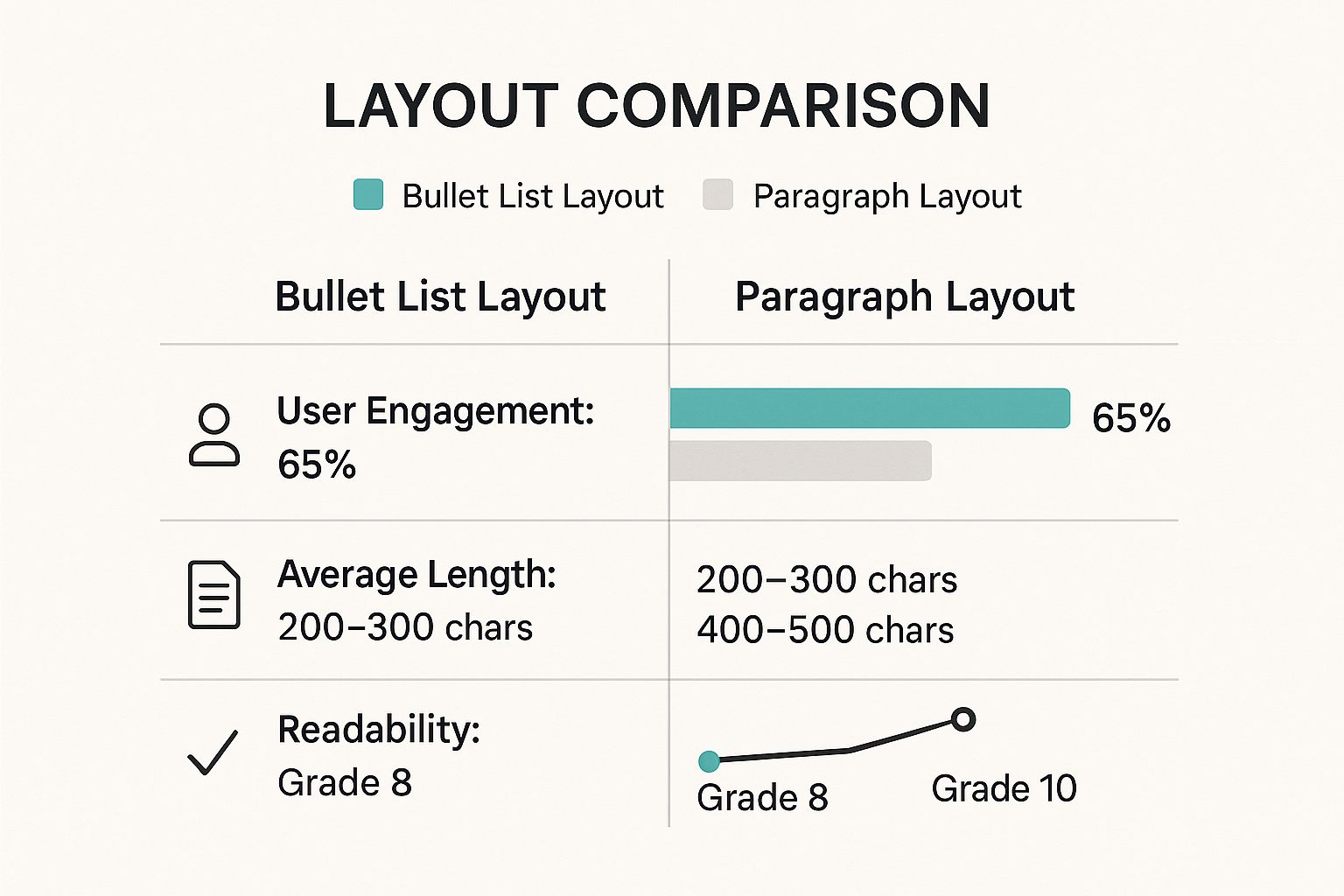
It's clear that bullet points and clean formatting help people digest information quickly, which is exactly what you want on a busy product page.
Weaving in Your Keywords Naturally
Now, let’s bring SEO back into the mix. The key is to make your primary and secondary keywords feel like a natural part of the story, not like they were awkwardly stuffed in.
A good rule I follow is to try and place my main keyword somewhere in the first paragraph. After that, I sprinkle it and a few secondary keywords into subheadings and bullet points where they genuinely fit. If you have to read a sentence out loud and it sounds clunky, rewrite it. Always write for a person first, search engine second.
Google’s focus on E-E-A-T (Experience, Expertise, Authoritativeness, and Trustworthiness) has made this approach non-negotiable. Gone are the days of keyword stuffing. Now, search engines reward authentic content that builds trust.
Paragraphs vs. Bullets: Finding the Right Mix
So, should you write a paragraph or use a bulleted list? My answer is almost always: both. Different shoppers read differently, and a good product page caters to all of them.
Here’s how I approach it:
- Paragraphs for the Story: I start with a short, punchy paragraph at the top. This is my hook. It's where I set the scene, inject some personality, and make an emotional connection.
- Bullets for the Skimmers: Right after that, I use a bulleted list to lay out the most important benefits and features. This is for the people who want the key info fast, without having to dig through a wall of text.
As you get into a rhythm, you might want to explore some of the modern AI content generators out there. They can be a huge help for drafting initial ideas or optimizing your text, saving you a ton of time.
A winning product page often uses a short, engaging paragraph to hook the reader, followed by a scannable bulleted list that summarizes the most important benefits. This hybrid approach serves both the storyteller and the skimmer.
By blending these narrative and structural elements, you create a description that’s not only compelling but also incredibly easy to read and digest. This balanced strategy is a core pillar of solid eCommerce SEO best practices.
Formatting Your Page for Scanners and Spiders
Let’s be honest, nobody reads every single word on a webpage anymore. We’re all scanners. We hunt for headings, skim bullet points, and look for bolded text to find what we need—fast. Your goal is to structure your product page to cater to these impatient humans and the search engine spiders crawling your site.
Think of great formatting as the unsung hero of a killer SEO product description. It’s what makes your copy easy to digest, keeps people on your page longer, and clearly signals to search engines what your product is all about. Without it, even the most beautifully written copy just looks like a giant wall of text.
Nailing Your On-Page SEO Elements
On-page SEO is more than just stuffing keywords into your text; it's about how you organize that text on the page. Getting these technical bits right is a straightforward way to give your product a real leg-up in the search rankings.
Start with your meta title and meta description—this is your first impression in the Google search results. Your meta title needs to be punchy and include your main keyword. The meta description is your mini-ad, the teaser that makes someone have to click.
A well-written meta description can be the difference between a click and a scroll-by. It's the movie trailer for your product page. Make it exciting enough that people want to buy a ticket.
Next, let's talk structure. Using header tags (H1, H2, H3) correctly is non-negotiable. Your product name should always be your one and only H1. From there, use H2s and H3s to break your description into bite-sized, logical chunks that are easy to scan.
How to Make Your Page Scannable and Engaging
With the basic structure in place, it’s time to get visual. The name of the game is clarity. You want to guide your reader's eye directly to the most compelling information.
Here are a few tricks I use to make product descriptions instantly more reader-friendly:
- Go for Ultra-Short Paragraphs: Seriously, stick to 1-3 sentences max. This creates a ton of white space, making the page feel open and approachable, especially on a phone.
- Embrace Bullet Points: When you need to list features, specs, or benefits, nothing works better than a simple bulleted list. It lets shoppers grab the key details in a glance.
- Use Bold Text Strategically: Make key benefits, important stats, or your unique selling points pop with bold text. It’s a simple way to draw the eye and reinforce what makes your product special.
And finally, let’s not forget about your images. Every single image needs descriptive alt text. This isn't just for accessibility; it’s another golden opportunity to tell search engines about your product. Instead of a lazy "image123.jpg," write alt text like "Men's Waterproof GORE-TEX Hiking Boots."
It’s a tiny detail that makes a huge difference. When you combine persuasive copy with smart formatting, you build a page that keeps both customers and Google happy.
Alright, you’ve written a fantastic, SEO-friendly product description. High five! But don’t pop the champagne just yet. Hitting that “publish” button isn’t the finish line; it’s the starting gun.
The real growth comes from treating your product descriptions like living, breathing documents. You have to watch, measure, and tweak. Think of yourself as a data detective, and luckily, you don't need a fancy trench coat or expensive software to get started.
What Numbers Should You Actually Watch?
You can easily get lost in a sea of data, so let's focus on the metrics that really tell you if your descriptions are doing their job. Your best friends here are free tools you're probably already using: Google Analytics and Google Search Console.
Here’s what to keep an eye on:
- Click-Through Rate (CTR): You’ll find this in Google Search Console. It’s the percentage of people who saw your product pop up in a Google search and actually clicked on it. If your CTR is low, it’s a huge red flag that your meta title or description isn't grabbing attention.
- Keyword Rankings: Are you climbing the ladder for the keywords you targeted? Or sliding back down? Watching your position in the search results is the most direct way to see if your SEO efforts are paying off.
- Conversion Rate: This is the big one—the ultimate test. Found in Google Analytics, it shows you what percentage of visitors actually hit "add to cart" and bought the thing. This tells you if your words are truly persuasive.
Get into a Rhythm of A/B Testing
Once you've got a handle on your baseline numbers, it's time to experiment. This is where A/B testing becomes your superpower. It might sound a bit techy, but the idea is simple: you create two slightly different versions of your description and see which one people respond to better.
You could test just about anything. Try a different headline. Change the call-to-action from "Buy Now" to "Get Yours Today." Maybe swap out a dense paragraph for a punchy bulleted list. The key is to change only one thing at a time. That way, you know exactly what caused the change in your results.
This constant cycle of measuring, testing, and refining is the secret sauce. It’s what separates the stores that just coast along from the ones that consistently boost their sales and search visibility month after month.
After your initial writing sprint, it’s all about this continuous improvement mindset. This is a huge part of a solid growth plan, and there are tons of great conversion rate optimization tips out there that you can apply to keep getting better. For smaller teams, weaving these measurement tactics into your daily routine is absolutely crucial—a theme we dive into in our guide on content marketing for small businesses.
Got Questions? Let's Talk SEO Product Descriptions
Even after you’ve got the basics down, a few practical questions always seem to pop up right when you sit down to write. It happens to everyone. Let's clear up some of the most common hurdles you'll likely face.
How Many Keywords Should I Actually Use?
Honestly, there isn't a magic number. Forget what you've heard about hitting a certain keyword density. That’s old-school thinking.
A much better approach is to focus on one primary keyword and maybe two or three closely related secondary keywords. The real goal is to write for a human being, not for a machine. Weave your keywords into your main paragraphs, bullet points, and subheadings, but only where they feel natural. If a sentence sounds forced or robotic, cut it and try again. Persuasion and clarity will always beat stuffing keywords.
Forget about keyword density. Instead, focus on keyword placement. Your primary keyword should appear in your H1 title, your meta description, and naturally within the first 100 words of your copy. This sends a clear, immediate signal to search engines about what your page is about.
Can I Just Use the Manufacturer's Description?
Please don't. While it's tempting to save time, this is one of the biggest and most common mistakes in ecommerce SEO. Using the manufacturer's description creates duplicate content, which is a huge red flag for Google.
Think about it: when dozens, or even hundreds, of websites have the exact same text, search engines can't figure out which one is the original or most helpful. Writing your own unique seo product description is your single best chance to stand out from the crowd, control the story, and target keywords that your specific customers are searching for.
So, How Long Should My Product Description Be?
It really depends. The answer isn't a specific word count, but "as long as it needs to be." A simple product like a basic t-shirt might only need 100-150 words. But a complex, high-tech gadget could easily require 400 words or more to explain all the features and answer every question.
The perfect length is whatever it takes to give a customer all the information they need to feel confident hitting that "buy" button.
A great strategy for any product is to lead with a scannable summary—usually bullet points—for the shoppers in a hurry. Then you can follow up with more detailed paragraphs. This gives you the best of both worlds.
Ready to stop guessing and start finding the keywords that actually drive sales? Let RankHub do the heavy lifting. Our AI-powered platform analyzes your site and delivers a targeted keyword strategy in minutes, not days. Get your first research report today at https://www.rankhub.ai.
More from Our Blog
The Top Influencer Marketing Platforms That Drive Real Results
Compare the best influencer marketing platforms for 2025. Find tools for creator discovery, campaign management, and ROI tracking tailored to your business.
Read more →
AI in Marketing: A Practical Guide for Teams Just Getting Started
Learn how AI transforms marketing with our beginner's guide. Discover practical uses, tools, and first steps to implement AI in your marketing strategy today.
Read more →
Market Research Platforms in 2026: What the Data Shows
Explore the latest data on online market research platforms: market size, AI adoption, mobile trends, and what researchers are investing in now.
Read more →