
So, what exactly is search intent? Think of it as the why behind every single Google search. It’s the user's ultimate goal when they type something into that search bar. Are they trying to learn something new, find a specific website, or are they ready to pull out their credit card and buy something?
The Secret to Connecting With Your Audience

I love to use a simple analogy: imagine you run a hardware store. When someone walks in and asks, "Where are the hammers?" you know they're probably looking to make a purchase. But what if they ask, "How do I hang a heavy mirror?" Now they're looking for your expertise.
Understanding search intent is just like being that helpful, intuitive shopkeeper—but for the entire internet. It's about getting to the heart of what someone really wants when they search. This is what separates modern, effective SEO from just chasing keywords. It's about understanding people.
From Keywords to Conversations
Back in the day, SEO was a much simpler game. If you wanted to rank for "best running shoes," you just stuffed that exact phrase onto your page a bunch of times. Google's algorithms have gotten a whole lot smarter since then, and now their main goal is to satisfy the user's true needs.
This shift has completely changed the game. Just hitting that #1 spot doesn't mean anything if your content misses the mark on intent. You'll just get a flood of irrelevant traffic from people who bounce right off your page because you didn't give them what they were looking for. That’s a massive lost opportunity.
Here’s the bottom line: Google’s number one job is to keep its users happy. When you create content that genuinely solves for user intent, you’re basically working with Google, not against it. That’s how you earn rankings that actually stick.
Why This Matters for Your Content
Getting this right is how you turn a random searcher into a loyal fan or a paying customer. It’s the foundation of a content strategy that actually helps people, guiding them through every step of their journey. If you really want to level up, exploring strategies for creating viral content can offer some incredible insights into what makes an audience tick.
When you decode what your users are trying to accomplish, you build trust and drive real business results. And that's exactly what this guide will teach you how to do.
Decoding the Four Types of User Intent
Think of every single search on Google as a mission. Someone, somewhere, is typing because they have a goal in mind. They might want an answer, a specific website, or to buy something right now. To create content that actually works, you have to get inside their head and figure out what that mission is.
This is where the four types of search intent come into play. They're basically a framework for understanding the "why" behind a search. Getting a handle on these four categories is your secret weapon for creating content that people are actually looking for.
This handy visual gives you a quick look at the main types of intent you'll encounter.
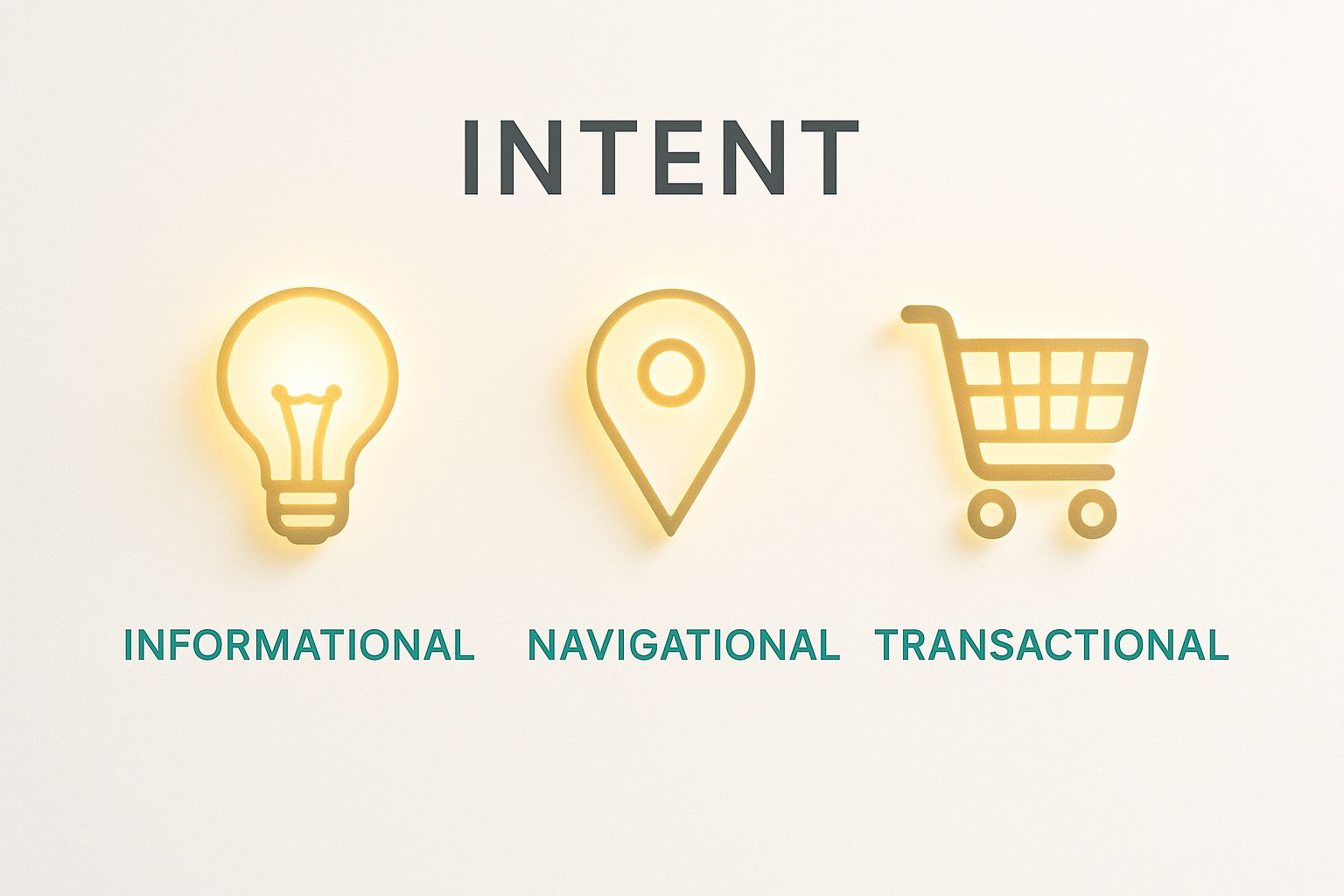
As you can see, each one has a totally different motivation, which means you need a totally different approach with your content.
Informational Intent: "I Need to Know Something"
This is the big one. Most people use search engines to learn stuff. They have a question, and they want an answer. Their goal is pure and simple: find information. They're not looking to buy anything... at least, not yet.
We're talking about searches like "how to fix a leaky faucet," "what's the best way to cook salmon," or "symptoms of a cold." The user is in research mode, plain and simple.
Your job here is to be the helpful expert. This is where you shine by creating top-notch, genuinely useful content. Think things like:
- How-to guides that walk someone through a task step-by-step.
- In-depth articles or blog posts that fully answer a question.
- Tutorial videos for people who'd rather watch than read.
- Easy-to-digest infographics that break down complex topics.
These folks are a long way from pulling out their wallets. Forget the hard sell. Just give them the valuable information they came for, and you'll start building trust that can pay off big time down the road.
Navigational Intent: "Take Me There"
This one is pretty straightforward. The user already knows exactly where they want to go online, and they're just using Google as a glorified bookmark. They can't be bothered to type in the full URL, so they search for it instead.
You see this all the time with queries like "YouTube," "Facebook login," or a specific brand name like "Outrank pricing." They have one destination in mind, and that's it.
Honestly, unless your brand is the destination, there’s not much you can do to capture this traffic. The main takeaway here is to make sure that when someone does search for your brand, they find you easily. This means your homepage and other key pages should be properly optimized for your own name.
Commercial Intent: "Help Me Choose"
Commercial intent is that crucial middle ground between "just looking" and "ready to buy." People with commercial intent are definitely planning to make a purchase soon, but they're still in the final stages of research, weighing their options.
This is where you see searches like:
- "best running shoes for flat feet"
- "Asana vs Monday review"
- "lightweight laptop comparisons"
- "cheapest meal delivery service"
These searchers are hungry for reviews, comparisons, and any details that can help them make the right choice. They are incredibly valuable because they are so close to converting.
When you're creating content for commercial intent, your entire goal is to build the user's confidence. You're giving them all the detailed, unbiased-as-possible information they need to feel great about their decision.
This is your moment to create comparison articles, detailed product reviews, and "best of" lists. It's the perfect opportunity to show off your expertise and gently nudge them toward your product or service as the best solution.
Transactional Intent: "I’m Ready to Buy"
And finally, we hit the bottom of the funnel. With transactional intent, the decision has been made. The user is ready to act. They've got their credit card out and are looking for the "buy now" button.
You can often spot these queries by the keywords they use. Look for modifiers like "buy," "deal," "discount," "coupon," or a specific product model like "buy iPhone 15 Pro Max" or "Nike Air Max 90 sale."
When you see a query like this, your job is to get out of the way and make the transaction as smooth as possible. Send them directly to a page where they can take action, such as:
- Product Pages: These need to be crystal clear, with great images, pricing, and a big, obvious "Add to Cart" button.
- Service Pages: A page where someone can sign up, book a demo, or get a quote.
- Pricing Pages: A clear breakdown of your plans and features so they can choose and check out.
One of the most common SEO mistakes is trying to rank a blog post for a transactional keyword. It just adds friction. The user wants to buy, not read an article. Always match the page type to the intent!
To help you keep these straight, here's a quick summary of the four main types of search intent.
The Four Types of Search Intent at a Glance
| Intent Type | User Goal (The 'Why') | Example Keywords | Example Search Query |
|---|---|---|---|
| Informational | To learn something or find an answer to a question. | how to, what is, why, guide, tutorial, ideas | "how to start a blog" |
| Navigational | To find a specific website or webpage. | Brand names, specific product/service names | "Twitter login" |
| Commercial | To research products/services before making a purchase. | best, review, comparison, vs, top, alternative | "best noise-canceling headphones" |
| Transactional | To complete a purchase or take a specific action. | buy, deal, discount, sale, price, coupon | "buy Macbook Air M2" |
Understanding this breakdown is the foundation of a smart SEO strategy.
It's also fascinating to see how these intents are distributed across all searches. Recent data reveals that a massive 52.65% of daily searches are informational, with another 32.15% being navigational. Commercial queries account for 14.51%, while purely transactional searches make up a tiny 0.69%. You can dive deeper into these numbers by exploring the full findings on search intent statistics. This really drives home the incredible opportunity available if you focus on creating truly helpful, informational content.
Why Search Intent Is the Secret Sauce of Modern SEO
It's one thing to know what search intent is, but the real magic happens when you understand why it matters so much. Search intent isn't just another industry buzzword to throw around; it’s the very foundation of an SEO strategy that actually works. Think of it as the handshake between what someone wants and what you offer.
At the end of the day, Google's entire business model relies on keeping users happy by giving them the best possible answers. If someone searches for a brownie recipe and gets a page trying to sell them a new oven, they're going to get frustrated and leave. That quick exit, known as a bounce, sends a loud and clear signal to Google: "This result was useless."
But when your content is the perfect match for what a searcher is looking for? They stick around. They read, they click, they engage. That extra time spent on your page, or "dwell time," tells Google, "Hey, this is exactly what I needed!" This is how you start working with Google's algorithm instead of fighting against it.
How Intent Directly Boosts Your SEO Metrics
Getting user intent right isn't just some vague, feel-good concept. It has a direct and measurable impact on the numbers that search engines care about most. When you nail the intent, you'll see a positive ripple effect across your most important metrics.
- Lower Bounce Rates: Give people exactly what they came for, and they won't have a reason to leave. A low bounce rate is a massive vote of confidence in Google's eyes.
- Longer Dwell Time: When your content truly satisfies a need, people hang around to consume it. Whether it's a deep-dive guide or a detailed product comparison, more time on the page is a powerful ranking signal.
- Higher Conversion Rates: By creating content that aligns with where someone is in their buying journey, you catch them at the perfect moment. You build trust with an informational post and seal the deal with a transactional page. Get this wrong, and you get zero sales.
Google's primary mission is user satisfaction. When you make it your mission to solve a user's problem or answer their question, your goals and Google's goals become one and the same. That alignment is the key to building rankings that last.
A Tale of Two Pages
Let's walk through a quick example. Imagine a company that sells premium coffee grinders. They see that the keyword "how to grind coffee beans" gets a ton of searches, so they decide to target it.
The "Before" Scenario (A Total Mismatch):
A person searches "how to grind coffee beans," a classic informational query. They click a link and land on a glossy product page pushing a $300 grinder. They're not ready to buy; they just wanted to learn! Confused and a little annoyed, they hit the back button. The page’s bounce rate goes through the roof, and it never ranks because it completely missed the point.
The "After" Scenario (Perfect Alignment):
The company smartens up. They create a comprehensive blog post: "The Ultimate Guide to Grinding Coffee Beans at Home." It covers everything—blade vs. burr grinders, the right grind size for a French press, and even includes a helpful video. Only after providing all that value does it subtly recommend their grinders as a great option for enthusiasts.
This new page is a perfect match for the user's intent. People stick around for minutes, the bounce rate drops like a rock, and Google rewards it with a top spot. Even better, a good chunk of those readers, now trusting the brand's expertise, click through and buy a grinder. To see how this fits into the bigger picture, explore our full guide on what is search engine optimization. That, right there, is intent-driven SEO in a nutshell.
How to Uncover the Intent Behind Any Keyword

Alright, time to put on your detective hat. It's one thing to understand the what and why of search intent, but figuring it out for any given keyword is where the real skill comes in. The good news? You don't need a crystal ball.
Your single biggest clue is waiting for you right on Google. The search engine results page (or SERP, as we call it) is basically a treasure map. Google has already spent billions of dollars figuring out what people want, so all you have to do is learn to read the signs.
Analyze the SERP Like a Pro
The absolute best way to pin down the intent for a keyword is to just search for it and see what’s already ranking. Those top results are there for a reason—they’re the pages that Google has determined do the best job of making searchers happy.
Your mission is to decode why they work. Start by asking a few simple questions about the top-ranking pages:
- What kind of content is this? Are you seeing mostly blog posts, product pages, category pages, or videos? The dominant format is a massive clue.
- What’s the page format? If they are blog posts, are they "how-to" guides, listicles like "Top 10...," or in-depth comparison reviews?
- Who is ranking? Are the top spots taken by big brands, e-commerce stores, review sites, or educational institutions?
Think about it: a search for "how to bake sourdough bread" is going to be packed with detailed guides and video tutorials. That’s a clear signal of informational intent. Trying to rank a product page there would be like showing up to a book club with a sales pitch. It just doesn't fit.
Look for Special SERP Features
Beyond the standard blue links, Google sprinkles its results with all sorts of special features. These aren’t random. They're direct answers to what Google understands about a searcher's goal. Think of them as giant neon signs pointing you to the right intent.
The SERP itself is a living, breathing focus group. By paying close attention to what shows up, you can reverse-engineer what Google thinks users want and build your content to match.
The table below breaks down some of the most valuable SERP features and what they tell you about the user's intent.
SERP Clues for Identifying Search Intent
| SERP Feature | Likely Search Intent | What It Tells You |
|---|---|---|
| Featured Snippets | Informational | The user wants a quick, direct answer to a "what is" or "how to" question. |
| "People Also Ask" | Informational | The user is in research mode and has related follow-up questions. |
| Image & Video Packs | Informational / Commercial | The query is visual. People want to see a process, product, or result. |
| Local Pack (Maps) | Navigational / Transactional | The user is looking for a physical business to visit or buy from nearby. |
| Shopping Ads | Transactional / Commercial | The user is ready to buy or is actively comparing products to purchase. |
| Review Stars | Commercial / Transactional | The user is evaluating options and trusts social proof before making a decision. |
Keeping an eye out for these elements gives you a huge advantage, turning a guessing game into a clear-cut strategy.
Decode Keyword Modifiers for Fast Clues
While a full SERP analysis is the gold standard, you can also get quick hints from the words people use in their searches. Certain words, or keyword modifiers, are powerful shortcuts for identifying intent. More advanced techniques even look at AI's role in real-time user behavior analysis to get an even clearer picture.
Here are some of the most common modifiers you'll see:
- Informational: how, what, why, guide, tutorial, ideas, tips, learn
- Commercial: best, review, top, comparison, vs, alternatives
- Transactional: buy, sale, discount, deal, price, coupon, cheap
- Navigational: A specific brand, product, or website name (e.g., "Facebook login")
Paying attention to these little words can save you a ton of time. This whole process is a cornerstone of smart SEO, and you can dive deeper into the mechanics by checking out this guide on how to do keyword research. When you combine all these clues, you build a nearly foolproof system for creating content that hits the mark, every single time.
Building Your Intent-Driven Content Strategy
Alright, let's put all the pieces together. It’s one thing to know what search intent is, but the real magic happens when you build a content strategy around it. This is how you turn a curious searcher into a happy customer.
Think of it like being a tour guide for your brand. You're creating a seamless, helpful journey that anticipates what someone needs at every step. Your job is to create the right content for the right moment, meeting people where they are instead of shoving a sales pitch at them when they’re just looking for an answer.
Aligning Content with the Customer Journey
The heart of an intent-driven strategy is simple: create content that directly answers what someone is trying to do. When you match your content format to their goal, you instantly build trust and create an experience that naturally pulls them closer to your solution.
This alignment is also a game-changer for your sales pipeline. A well-oiled, intent-driven content machine is one of the most effective B2B lead generation best practices out there because it attracts people who are genuinely looking for what you offer.
Here’s a practical look at how this mapping works:
- For Informational Intent: This is your top-of-funnel playground. Think helpful blog posts, deep-dive guides, how-to articles, and quick explainer videos. Your goal is to become the trusted resource that answers their questions, planting the first seed of authority.
- For Commercial Intent: Now you’re helping people who are weighing their options. This is where you bring out detailed comparison articles, "best of" roundups, honest product reviews, and compelling case studies. The content should be genuinely useful, helping them sort through the noise.
- For Transactional Intent: Time to close the deal. Your product pages, service pages, and pricing tables need to be crystal clear and action-oriented. Make it incredibly easy for someone to buy, sign up, or request a quote with strong calls-to-action and zero friction.
Creating Pathways with Internal Linking
Once you have content for each stage, you need to connect the dots. This is where internal linking becomes your secret weapon. On the surface, it’s just a link from one page on your site to another. But strategically, it’s so much more.
Imagine your internal links are signposts guiding users on their journey. Someone lands on your informational post, "how to choose a project management tool." They should find a natural, helpful link pointing them to your commercial article, "Asana vs. Monday." And from that page, it’s a smooth, logical jump over to your product page.
A smart internal linking structure does more than just help users navigate. It also distributes authority (or "link equity") throughout your site, signaling to Google which of your pages are most important and how they relate to one another.
You’re creating a cohesive experience that feels helpful, not pushy. You aren’t forcing anyone down a funnel; you're simply offering the next logical step right when they need it. This is a non-negotiable part of knowing how to create a content strategy that actually works.
Expanding Your Reach with Global Intent
As you map out your strategy, don’t forget to think beyond your own backyard. Search intent is just as critical for international SEO, because users everywhere want content that feels local and relevant. It’s not just about language—it's about culture, context, and nuance.
Research shows that a whopping 75% of users prefer buying things in their native language. This stat alone tells you how important it is to understand the intent behind non-English searches. A direct translation rarely cuts it; you have to adapt your content to fit the unique expectations and search habits of each market to build a truly global presence.
Answering Your Top Questions About Search Intent
Even after we've walked through the basics, you've probably still got a few questions rattling around. That's completely normal. Let’s treat this section like a quick FAQ session to tackle those common "what ifs" and "how does this actually work?" moments.
My goal here is to give you clear, no-fluff answers so you can feel confident putting this stuff into practice. By the end, you'll have a much better handle on building a content strategy that’s genuinely driven by intent.
Can One Keyword Have Multiple Search Intents?
Oh, absolutely. It happens all the time, especially with broader keywords. We often call this "mixed intent."
A perfect example is a term like "CRM software." Think about who might be typing that in:
- Someone could be just starting out, simply trying to understand what a CRM is (Informational).
- Another person might be in buying mode, looking for a comparison of the top tools (Commercial).
- And a third user might know exactly what they want and are just trying to get to the Salesforce website (Navigational).
So, what do you do? Go look at the SERPs. Google’s results page will tell you everything. If you see a jumble of blog posts, review sites, and brand homepages, that’s your signal for mixed intent. Your best move is to either aim for the most dominant intent you see or create a powerhouse piece of content that actually serves a few of those needs at once.
How Does Search Intent Affect Voice Search and AI?
Search intent is even more important when you factor in voice search and those new AI Overviews. People don't talk to their smart speakers in keywords; they ask real questions. Think, "Hey Google, what's the best way to clean a coffee maker?" This is classic informational intent, and it needs a direct, quick answer.
To show up in these new formats, you have to structure your content impeccably. You need to provide answers so clearly and directly that an AI can easily grab them and present them as the solution.
Your goal is to create the single best answer to a very specific question. This makes your content a prime source for these new search formats, positioning you as an authority that both users and algorithms trust.
This really just means getting back to basics: use clear headings, keep your paragraphs short, and get straight to the point. No waffling.
How Often Should I Re-Evaluate Search Intent?
Search intent is definitely not a "set it and forget it" kind of thing. People change, markets shift, and what someone wants from a search today could be totally different next year.
As a general rule, I’d recommend checking the intent for your most important keywords at least once a year. It’s also a smart idea to do a quick check whenever you see a major ranking drop for one of your key pages—a shift in intent is often the hidden culprit.
For instance, a keyword that was purely informational might slowly become more commercial as new products hit the scene. The only way to keep up is to pop open an incognito window and actually look at the SERPs for your target keywords every so often. This makes sure your content stays aligned with what your audience—and Google—is looking for right now.
Ready to stop guessing what keywords to target? RankHub takes the mystery out of search intent by analyzing your entire website in under a minute to deliver a prioritized list of high-value opportunities. Ditch the complex tools and get a clear, actionable content strategy today. Start your first research project at https://www.rankhub.ai.
More from Our Blog
7 Content Writing Tools That Boost Your SEO Rankings
Discover the top 9 SEO content writing tools to automate drafting, optimization, and publishing. Boost rankings with AI-assisted workflows.
Read more →
Zoho Marketing Automation Explained: Is It Right for You?
Compare Zoho Marketing Automation vs HubSpot on pricing, features, ease of use, and automation depth. See which wins for small teams and solo founders.
Read more →
Looking for an SEO Company? Here Are Your Best Options
Compare top SEO companies, AI platforms, and agencies. Find the best fit for your budget, from $49/month tools to full-service retainers.
Read more →