
So, what is Search Engine Optimization (SEO), really?
At its core, SEO is all about making your website more visible when people look for your products or services on search engines like Google or Bing. Think of it this way: the higher your pages rank in search results, the better your chances of attracting new customers and keeping your current ones engaged.
It’s not a one-and-done task; it's an ongoing process of improvement.
How Search Engines Actually See Your Website

Let's use an analogy to make this crystal clear. Imagine the internet is a gigantic, ever-growing library, and Google is the super-smart librarian. Your website? It’s a book on one of the shelves.
SEO is everything you do to convince that librarian your book is the most credible, helpful, and well-written resource on its subject.
When someone walks up to the librarian and asks a question (or types a search into Google), the librarian scans the shelves to find the perfect book to provide the answer. Your goal is to make sure your book is the one they pull out first. This isn't about gaming the system; it's about making it incredibly easy for the librarian to see what your book is about and why it’s a source people can trust.
The Real Goal of SEO
The ultimate aim of SEO is to get more organic traffic—that means visitors who find you through a regular, unpaid search. Unlike paid ads that vanish the second you stop paying for them, SEO builds a lasting asset. A page that ranks well can continue to bring in traffic for months, sometimes even years.
To get there, you need to focus on a few key areas that signal quality and relevance to search engines. These efforts are typically grouped into three main categories.
The Core Pillars of SEO at a Glance
To truly understand how SEO works, it helps to break it down into its three main components. Each one plays a distinct but interconnected role in telling search engines that your site is worth showing to users.
Here's a quick summary of these three pillars:
| SEO Pillar | Main Goal | Key Activities |
|---|---|---|
| On-Page SEO | Make your content clear and valuable to both users and search engines. | Keyword research, quality content creation, title tags, meta descriptions. |
| Off-Page SEO | Build your website's authority and reputation across the web. | Link building (backlinks), brand mentions, social media marketing. |
| Technical SEO | Ensure your website is easily accessible and understood by search engine crawlers. | Site speed optimization, mobile-friendliness, XML sitemaps, secure connection (HTTPS). |
By working on all three of these areas together, you create a comprehensive strategy that gives your website the best possible chance to rank well. It's a holistic approach that builds trust and authority over time.
This holistic approach proves to search engines that your website offers real value. That's what boosts your chances of landing on that all-important first page of the search results—which is critical when you consider that a whopping 75% of users never even click to the second page.
For businesses ready to dive in, partnering with experts who offer Search Engine Optimization (SEO) services can make all the difference in navigating these pillars effectively.
The Evolution of Search: From Wild West to Walled Garden
To really wrap your head around modern SEO, you have to understand where it came from. This isn’t some boring history lecture; it’s the origin story of how a digital free-for-all evolved into the sophisticated marketing practice we know today. Seeing how we got here makes it crystal clear why today's strategies are all about genuine quality, not smoke and mirrors.
Back in the mid-90s, the first search engines like AltaVista and Yahoo were pretty basic. Think of them as librarians who only cataloged books by counting how many times a word appeared on the cover. As you can imagine, this system was easy to game. People quickly figured out they could shoot to the top of the search results by just cramming their pages with keywords—sometimes even hiding them by using white text on a white background. It was a race to the bottom, and the sneakiest tactics often won.
A New Sheriff in Town
This keyword-stuffing chaos created a miserable experience for anyone actually trying to find something. Search results were clogged with useless, low-quality pages built only to trick the system, not to help people. The digital library was a disaster, and users were fed up. Something had to change.
The real game-changer was Google. Instead of just counting keywords, Google’s founders introduced a revolutionary idea called PageRank. This new algorithm didn't just look at the words on a page; it looked at how many other websites were linking to it. Each link was treated like a vote of confidence.
A link from a trusted, high-authority website was suddenly like getting a glowing five-star review from a world-renowned expert. This one concept completely flipped the script, shifting the focus from on-page tricks to earning off-page credibility.
Google Declares War on Spam
PageRank was a massive step forward, but the cat-and-mouse game wasn't over. Shady marketers just found new ways to cheat, like creating huge networks of bogus websites simply to generate artificial links. In response, Google started releasing major algorithm updates that hit the industry like digital earthquakes, completely changing the rules of the game.
These updates were designed to hunt down and penalize specific manipulative tactics, forcing everyone to clean up their act and focus on quality.
- Panda (2011): This update was a killer for sites with "thin" or low-value content. Websites that were just mass-producing shallow articles to rank for keywords saw their traffic completely vanish, seemingly overnight.
- Penguin (2012): This one went after spammy and unnatural link-building. Any site that had bought links or used shady schemes to fake their authority got hit with severe penalties.
These updates officially marked the death of the spam era and the birth of modern SEO. Google sent a loud and clear message: the only long-term way to win is by creating genuinely helpful content and earning real authority. This fundamental shift from manipulation to a user-first mindset is the bedrock of every effective SEO strategy today. If you want to dive deeper, you can check out this detailed history of SEO for the full story.
Why SEO Is Your Most Valuable Digital Asset

So, after all that, is SEO really worth the effort? I get asked this all the time, and the answer is a resounding yes. SEO isn't just a marketing tactic; it's one of the most powerful engines for sustainable business growth you can build.
Think of it this way: paid ads are like renting an audience. The second you stop paying, the traffic disappears. SEO, on the other hand, is like owning your own home. It’s an asset you build over time, and its value keeps appreciating.
Sure, it takes work upfront—like planting a garden. But a well-ranked page on Google can bring in a steady stream of high-quality organic traffic for months, or even years, without you paying for every single click. It’s a cost-effective marketing channel that keeps on giving.
Building Trust on Autopilot
Let’s be honest, we all do it. We instinctively trust Google's organic results more than the ads at the top of the page. When your site consistently shows up for the right searches, you're not just getting clicks; you're building serious credibility.
Every time a potential customer finds you through search, you’re doing more than just answering their question. You’re quietly proving that your brand is a reliable authority in your space.
That kind of trust is priceless. It leads to more engagement, stronger brand loyalty, and ultimately, more customers. Your SEO efforts compound over time, turning your website from just a URL into a go-to resource people actively seek out.
Gaining a Competitive Edge
In a world where your competitors are just one click away, a smart SEO strategy is your secret weapon.
Imagine a small, local bakery. With the right local SEO, they can pop up in search results the moment someone nearby gets a craving for fresh bread. They can actually outrank a giant national supermarket chain for that specific, high-intent search. That's the power of finding your niche and owning it.
A big part of this is doing thorough competitor research to see what’s working for others. By spotting their weaknesses, you can find golden opportunities to outperform them and grab a bigger piece of the pie.
This isn't just a hunch; the numbers back it up. The global SEO industry is valued at a massive $86.8 billion as of 2025, which shows just how crucial it has become.
At the end of the day, putting resources into SEO is an investment in a durable, long-term asset. It generates predictable traffic, builds rock-solid brand authority, and delivers a return that paid channels just can't compete with in the long run. If you're ready to start building that asset, the first step is learning https://rankhub.ai/blog/how-to-find-profitable-keywords to attract the right kind of attention.
Breaking Down The Three Pillars of SEO
SEO can seem like this massive, intimidating thing. But really, it all boils down to three core parts. Once you get how they fit together, the whole puzzle starts making sense.
Think of a solid SEO strategy like a three-legged stool. You need all three legs firmly on the ground for it to be stable and do its job. Take one away, and the whole thing topples over.
These three legs are On-Page SEO, Off-Page SEO, and Technical SEO. Each one handles a different piece of the puzzle, but they’re all working toward the same goal: showing search engines that your website is the real deal and deserves to be at the top of the results.
On-Page SEO: What’s On Your Pages
On-page SEO is everything you do directly on your website to make it clear what your content is about. This is your chance to tell Google (and your visitors) exactly what you’re offering. It’s all about the words, images, and structure of your actual pages.
The main idea here is to make your content both high-quality and easy to understand—for people and for search engine bots. You want to create pages that are not only valuable and relevant but also organized in a way that just makes sense.
Some of the biggest pieces of on-page SEO are:
- Keyword Research: Figuring out the exact words and phrases your ideal customers are typing into Google.
- Content Creation: Actually writing helpful, engaging articles, guides, or product descriptions that answer your audience's questions.
- Title Tags & Meta Descriptions: Crafting the clickable headlines and short summaries people see in the search results. A good one gets the click.
- Header Tags (H1, H2, etc.): Using headings to break up your content and create a clear, logical structure. It makes reading way easier.
- Internal Linking: Linking from one page on your site to another relevant page on your site. This helps Google and users discover more of your great content.
In short, on-page SEO is about creating awesome content and making sure it's presented perfectly.
Off-Page SEO: Your Website's Reputation Around The Web
Off-page SEO covers all the things you do outside of your website to build its authority and credibility. It’s not about what you say about yourself; it’s about what the rest of the internet says about you.
Think of it as your site’s public reputation. The cornerstone of this is backlinks, which are simply links from other websites pointing to yours.
A backlink from a respected, well-known website is like a public endorsement from an expert in your field. It's a massive signal to Google that your site is trustworthy and valuable.
Building this reputation involves things like:
- Link Building: Earning links from other high-quality, relevant websites. This is the big one.
- Brand Mentions: Getting your business or website talked about on other blogs, news sites, or forums (even without a direct link).
- Social Media: Promoting your content on social platforms to get it in front of more people, which can lead to shares and links.
The image below gives a good visual of how different types of links work together to build up your site's authority.
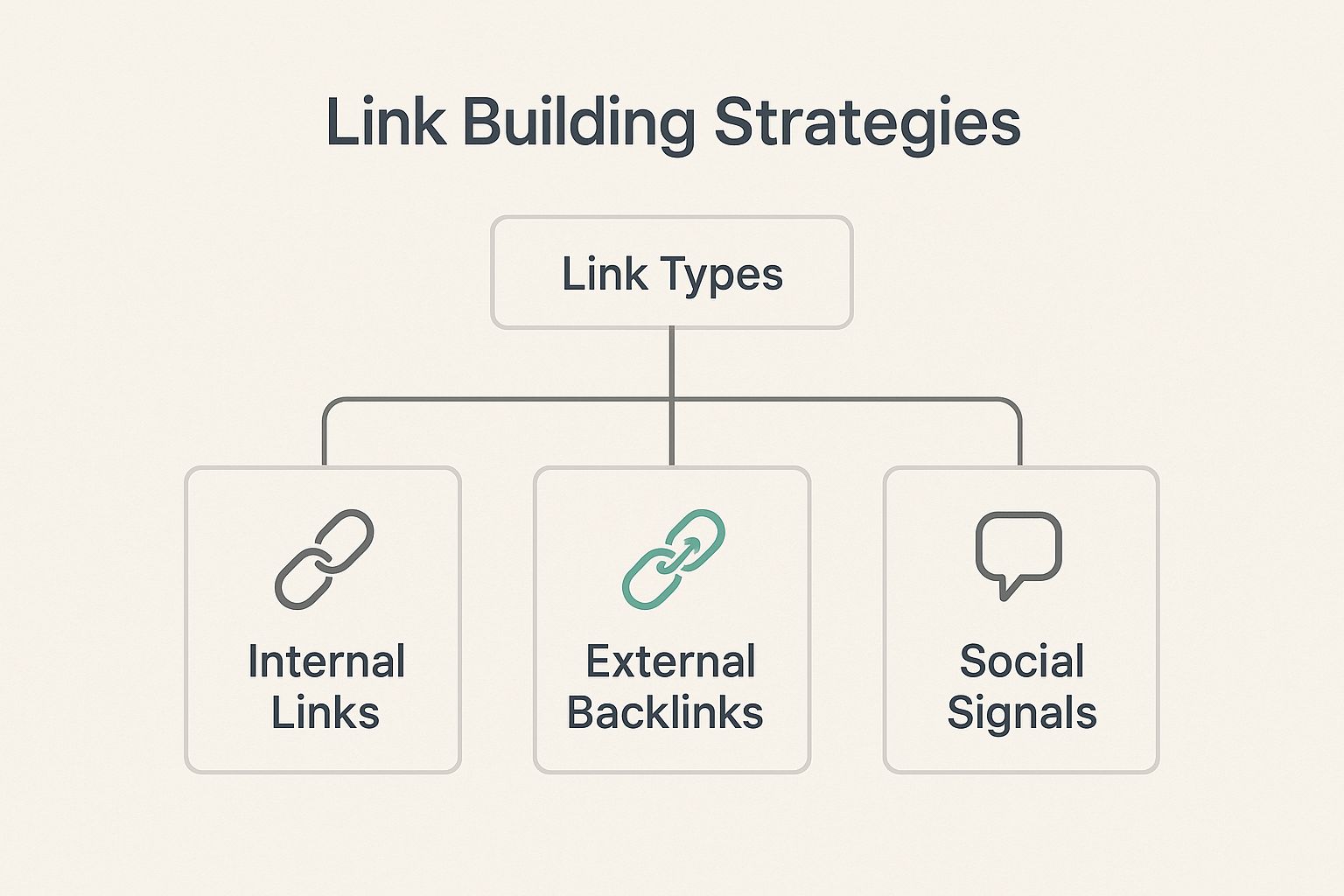
As you can see, a healthy mix of links you control (internal) and links you earn (external) creates a powerful profile.
Technical SEO: The Foundation of Your House
Finally, we have technical SEO. This is all about the nuts and bolts of your website—the stuff happening behind the scenes. Think of it as the foundation of your house. If the foundation is cracked and unstable, it doesn’t matter how great your furniture (content) is; the whole thing is at risk.
Technical SEO ensures your website is built in a way that search engines can easily find, crawl, and index your content. If Google’s bots can’t access your pages properly, they might as well not exist. A slow, buggy, or insecure site will kill even the best content marketing efforts.
Key tasks for a technically sound website include:
- Site Speed: Making sure your pages load lightning-fast. Nobody waits for a slow website anymore.
- Mobile-Friendliness: Ensuring your site works perfectly on a smartphone. Most searches happen on mobile now.
- Site Architecture: Having a clean, logical site structure so bots (and users) don't get lost.
- XML Sitemap: Providing a "map" of all your pages to help search engines discover them.
- Security (HTTPS): Using a secure connection to protect your visitors' data. Google demands it.
To give you a clearer picture of how these three pillars differ and overlap, here's a quick breakdown:
On-Page vs. Off-Page vs. Technical SEO
| SEO Pillar | Primary Focus | Example Tactics | Why It Matters |
|---|---|---|---|
| On-Page SEO | The content and structure of individual pages. What your site is about. | Keyword research, content writing, title tags, header tags, internal linking. | Tells search engines and users about the relevance and quality of your content. |
| Off-Page SEO | Your website's authority and reputation on the wider internet. | Earning backlinks from other sites, brand mentions, social media marketing. | Builds trust and credibility, showing Google that others vouch for your site. |
| Technical SEO | The backend and infrastructure of your website. How easily it can be crawled. | Improving site speed, ensuring mobile-friendliness, creating an XML sitemap, using HTTPS. | Forms the foundation that allows your content to be found and ranked effectively. |
When you put it all together, you can see that a truly successful SEO strategy needs all three. You can’t just have amazing content without a technically sound site, and you can’t rank with a great site if no one else on the web is vouching for you. They all work in harmony.
To dive even deeper into all the specific elements that play a role, check out our complete guide to search engine ranking factors.
How AI and User Experience Are Shaping the Future of SEO

The world of SEO never sits still. What worked five years ago is probably outdated today, and the strategies we're using right now are already laying the groundwork for what's next. The future isn't about guesswork, though. It's about understanding two massive forces steering the ship: artificial intelligence and a hardcore focus on the user.
Think of it like this: old-school SEO was like giving a librarian a book with the title repeated 100 times on the cover, hoping they’d notice. Today’s SEO is about writing a book so engaging and well-organized that the librarian just knows it's the best answer, no matter how someone asks the question. This entire shift is powered by AI.
The Rise of the Smart Search Engine
Google isn't just a simple matching engine anymore. It's evolving into an answer engine, using sophisticated AI that actually tries to understand language the way people do. This move away from just matching keywords to understanding the intent behind them is the single biggest change in modern SEO.
Two key algorithms really kicked this into high gear:
- RankBrain: Imagine Google’s AI learning from every single search. That's essentially what RankBrain does. It helps the search engine make sense of weird, ambiguous, or brand-new queries it’s never seen before. It figures out what people really mean, not just what they typed.
- BERT (Bidirectional Encoder Representations from Transformers): This piece of tech lets Google understand the subtle relationships between words in a sentence. It gets the context, prepositions, and all the little nuances, which leads to much more accurate results.
This AI-driven approach was a major turning point. Between 2015-2020, we saw the 'Renaissance' of SEO, with a huge focus on E-A-T (Expertise, Authority, and Trustworthiness), mobile-first design, and voice search—all things that algorithms like RankBrain and BERT made possible.
User Experience Is the New SEO King
As the AI got smarter, Google started rewarding websites that give people a genuinely good experience (UX). It’s simple, really. If users land on your site and have a terrible time—it’s slow, a pain to use on mobile, or full of annoying pop-ups—they’re going to bounce. Google sees that as a big red flag.
Key Takeaway: A great user experience isn't just a "nice-to-have" anymore. It's a direct, measurable ranking factor. Google wants to send its users to pages they will actually enjoy.
This obsession with UX is crystal clear when you look at the Core Web Vitals. These are specific metrics that measure the real-world experience a user has on your page, boiling it down to three main things:
- Loading Performance (LCP): How fast does the main content show up?
- Interactivity (FID): How quickly can you click on something and have the page respond?
- Visual Stability (CLS): Does the layout jump all over the place while the page loads?
Getting these right is no longer optional. In fact, seeing how specialized search engine UI design agencies build interfaces can give you a peek into just how deep this connection between UX and rankings goes.
Getting Your Strategy Ready for Tomorrow
So, what does all this mean for your website? The future of SEO demands a much more human-centric game plan. The days of just stuffing keywords are long gone; now it’s all about creating genuinely helpful experiences.
As you build out your strategy, make sure you're thinking mobile-first, since that’s where most searches are happening.
Also, don't forget about the rise of voice search ("Hey Google..."). This favors natural, conversational language. Writing content that answers questions directly has never been more important. If you're looking for practical ways to pull all this together, you can check out this guide on https://rankhub.ai/blog/how-to-use-ai-for-seo.
Ultimately, the websites that win in the long run will be the ones that have the same goal as Google: to give the user the best possible answer and experience.
Got SEO Questions? We've Got Answers.
If you're just starting to explore SEO, you've probably got a few questions swirling around. It's a big topic, and it's easy to get lost in the weeds. Let's clear up some of the most common ones right now.
"So, How Long Does This SEO Thing Actually Take?"
This is the big one, isn't it? Everyone wants to know when they'll see the magic happen. The honest, no-fluff answer is: it takes time. SEO is a marathon, not a sprint. You can often see some small wins and positive movement in a few weeks, but for the big, game-changing results—like hitting the first page—you’re typically looking at a four to twelve-month journey.
Think of it like getting in shape. You don't go to the gym once and walk out with a six-pack. It takes consistent effort over time to build strength. The same goes for your website. Factors like how old your site is, how tough your competition is, and the quality of your SEO work all affect the timeline. The payoff for that patience, though, is incredible: a steady stream of traffic that keeps coming long after you've stopped paying for ads.
The real power of SEO is that it compounds. The effort you put in today builds on itself, creating a foundation for organic growth that can pay dividends for years.
"Can I Do SEO Myself, or Do I Need to Hire a Pro?"
You can absolutely get your hands dirty and do SEO yourself! There's a treasure trove of amazing free guides and tools out there that can walk you through the basics, from finding the right keywords to tweaking your on-page content.
If you're running a personal blog or a small local shop, a DIY approach is often a fantastic way to learn the ropes and see real results. But if your business is in a super-crowded market or you're trying to grow fast, bringing in an SEO expert or an agency can be a total game-changer. They have the deep technical know-how and strategic vision to sidestep common pitfalls and speed up your growth.
"What’s the Real Difference Between SEO and SEM?"
This is a great question, and it's one that trips up a lot of people. It’s actually pretty simple when you break it down.
Think of Search Engine Marketing (SEM) as the entire toolbox for getting seen on search engines. SEO is just one of the most important tools in that box.
- SEO (Search Engine Optimization) is all about earning your way to the top of the search results organically. It’s the "free" traffic you don't pay for directly, built on great content and a solid site.
- PPC (Pay-Per-Click) is the other side of the coin. This is where you pay to place ads at the top of the search results. It's fast, but your visibility stops the moment you stop paying.
So, SEM is the overall strategy that includes both your free (SEO) and paid (PPC) efforts to attract visitors from search engines like Google.
Ready to stop guessing and start ranking? RankHub uses AI to read your entire website and deliver a custom keyword strategy in under a minute. Find your winning keywords today with RankHub.
More from Our Blog
7 Content Writing Tools That Boost Your SEO Rankings
Discover the top 9 SEO content writing tools to automate drafting, optimization, and publishing. Boost rankings with AI-assisted workflows.
Read more →
Zoho Marketing Automation Explained: Is It Right for You?
Compare Zoho Marketing Automation vs HubSpot on pricing, features, ease of use, and automation depth. See which wins for small teams and solo founders.
Read more →
Looking for an SEO Company? Here Are Your Best Options
Compare top SEO companies, AI platforms, and agencies. Find the best fit for your budget, from $49/month tools to full-service retainers.
Read more →