
A solid content strategy is the difference between just making noise and actually getting results. It's how you stop throwing spaghetti at the wall and start creating a purpose-driven system that delivers measurable growth. This whole process is about making sure every single piece of content you create has a clear job to do.
Stop Guessing and Start Strategizing

Let's be real for a second. A lot of so-called "content strategies" are just a list of random ideas. That's not a strategy; it's a content wish list. A real strategy starts with getting crystal clear on what you're trying to accomplish.
Before you even think about a blog post, a video, or an Instagram story, you have to define what "winning" actually looks like for your business. This is the step that turns content chaos into a predictable growth engine. Without it, you’re just another voice shouting into the void.
Define What Winning Actually Looks Like
First things first: you have to tie your content directly to real business outcomes. Your content isn't just there to look pretty—it's a tool that should be working for you.
So, what does that mean in the real world? It means ditching vague goals like "brand awareness." Instead, a B2B software company might set a goal to increase qualified demo requests from organic search by 20% in the next quarter. Or an e-commerce brand might aim to reduce cart abandonment by 15% with a new email sequence. See the difference?
Your goals are your North Star. They dictate every topic you choose, every format you produce, and every channel you use for distribution. If a piece of content doesn't directly support a specific goal, you have to ask why you're creating it.
Here are a few more examples of strong, measurable goals:
- Generate 50 marketing-qualified leads (MQLs) per month from our blog.
- Boost customer retention by 10% with a new onboarding email series.
- Get our 5 most important "money" keywords onto the first page of Google within six months.
Nailing down these goals gives you the focus you need to build a strategy that actually delivers a return on your effort. For a deeper dive into building out this foundation, check out this ultimate social media content strategy guide.
Get to Know Your Audience for Real
Once you know what you're aiming for, you need to figure out who you're talking to. And I mean really figure them out, far beyond basic demographics like age and location. You need to build customer personas that feel like actual people with real-world problems.
Great personas come from research, not guesswork. You need to dig deep to find their true pain points, the exact language they use, and the questions they're secretly typing into Google at midnight.
So where do you find this intel?
- Customer Support Tickets: What are the top three questions your support team gets, day in and day out? That's content gold.
- Sales Call Recordings: Listen in. What objections pop up constantly? What are the prospects' biggest hesitations? That's what you need to address.
- Online Communities: Go hang out where your audience lives online. Sift through Reddit threads, Facebook groups, and industry forums. Pay attention to their unfiltered conversations.
For example, a project management software company might discover on Reddit that their ideal customers aren't just searching for "better organization." They're stressed about "managing stakeholder expectations" and "preventing scope creep." That specific language is what you need to echo in your content.
When you know exactly who you’re talking to and what keeps them up at night, your content stops being generic and starts building real trust—the kind that turns a casual reader into a loyal customer.
Finding Your Unique Angle in a Crowded Market
So, you’ve got your goals and you know who you’re talking to. Now comes the fun part: figuring out how to stand out. Let's be real, the internet is loud. A great content strategy isn't about shouting louder; it's about starting a conversation no one else is having—at least, not in the way you can.
The content marketing world is absolutely booming. It was valued at $413.2 billion in 2022 and is expected to hit a staggering $2 trillion by 2032. That’s a whole lot of competition. If you want to cut through the noise, you've got to find your own lane.
Go Beyond Surveys with Deep Audience Research
To find that unique angle, you need to understand your audience better than your competitors do. I'm not talking about generic surveys. I mean getting into the trenches where people are actually talking about their problems, using their own words.
Where do you find this gold?
- Reddit Threads & Niche Forums: Jump into the subreddits and forums where your people hang out. Look for the posts titled "How do I fix this?" or "Am I the only one who struggles with...?" The language they use is pure content fuel.
- Customer Support Tickets: Your support team is sitting on a treasure trove. Dig through those tickets. What are the most common questions and frustrations? If 10 people asked about it this week, you can bet thousands more are Googling it right now.
- Sales Call Recordings: Listen in. How do potential customers describe their pain points? What words keep popping up? What makes them hesitate? Your content can address these things head-on and build instant trust.
This isn't just about topic mining. It’s about understanding the emotion behind the search. When you can describe a customer's problem even better than they can, you've won.
The real magic happens when you shift from, "We think our audience cares about X," to "We know our audience uses the exact phrase 'Y' when they struggle with X." That small change is a complete game-changer.
To truly get inside your audience's head, you need a structured approach. Breaking down your research into key areas helps ensure you don't miss anything critical.
Table: Key Focus Areas for Audience Research
| Research Area | What to Look For | Tools to Use |
|---|---|---|
| Demographics | Age, location, job title, income level | Google Analytics, CRM data |
| Pain Points | Specific challenges, frustrations, obstacles | Reddit, Quora, support tickets, sales calls |
| Goals & Motivations | What they want to achieve, their aspirations | Customer interviews, surveys, social media listening |
| Watering Holes | Where they hang out online (forums, blogs, social) | SparkToro, BuzzSumo, manual forum searches |
| Language & Jargon | The exact words and phrases they use | Review mining (G2, Capterra), forum analysis |
By systematically gathering this intel, you're not just guessing what content to create; you're building it based on real, human data. This foundation is what allows you to find an angle that truly connects.
Uncover Content Gaps Your Competitors Missed
Looking at your competitors isn't about copying their greatest hits. It's about finding what they aren't doing. That's your opening. That's where you can become the go-to resource.
A content gap analysis is simply the process of finding the valuable topics your audience is looking for that your competitors are either ignoring or just doing a lousy job of covering.
How to Spot Content Gaps
First, make a short list of your top three to five direct competitors. Now, let’s go hunting through their content (blogs, YouTube, resource hubs) for weaknesses.
- Missing Topics: Are there obvious subjects in your industry they just haven't touched? Maybe they're great at beginner content but completely whiff on the advanced stuff.
- Outdated Information: This one's a layup. Find articles with old stats, broken links, or screenshots from a bygone software era. You can easily create something better, fresher, and more valuable.
- Format Gaps: Is everyone in your space just writing blog posts? What if you created the definitive video guide, an interactive calculator, or a killer infographic on a popular topic? You'd own it.
For instance, a B2B software company might see that every competitor has a "Project Management 101" post, but nobody has written a detailed guide on integrating their tool with a specific, popular CRM. Bingo. That integration guide is their content gap—a super specific, high-value topic they can dominate. If you're looking to consistently find these kinds of opportunities, it helps to have some proven idea generation techniques in your back pocket.
Or think about an e-commerce brand selling running shoes. They see competitors only talking about product specs. The gap? Content about the runner's lifestyle—marathon nutrition plans, injury prevention exercises, or guides to local trails. Suddenly, they're not just selling shoes; they're an indispensable part of the running community.
When you blend deep audience empathy with a sharp eye for what the competition is missing, you build a content strategy that does more than just add to the noise. You create a clear signal that the right people can't ignore. This is a fundamental part of all the best content marketing best practices out there.
Building Your Content Production Engine

A brilliant strategy is just a collection of good ideas without a system to bring it all to life. This is where we stop planning and start doing. We're going to build a repeatable, sustainable engine that turns your vision into a steady stream of high-quality content—without the last-minute panic.
The whole point is to ditch the chaotic, one-off content creation model and build a real workflow. This system makes sure every piece of content has a purpose, gets polished, and launches on time, reinforcing your strategy day after day.
From Ideas to a Strategic Calendar
First things first, you need a backlog of solid ideas. Dig back into your audience research and buyer personas. Brainstorm a list of topics that hit on their specific pain points and goals at every stage of their journey: awareness, consideration, and decision.
For example, an awareness-stage idea for a SaaS company might be "5 Signs Your Team Has Outgrown Spreadsheets." A decision-stage idea, on the other hand, would be something more direct, like "Product X vs. Competitor Y: A Detailed Feature Breakdown." See the difference? You're not just making noise; you're guiding people through their buying process.
Once you have a healthy list of ideas, you can start building out your content calendar. Think of this as less of a simple schedule and more of a strategic map. A good calendar doesn't just say what you're publishing and when. It ties your content to your bigger marketing initiatives.
A content calendar should be the single source of truth for your entire team. It aligns your content with product launches, sales promotions, and seasonal campaigns, ensuring every piece works together to achieve a larger business objective.
This alignment stops your content from feeling random. Instead, it becomes a key player in every major company push, amplifying its impact and creating a cohesive message everywhere. A big part of this engine is also understanding what makes content pop, especially when you're learning how to create viral content.
Defining Roles and the Production Workflow
It doesn't matter if you’re a team of one or a team of ten—defining roles is crucial for consistency and avoiding burnout. Every single piece of content goes through a series of stages, and someone needs to own each step.
Here’s a simple workflow you can steal and adapt:
- Ideation & Research: Who's in charge of cooking up new topics, doing the keyword research, and making sure the ideas actually fit the strategy?
- Creation (Writing & Design): Who's going to write the copy, create the graphics, or shoot the video? This is the core production part.
- Editing & SEO Optimization: Who gives it a final polish for clarity, tone, and grammar, while also making sure it’s ready to rank?
- Approval & Scheduling: Who has the final say and plugs it into your CMS or social media tools?
Even if you’re a solopreneur, just thinking about these roles separately helps you dedicate focused time to each stage, which almost always improves the final quality. This structured process turns a messy creative project into a predictable system. And with today’s tools, you can supercharge this whole process; check out how to https://rankhub.ai/blog/how-to-use-ai-for-seo to make your engine even more efficient.
Creating Your Core Content Assets
To make your production engine run smoothly, you need a set of core assets. These are the reusable pieces that keep your brand consistent and speed up the whole creation process.
Think of it as your core asset toolkit. It should include:
| Asset Type | Description | Why It Matters |
|---|---|---|
| Style Guide | A doc defining your brand's voice, grammar rules, and formatting. | Keeps everything you publish sounding like it came from your brand, no matter who created it. |
| Content Templates | Pre-built outlines for blog posts, case studies, or social media updates. | Slashes creation time and helps you maintain a consistent structure and level of quality. |
| Visual Asset Library | A central folder with approved logos, brand colors, fonts, and image subscriptions. | Puts an end to the frustrating hunt for visuals and keeps your branding tight across all channels. |
Building these assets up front is a one-time investment that pays off with every single piece of content you create. It’s the difference between building a new car from scratch every time and having a fine-tuned assembly line. This is the engine that will make your content strategy scalable and sustainable for the long haul.
Getting Your Content Seen by the Right People
Let's be honest. Hitting 'publish' on a great piece of content and then just… waiting? That’s a one-way ticket to obscurity. You can have the best article, video, or guide in the world, but if it falls in the digital forest and no one's there to see it, it made zero impact.
This is where a smart distribution and promotion plan comes in. It’s the difference between shouting into the void and starting a meaningful conversation with the exact people you want to reach. It's about maximizing the value of every single thing you create.
Master the Art of Content Repurposing
The most successful content marketers I know don't work harder; they work smarter. They squeeze every last drop of value out of their best content. Think of a big, cornerstone piece—like an in-depth industry report or a comprehensive webinar—as a Thanksgiving turkey. You wouldn't throw out the leftovers after one meal, would you?
Of course not. You'd make sandwiches, soup, and tacos all week. Your content is the exact same. That single, high-effort piece is a goldmine for dozens of smaller, bite-sized assets. This approach not only saves you a ton of time but also ensures your core message gets heard across different platforms, reaching people in the format they prefer.
For instance, that 2,000-word blog post you just published? It can easily become:
- A 10-tweet thread breaking down the key takeaways.
- A slick infographic visualizing the most important stats for LinkedIn or Pinterest.
- A series of 3-5 short videos for Instagram Reels or TikTok, each diving into one main point.
- The core talking points for your weekly email newsletter, driving your most engaged audience back to the full piece.
This isn't about being lazy. It’s about being incredibly efficient. You’ve already done the heavy lifting with the research and writing. Now, you’re just repackaging that value for different contexts and audiences.
The real goal of repurposing is to amplify your message by meeting your audience on their turf. The person who loves a quick video on Instagram might never sit down to read your long-form article, but you can still reach them with the same core idea.
Leverage Your Owned, Earned, and Paid Channels
A solid distribution strategy is never a one-trick pony. It’s a balanced mix of channels working together. Relying on just one is like trying to build a house with only a hammer. You need to understand the strengths of each channel and use them in concert to create a promotion engine that runs on its own.
Let's break them down:
- Owned Channels: These are the platforms you have complete control over. I’m talking about your company blog, your email list, and your primary social media profiles. This is your home base, and it should always be the first place you share new content.
- Earned Channels: This is the good stuff—free promotion you get from other people. It includes social media shares, brand mentions, guest posts on industry blogs, and organic press. Earned media is built on two things: relationships and creating content so damn good people can't help but share it.
- Paid Channels: This is where you put your money where your mouth is. You're paying to guarantee your content gets in front of a specific audience. This could be anything from social media ads (like boosting a LinkedIn post) to search engine marketing or native advertising.
A winning formula blends all three. You publish on owned channels, create something share-worthy to generate earned media, and then use paid ads to put your best-performing content in front of a highly-targeted new audience.
The image below gives a simple look at how planning content monthly instead of weekly can free up more time for this crucial distribution work.
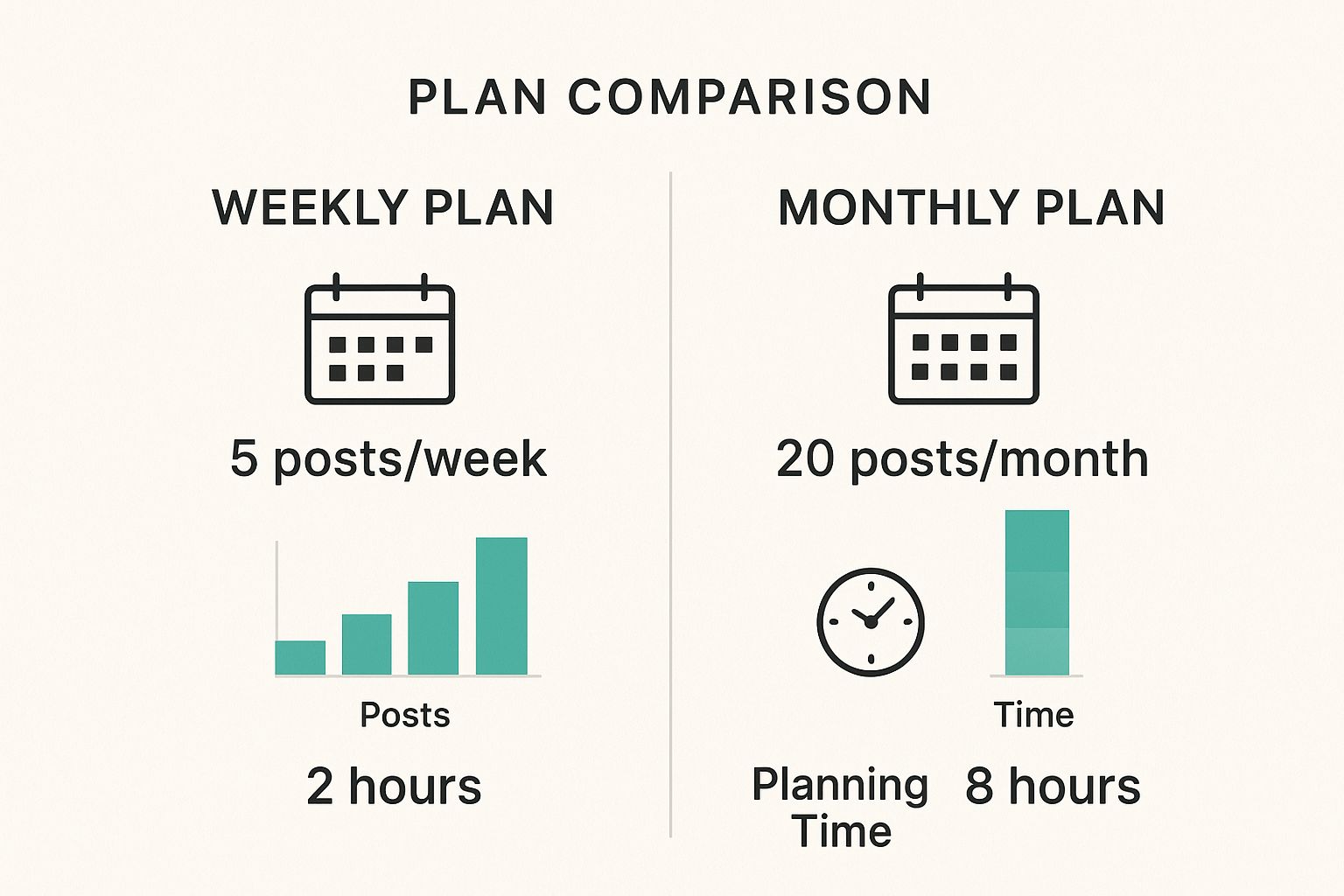
As you can see, batching your content creation frees up a significant chunk of time that you can then pour back into promotion and getting your work seen.
Here's a quick comparison of the different channels to help you decide where to focus your energy.
Content Distribution Channel Comparison
| Channel Type | Examples | Pros | Cons |
|---|---|---|---|
| Owned Media | Company Blog, Email List, Social Media Profiles | Complete control over messaging and timing; Builds a direct relationship with your audience; Cost-effective. | Can be slow to build an audience; Reach is limited to your existing followers. |
| Earned Media | Social Shares, Press Mentions, Guest Posts, Reviews | Highly credible and trustworthy (third-party validation); Can drive significant traffic and brand authority; Free. | Unpredictable and hard to control; Requires strong relationships and excellent content to achieve. |
| Paid Media | Social Media Ads, PPC, Native Advertising, Influencer Marketing | Immediate results and guaranteed reach; Highly targeted to specific demographics and interests; Scalable. | Can be expensive; Ad fatigue is real; Perceived as less authentic than owned or earned media. |
Ultimately, a balanced approach that integrates all three channel types will give you the best results, creating a flywheel effect where each channel supports the others.
Invest in Smart Amplification
The writing is on the wall: businesses are doubling down on content. Data for 2025 shows that 46% of B2B marketers are planning to increase their content marketing budgets. But where is that money going? The top investment areas are video (61%), thought leadership (52%), and a tie between AI tools and paid advertising (both at 40%).
Here’s the kicker, though: only 29% of marketers with a documented strategy feel it's actually working well. You can find more of these eye-opening content marketing statistics at Content Marketing Institute.
That statistic highlights a massive gap between creation and effective distribution. This is precisely why smart, paid amplification is a game-changer. Don't just throw money at every post. Find the content that is already getting some organic love and put a budget behind it to reach a wider, lookalike audience. This is how you turn a solid blog post into a reliable lead-generation machine and ensure all your hard work actually pays off.
Measuring What Matters and Tweaking Your Plan

Here’s a hard truth: a content strategy isn't a "set it and forget it" kind of deal. It's a living, breathing plan that needs constant attention to actually work. The very best strategies I've seen are built on a simple, continuous loop: measure, analyze, and improve. This is how you stop guessing and start knowing what resonates with your audience.
The trick is to focus on metrics that connect directly back to the business goals you set earlier. It’s so easy to get caught up in vanity metrics like social media likes or a spike in page views, but honestly, they rarely tell you the full story.
Building Your Performance Dashboard
To keep from drowning in data, you need a simple performance dashboard. Don't overthink this—it doesn't have to be some fancy, expensive software. A basic spreadsheet is often all you need to get started. The point is to have one central place to track the key performance indicators (KPIs) that really matter.
I like to organize my dashboards around three core areas that paint a clear picture of your content’s health:
- Traffic and Reach: How are people finding you in the first place? Here, we're looking for quality, not just quantity.
- Engagement: Once they find you, does your content actually grab their attention and hold it?
- Conversions: Is your content compelling people to take the actions you care about, like signing up for a demo or making a purchase?
By focusing on these three pillars, you’re tracking the entire customer journey, from that first click all the way to a sale. This is the only way to truly understand if your content is delivering a real return on your investment.
A great content dashboard doesn't just throw numbers at you; it tells a story. It shows you what’s working, screams at you about what’s failing, and points you toward your next best move.
For example, if you see your organic traffic is climbing but your conversion rate is totally flat, that's a huge clue. It tells you your SEO is on point, but your content might not be persuasive enough to get visitors to act. Insights like that are pure gold.
KPIs That Actually Move the Needle
Not all metrics are created equal. Instead of obsessing over dozens of data points, just concentrate on a handful of powerful KPIs for each of those core areas.
Here are a few essentials I always include in my dashboards:
- Traffic Sources: Where are your best visitors coming from? Organic search, social media, direct? This tells you where to double down.
- Time on Page: A fantastic indicator of whether your content is truly engaging or just getting a quick glance.
- Bounce Rate: If people land on a page and immediately leave, it's a strong sign the content didn't match their expectations.
- Lead Conversion Rate: For things like e-books or contact forms, what percentage of people are actually converting?
- Newsletter Sign-ups: This is a crucial metric for building an audience you own and can nurture over time.
- Customer Acquisition Cost (CAC) from Content: The ultimate gut-check. How much are you actually spending to get a new customer through your content?
If you want to dig deeper into these numbers, our guide on how to increase organic traffic has some really practical tips for boosting the top of your funnel.
The Power of the Quarterly Content Audit
Data is completely useless if you don't act on it. A quarterly content audit is your chance to turn all those insights into real improvements. This isn’t about painstakingly reviewing every single blog post. It's a strategic look to find your winners, losers, and hidden gems.
Block off a day every three months, pour a big cup of coffee, and dive into your analytics. You can use a simple system to categorize everything:
| Content Category | Description | Your Next Action |
|---|---|---|
| High Performers | These are your rockstars—the articles driving serious traffic and conversions. | Amplify and Repurpose: Double down. Create spin-off content, update them with new stats, and promote them all over again. |
| Underperformers | Content that’s collecting digital dust with little traffic or engagement. | Prune or Improve: If a post has zero strategic value, consider deleting it. If it has potential, give it a major overhaul and relaunch it. |
| Growth Opportunities | Posts hanging out on page two or three of Google for valuable keywords. So close! | Optimize for the Win: These are your priority. Update them with more depth, better internal links, and fresh visuals to give them the push they need to hit page one. |
This regular audit cycle is the secret sauce. It forces you to be ruthless about what isn't working and incredibly strategic about what is. This is what turns a static content plan into a dynamic, results-driven engine that gets better and better over time.
Got Questions About Content Strategy? I've Got Answers.
When you're first mapping out a content strategy, a few key questions always seem to pop up. Let's tackle them head-on, because getting these fundamentals right from the start can be the difference between a plan that fizzles out and one that truly delivers.
How Often Should I Be Publishing Content?
Everyone asks this, hoping for a magic number. The truth? There isn't one. The right publishing cadence is whatever you can do consistently without sacrificing quality.
Seriously, it’s far better to publish one killer, in-depth article a week, every single week, than to flood your blog with five so-so posts and then disappear for a month. Your audience craves reliability. Start with a schedule that feels manageable, even a little bit easy. You can always ramp things up once you get your workflow down and see what's resonating.
The real goal here is to build a habit with your audience. You want them to know when to expect something new from you, making your brand a reliable part of their routine.
What's the Real Difference Between a Strategy and a Plan?
This one trips up even seasoned marketers, but it's a critical distinction. Let me break it down with an analogy I love: planning a road trip.
Your content strategy is your destination and the reason you're going. It’s the big picture. It answers the "why" and the "who." For example: "We will become the #1 trusted resource for first-time homebuyers in Texas to generate high-intent mortgage leads."
Your content plan is the turn-by-turn GPS navigation. It's the nitty-gritty of how you'll get there. This is your content calendar, your promotion checklists, and your topic lists. For instance: "Publish a blog post on 'A First-Time Homebuyer's Checklist for Austin' next Tuesday and promote it on Instagram and in local Facebook groups."
You absolutely need the strategy first. A plan without a strategy is just driving around aimlessly, hoping you end up somewhere good.
Honestly, How Long Until I See Results?
I'll be straight with you: content marketing is a long game, especially if you're chasing organic growth through SEO. It’s not like flipping a switch on a paid ad and watching the clicks roll in. This is about building a valuable asset over time.
Realistically, you should expect to put in 6-12 months of consistent work before you see a significant, needle-moving impact on things like organic traffic and leads. But that doesn't mean you're flying blind for a year.
You can—and should—track early indicators to know you're on the right track. Keep an eye on these "green shoots":
- Your keyword rankings starting to climb for key topics.
- More people sharing your content on social media.
- A steady uptick in your email newsletter subscribers.
Watching these smaller wins is crucial. It keeps morale high and gives you the proof you need to show that the strategy is working, long before you hit those big-picture goals.
Ready to stop guessing and start building a data-driven keyword strategy in minutes? RankHub analyzes your entire website to uncover the high-value opportunities your competitors are missing. Get your AI-powered strategy.
More from Our Blog
Top Marketing Automation Platforms That Save Time & Money
Compare the best marketing automation software for SMBs and enterprises. See pricing, features, and expert recommendations to find your ideal platform.
Read more →
Why Your Content Isn't Ranking: The Content Optimization Fix
Master content optimization to boost SEO rankings and engagement. Learn root causes, 5 proven solutions, and prevention tactics for 2024-2025.
Read more →
Digital Marketing Online: Your Complete Roadmap to Success
Master digital marketing online with our comprehensive guide. Learn strategies, tools, and best practices to grow your business in 2025.
Read more →