If you want to get more organic traffic, it really comes down to one thing: create content that people actually want to read, and make it easy for search engines to understand what it's about. It’s a two-part game of satisfying your audience while also playing by the search engine's rules. This isn't about quick tricks; it's about building a solid foundation for real, sustainable growth.
Build Your Foundation on Keyword Research and Intent

Before you even think about writing, you have to know what your audience is looking for. This is where keyword research becomes your best friend. But modern keyword research isn't just about chasing high-volume, generic terms anymore. The real gold is in understanding user intent—the why behind every search.
Think of yourself as a detective. You're not just collecting words; you're piecing together clues to figure out what a searcher truly wants to find. This insight is what will guide every piece of content you create from here on out.
Uncovering The Why Behind the Search
Every single search query has a purpose behind it, and if you can figure out that purpose, you can create content that hits the nail on the head. This dramatically increases how valuable your content is to the user, which is exactly what Google wants to see.
There are a few main types of search intent you'll run into:
- Informational: The user needs to know something. Their search might start with "how to," "what is," or "guide."
- Navigational: The user is looking for a specific place. Think searches like "RankHub login" or "YouTube."
- Transactional: The user has their wallet out and is ready to buy. These searches often include words like "buy," "price," or a specific product model.
- Commercial Investigation: The user is comparing their options before making a decision. You'll see keywords like "best," "review," or "vs." here.
When you're creating content, it's so important to match the format to the searcher's intent. You wouldn't write a "how-to" guide for someone trying to buy something, and a product page is pretty useless for a person who just wants information.
To help visualize this, let's break down how to match your content to what the user is actually looking for.
Matching Content to Keyword Intent
| Search Intent | Typical Keywords | Best Content Format |
|---|---|---|
| Informational | "how to fix a leaky faucet," "what is SEO" | Blog posts, guides, tutorials, infographics |
| Commercial Investigation | "best running shoes 2024," "Ahrefs vs Semrush" | Comparison articles, reviews, top-10 lists |
| Transactional | "buy iPhone 15 Pro," "Nike Air Max price" | Product pages, service pages, e-commerce category pages |
| Navigational | "Facebook," "Amazon login" | Your homepage, a dedicated login page |
Thinking this way ensures you're always creating the right kind of content for the right person at the right time.
From Broad Terms to High-Intent Phrases
Chasing those big, one-word keywords might feel like the goal, but they're often incredibly competitive and way too broad. The real opportunity for boosting organic traffic usually lies in long-tail keywords. These are the longer, more specific phrases people use when they know what they want.
For example, a person searching for "shoes" is just window shopping. But someone searching for "best waterproof trail running shoes for wide feet"? That person is serious, and they’re probably close to making a purchase.
Targeting these super-specific phrases brings much more qualified traffic to your site. This is a fundamental part of any good keyword strategy. For a more detailed walkthrough, you can check out our complete guide on how to do keyword research effectively.
Key Takeaway: Stop thinking about keywords as just words. Start thinking about them as questions your audience is asking. Your content needs to be the best answer.
When you consistently solve a user's problem with your content, Google takes notice. The reward is better visibility and more of the right kind of traffic. This is more critical now than ever before.
In fact, recent data shows the #1 organic result on Google now pulls in an average click-through rate of 39.8%. That’s a huge slice of the pie, highlighting just how much you stand to gain by getting to the top.
Create Content That Actually Ranks and Converts

Alright, you've got your keyword map. Now for the fun part: building the engine that will actually drive your organic traffic. And that engine is your content.
I'm not talking about just any content, though. We need to create pages that are so genuinely helpful, well-organized, and perfectly matched to what people are searching for that Google has no choice but to rank them.
This isn't a numbers game of churning out articles to hit a quota. It’s about building digital assets that solve real problems, answer pressing questions, and guide people toward the solutions they need. Think of every piece of content as a magnet for your ideal audience.
The Real Foundation of High-Ranking Content
Let's be clear: top-tier content is more than just good writing. It's a blend of smart structure, proven authority, and real value that keeps people glued to the page. This is what tells search engines you're a source worth trusting.
To do this consistently, you absolutely need an effective content creation workflow. This system ensures every article is properly planned, created, and fine-tuned for the biggest possible impact.
Your guiding star should always be helpfulness. Ask yourself, "Does this page completely solve the user's problem?" If there's any hesitation, it's not ready to publish.
My Two Cents: I always tell my team to think of content as a product. Your audience is "hiring" that blog post to do a job for them. Maybe that job is teaching them a new skill, helping them choose between two options, or fixing a nagging issue. If your "product" does the job better than anyone else's, you win. Every time.
This user-first mindset is the most reliable path to long-term organic growth because it lines up perfectly with what search engines are trying to do for their users.
Structure Your Content So People Actually Read It
Here’s a hard truth: people don't read online, they scan. The layout of your content is just as crucial as the words themselves. If someone lands on your page and is greeted by a giant wall of text, they're gone.
Here’s how I structure articles for real-world readability:
- Use Short Paragraphs: Seriously, stick to 1-3 sentences max. This creates breathing room (white space) and makes the page feel way less overwhelming.
- Write Killer Headings: Your H2s and H3s should be clear and descriptive. They act as signposts that guide readers through your article.
- Embrace Lists: Bullet points and numbered lists are a scanner's best friend. They're perfect for breaking down steps or features into easy-to-digest bites.
- Add Visuals: A good image, chart, or infographic can explain a complex idea faster than a hundred words ever could. Plus, they make your content look more professional.
A scannable format makes your content more enjoyable to use, which boosts how long people stay on your page—a big, positive signal to Google.
Build Topical Authority with Pillar Pages
Throwing random blog posts at the wall to see what sticks is a strategy for failure. To show search engines you're a true expert, you need to build topical authority. The best way I’ve found to do this is with the pillar page and topic cluster model.
Here’s how it works:
- The Pillar Page: This is your cornerstone. It's a massive, in-depth guide covering a broad topic from top to bottom. For an SEO agency, a pillar page could be "The Ultimate Guide to SEO."
- The Topic Clusters: These are shorter, highly-focused articles that dive deep into one specific subtopic from your pillar. For our SEO example, clusters might be "How to Do Keyword Research" or "An On-Page SEO Checklist."
- The Internal Links: This is where the magic happens. You link from all your specific cluster articles back up to your main pillar page. This creates a beautifully organized web of content that screams "expert" to Google.
This structure does wonders. It organizes your site, makes it a breeze for users to find related information, and proves your deep knowledge on a subject—a huge lever for increasing organic traffic.
The hard work you invest in creating this kind of organized, high-value content really pays off. Organic search still brings in the lion's share of website traffic. In fact, it accounts for about 53% of all traffic, making it far more cost-effective than paid ads over time. The quality of this traffic is usually higher, too, often leading to better conversion rates than paid search.
Get Your On-Page SEO Dialed In
Okay, so you've created some fantastic content. That's a huge win! But now comes the part where you give Google all the right signals so it knows exactly what your page is about and who to show it to. This is on-page SEO in a nutshell.
Think of it less like a rigid, technical chore and more like organizing your work so it’s impossible to misunderstand. You’re essentially telling search engines, "Hey, this page is the perfect answer for someone searching for X." When you get this right, you'll see a noticeable lift in organic traffic, often much faster than with other SEO tactics.
The whole process, from research to the final structure, is what makes or breaks your content's visibility.
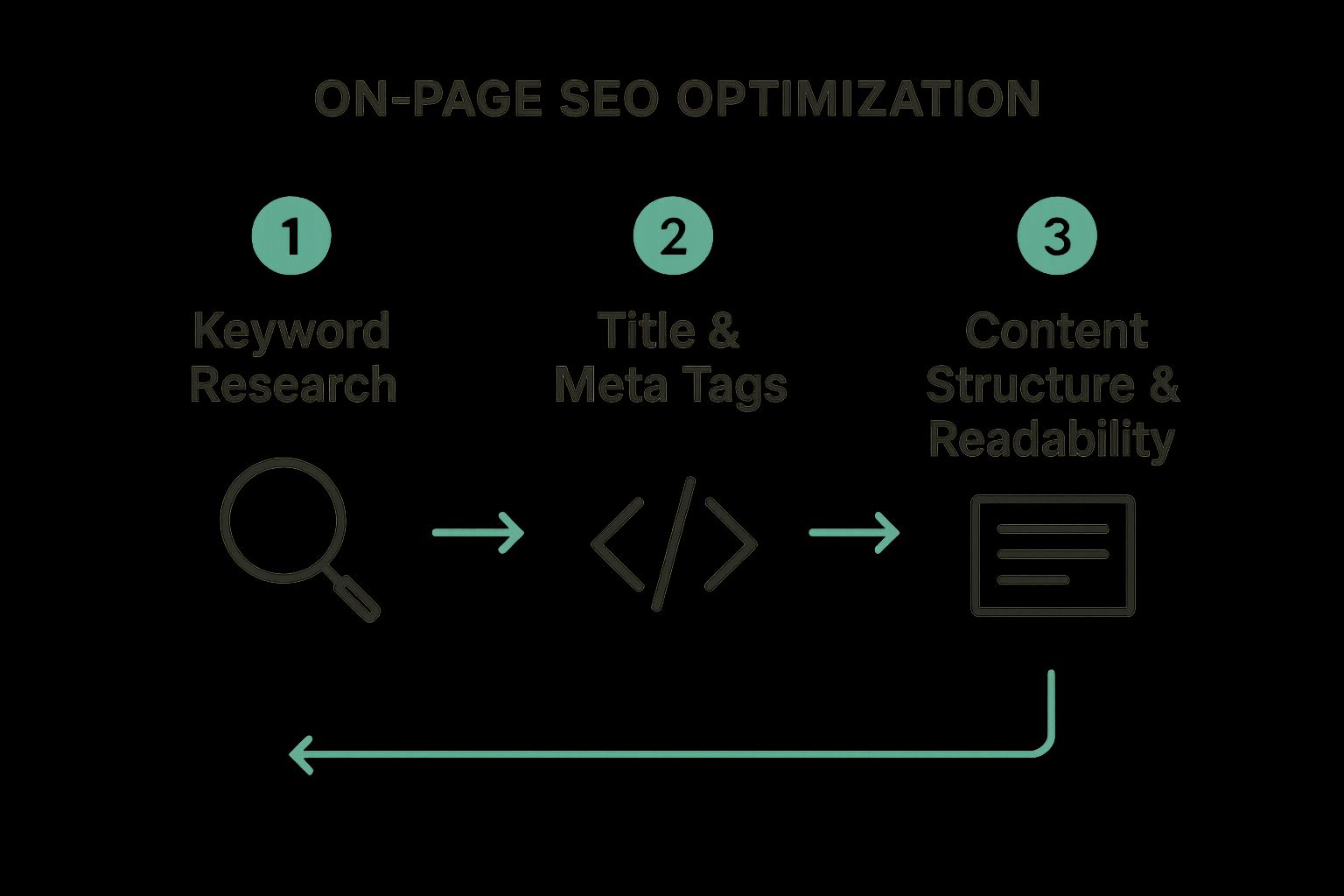
As you can see, on-page SEO isn't just one thing. It's a series of connected steps, where each one builds on the last to create a powerful, cohesive signal for search engines.
To help you nail this, I've put together a quick-reference checklist. These are the core elements I focus on for every single piece of content.
On-Page SEO Optimization Checklist
This table breaks down the most critical on-page elements, why they matter, and a practical tip for each one.
| On-Page Element | Primary Purpose | Pro Tip |
|---|---|---|
| Title Tag & H1 | First Impression & Relevance | Front-load your main keyword and add an emotional trigger or number to boost clicks. |
| Header Tags (H2, H3) | Structure & Scannability | Use headers to create a logical outline. A user should grasp the page's topic by just reading the headers. |
| Image Alt Text | Accessibility & Image Search | Describe the image accurately for screen readers and include your keyword naturally to rank in Google Images. |
| Internal Links | Site Authority & User Path | Link from your established, high-performing pages to your new content to pass authority and help with discovery. |
Getting these four things right is a massive step toward better rankings. Let's dig a little deeper into each one.
Write Headlines That People Actually Want to Click
Your title tag and H1 are your most valuable on-page real estate. Period. They're what people see in the search results, and a boring headline will get ignored, even if you’re ranked #1.
Here’s how to craft headlines that beg to be clicked:
- Lead with your keyword. Get it as close to the beginning as you can.
- Keep it under 60 characters. This helps you avoid getting cut off in search results.
- Spark some emotion. Words like "Proven," "Effortless," or "Ultimate" create curiosity.
- Use numbers or brackets. It's a classic for a reason—headlines like "7 Proven Ways..." just work.
For example, "Guide to Organic Traffic" is fine, but it’s bland. "How to Increase Organic Traffic [7 Proven Steps]" is specific, actionable, and far more compelling.
Use Headers to Create a Clear Path
Header tags (H2s and H3s) do more than just make your text look pretty. They build a logical hierarchy for your content, which is a lifesaver for both readers and search engines. People can scan your page and immediately understand the main points.
Always use an H1 for your main title. Then, break up your article with H2s for the major sections and H3s for the supporting points within them. This simple structure makes your content infinitely easier to read and improves the user experience.
Pro Tip: I always use this little trick: read only your H1, H2, and H3 tags out loud. If they tell a complete, coherent story, you've nailed your structure.
Don't Forget to Optimize Your Images
Every single image you upload is another chance to show up in search. Since Google can't "see" what's in a picture, it relies on your alt text to understand the context.
Good alt text is descriptive, concise, and includes your target keyword if it feels natural. This not only helps your images rank in Google Image Search but is also critical for accessibility, as it’s what screen readers announce to visually impaired users.
For instance, alt="chart" is useless. Something like alt="Bar chart showing organic traffic growth increasing by 45% in Q2" is a world of difference. If you're heavy on visuals, especially on platforms like Pinterest, diving into an ultimate Pinterest SEO guide can be a game-changer.
Build a Smart Internal Linking Web
Internal links—the ones pointing from one page on your site to another—are incredibly powerful. A smart internal linking strategy helps spread authority (often called "link juice") around your website and guides your visitors to other helpful content.
Whenever you publish a new article, make it a habit to find a few older, high-authority pages on your site and add a link to the new piece. This tells Google about your new content faster. This also keeps people on your site longer, which lowers your bounce rate and sends all the right engagement signals.
For more ideas on this, check out these other actionable website traffic increase tips.
Build Real Authority with Strategic Link Building

Alright, once your on-page SEO is solid and your content is firing on all cylinders, it’s time to build some serious authority. In the eyes of Google, authority is largely measured by one thing: backlinks. These are simply links from other websites pointing to yours.
Think of each backlink as a vote of confidence. When a reputable site in your niche links to one of your pages, they’re essentially vouching for you. They’re telling Google, "Hey, this stuff is legit and valuable." The more of these high-quality votes you collect, the more authoritative your site becomes, which is a massive lever for boosting your organic traffic.
But let's get one thing straight. This isn't a numbers game anymore. The goal isn't just to hoard as many links as possible from any random site. Quality over quantity is the name of the game now.
Ditch the Outdated Link Building Tricks
Back in the day, SEOs would do all sorts of shady stuff to get links—spamming blog comments, submitting to worthless directories, and even buying links by the dozen. Not only are those tactics completely useless today, but they're a fast track to a Google penalty. You don't want that.
Modern link building is all about earning links naturally. It’s about creating things so genuinely useful and interesting that other people want to link to them. This approach is built on creating value and fostering real relationships, not finding shortcuts.
How to Earn Links the Right Way
If you want a backlink profile that actually helps you and doesn't crumble during the next Google update, you need to focus on ethical, sustainable strategies. Here are a few of the methods I've seen work time and time again.
- Create "Linkable Assets": This just means making content that’s specifically designed to attract links. Think original research packed with fresh data, a free tool that solves a common problem in your industry, or an ultimate guide that’s way more detailed than anything else out there.
- Get into Digital PR: This is where you create a compelling story—maybe from that original research you did—and pitch it to journalists and bloggers. A great story can get picked up by major publications, earning you some incredibly powerful backlinks.
- Build Real Relationships: Seriously, just talk to people. Connect with other creators and site owners in your space. Comment on their posts, share their work, and look for natural ways to collaborate. A genuine connection is always more likely to result in a link than a cold email.
- Do Strategic Guest Blogging: Writing for other well-regarded blogs is a fantastic way to build your brand and get a relevant link. The trick is to focus on delivering massive value to their audience. Don't just show up to plug your own site.
Sure, these methods take more work. But the links you get will be exponentially more valuable and will protect your site's health for the long run.
Key Insight: A single backlink from a trusted, high-authority site in your industry is worth more than a hundred spammy links from irrelevant websites. Always, always prioritize quality.
Finding and Vetting Good Link Opportunities
Not every website is a good place to get a link from. Before you invest any time or effort, you have to vet your targets to make sure they're worth it.
Here’s my quick checklist for vetting potential link partners:
- Relevance: Is the site actually related to your niche? A link from a home gardening blog to your SaaS company isn't going to do much.
- Authority: Does this site have a good reputation? You can use tools like Ahrefs or Semrush to check metrics like Domain Rating (DR) or Authority Score (AS).
- Traffic: Does the site actually get visitors? A link from a site with a real, engaged audience is far more valuable than one from a digital ghost town.
This process helps you focus your energy where it will make the biggest difference. For anyone in a tough market, like e-commerce, a stellar backlink profile is absolutely essential. You can dig deeper into some specific strategies with these e-commerce SEO best practices for 2025.
The Art of the Outreach Email
So you've found the perfect site. Now you have to ask for the link. This is where so many people mess up. A generic, copy-and-pasted email is destined for the trash folder.
Your outreach has to be personal. Show them you’ve actually engaged with their site. Clearly and concisely explain why your resource would be a great fit for their audience. Make it incredibly easy for them to say yes. Keep it short, personal, and focused on the value you're offering them.
Look Beyond Keywords to Future-Proof Your SEO
Let's be real: If you're still obsessing over old-school keyword rankings, you're playing yesterday's game. The way people find what they need online is changing, and fast. To keep your organic traffic flowing for the long haul, you have to think bigger. We're talking about preparing for a search world dominated by AI, user experience, and genuine brand authority.
This isn't just another trend. It's a fundamental shift. The competition is already brutal—the top five organic results snap up around 70% of all clicks, and a surprising 69% of traffic now comes from those super-specific long-tail keywords. But the ground is shifting again. Some folks are predicting that organic search traffic could plummet by as much as 50% by 2028 as AI interfaces start giving answers directly, no click required.
If you want the full scoop on this, you can check out the analysis on swydo.com. All of this means that future-proofing your SEO isn't just a smart move; it's a survival tactic.
Adopt the E-E-A-T Mindset
Google’s obsession with Experience, Expertise, Authoritativeness, and Trustworthiness (E-E-A-T) isn't just a new algorithm tweak. It's a whole new philosophy. It means your content can't just be correct—it has to come from someone who actually knows what they're talking about.
So, how do you put this into practice? You have to wear your credibility on your sleeve.
- Beef up your author bios. Don't just list a name. Add real credentials, relevant work history, and links to social profiles. Let your readers see the expert behind the curtain.
- Publish original research. Nothing builds authority faster than your own data. Run a survey, analyze some industry trends, or conduct an experiment and share what you find. This creates a powerful asset that other people will want to link to.
- Show, don't just tell. Instead of just writing about a process, show it in action. I'm talking case studies with real numbers, examples from your own projects, and plenty of screenshots to prove you've actually done the work.
This is exactly why it’s so critical to understand how AI writers are changing the SEO landscape. An AI can spit out text, but it can’t fake lived experience. That’s where you have the edge.
Optimize for AI Summaries and Zero-Click Searches
With the rise of features like Google's AI Overviews, you need your content to be easily understood by machines, not just people. The new goal is to be the source for these AI-generated answers, even if it doesn't lead to a direct click every time.
Here's how you can start positioning your content for this:
- Answer questions directly. Get straight to the point, especially at the beginning of a section. Use simple, factual language that an AI can easily parse and present as an answer.
- Use structured data. This is like leaving a cheat sheet for search engines. Implementing schema markup, especially things like FAQ schema, explicitly tells Google what your content is about and makes it easy to feature.
- Structure your info in lists. AI models love a good bulleted or numbered list. They are easy to scan and perfect for pulling into summaries.
My two cents: I've started treating the first paragraph of every important section as a mini-summary. I try to answer the core question right away, then use the rest of the text to elaborate. I’ve seen this help my clients get featured in snippets and AI answers way more often.
Build a Brand People Search for Directly
What's the ultimate trump card for future-proofing your SEO? Build a brand so reputable that people skip the generic search and look for you by name.
When someone types "RankHub keyword research" instead of just "keyword research tool," you've already won. That's called branded search, and it's one of the strongest signals of trust and authority you can send.
This doesn't happen overnight. You build this kind of brand equity with consistently great work across every channel. It’s about becoming the undisputed go-to resource in your field. Think about how you can become a destination, not just another result on the page. Maybe it's through a unique perspective, a weekly newsletter people can't wait to open, or a free tool that's genuinely helpful.
When you become the source, you're not just playing Google's game anymore. You're playing your own.
Common Questions About Increasing Organic Traffic
https://www.youtube.com/embed/pRKpaZJJRxk
Alright, so you've gotten a handle on the big-picture strategies for boosting your site's traffic. But as anyone who's been in the trenches of SEO knows, that's when the real questions start popping up. It's one thing to know the theory, but another to apply it day-to-day.
Let's dive into some of the most common questions I hear from people trying to get more organic traffic.
How Long Does It Really Take to See Results?
This is the million-dollar question, isn't it? And the honest, no-fluff answer is that it truly depends. SEO is a long game, a marathon, and anyone promising you page-one rankings overnight is selling you snake oil.
For a brand-new website with very little authority, you're realistically looking at 6 to 12 months of consistent work before you start to see meaningful, lasting traffic growth. If you're working with a more established site that already has some domain authority, you could start seeing some positive movement in as little as 3 to 6 months.
But what causes that wide range? A few key things:
- Your Niche's Competitiveness: Trying to rank for something like "best credit cards" is going to be a much tougher, longer battle than ranking for "best dog groomers in Boise."
- Your Content Game: Pushing out one fantastic article every few months just isn't going to move the needle. You need a steady drumbeat of high-quality, genuinely helpful content.
- Your Site's Technical Health: A slow, clunky website that's a nightmare to navigate will sabotage even the most brilliant content strategy.
What Should I Prioritize First?
Feeling swamped by the endless list of SEO tasks? You're not alone. When you're just starting out, the key is to focus on the 20% of efforts that will get you 80% of the results.
Here’s where I’d tell anyone to start:
- Build a Solid Foundation: Before anything else, make sure your website is crawlable for search engines, works beautifully on mobile, and loads at a decent speed. A quick SEO audit can uncover any glaring technical issues that need fixing.
- Smart Keyword Research: You don't need a list of 1,000 keywords. Find a handful of high-intent, lower-competition keywords to serve as your initial beachhead.
- Create Genuinely Helpful Content: Take those keywords and build the best possible piece of content on the internet for them. Go deep, answer the user's questions, and make it better than what's currently ranking.
My Advice: Don't get lost in the weeds with advanced link-building tactics or complex schema markup right off the bat. Nail the fundamentals. Nothing is more powerful than a technically sound site filled with content that actually helps people.
Paid Ads vs. Organic Traffic: Which Is Better?
This is less of an "either/or" debate and more of a "when and why" situation. Smart marketers know that paid ads and organic traffic aren't rivals; they're teammates that play different positions.
Think of it this way:
| Aspect | Paid Ads (PPC) | Organic Traffic (SEO) |
|---|---|---|
| Speed | You get traffic the minute your campaign goes live. | It takes months to build real momentum. |
| Cost | You pay for every single click. The meter is always running. | The traffic is "free," but it costs time and resources to earn. |
| Longevity | The second you stop paying, the traffic disappears. | It’s a long-term asset that can deliver traffic for years. |
| Trust | Users know it’s an advertisement, and some are naturally skeptical. | Builds immense trust and credibility with your audience. |
Paid ads are like a faucet—you can turn them on for an instant flow of traffic and valuable data. SEO is like building a powerful river—it takes time to carve the channel, but eventually, it creates a sustainable flow that gets stronger over time. Using both gives you the immediate wins you need while you build the long-term asset you want.
More from Our Blog
7 Content Writing Tools That Boost Your SEO Rankings
Discover the top 9 SEO content writing tools to automate drafting, optimization, and publishing. Boost rankings with AI-assisted workflows.
Read more →
Zoho Marketing Automation Explained: Is It Right for You?
Compare Zoho Marketing Automation vs HubSpot on pricing, features, ease of use, and automation depth. See which wins for small teams and solo founders.
Read more →
Looking for an SEO Company? Here Are Your Best Options
Compare top SEO companies, AI platforms, and agencies. Find the best fit for your budget, from $49/month tools to full-service retainers.
Read more →