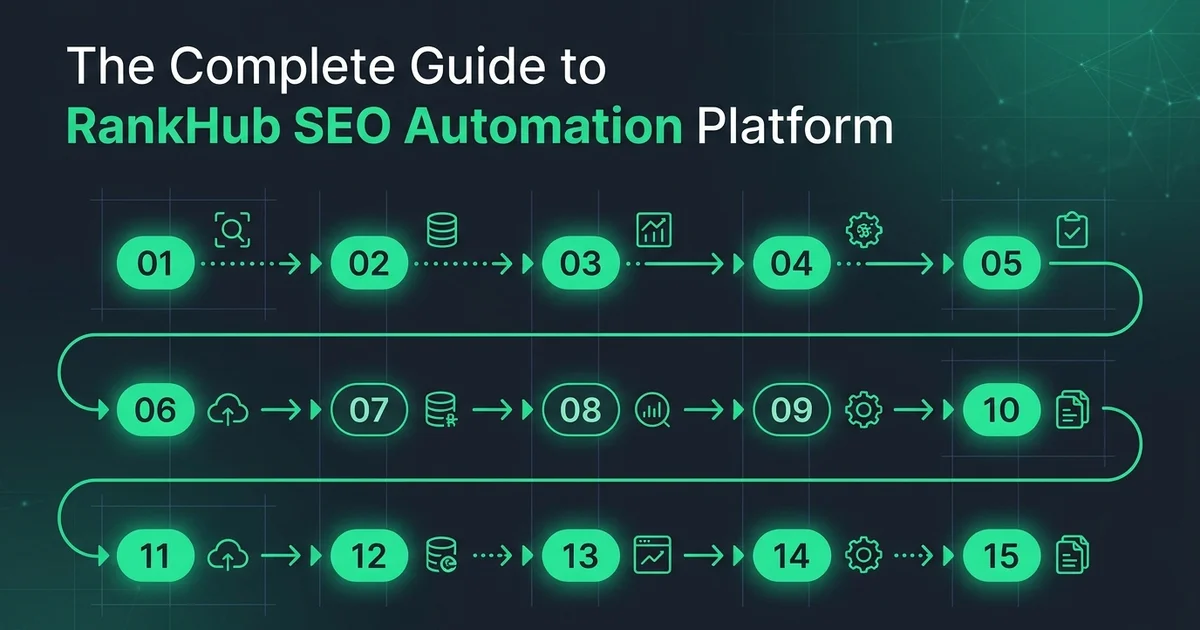
The complete guide to RankHub SEO automation platform
Introduction: What is RankHub SEO automation?
Every business with a website eventually faces the same problem: publishing consistent, well-researched content is genuinely hard work. Keyword research, article writing, image creation, and scheduling all compete for time that founders and marketing teams rarely have to spare.
What SEO automation actually means
SEO automation is the practice of using software to handle the repetitive, time-intensive tasks that make up a content strategy: finding keyword opportunities, producing optimized articles, and publishing them on a reliable schedule. Rather than replacing strategic thinking, automation handles the execution so that teams can focus on higher-value decisions.
Why manual SEO workflows fall short
The core problem with doing SEO manually is volume. Ranking in competitive search results typically requires a steady stream of fresh, relevant content. For a solo founder or a small marketing team, producing even one well-researched article per week means hours of work across research, writing, editing, and publishing. That workload compounds quickly, and most teams end up publishing inconsistently or not at all.
Where RankHub fits in
RankHub is an end-to-end SEO content platform built around a single idea: add your website once, and the platform handles everything else. Its Autopilot feature runs AI keyword research, writes SEO-optimized articles, generates featured images, and publishes content on a set schedule through a webhook integration. The goal is to remove the manual bottleneck entirely.
This guide covers every major aspect of the platform: how the automation pipeline works, how to configure it for your site, and how to get the most from hands-off content publishing.
Understanding SEO automation fundamentals
SEO automation uses software tools to streamline repetitive optimization tasks like keyword research, content analysis, and performance tracking. Understanding these fundamentals helps you leverage automation effectively within your content strategy to improve efficiency and search rankings.
The core components of SEO automation
SEO automation replaces repetitive, time-intensive tasks with software-driven workflows. In practice, that covers four interconnected activities:
- Keyword research: Identifying search terms your audience uses, prioritizing by volume and competition, and checking for gaps in your existing content
- Content creation: Drafting articles structured around target keywords, with appropriate headings, internal links, and semantic depth
- On-page optimization: Ensuring titles, meta descriptions, and body copy align with ranking signals
- Publishing: Scheduling and delivering finished content to your CMS on a consistent cadence
Manual SEO workflows require a person to coordinate each of these steps separately, often across multiple tools. Automation connects them into a single, repeatable process. For a broader view of how tools handle these tasks, the Mind-Blowing SEO Automation Statistics For 2025 resource offers useful context on adoption trends.
Common misconceptions about automated content
A persistent concern is whether automated content violates Google's guidelines. Google's position, documented in its guidance on generative AI content, is clear: content quality and helpfulness matter, not the production method. Automation that produces genuinely useful, accurate articles is treated no differently than human-written work.
That said, human review remains important. Approving headlines, checking factual accuracy, and occasionally refining tone ensures the output stays on-brand and credible.
Why scale changes the equation
The real advantage of automation is not speed alone. It is the ability to publish consistently at volume without proportional effort. Moving from four posts per month to thirty or more with the same setup time is where platforms like RankHub create a compounding advantage: more indexed content, broader keyword coverage, and steadily growing organic reach.
How RankHub automation works: The 15-step pipeline
Understanding the theory of automation is one thing. Seeing exactly how a platform executes it, step by step, is where the picture becomes concrete. RankHub's autopilot runs 15 automated steps every month, turning a single website setup into a continuously publishing content operation.
Website scanning and content discovery
The pipeline begins by scraping your website, discovering your sitemap, and cataloguing existing blog articles. This baseline audit is what makes everything downstream smarter. Rather than generating content blindly, the system understands what already exists before it writes a single word.
Keyword discovery and gap analysis
With your existing content mapped, RankHub identifies keyword gaps: search terms your site is not yet targeting but should be. This is one of the more labour-intensive tasks in traditional SEO, and automating it means opportunities surface continuously rather than only when someone has time to look. The process also includes anti-cannibalization checks, so no two articles compete for the same keyword and dilute each other's rankings.
AI-assisted content generation
Once target keywords are confirmed, the platform generates SEO-optimized articles built around each term. The content is written natively, which matters for multilingual sites where translated-sounding copy undermines credibility. Each article also includes a generated featured image, removing one more manual step from the production process.
For a broader look at how AI-driven workflows are reshaping content production, the SEO automation statistics roundup at SEO Sandwitch offers useful context on where the industry is heading.
Scheduled publishing and webhook integration
Finished articles do not sit in a queue waiting for someone to hit publish. RankHub pushes content live on a set schedule via webhook, meaning the publishing cadence runs without manual intervention. Depending on the plan, that means a new post every day, every two days, or every week.
Real-time tracking
For a practical look at what this kind of consistent, automated output can produce over time, see SEO autopilot tools that actually deliver results.
Keyword research and discovery automation
Finding the right keywords has always been one of the most time-intensive parts of SEO, and it is also where automation delivers some of its most immediate value. Rather than manually combing through keyword tools and competitor sites, automated systems can surface high-opportunity targets in minutes.
How automated tools identify high-opportunity keywords
Automated keyword research works by crawling your existing content, analyzing your site's topical footprint, and cross-referencing search volume and competition data to find gaps worth targeting. RankHub's AI keyword research does exactly this at the start of each monthly cycle, scanning your sitemap and existing blog articles before generating new keyword targets, so every article it writes fills a genuine gap rather than repeating ground already covered.
Competitor gap analysis and untapped niches
One of the strongest arguments for automation over manual research is the ability to surface keyword gaps you would never spot otherwise. Automated analysis can reveal topics your existing content is missing. For solo founders and small teams who cannot afford to spend hours on this each week, it is a compelling alternative to hiring an seo agency alternative.
Search intent and long-tail prioritization
Automated tools classify keywords by search intent, grouping informational, navigational, and transactional queries into clusters. Long-tail keywords, which typically carry lower competition and higher conversion intent, are prioritized because they are more achievable for newer or smaller sites. For broader context on how AI is reshaping this process, the AI SEO statistics roundup at seo.com offers useful background.
Anti-cannibalization checks add another layer of precision, ensuring no two articles compete for the same keyword, which is a common and costly mistake in high-volume content programs.
Automated content creation and optimization
Once the keyword research phase is complete, the next challenge is turning those opportunities into finished, publish-ready articles without bottlenecking on human bandwidth. This is where content automation earns its place in a serious SEO strategy.
From brief to finished article
The content pipeline in a modern seo automation platform moves from keyword selection through outline generation, draft writing, and final optimization in a single continuous workflow. RankHub Autopilot handles each of these steps sequentially, so what begins as a keyword signal ends as a finished, SEO-optimized article, without requiring manual intervention at each stage.
SEO optimization built into every article
Automation does not mean cutting corners on quality signals. Each article produced through RankHub is written as an SEO-optimized article, so quality signals stay consistent at scale.
For background on how search engines evaluate AI-generated content, Google Search Central's guidance on generative AI content is worth reading before building any automated content program.
Image generation and brand consistency
Featured images are generated and attached to each article automatically. This removes a step that frequently delays publication in manual workflows.
Maintaining a consistent editorial voice across dozens of monthly posts is genuinely difficult without a dedicated team.
Publishing and scheduling at scale
Once articles are written and images attached, the next challenge is getting content live consistently without manual intervention. This is where scheduling and publishing infrastructure becomes the real differentiator between tools that assist and tools that truly automate.
Webhook integration and one-time setup
RankHub connects to your website through a webhook that you configure once. After that, articles move from the content queue to your live blog automatically, on schedule, without requiring you to log in or press publish. As one RankHub user from BookTranslator.ai put it: "We plugged the webhook in once and haven't touched it since."

Frequency options and publishing cadence
Plans are structured around publishing frequency rather than arbitrary feature tiers. The Starter plan publishes one post per week, Growth publishes every two days, and Scale delivers a new article every day. Each plan runs the full automation pipeline, so the only variable is how aggressively you want to build content volume. For context on how publishing frequency affects organic growth, see this SEO automation case study tracking growth from zero to 50K visits.
Anti-cannibalization and keyword conflict prevention
Publishing at scale creates a specific risk: multiple articles competing for the same keyword. RankHub runs anti-cannibalization checks across your existing content before assigning new topics, so each post targets a distinct keyword opportunity. This is particularly valuable as your blog grows and the risk of internal keyword conflicts increases.
Multi-language and editorial control
RankHub writes natively in your site's language rather than translating from English, which matters for both readability and local search relevance. Editorial control is lightweight by design: you can approve headlines from your inbox, keeping oversight minimal without sacrificing final say over what publishes.
Benefits of SEO automation for your business
The case for automating your SEO content comes down to a simple trade-off: the resources you spend on manual content creation versus the organic growth you could be generating instead.
Discover how RankHub Autopilot approaches rankhub seo automation RankHub Autopilot.
Time savings that compound
RankHub's autopilot is built around reclaiming the hours that manual SEO consumes. The platform handles keyword research, article writing, image generation, and publishing in a single automated pipeline, which is how it delivers on the promise of saving 40+ hours every month. For a solo founder or a lean marketing team, that time is better spent on product, sales, or strategy.
Consistent publishing without burnout
Irregular publishing is one of the most common ways content strategies stall. When the pipeline runs automatically on a fixed schedule, your blog grows steadily whether or not anyone on your team has bandwidth that week. That consistency signals to search engines that your site is active, and it builds topical authority over time in a way that sporadic bursts of content simply cannot.
Keyword coverage and competitive reach
Manual content planning tends to miss the long-tail gaps that drive a significant share of organic traffic. Automated keyword discovery, like the approach built into RankHub, surfaces opportunities a human researcher would overlook. For a broader view of how automation is reshaping search visibility, the SEO automation statistics roundup at SEO Sandwitch is worth bookmarking.
Cost efficiency and scalability
Hiring a content team or agency to publish daily is expensive. A content marketing automation platform lets startups operate at a publishing volume that previously required significant headcount, and scales up as the business grows without a proportional increase in cost.
Challenges and safeguards in automated SEO
Automation delivers real efficiency gains, but it also introduces risks that every founder and marketing team should understand before scaling content output. Knowing where the guardrails are is what separates a sustainable SEO strategy from one that eventually attracts a manual penalty.
Google's stance on AI-assisted content
Google's position is clear: content quality matters more than how it was produced. For a thorough reading of the official position, see Google's guidance on generative AI content. The core requirement is that content must be helpful, accurate, and written for people, not just to manipulate rankings. Scaled content abuse, where automation is used to flood a site with thin, low-value pages, remains a violation of Search Essentials regardless of whether a human or an algorithm produced the text.
Avoiding thin and duplicate content
Volume without quality is a liability. Automated workflows need built-in checks to prevent near-duplicate articles targeting the same keyword from different angles. RankHub addresses this directly through anti-cannibalization checks that ensure no two scheduled articles compete for the same search term, keeping the content calendar strategically coherent rather than self-defeating.
Accuracy and editorial oversight
AI-generated articles can confidently state things that are outdated or simply wrong. Fact-checking remains a human responsibility. The most effective approach treats automation as a capable first draft, with a light editorial pass before or after publication to verify claims, update statistics, and align the tone with your brand voice. This is especially important for any seo content automation software handling technical or regulated topics.
Adapting to algorithm changes
Search behavior and ranking signals shift regularly. An automated system that locks in a fixed content formula can underperform when Google updates its quality criteria. Monitoring content performance, tracking keyword movement, and periodically reviewing the topics your automation is targeting keeps the strategy responsive rather than static.
Getting started with RankHub automation
Moving from awareness to action is straightforward with RankHub. The platform is built around a single principle: add your website once, and the system handles the rest.
Free trial and initial setup
After signing up, the onboarding flow prompts you to enter your website URL. From there, RankHub scans your site, discovers your sitemap, and identifies any existing blog content, giving the system a baseline before it writes a single word.
Connecting your publishing channel
Publishing is handled through a webhook integration. You configure it once, and RankHub pushes finished articles directly to your blog on schedule. For teams exploring broader seo automation for content teams, this hands-off publishing step is often where the most time is recovered.
Choosing your publishing frequency
RankHub offers three cadences: weekly, every two days, or daily. Newer sites or niche blogs typically benefit from starting at the weekly pace, building topical authority steadily before increasing volume.
Keyword audit and content gap analysis
Once connected, RankHub runs its AI keyword research automatically, surfacing gaps your existing content has missed. Its anti-cannibalization checks ensure new articles target distinct queries rather than competing with pages you already rank for.
Monitoring early results
After the first few articles publish, track keyword movement and organic impressions through Google Search Console.
Best practices for successful automation
Automation works best when it runs on a solid strategic foundation. The setup steps covered earlier get you live, but the practices below are what separate teams that see compounding organic growth from those that simply publish more content.
Start with a content audit and clear editorial guidelines
Before scaling output, identify the gaps your existing content leaves open. A quick audit reveals which topics you cover well, which you've barely touched, and where competitors are winning traffic you could claim. Once you know your gaps, document editorial guidelines: preferred tone, target reading level, topics to avoid, and any brand-specific terminology. Having these guidelines written down keeps your content strategy consistent.

Review headlines and monitor performance metrics
Automation handles the heavy lifting, but a quick headline review keeps your brand voice intact. Most teams find this takes only a few minutes per batch. Beyond approvals, track the metrics that matter: organic traffic, keyword rankings, and on-page engagement. For a structured approach to tracking output over time, a well-planned seo content calendar automation process makes performance patterns far easier to spot.
Combine automation with strategic manual content
Automation excels at capturing mid-to-long-tail keyword opportunities consistently. For highly competitive head terms, pair automated volume with carefully crafted manual pieces. RankHub's anti-cannibalization checks ensure automated articles don't undercut your manually written cornerstone content, keeping your entire site's keyword strategy coherent. For broader context on where automation fits into modern SEO workflows, the SEO Automation Case Study at GENESIS offers a useful real-world perspective.
Iterate based on data
Review which topics drive actual clicks and conversions every month. Double down on formats and subject areas that perform, and refine your guidelines to produce more of what works. Automation frees the hours you would have spent writing, giving you space to focus on link building, technical SEO, and conversion optimisation: the high-impact tasks that compound results over time.
Tools, integrations, and the automation ecosystem
A well-chosen set of tools turns SEO automation from a single tactic into a compounding system. The goal is to connect content production, distribution, and measurement so each layer informs the next.
RankHub's publishing integrations
RankHub uses a webhook-based publishing model, which means it can push finished articles to any platform that accepts webhook payloads. Once the connection is configured, the pipeline runs without manual intervention: keyword research, article writing, featured image generation, and scheduled publishing all happen automatically. This makes it a practical fit for small businesses building an online marketing platform without a dedicated content team.
Connecting analytics and rank tracking
Pairing RankHub with your own analytics tools and Google Search Console gives you impression and click data at the keyword level, so you can see which articles are gaining traction in search results. Adding a dedicated rank tracker on top closes the loop between content output and ranking movement.
Building a complete tech stack
A lean but effective stack typically combines an automated content platform, an analytics layer, and a technical SEO tool. For a broader view of how automation fits into modern SEO workflows, the SEO automation statistics roundup at SEO Sandwitch is worth reviewing. Each tool should have a clear, non-overlapping role to avoid redundancy and keep reporting clean.
Future trends in SEO automation and AI search
The SEO landscape is shifting faster than at any point in the past decade, and understanding where it's heading helps you invest in the right capabilities now.
AI Overviews and generative search
Google's AI Overviews have changed what "ranking" means. Appearing in a generated answer requires content that directly addresses specific questions with clear, authoritative structure. For guidance on how Google evaluates AI-assisted content, the Google Search Central documentation on generative AI content is the definitive starting point.
The rise of end-to-end automation
Marketers are moving away from stitching together point solutions and toward platforms that handle the full workflow, from keyword discovery through publishing. Platforms like RankHub are built around this model, running a 15-step automated pipeline each month so nothing falls through the gaps between tools.
E-E-A-T signals at scale
Automated content increasingly needs to demonstrate experience and expertise, not just topical coverage. Well-structured articles, consistent publishing cadence, and native-language output all contribute to how search engines assess trustworthiness across a growing content library.
Programmatic SEO lessons
Successful implementations consistently point to the same principle: consistency beats volume. Publishing on a reliable schedule, avoiding keyword cannibalization, and covering genuine gaps in your niche compounds over time in ways that sporadic bursts of content cannot.
Related Articles
Frequently asked questions
What is SEO automation?
SEO automation uses software to handle repetitive tasks like keyword research, content creation, and publishing on a consistent schedule. It reduces the manual effort required to maintain an active blog and helps businesses publish more frequently without expanding their team.
Can AI automate SEO?
Yes. AI tools can research keywords, write optimized articles, generate images, and publish content automatically. Platforms like RankHub handle the full pipeline, from identifying keyword gaps to scheduling posts, without requiring ongoing manual input.
Is automated SEO safe for Google rankings?
Automated SEO is safe when the output is genuinely helpful, well-structured, and relevant to your audience. Google evaluates content quality, not production method, so consistent, readable articles that serve real search intent perform well.
How do AI SEO tools find keywords and create content?
They then generate articles structured around those target terms, incorporating headings, internal links, and relevant context.
Does AI-generated content rank on Google?
Yes, provided it is accurate, useful, and well-organized. Google's guidance focuses on content quality and user experience rather than how content was produced. Human review before publishing helps ensure accuracy and brand consistency.
What is the best AI SEO automation tool for small businesses?
For solo founders and small teams, the ideal tool handles the entire workflow without requiring technical expertise. RankHub Autopilot researches keywords, writes articles, generates featured images, and publishes on schedule, making it practical for businesses without a dedicated content team.
How can I automate SEO content publishing without getting penalized?
Focus on tools that include anti-cannibalization checks, native-quality writing, and consistent scheduling rather than mass-producing thin content. RankHub's built-in anti-cannibalization feature ensures no two posts compete for the same keyword, which protects your site's topical structure.
What human review is needed before publishing AI-generated SEO content?
At minimum, review for factual accuracy, brand tone, and any claims that require verification. Many publishers approve headlines and scan drafts for obvious errors, spending only a few minutes per article rather than writing from scratch.
More from Our Blog
9 Proven Ways to Automate Your Content Publishing Process
Discover 9 proven content publishing automation strategies to scale your blog, save time, and maintain quality. Learn workflows, tools, and best practices.
Read more →
The Hidden Metrics Behind Organic Traffic Automation Success
Discover how organic traffic automation is reshaping SEO. Real statistics on AI, content velocity, and ranking impact for 2024-2025.
Read more →
SEO Automation for Small Teams: Everything You Need to Know
Learn how small teams can automate SEO tasks like keyword research and content creation without sacrificing quality. Start your automation journey today.
Read more →