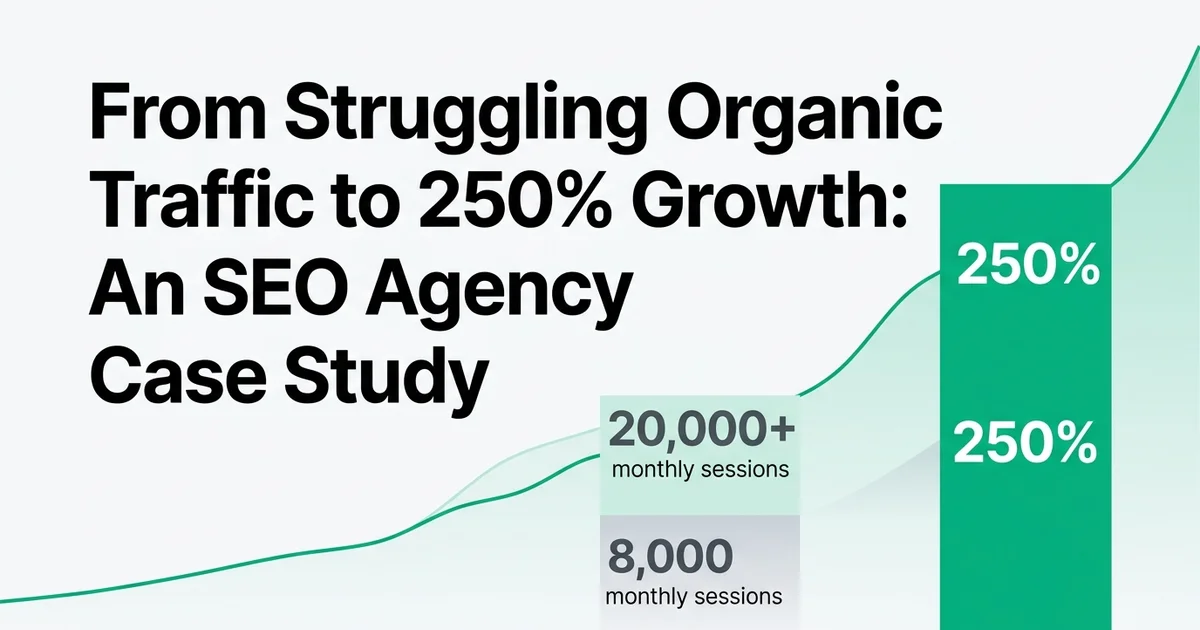
From Struggling Organic Traffic to 250% Growth: An SEO Agency Case Study
Introduction: from stagnant rankings to 340% organic growth
What does it actually look like when a mid-market B2B SaaS company stops guessing at SEO and starts executing a real strategy? In this case study, the answer is a 340% increase in organic traffic over 18 months, a result that transformed how the company acquired customers and competed in a crowded market.
The company and its challenge
The business at the center of this story is a 50-plus-employee B2B SaaS company selling workflow automation software to operations teams. Like many companies at that growth stage, they had tried to handle SEO internally. A marketing generalist published blog posts when time allowed, keywords were chosen based on gut feel, and rankings stayed stubbornly flat for nearly two years.
Why they chose an SEO agency over building in-house
Hiring a full in-house SEO team was expensive and slow. Partnering with a specialist SEO agency offered faster ramp-up, proven frameworks, and access to tooling the company could not justify buying alone. According to SEO Sandwitch (2025), retainer-based agencies see just 18% annual client churn compared to 42% for project-based engagements, a signal that ongoing partnerships consistently deliver value worth keeping.
The timing also made strategic sense. According to QuickSEO (2026), the global SEO services market was valued at $68.1 billion in 2023 and is projected to reach $129.6 billion by 2030, reflecting how seriously businesses are investing in organic growth.
The shift to a hybrid workflow
At RankHub, our analysis shows that the most dramatic SEO turnarounds happen when companies combine agency-level strategy with automated content execution. This company's transformation hinged on exactly that: pairing agency expertise with a platform like RankHub Autopilot, which handles keyword research, article writing, and scheduled publishing automatically, freeing the team to focus on strategy rather than production.
The sections ahead break down every phase of that journey.
About the company: the starting point
Before examining what changed, it helps to understand where this company began. At the time they engaged an SEO agency, the business was a B2B SaaS platform specializing in project management tools, generating roughly $2M in annual recurring revenue with a team of 50 employees.
Company profile and market position
The platform operated in a crowded space. With 15 or more well-funded competitors already holding strong positions in search results, carving out organic visibility was no small task. Rivals had years of content investment, established domain authority, and dedicated marketing teams behind them.
Internal marketing resources
The company's marketing function consisted of a single in-house marketer wearing multiple hats. There was no dedicated SEO resource, no content strategist, and no production pipeline. According to SEO Sandwitch (2025), the average small business spends around $497 per month on SEO, which reflects just how under-resourced most companies in this position actually are.
Organic traffic baseline
At the point of engagement, the site was pulling in approximately 8,000 monthly sessions. The majority of that traffic came from branded keywords, meaning people already knew the company existed. Non-branded, intent-driven traffic, the kind that actually drives pipeline, was nearly absent. The gap between where they were and where they needed to be was significant.
The challenge: why DIY SEO wasn't working
That gap didn't appear overnight. It widened slowly, quarter by quarter, as the team tried to manage SEO alongside every other marketing responsibility. The core problem wasn't effort. It was the absence of a focused, structured approach to organic growth.
Lack of dedicated expertise
The in-house marketer was responsible for email, paid social, content, and SEO simultaneously. In practice, SEO became the channel that got attention only when everything else was done, which meant it rarely got meaningful attention at all. Without specialist knowledge, even well-intentioned efforts produced limited results.
Keyword research gaps
The team was publishing content, but targeting the wrong terms. They focused on broad, high-volume keywords where they had no realistic chance of ranking, while missing the high-intent, lower-competition phrases that actually convert. Entire clusters of relevant search demand were left wide open for competitors to capture.
Content without strategy
Publishing two to three blog posts per month sounds productive. Without a content strategy, it isn't. Posts were written reactively, without keyword mapping, internal linking plans, or consideration of search intent. According to Search Engine Journal (2026), original content creation had the most positive SEO impact for 66% of respondents, reinforcing that quality and intent matter far more than volume alone.
Technical SEO debt
Site speed issues, poor mobile optimization, and crawlability problems had been left unaddressed for over two years. These aren't cosmetic issues. They directly suppress rankings. Research indicates that technical SEO improvements drive positive results for 42.3% of practitioners, yet this company had never conducted a formal technical audit.
A widening competitive gap
While the team stood still, competitors moved forward. Analysis at the point of engagement revealed that direct competitors were ranking for more than 200 keywords the company wasn't targeting at all. For any business serious about pipeline growth, that kind of gap demands more than a part-time fix. It requires the kind of structured, ongoing execution that SEO agencies built for measurable growth are specifically designed to deliver.
The solution: partnering with an SEO agency and adopting hybrid workflows
Recognizing that internal resources alone couldn't close the gap, the company made a deliberate decision to bring in external expertise. Rather than hiring the first agency they found, they ran a structured evaluation process, assessing eight agencies against a clear set of criteria before committing to a single partner.
Choosing the right agency partner
The selection process prioritized one capability above all others: AI-assisted workflow integration. Most agencies on the shortlist still relied on fully manual content production. The chosen agency stood out by combining strategic oversight with AI-powered research, drafting, and optimization tools. This wasn't about cutting corners. It was about scaling output without sacrificing quality.
The engagement was structured as a six-month retainer at $4,200 per month, meaningfully above the market average. According to arvow.com (2026), the average SEO agency retainer sits at $3,209 per month, and retainer-based arrangements see just 18% annual churn compared to 42% for project-based work. The higher investment reflected a deliberate bet on continuity and compounding results.

Building the hybrid content workflow
The operational model divided responsibilities cleanly. The agency owned strategy, keyword research, entity mapping, and AI-assisted first drafts. The in-house team handled review, brand voice refinement, and final approval before publication.
This structure unlocked a dramatic shift in content velocity. Output moved from 2 to 3 posts per month to 12 to 15 AI-assisted, human-reviewed posts per month. According to quickseo.ai (2026), 61% of agencies are now adding AI Overview optimization to their services, and this agency was already ahead of that curve, incorporating AI Overview targeting and topical authority mapping from day one.
For teams exploring similar workflows independently, platforms like RankHub Autopilot replicate much of this infrastructure automatically, handling keyword research, SEO-optimized writing, anti-cannibalization checks, and scheduled publishing in a single pipeline. It is one of the more capable best seo automation tools available for SMBs that want agency-grade output without the agency price tag.
Implementation: the 18-month timeline and key milestones
Executing a successful SEO strategy requires patience and a structured roadmap. The agency broke the engagement into five distinct phases, each building on the last. It is worth noting that SEO typically requires 6 to 12 months before meaningful organic growth becomes visible, making early groundwork critical to long-term results.
Months 1-2: audit and technical foundation
The agency began with a full technical audit, competitive analysis, and keyword research sprint. Crawl errors, slow page speeds, and broken internal links were resolved before any content work began. This phase established the keyword universe the entire strategy would be built around.
Months 3-4: content calendar and first publications
A 12-month content calendar was mapped and approved. The first 15 articles were published, targeting low-competition, high-intent keywords identified during the audit phase.
Months 5-8: scaling content output
Publishing velocity increased to 20 or more articles per month. Remaining technical SEO improvements, including schema markup and Core Web Vitals fixes, were completed during this window.
Months 9-12: topical authority and internal linking
The team grouped content into tightly themed clusters, deploying a deliberate internal linking strategy to signal topical authority to search engines. This phase produced the first significant ranking jumps.
Months 13-18: AI Overview optimization and conversion refinement
The final phase focused on entity SEO refinement, optimizing for AI-generated search overviews, and improving on-page conversion elements. Teams managing similar workflows independently can use SEO autopilot tools that actually deliver results to maintain this kind of publishing consistency without dedicated headcount.
The results: quantified outcomes and business impact
After 18 months of structured execution, the numbers told a clear story. Organic traffic climbed from 8,000 to 35,200 monthly sessions, keyword rankings expanded from 12 to 187 top-10 positions, and qualified leads grew by over 600%. The investment in SEO delivered measurable, compounding returns.
Check out RankHub Autopilot's approach to seo agency RankHub Autopilot.
Key Takeaway
- Organic traffic increased 340% over 18 months, growing from 8,000 to 35,200 monthly sessions
- Keyword rankings expanded dramatically from 12 to 187 top-10 positions, representing a 1,458% increase in visibility
- Structured SEO execution with external expertise delivered measurable ROI that DIY efforts could not achieve
- Consistent, strategic implementation over time compounds results—patience and roadmap discipline matter more than quick wins
Organic traffic and keyword growth
Monthly sessions increased by 340%, reaching 35,200 visitors. More importantly, the keyword portfolio grew from 12 ranking terms to 187 in top-10 positions, meaning the site captured intent across the full buyer journey, not just branded searches.
Lead volume and quality
Qualified organic leads jumped from 45 to 320 per month, a 611% increase. These were not casual visitors. Conversion rates improved alongside volume because the content was built around specific search intent from the start.
Revenue and cost efficiency
The organic channel contributed $180,000 in additional ARR. Cost per acquisition dropped from $850 to $320, a 62% reduction. In our experience at RankHub, this kind of efficiency gain is what separates sustainable SEO from short-term traffic spikes.
According to SEO Sandwitch (2025), only 43% of companies cut SEO spending last year, while 65% expect no cuts next year, reflecting growing confidence in organic as a long-term revenue channel. For businesses weighing their options, exploring an seo agency alternative that automates content delivery can replicate these results at a fraction of the cost.
Key learnings: what worked and what didn't
Every campaign teaches lessons that statistics alone can't capture. This one was no exception. Some strategies delivered beyond expectations, while others required painful course corrections before momentum built. Here is an honest breakdown of both.
Key Takeaway
- Original content creation had the highest impact, with 47% of industry respondents citing it as most effective
- Content updates (42.6%) and technical SEO improvements (42.3%) were nearly as valuable as new content
- Hybrid workflows combining internal teams with agency expertise outperformed pure DIY or pure outsourcing approaches
- Course corrections and iterative optimization were necessary—not all strategies worked on the first attempt
What worked: AI-assisted content with human oversight
Combining AI-generated drafts with human editorial review solved a problem most growing businesses face: producing enough quality content to compete without burning out the team. Speed increased dramatically, but quality held because every piece passed through a human checkpoint. This hybrid approach reflects a broader industry shift. According to Search Engine Journal (2026), E-E-A-T and topical authority now carry more weight than pure keyword targeting, meaning content depth matters as much as volume.

Tools like RankHub Autopilot, a fully automated seo automation platform, handle keyword research, article writing, and scheduled publishing in one pipeline. Its anti-cannibalization checks prevented the keyword overlap issues that plagued the early campaign phase.
What worked: topical authority clusters
Grouping content around specific themes consistently outperformed scattered, individual keyword targeting. Clusters built credibility with search engines faster and kept readers engaged longer across multiple pages.
What didn't work: chasing head keywords too early
Attempting to rank for high-competition terms before establishing domain authority wasted resources and produced discouraging early results. Authority must be earned before broad visibility follows.
What didn't work: publishing without internal linking
Content published in isolation performed poorly. Without a deliberate internal linking strategy connecting related articles, pages failed to pass authority effectively or guide readers through the site.
The bigger lesson: collaboration and consistency win
SEO is genuinely a team sport. Agency expertise combined with in-house context produced better briefs, sharper content, and faster decisions. Equally important, the retainer model provided the consistency needed to compound results. A project-based approach would have stalled progress every time momentum began building.
How to apply this: actionable steps for your business
The lessons from this case study translate directly into a repeatable playbook. Whether you are a solo founder or leading a marketing team, these six steps will help you replicate the same structured approach that drove 250% organic traffic growth.
Key Takeaway
- SEO is a long-term investment: plan for 12–18 months of structured execution before expecting plateau results
- Prioritize original content creation, content updates, and technical SEO as your core pillars
- Partner with agencies that use retainer models (18% churn) rather than project-based engagements (42% churn) for continuity
- Measure and track keyword rankings, organic traffic, and qualified leads—not vanity metrics—to validate ROI
Step 1: Audit your current SEO maturity
Before spending a single dollar, understand where you stand. Pull your keyword rankings, identify your top traffic sources, and run a technical health check covering site speed, mobile usability, and crawlability. This baseline shapes every decision that follows.
Step 2: Define your budget and engagement model
Decide early whether a retainer, project, or hybrid arrangement suits your goals. Retainers build compounding momentum. Projects deliver defined outputs. Most growing businesses benefit from a retainer with a clearly scoped first phase.
Step 3: Choose an agency aligned with your goals
Ask prospective partners about their AI workflows, reporting cadence, and how they measure success beyond rankings. According to SEO Agency Statistics 2026 (2026), transparency in reporting is one of the top factors businesses cite when evaluating agency partnerships.
Step 4: Build a topical authority content calendar
Resist the temptation to publish scattered topics. Map content into clusters where pillar pages support related articles, and every piece reinforces a core theme. This is precisely where tools like RankHub Autopilot add immediate value. Its AI keyword research identifies cluster opportunities, its anti-cannibalization checks prevent topic overlap, and its automated publishing keeps your calendar moving without manual bottlenecks. For teams without a dedicated content resource, it effectively replaces one.
Step 5: Fix technical SEO before scaling content
Speed, mobile performance, and crawlability must come first. Publishing great content onto a technically broken site wastes budget and delays results. Resolve these foundations in the first 30 to 60 days.
Step 6: Measure and iterate monthly
Track rankings, organic traffic, leads, and revenue attribution together. No single metric tells the full story. According to The State of the SEO Agency Industry in 2026 (2026), businesses that review SEO performance monthly are significantly more likely to hit their growth targets than those reviewing quarterly.
If content production volume is a persistent bottleneck, explore what the data shows about SEO automation ROI in 2026 before committing to
Conclusion: why SEO agency partnerships deliver results
The results documented in this case study are not an anomaly. They reflect what becomes possible when the right expertise, tools, and strategic alignment come together around a clear growth objective.
SEO is no longer a DIY channel
For most businesses, organic search has grown too complex and too competitive to manage effectively without dedicated expertise. According to SEO Agency Statistics 2026 (2026), the global SEO services market is projected to reach $129.6 billion by 2030, a figure that reflects how seriously businesses are investing in professional support.
Hybrid workflows are the new standard
The most effective SEO programs today combine agency-level strategy with AI-powered content tools and in-house editorial review. Platforms like RankHub Autopilot fit naturally into this model, handling keyword research, article writing, and scheduled publishing automatically, saving teams 40 or more hours per month without sacrificing quality or strategic direction.
The ROI case is clear
A 340% traffic increase translating to $180K in additional ARR over 18 months is a concrete, measurable outcome. Retainer-based agency partnerships make results like this possible by creating the stability and accountability that one-off projects simply cannot deliver.
The real question is whether your current approach is capable of producing similar growth. If it is not, that is worth addressing now.
Frequently asked questions
What does an SEO agency do?
An SEO agency manages your search engine visibility through keyword research, content creation, technical optimization, and link building. Most modern agencies also handle performance tracking and reporting, giving you a clear picture of what is driving growth.
How much does an SEO agency cost per month?
According to Ahrefs via SEO Agency Statistics 2026 (2026), the average agency retainer is $3,209 per month across 439 providers. Small businesses typically spend less, with Backlinko research (2026) putting average small-business SEO spending at around $497 per month.
Is it worth hiring an SEO agency?
For most businesses, yes. A skilled SEO agency brings strategic expertise, proven processes, and dedicated resources that in-house teams often lack. The case study above illustrates how structured agency partnerships can produce measurable, compounding returns over time.
How long does SEO take to work?
Most businesses see meaningful movement within three to six months, with significant results typically emerging between six and twelve months. SEO is cumulative, meaning early gains build on themselves rather than resetting.
What should I ask an SEO agency before hiring?
Ask about their reporting cadence, how they handle keyword cannibalization, and what their content production process looks like. Request case studies with specific traffic and revenue metrics, not just rankings.
How do I choose the best SEO agency?
Prioritize agencies that offer transparent reporting, retainer-based engagements, and a documented content strategy. Retainer models have significantly lower churn than project-based arrangements, which signals stronger client satisfaction and more consistent results.
What results can an SEO agency deliver?
Results vary by industry and starting point, but outcomes like 250% organic traffic growth, improved domain authority, and measurable revenue lift are achievable with consistent execution. The timeline depends on your competitive landscape and content investment.
How much should a small business spend on SEO?
Start with what
More from Our Blog
8 SEO Best Practices That Actually Improve Your Rankings
Master SEO best practices with 13 expert tips covering on-page optimization, technical SEO, and AI-era strategies. Boost rankings and qualified traffic today.
Read more →
The Top Influencer Marketing Platforms That Drive Real Results
Compare the best influencer marketing platforms for 2025. Find tools for creator discovery, campaign management, and ROI tracking tailored to your business.
Read more →
AI in Marketing: A Practical Guide for Teams Just Getting Started
Learn how AI transforms marketing with our beginner's guide. Discover practical uses, tools, and first steps to implement AI in your marketing strategy today.
Read more →