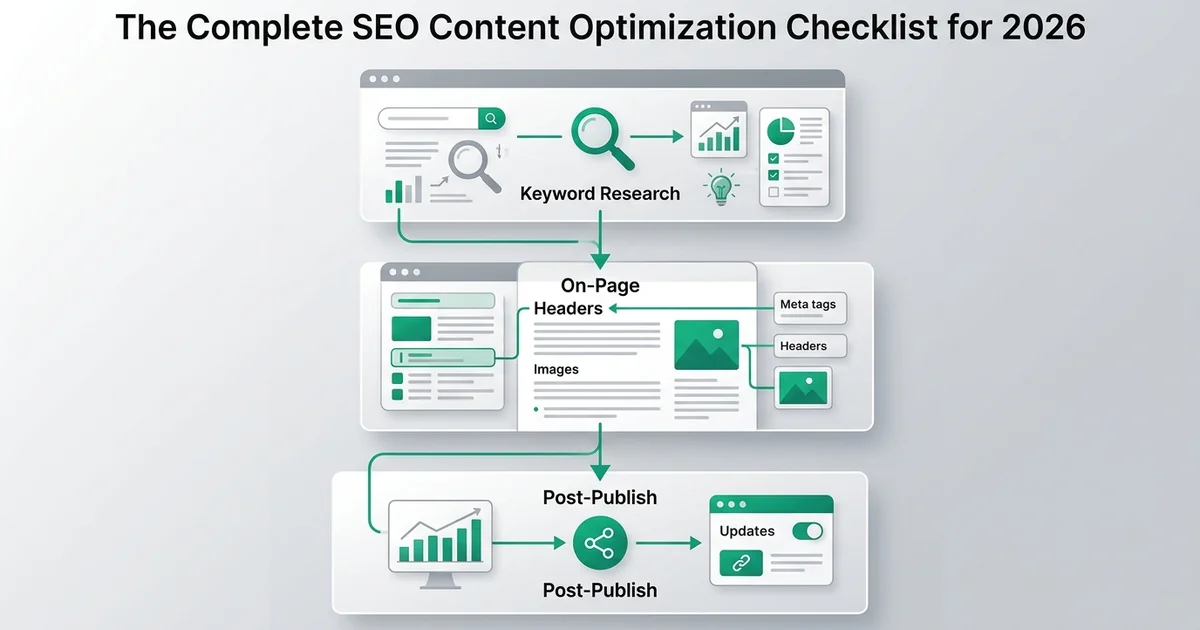
The complete SEO content optimization checklist for 2026
- Basic understanding of how search engines work
- Access to a website or blog platform
- Familiarity with Google Search Console (optional but helpful)
Introduction: when and why to use this checklist
SEO content optimization is the process of creating and refining content so that search engines can understand, rank, and surface it to the right audience. This checklist gives you a structured, phase-by-phase workflow to apply that process consistently, whether you are publishing your first article or auditing an existing library of hundreds of pages.
Why SEO content optimization still matters in 2026
The business case for organic search remains strong. According to the State of Organic Marketing (2025), organic search generated 33% of overall website traffic across seven key industries in 2024, and SEO positively affected website performance and marketing goals for 91% of survey respondents. At RankHub, our analysis shows that teams who follow a repeatable optimization framework consistently outperform those who publish without one, regardless of budget or team size.
When to use this checklist
Apply this checklist at three points in your workflow: before you write (to plan and research), during production (to structure and optimize), and after publishing (to measure and refine). It is designed for solo founders, lean marketing teams, and SMBs who need a reliable process without dedicating hours to manual SEO work every week.
Phase 1: Keyword research and content planning
Effective SEO content optimization starts before you write a single word. This phase ensures every piece of content targets a realistic keyword opportunity, matches genuine user intent, and fits into a broader topical strategy. Skipping it is the most common reason well-written content fails to rank.
- Conduct keyword research using tools like SEMrush, Ahrefs, or Google Keyword Planner
- Identify primary keyword with realistic search volume and manageable competition
- Research related keywords and semantic variations for natural integration
- Analyze top-ranking pages for your target keyword to understand content gaps
- Verify search intent matches your content type (informational, transactional, navigational)
- Create a content brief with target keyword, related terms, and key talking points
- Define your target audience and their pain points
- Plan content structure and outline before writing
Identify target keywords with intent and competition data
- Enter your seed topic into a keyword research tool. Look for keywords with a clear search intent label (informational, commercial, transactional, or navigational) alongside volume and difficulty scores. RankHub's AI keyword research feature does this automatically, surfacing opportunities matched to your site's current authority.
- Validate the opportunity before committing. Confirm that the top-ranking pages are genuinely beatable. Check domain authority, content depth, and backlink counts for the first page of results. You should see at least two or three results from sites at or below your own authority level.
- Check for keyword cannibalization. Ensure no existing page on your site already targets the same primary keyword. RankHub includes built-in anti-cannibalization checks that flag conflicts before a brief is created, saving you from splitting ranking signals across duplicate content.
Build a content brief with semantic coverage
- Research People Also Ask questions for your target keyword. These reveal the sub-questions your content must answer to satisfy search intent fully. Add the most relevant ones as H3 subheadings or FAQ items in your brief.
- Map secondary and LSI keywords (latent semantic indexing terms, meaning conceptually related phrases) into your outline. According to HubSpot (2025), AI-using companies produced 42% more content per month than those not using AI, making structured briefs essential for maintaining quality at scale.
- Plan your internal linking structure now, not after publishing. Identify two or three existing posts that should link to this new piece and one or two places where this piece can link outward. A planned seo content calendar automation workflow makes this step repeatable across your entire content pipeline.
- Assign a search stage to each keyword. Label it as awareness, consideration, or decision. This keeps your content aligned with where the reader actually is in their journey, which directly affects conversion potential.
Once your brief is complete and your keyword is validated, you are ready to move into on-page optimization during the writing phase.
Phase 2: On-page optimization during writing
With your brief in hand, every editorial decision you make during the writing process directly affects how search engines and AI systems interpret your content. This phase covers the structural and semantic signals that determine whether your page earns visibility or gets buried.
- Include primary keyword in title tag (keep under 60 characters)
- Write a compelling meta description with primary keyword (keep under 160 characters)
- Use primary keyword in the first 100 words of content
- Structure content with H1 (one per page), H2s, and H3s for hierarchy
- Include related keywords and semantic variations naturally throughout
- Write short, scannable paragraphs (2-4 sentences maximum)
- Use bullet points and numbered lists to break up text
- Add internal links to relevant pages using descriptive anchor text
- Optimize images with descriptive alt text containing relevant keywords
- Maintain target keyword density between 0.5-2% (avoid over-optimization)
- Ensure content is at least 1,500 words for competitive topics
Write a title tag under 60 characters
Craft your title tag to include the primary keyword as close to the front as possible. Keep it under 60 characters to avoid truncation in search results. A clear, specific title also improves click-through rates from both traditional results and AI-generated summaries.
Write a meta description between 155-160 characters
Your meta description should summarize the page's value and include a natural use of the primary keyword. Treat it as a micro-pitch: one sentence on what the reader gets, one on why it matters. Stay within 155-160 characters to avoid truncation.
Structure headings with sentence case
Use descriptive H2 and H3 headings that reflect exactly what each section covers. Sentence case improves readability and aligns with how people phrase search queries. Avoid vague labels like "Introduction" or "Tips."
Place the primary keyword in the first 100 words
Introduce your primary keyword naturally within the opening paragraph. This confirms topical relevance early for both crawlers and readers. It also positions your content to capture People Also Ask placements, which reward concise, direct answers near the top of a page.
According to HubSpot (2025), AI Overviews reduced clicks to the top-ranking page by 58%, making clear structure and precise early answers more critical than ever for retaining organic traffic.
Use semantic variations throughout
Incorporate related terms, synonyms, and supporting concepts naturally across the body. This signals topical depth without keyword stuffing. RankHub's AI-generated articles are built around semantic clusters, so every piece it produces already covers related terms your target readers are searching for.
Add internal links to relevant content
Link to pillar pages and related articles where they genuinely add value. Internal linking distributes authority and keeps readers engaged. For teams managing multiple content types, an SEO autopilot tool can automate internal link suggestions at scale.
Optimize images with descriptive alt text
Name image files descriptively before uploading (for example, seo-content-optimization-checklist.webp). Write alt text that describes the image accurately and, where relevant, includes a keyword. This improves accessibility and gives search engines additional context about your page's topic.
Phase 3: E-E-A-T and content quality signals
E-E-A-T (Experience, Expertise, Authoritativeness, and Trustworthiness) is Google's framework for evaluating content quality. As AI-generated content becomes standard, the signals that prove genuine human expertise are what separate high-ranking pages from the rest. Apply each step below before publishing.
- Clearly display author credentials and expertise
- Include author bio with relevant experience and qualifications
- Cite authoritative sources and link to them
- Include publication date and last updated date
- Add author photo and social media links for trust signals
- Reference original research, studies, or data when applicable
- Provide unique insights or perspectives not found in competing content
- Use clear, professional language and correct grammar throughout
- Include disclaimers where appropriate (especially for YMYL content)
- Demonstrate firsthand experience or expertise in the topic
Add a credible author byline and bio
- Include the author's full name at the top of the article, directly below the headline.
- Write a short author bio (two to three sentences) that states relevant credentials, years of experience, and links to a professional profile such as LinkedIn.
- Link to an author archive page so Google can associate multiple pieces of content with the same expert.
This matters because Google's systems use author signals to assess trustworthiness, particularly in competitive or sensitive niches.
Include original data, research, or first-hand experience
Generic content is increasingly easy to produce, which means originality is now a genuine ranking differentiator. According to HubSpot (2025), 63% of respondents reported that Google AI Overviews positively affected organic traffic, visibility, or rankings, reinforcing that content surfaced by AI must demonstrate clear expertise.
- Add a personal case study, original survey result, or proprietary data point to at least one section of every article.
- Document first-hand experience where relevant, for example, screenshots of results, before-and-after comparisons, or process walkthroughs.
- Cite authoritative external sources using inline links so readers and search engines can verify your claims.
If you are considering whether to build this process in-house or outsource it, the SEO agency alternative guide covers the trade-offs in detail.
Maintain accurate publication and update dates
- Display the original publication date and a clearly labeled "last updated" date on every post.
- Audit statistics and references each time you update a page, replacing outdated figures with current data.
- Remove or rewrite sections that reference superseded tools, policies, or industry practices.
RankHub's automated publishing workflow timestamps each article on publication and flags content for periodic review, reducing the manual effort of keeping a growing library accurate and current.
Add structured data markup for your content type
Structured data (schema markup added to your HTML) helps search engines understand what type of content a page contains, whether that is an article, FAQ, how-to guide, or review.
- Apply Article schema to editorial content, including
author,datePublished, anddateModifiedproperties. - Add FAQPage schema to any FAQ section to increase eligibility for rich results.
- Validate your markup using Google's Rich Results Test before publishing to confirm there are no errors.
Phase 4: Technical optimization and publishing
Technical optimization ensures that well-crafted content is actually discoverable, fast-loading, and correctly indexed. Without these foundations in place, even the strongest content can underperform in search rankings. Work through each item below before hitting publish.
- Ensure page loads in under 3 seconds on mobile devices
- Optimize images for web (compress without losing quality)
- Implement responsive design for mobile and desktop
- Create a descriptive URL slug with primary keyword
- Set up proper heading hierarchy (H1, H2, H3)
- Enable GZIP compression on your server
- Implement schema markup (Article, FAQ, or BreadcrumbList as appropriate)
- Add internal links from relevant existing pages
- Create an XML sitemap and submit to Google Search Console
- Set canonical tags if content appears on multiple URLs
- Enable SSL/HTTPS encryption

Confirm mobile responsiveness and page speed
- Test your page on Google's Mobile-Friendly Test and PageSpeed Insights before publishing.
- Compress images and enable lazy loading to reduce initial load time.
- Look for layout shifts (Cumulative Layout Shift) and fix any elements that move during page load. You should see a CLS score below 0.1 in PageSpeed Insights.
Optimize your URL structure
- Include your target keyword in the URL slug, keeping it short and descriptive (for example,
/seo-content-optimization). - Remove stop words like "and," "the," and "for" to keep URLs clean.
- Use hyphens, not underscores, to separate words.
Configure canonical tags and indexing settings
- Set a canonical tag pointing to the preferred URL if this content appears in multiple locations or is republished elsewhere.
- Verify the page is set to index and that no
noindextags have been added accidentally. - Check your robots.txt file to confirm the page is not blocked from crawling.
Submit your sitemap and enable discovery
- Submit your XML sitemap to Google Search Console so the page enters the crawl queue promptly.
- Request indexing directly via the URL Inspection tool in Search Console for faster results. You should see the status change to "URL is on Google" within a few days.
According to The State of SEO in 2025 (2025), search optimization is expanding well beyond Google into AI chatbots and alternative discovery channels, making proper structured data and indexing signals more important than ever.
For teams without dedicated technical resources, an seo automation platform can handle much of this workflow automatically. RankHub manages webhook publishing, structured metadata, and consistent scheduling through its automated workflow, so technical publishing steps do not fall through the cracks between content creation and going live.
Phase 5: Post-publication monitoring and updates
Publishing is not the finish line. SEO content requires ongoing attention to maintain and improve rankings over time. Set up a structured monitoring routine from day one so performance signals do not go unnoticed for weeks.
Check out RankHub Starter's approach to seo content optimization RankHub Starter.
- Monitor rankings for target keyword weekly for first month
- Track organic traffic using Google Analytics 4
- Check click-through rate (CTR) in Google Search Console
- Monitor average position in search results
- Review user engagement metrics (bounce rate, time on page)
- Update content if rankings drop or traffic plateaus
- Add new information or data as it becomes available
- Refresh publication date when making significant updates
- Monitor competitor content for new ranking opportunities
- Test and optimize meta descriptions if CTR is low
- Update internal links as your content library grows
Monitor rankings and traffic in Search Console
Connect Google Search Console and check your target page weekly. Track impressions, clicks, and average position for your primary keyword. A sudden drop in impressions often signals a ranking shift before traffic data catches up.
What you should see: Steady impression growth in the first four to eight weeks, followed by click-through rate stabilisation as your position settles.
Track click-through rate and refine titles
Review CTR weekly. If impressions are strong but clicks are low, test a revised title tag or meta description. Even a one percent CTR improvement compounds significantly at scale.
Identify and answer new People Also Ask questions
Search your target keyword monthly and record any new People Also Ask questions that appear. Add concise, direct answers to your content to capture these placements. According to HubSpot's SEO Trends report, optimising for PAA and conversational queries is increasingly important as AI-driven search surfaces more question-based results.
Update content when rankings drop
If a page drops more than three positions, audit competitor content that has overtaken it. Identify gaps in depth, freshness, or format and update accordingly. In our experience at RankHub, pages refreshed with new data and expanded sections recover rankings faster than those left untouched.
Refresh statistics and data annually
Outdated figures erode credibility and can hurt rankings. Schedule an annual content audit to replace stale statistics, update examples, and verify that all internal and external links still resolve correctly.
Add internal links as new content is published
Each new article you publish is an opportunity to strengthen your internal linking structure. Return to older posts and add contextual links to newer related content. This distributes authority and helps search engines understand topical relationships across your site. See what the data shows about SEO automation ROI in 2026 for evidence of how consistent publishing compounds these gains.
Monitor AI Overview appearance
Check whether your content appears in Google's AI Overviews for target queries. If a competitor's content is cited instead, review how their content is structured and whether your answers are direct and well-attributed enough to be selected as a source. Adjust formatting and add concise summary paragraphs near the top of the page if needed.
For teams managing multiple pages simultaneously, RankHub tracks publishing cadence and flags content gaps automatically, reducing the manual overhead of keeping an entire content library current.
Common mistakes to avoid
Even well-intentioned SEO content optimization efforts can fall short when a few recurring errors undermine your work. Recognizing these pitfalls before they affect your rankings is far more efficient than diagnosing them after traffic drops.
- Targeting keywords with no search volume or unrealistic competition
- Ignoring search intent and creating mismatched content
- Keyword stuffing or over-optimization that hurts readability
- Publishing thin content under 1,000 words for competitive topics
- Neglecting mobile optimization and page speed
- Failing to update content after publication
- Using generic, non-unique content that doesn't differentiate
- Ignoring E-E-A-T signals and author credibility
- Creating content without internal linking strategy
- Publishing without proper technical setup (schema, canonicals, etc.)
- Not monitoring performance or adjusting based on data
Keyword stuffing
Repeating your target keyword too frequently damages readability and signals low quality to search algorithms. Aim for natural usage and rely on semantically related terms to reinforce topical relevance without forcing repetition.
Ignoring search intent
Publishing content that ranks for a keyword but fails to satisfy what users actually want leads to high bounce rates and poor conversions. Always verify the dominant intent (informational, navigational, or transactional) before writing a single word.
Thin content
Pages under 300 words with no original insight rarely earn rankings or trust. Every published piece should add genuine depth, a unique perspective, or data that readers cannot easily find elsewhere.
Poor internal linking
Skipping internal links means leaving both users and page authority with nowhere to go. Treat every new post as an opportunity to connect related content and reinforce your site's topical structure.
Neglecting mobile optimization
With over 60% of searches occurring on mobile devices, a page that performs poorly on smaller screens will lose rankings and users simultaneously.
Outdated information
Statistics and data age quickly. Failing to refresh figures annually erodes credibility and E-E-A-T (Experience, Expertise, Authoritativeness, Trustworthiness) signals that Google increasingly weighs in ranking decisions. As noted by Conductor (2024), SEO positively affected website performance and marketing goals for 91% of survey respondents, making consistent content quality a business priority, not just a technical one.
Skipping E-E-A-T signals
Publishing without a clear author bio, cited sources, or demonstrated expertise leaves content vulnerable, particularly in competitive or sensitive niches. Establish credentials visibly and link to authoritative references.
Publishing before on-page SEO is complete
Hitting publish before optimizing your title tag, meta description, heading structure, and image alt text wastes the effort invested in writing. Use a pre-publish checklist, or let a content marketing automation platform like RankHub handle on-page requirements automatically before content goes live.
Quick reference summary
This condensed checklist gives you everything covered in this guide in one scannable reference. Pin it to your workspace, share it with your content team, or run through it before every publish. Organized by phase so nothing slips through the cracks.

Pre-writing phase
- Identify target keyword using AI keyword research
- Check for cannibalization against existing content
- Confirm search intent before outlining
- Research competing pages for topical gaps
Writing and on-page phase
- Place primary keyword in title tag, H1, and meta description
- Structure headings in logical H2 and H3 hierarchy
- Add image alt text to every visual asset
- Link internally to relevant existing pages
Pre-publish phase
- Review readability and sentence length
- Confirm E-E-A-T signals are visible
- Run final on-page check before going live
RankHub's automated workflow handles most of these steps by default. Start a free 7-day trial at rankhub.ai or explore seo content automation software to see how automation fits your process.
Tools you'll need
Effective SEO content optimization requires a focused stack of tools, each serving a distinct role in your workflow. Below is a practical breakdown by task so you can identify what you already have and what gaps to fill.
Keyword research
Use Ahrefs, SEMrush, or Moz to assess keyword difficulty, search volume, and competitive gaps before writing a single word.
Content brief creation
RankHub generates AI-assisted briefs automatically, covering target keywords, structure, and competitor insights. Surfer SEO is a solid alternative for manual on-page recommendations.
On-page optimization
Yoast SEO, Rank Math, or Surfer SEO provide real-time feedback as you write or edit.
Internal linking
Ahrefs Site Explorer and Semrush help surface internal link opportunities across your existing content. Pairing these with a tool like RankHub supports the kind of seo automation for content teams that removes manual guesswork.
Rank monitoring
Google Search Console, Ahrefs, and SE Ranking cover rank tracking and performance reporting.
AI writing assistance
According to HubSpot (2025), 66% of content marketers use AI for idea generation and editing, and 58% use it for headline writing. ChatGPT, Claude, and Jasper are the most widely adopted options. RankHub's built-in AI layer handles generation, optimization, and publishing in one place, making it a practical choice if you want to consolidate your stack.
Frequently asked questions
What is SEO content optimization?
SEO content optimization is the process of improving written content so search engines can understand, index, and rank it effectively. It covers keyword research, on-page structure, internal linking, and E-E-A-T signals.
How do I optimize content for SEO?
Start with thorough keyword research, then structure your content with clear headings, answer user intent directly, and build internal links. Tools like RankHub automate much of this workflow so nothing gets missed.
What are the 5 most important SEO factors?
Search intent alignment, E-E-A-T signals, on-page structure, page speed, and internal linking consistently rank among the most critical factors for organic performance.
How long should an SEO-optimized blog post be?
Length should match search intent. Informational posts typically perform well between 1,500 and 2,500 words, but quality and relevance matter more than word count alone.
How often should SEO content be updated?
Review high-traffic pages every six to twelve months. Update statistics, refresh examples, and re-check keyword alignment whenever rankings begin to decline.
Can AI-generated content rank on Google?
Yes. Google evaluates content quality and helpfulness, not its origin. Research suggests AI-generated content accounts for a notable share of top-ranking results, provided it demonstrates genuine expertise and accuracy.
What is the difference between SEO and content optimization?
SEO covers the full technical and strategic picture, including site architecture and backlinks. Content optimization focuses specifically on making individual pages more relevant, readable, and authoritative for target queries.
Based on our work at RankHub, the teams that see the fastest ranking gains treat SEO content optimization as an ongoing system, not a one-time task. Start your 7-day free trial to put that system on autopilot.
More from Our Blog
Top Marketing Automation Platforms That Save Time & Money
Compare the best marketing automation software for SMBs and enterprises. See pricing, features, and expert recommendations to find your ideal platform.
Read more →
Why Your Content Isn't Ranking: The Content Optimization Fix
Master content optimization to boost SEO rankings and engagement. Learn root causes, 5 proven solutions, and prevention tactics for 2024-2025.
Read more →
Digital Marketing Online: Your Complete Roadmap to Success
Master digital marketing online with our comprehensive guide. Learn strategies, tools, and best practices to grow your business in 2025.
Read more →