Digital Marketing Online: Your Complete Roadmap to Success
Introduction: why digital marketing online matters for your business
The way businesses reach customers has changed permanently. Whether you are a solo founder building your first product or a marketing team scaling an established brand, digital marketing online is no longer optional. It is the primary arena where buying decisions are made, brand trust is built, and revenue is won or lost.
At RankHub, our analysis shows that businesses struggling with inconsistent online visibility share one common problem: they lack a structured, repeatable approach to digital marketing. This guide exists to solve that.
The scale of the opportunity is significant. According to Zebracat (2025), 31% of global consumers discover products through social media ads, while SEO.com (2025) reports that 68% of marketers view AI adoption positively, signalling a major shift in how campaigns are planned and executed.
In the sections ahead, you will find a complete roadmap covering every major channel, strategy, and tool available to modern businesses. From SEO and content marketing to paid advertising, email, and analytics, this guide is designed to give you both the strategic clarity and practical direction you need to grow online with confidence.
What is digital marketing online?
Digital marketing online refers to any promotional activity carried out through internet-connected channels, including search engines, social media platforms, email, and websites. Unlike traditional marketing, which relies on print, broadcast, or outdoor media, digital marketing is measurable, targeted, and interactive in real time.
Digital vs. traditional marketing
Traditional marketing pushes a message outward with limited feedback. Digital marketing, by contrast, creates a two-way conversation. You can track exactly who saw your ad, when they clicked, and whether they converted, giving you data that print or television simply cannot provide.
The scope of online channels
Digital marketing online spans a wide ecosystem of touchpoints:
- Search engines (organic and paid)
- Social media platforms and communities
- Email and marketing automation
- Content including blogs, video, and podcasts
- Affiliate and influencer partnerships
Each channel serves a different stage of the customer journey, from initial awareness through to purchase and retention.
Digital marketing and online marketing: are they the same?
The terms are used interchangeably in most business contexts. Technically, digital marketing can include offline digital formats such as digital billboards, but for practical purposes, and throughout this guide, digital marketing online means activity conducted via the internet. If you are exploring online business ideas, understanding this scope is your essential starting point.
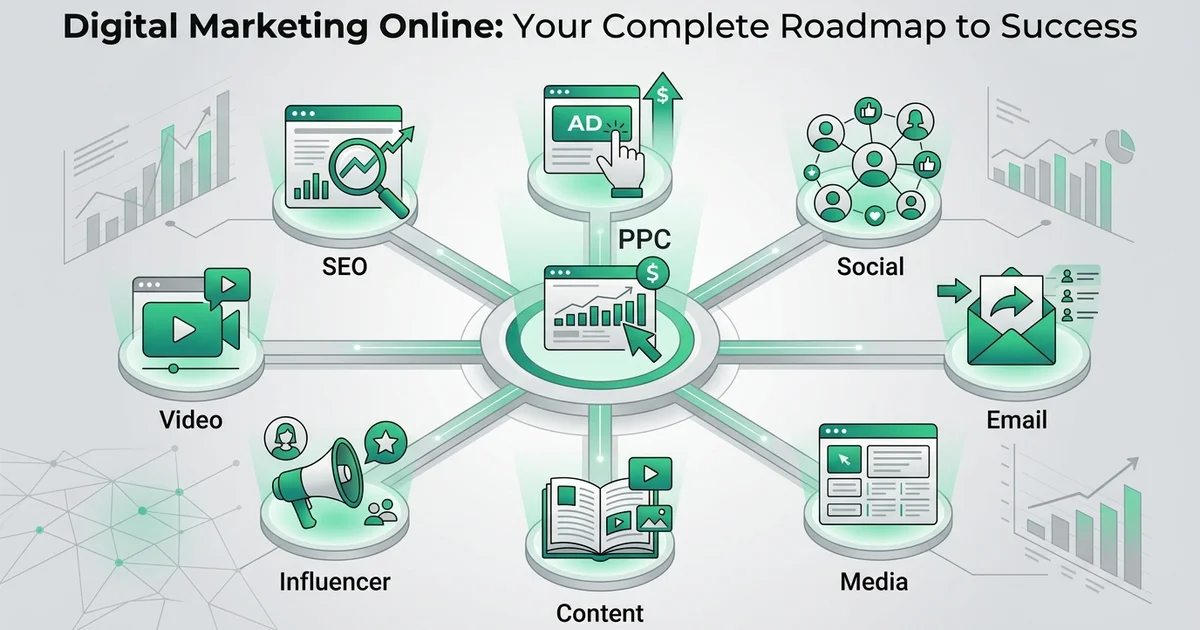
The seven core types of digital marketing online
Digital marketing online encompasses seven distinct disciplines, each serving a different purpose in your growth strategy. Understanding all seven helps you allocate budget and effort intelligently, rather than defaulting to whichever channel feels most familiar.
Search engine optimization (SEO)
SEO is the practice of improving your website's visibility in organic (unpaid) search results. According to MediaValet (2025), SEO has a positive impact on website performance for 91% of businesses, making it one of the highest-return investments available. For solo founders and small teams without dedicated SEO staff, tools like RankHub automate the process, handling keyword research and publishing SEO-optimized articles on a consistent schedule so nothing falls through the cracks.
Pay-per-click (PPC) advertising
PPC places your business at the top of search results instantly, with costs incurred only when someone clicks. It complements SEO by delivering immediate traffic while organic rankings build over time.
Social media marketing
Social platforms give brands direct access to their audiences. According to Zebracat (2025), social media ads capture the attention of 31% of consumers, making platform-specific strategies essential for awareness and engagement.
Email marketing
Email remains one of the most cost-effective channels for customer retention, nurturing leads through personalised, timely communication long after the first touchpoint.
Content marketing
Consistent, valuable content builds authority and drives organic traffic over time. A content marketing automation platform can help smaller teams maintain publishing frequency without sacrificing quality.
Influencer marketing
Partnering with trusted voices in your niche accelerates credibility and reach, particularly for new brands entering competitive markets.
Marketing automation
Automation connects every channel above into coherent customer journeys, triggering the right message at the right moment based on behaviour and intent.
How digital marketing online works: the customer journey
Understanding how digital marketing online functions as a system, rather than a collection of isolated tactics, is what separates consistently growing businesses from those chasing short-term wins. Every customer moves through a predictable sequence of stages, and your job is to meet them at each one.
Awareness stage: discovery through search and social
Prospects first encounter your brand through organic search, paid ads, or social content. Strong SEO and consistent publishing are critical here. According to Zebracat (2025), businesses that blog regularly generate significantly more inbound traffic than those that do not, making content volume a genuine competitive advantage.
Consideration stage: nurturing with content and email
Once someone is aware of your brand, they need reasons to trust it. Email sequences, comparison content, and case studies do this work quietly in the background, moving prospects closer to a decision without requiring direct sales effort.
Decision stage: conversion and retargeting
Retargeting campaigns and conversion-optimised landing pages recapture visitors who did not convert initially. This stage rewards brands that have already built familiarity through earlier touchpoints.
Retention stage: loyalty and repeat engagement
Existing customers are your most cost-effective growth channel. Personalised email, loyalty incentives, and community-building keep them engaged long after the first purchase.
Measurement and attribution across channels
Connecting activity to revenue requires consistent tracking across every touchpoint. Tools like seo content automation software help teams maintain publishing cadence while attribution dashboards reveal which channels genuinely drive conversions. RankHub's built-in AI keyword research ensures each published article targets terms with real commercial intent, so every piece of content contributes measurably to the awareness and consideration stages rather than generating traffic that never converts.
Key benefits of digital marketing online
Digital marketing online delivers advantages that traditional channels simply cannot match: precise targeting, transparent performance data, and the ability to adjust campaigns in real time. For solo founders and growing teams alike, these qualities translate directly into smarter spending and faster growth.

Measurable ROI and transparent analytics
Every click, conversion, and customer journey stage is trackable. According to SEO.com (2025), AI-assisted content marketing improves ROI by 68%, a figure that underscores how data-driven decisions compound over time. Unlike a billboard or print ad, digital campaigns show you exactly what is working.
Targeted reach and cost-effectiveness
Digital channels let you reach precisely defined audience segments, whether by location, behaviour, or purchase intent, without the broad waste of traditional media spend. Budgets stretch further because impressions are served to people most likely to convert.
Real-time optimization and scalability
Campaigns can be paused, refined, or scaled within hours. This agility is particularly valuable for SMBs managing lean teams. Platforms like seo automation for content teams remove the manual overhead, and tools such as RankHub Starter automate weekly SEO-optimized publishing so your content output scales without proportionally scaling your workload.
Global reach with local customization
Digital marketing online removes geographic barriers while still allowing hyper-local targeting. Native multilingual capabilities mean a single strategy can serve multiple markets simultaneously, giving growing businesses a genuinely global footprint.
Common challenges and how to overcome them
Every digital marketing strategy encounters friction. Understanding the most common obstacles before you hit them allows you to build contingency into your planning rather than scrambling to react.
Algorithm changes and platform dependency
Search engines and social platforms update their algorithms constantly, and rankings that took months to build can shift overnight. Diversifying across multiple channels reduces your exposure to any single platform's decisions. Prioritise owned assets, your website, email list, and content library, over rented ones.
Content saturation and standing out in search results
The volume of content published daily makes visibility increasingly difficult. Quality, specificity, and search intent alignment matter far more than volume alone. For small teams managing publishing consistency, tools that automate an seo content calendar automation workflow help maintain a steady cadence without sacrificing quality.
Attribution complexity across multiple channels
Connecting conversions to the correct touchpoint across email, paid, organic, and social is genuinely difficult. Start with UTM parameters and a simple attribution model, then refine as your data matures.
Resource constraints for small teams
Limited budgets and lean headcounts force difficult prioritisation. Automation is the practical answer here. RankHub Starter, for example, publishes one SEO-optimised article weekly with AI keyword research and anti-cannibalization checks built in, saving small teams 40 or more hours per month.
Keeping pace with AI and emerging tools
AI is reshaping digital marketing rapidly. According to Zebracat (2025), 43% of consumers distrust AI-generated advertising, which means transparency and human editorial oversight remain competitive advantages even as automation accelerates.
Maintaining quality while scaling production
Scaling content output without diluting quality is one of the most persistent tensions in digital marketing. Establishing clear editorial standards, using structured briefs, and automating repetitive production tasks rather than creative judgment keeps quality intact as volume grows.
Getting started with digital marketing online: a practical roadmap
Turning strategy into action requires a structured starting point. Before investing in any channel or tool, founders and marketing teams need a clear sequence: understand where you stand, define where you want to go, and build the infrastructure to measure progress. The steps below provide that sequence.
See how RankHub Starter compares when it comes to digital marketing online RankHub Starter.
Audit your current online presence
Review your existing website, social profiles, and any content you have published. Identify gaps in SEO coverage, inconsistent branding, and underperforming pages. This baseline shapes every decision that follows.
Define clear business goals and KPIs
Vague objectives produce vague results. Tie every digital marketing activity to a specific, measurable outcome, whether that is lead volume, organic traffic growth, or conversion rate improvement.
Identify your target audience and personas
Document the demographics, pain points, and online behaviors of your ideal customers. Personas prevent wasted spend on channels your audience simply does not use.
Choose your priority channels based on audience behavior
Resist the temptation to be everywhere at once. Select two or three channels where your audience is most active and commit to those before expanding.
Create a content calendar and publishing schedule
Consistency drives compounding results. Research suggests high-performing teams publish between 12 and 17 articles monthly. In our experience at RankHub, teams that automate scheduling through tools like RankHub Starter maintain that cadence without the manual overhead, freeing editorial attention for quality rather than logistics.
Set up analytics and tracking infrastructure
Install Google Analytics, configure conversion goals, and connect your chosen online marketing platform for small businesses before publishing a single piece of content. Data collected from day one is irreplaceable.
Best practices for digital marketing online success
Sustainable digital marketing online success comes from disciplined habits rather than one-off campaigns. The businesses that consistently outperform competitors share a common approach: they prioritize quality, stay close to their data, and refine their methods continuously rather than chasing every new tactic.
Prioritize quality and originality over volume
Publishing fewer, more comprehensive pieces outperforms a high-volume, low-depth approach. According to Zebracat (2025), guides, webinars, and roundups each drive significant engagement, accounting for 27%, 26%, and 26% of effective content formats respectively. Depth signals authority to both search engines and readers.
Build topical authority through comprehensive content
Cover a subject thoroughly before moving to the next. Search engines reward sites that demonstrate expertise across a topic cluster, not just individual keywords. Internal linking between related articles reinforces that authority and improves user navigation.
Optimize for user experience and search intent
Every piece of content should answer a specific question your audience is actively asking. Match format to intent: tutorials for how-to queries, comparison pages for evaluative searches, and concise answers for informational lookups.
Leverage AI thoughtfully with human oversight
AI tools accelerate content production, but human review remains essential. According to SEO.com (2025), 68% of marketers report positive outcomes when combining AI generation with editorial oversight, underscoring that automation supports rather than replaces strategic judgment.
Test, measure, and iterate continuously
Set a regular cadence for reviewing performance data. Identify what is working, cut what is not, and run structured A/B tests on headlines, calls to action, and landing page layouts. Small, consistent improvements compound significantly over time.
Maintain consistent brand voice across channels
Your audience should recognize your brand whether they encounter a social post, an email, or a blog article. Document tone-of-voice guidelines and apply them uniformly. Consistency builds trust, and trust accelerates conversion.
Essential tools and platforms for digital marketing online
The right tools transform digital marketing online from an overwhelming task into a manageable, repeatable system. From keyword research to email automation, the platforms you choose directly shape your efficiency, output quality, and ability to scale without proportionally increasing headcount.

SEO and keyword research tools
Solid SEO begins with understanding what your audience is actually searching for. Tools like Google Search Console, Ahrefs, and Semrush surface keyword opportunities, track rankings, and flag technical issues. For teams that want a fully automated approach, RankHub combines AI keyword research with anti-cannibalization checks and publishes SEO-optimized articles on a consistent schedule, saving founders and small teams 40 or more hours every month.
Content creation and AI-assisted writing platforms
According to SEO.com (2025), 67% of SMBs have adopted AI tools, largely because they compress content production timelines dramatically. Platforms like Jasper, Surfer SEO, and Canva help teams produce written and visual content faster without sacrificing quality.
Analytics and performance tracking
Google Analytics 4, Hotjar, and Looker Studio give marketers a clear picture of traffic sources, user behaviour, and conversion paths. Connecting these platforms to your CRM closes the loop between marketing activity and revenue outcomes.
Social media management and scheduling
Tools like Buffer, Hootsuite, and Later allow teams to plan, schedule, and monitor social content from a single dashboard, maintaining the consistent posting cadence that algorithms reward.
Email marketing automation platforms
Mailchimp, ActiveCampaign, and Klaviyo handle segmentation, triggered sequences, and A/B testing at scale. Automation ensures your audience receives timely, relevant messages without requiring manual intervention for every send.
Future trends shaping digital marketing online
The digital marketing landscape is shifting rapidly, driven by artificial intelligence, tightening privacy regulations, and changing consumer behaviour. Understanding where things are headed allows founders and marketing teams to invest in the right capabilities before competitors do.
AI-assisted workflows becoming standard
AI is no longer experimental. According to SEO.com (2025), 59% of marketers express excitement about AI's role in advertising, and AI-generated content now appears in 17.3% of top search results. Platforms like RankHub automate the entire content pipeline, from keyword research to published article, freeing teams to focus on strategy rather than production.
First-party data and privacy
With third-party cookies phasing out, brands that build direct audience relationships through email lists, loyalty programmes, and owned channels will hold a significant competitive advantage. Transparency around data collection is becoming a genuine differentiator.
Short-form video and social commerce
Platforms like TikTok Shop and Instagram Checkout are collapsing the distance between discovery and purchase. Brands integrating shoppable content into their social strategies are capturing buyers at the moment of intent.
Search visibility and content scale
Organic search is growing more competitive as AI tools flood the internet with content. Consistent, well-optimised publishing schedules matter more than ever, which is precisely where automated workflows earn their place.
Scaling your digital marketing online with automation
Automation is no longer a luxury reserved for enterprise marketing teams. For solo founders, SMBs, and growing marketing teams alike, the right systems turn inconsistent content efforts into reliable, compounding growth engines. The key is knowing where automation adds value and where human judgment remains essential.
How content operations platforms streamline workflows
Content operations platforms eliminate the repetitive manual steps that slow teams down: keyword research, brief creation, drafting, formatting, and publishing. According to SEO.com (2025), marketers using AI tools produce 42% more articles, and 68% report confidence in AI-assisted content quality. That output advantage compounds over time, building topical authority faster than manual processes allow.
Balancing automation with human oversight
Automation handles volume. Humans handle nuance. The most effective scaled content operations use automation to produce consistent first drafts and structured publishing schedules, then apply editorial review to ensure accuracy, tone, and brand alignment. Skipping this step risks publishing content that is technically optimised but editorially hollow.
Building repeatable processes for growth
Repeatable systems are the foundation of scalable digital marketing online. Defining templates, approval workflows, and publishing cadences means growth does not depend on individual heroics.
Tools like RankHub are built around this principle. Its automated SEO workflow handles keyword research, article creation, and publishing on a consistent weekly schedule, freeing teams to focus on strategy rather than production. The built-in anti-cannibalization checks also protect existing rankings as your content library grows, a detail that manual processes frequently overlook.
Maintaining brand voice at scale
Volume without consistency undermines brand trust. Establishing clear style guidelines, tone-of-voice documentation, and editorial standards before scaling ensures that every piece of content, however it is produced, sounds like your brand.
Conclusion: your path forward in digital marketing online
Digital marketing online rewards those who commit to strategy first and tactics second. The fundamentals covered throughout this guide, from SEO and content creation to automation and brand consistency, work together as a system. No single channel or tool produces results in isolation.
Start with strategy, then build
Before investing in any platform or campaign, define your audience, your goals, and your metrics for success. Tactics without strategy produce noise, not growth.
Iterate from a strong foundation
Begin with what you can execute consistently. A single well-optimized blog post published every week outperforms a burst of unfocused content. Tools like RankHub support this discipline by automating keyword research and SEO-optimized publishing on a reliable schedule, removing the friction that causes most businesses to fall behind.
Consistency is your competitive advantage
The businesses that win in digital marketing are rarely the most creative. They are the most consistent. Commit to the process, measure what matters, and keep improving.
Frequently asked questions
What is digital marketing online?
Digital marketing online refers to promoting products or services through internet-based channels such as search engines, social media, email, and websites. It encompasses any marketing activity that reaches audiences via a digital device or network connection.
How do I start digital marketing online?
Begin by defining your target audience and business goals, then choose one or two channels to focus on first. Building an SEO foundation early pays long-term dividends, and platforms like RankHub can automate keyword research and content publishing so you start generating organic traffic without needing a dedicated team.
What are the 7 types of digital marketing?
The seven core types are search engine optimization (SEO), pay-per-click advertising (PPC), content marketing, social media marketing, email marketing, affiliate marketing, and influencer marketing. Most successful strategies combine several of these disciplines.
How can I learn digital marketing online for free?
Google Digital Garage, HubSpot Academy, Meta Blueprint, and YouTube channels from reputable marketing practitioners all offer free, structured courses. Supplementing coursework with hands-on practice on a real website accelerates learning considerably.
Is digital marketing a good career?
Digital marketing offers strong career prospects, competitive salaries, and flexibility across industries. Demand continues to grow as businesses shift budgets toward measurable online channels.
How much does online digital marketing cost?
Costs vary widely depending on channels and scale. Small businesses often start with a few hundred dollars per month on paid ads or tools, while enterprise campaigns can reach six figures. Organic strategies like SEO require more time than direct spend.
What is the difference between digital marketing and online marketing?
The terms are used interchangeably in most professional contexts. Technically, digital marketing is the broader category and can include offline digital channels such as digital billboards, whereas online marketing refers specifically to internet-based activity.
How does SEO work in digital marketing?
SEO improves a website's visibility in unpaid search results by optimizing content, technical structure, and backlink profiles to match what search engines reward. Research suggests that 91% of marketers report SEO has a positive impact on website performance and marketing goals, making it one of the highest-return disciplines available.
Based on our work at RankHub, businesses that treat SEO as a consistent, automated process rather than a one-time project see compounding results that outpace most paid-channel investments over time.
More from Our Blog
Beyond Traditional SEO Services: Better Alternatives for Your Budget
Compare top SEO services platforms: RankHub, Outrank, SEObot & alternatives. Find the best fit for your budget, team size & automation needs.
Read more →
10 Online Business Ideas That Work for Beginners & Entrepreneurs
Discover 9 proven online business ideas for 2025, including startup costs, revenue timelines, and step-by-step validation strategies for solo founders.
Read more →
Building an SEO Career: What You Need to Know to Succeed
Learn how to launch an SEO career with our step-by-step guide covering skills, tools, portfolio projects, and realistic salary expectations for 2025.
Read more →