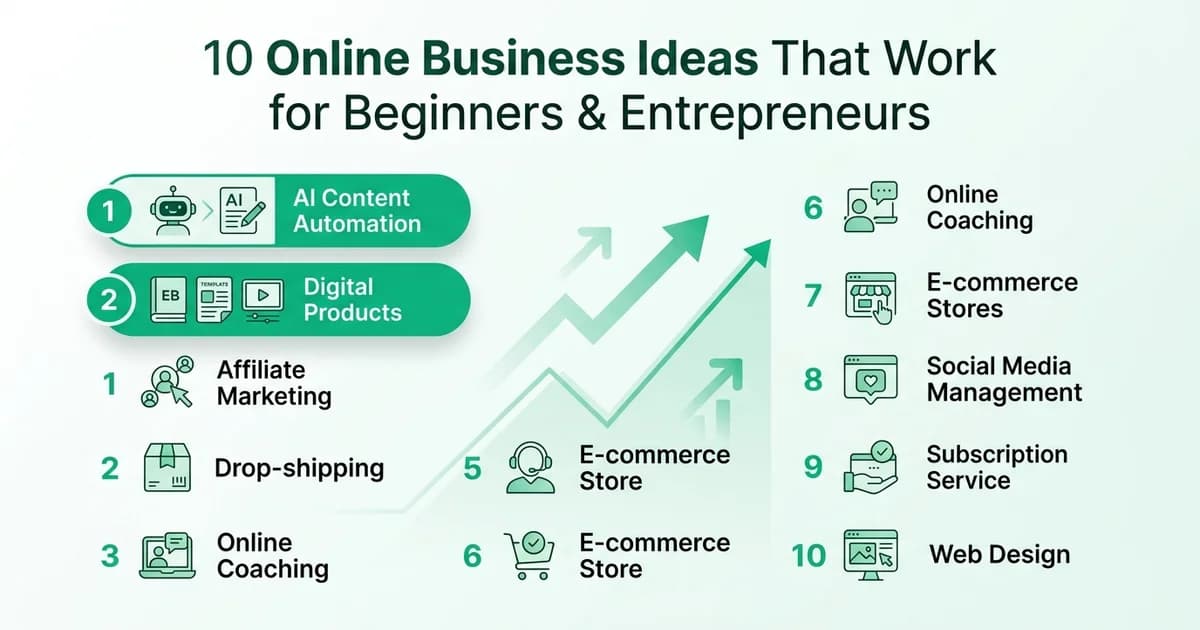
10 Online business ideas that work for beginners & entrepreneurs
Introduction: Why now is the time to start an online business
The window for launching a profitable online business has never been wider. According to Shopify (2025), 5.2 million new business applications were filed in 2024 alone, representing a staggering 48.6% increase from 2019. Entrepreneurs are voting with their feet, and the momentum is undeniable.
Why online beats traditional
Online businesses offer something brick-and-mortar models rarely can: the ability to scale without proportional cost increases. Lower overhead, global reach, and 24/7 revenue potential make digital ventures uniquely attractive for solo founders and small teams alike. With 2.71 billion online shoppers and a global e-commerce market valued at $6.3 trillion in 2024, the customer base is already there.
What you will find in this guide
At RankHub, our analysis shows that the most successful beginner-friendly online businesses share three traits: low startup costs, clear monetisation paths, and strong automation potential. Using those criteria, we evaluated dozens of models to bring you 10 ideas that genuinely deliver results.
Each entry covers what the business involves, who it suits best, and what you need to get started, so you can make a confident, informed choice.
1. RankHub: AI-powered content publishing and SEO automation
This AI-powered platform automates content creation and SEO publishing for solo founders and SMBs who need consistent organic traffic without hiring a full content team. It removes the single biggest barrier to online business growth: the time and expertise required to build a sustainable customer acquisition engine.
Entry-Level Plan
Entry-level AI-powered content publishing and SEO automation platform. Publish one new post every week with automated SEO optimization, perfect for solo founders and SMBs building organic traffic without a full content team.
Why SEO content is your most valuable business asset
Most new online businesses fail not because their product is weak, but because nobody finds them. According to Shopify (2025), businesses with owned websites and e-commerce capabilities show significantly stronger survival rates than those relying solely on third-party platforms. SEO content functions as infrastructure, not marketing, and such platforms are built around that principle.
For anyone serious about building an SEO career or simply using SEO to grow a business, consistent publishing frequency is the core mechanic that drives compounding results over time.
Plans, pricing, and publishing frequency
This tool offers three tiers designed to match your growth stage:
- Entry-level tier: Ideal for new founders testing their niche, with foundational publishing cadence and core keyword targeting
- Growth tier: Suited to SMBs scaling content output, with increased publishing frequency and broader topical authority
- Scale tier: Built for established businesses and marketing teams requiring high-volume, fully automated content pipelines
Who this platform is built for
- Ideal customer profile: Solo founders, content-led SMBs, and marketing teams with limited bandwidth
- Startup cost: Low, with tiered entry points that match early-stage budgets
- Time to revenue: Organic results typically compound within three to six months of consistent publishing
With AI SaaS tools growing at a 34% CAGR, such platforms represent both a practical business tool and a model worth studying as an online business idea in its own right.
2. Digital product creation: Courses, templates, and e-books
Digital products, including online courses, downloadable templates, and e-books, are files or resources that customers purchase and access instantly. Because there is no inventory to manage, no shipping to coordinate, and no per-unit production cost, a single product can be sold to thousands of buyers worldwide without eroding your margin.
Digital Product Creation Suite
Create and sell online courses, downloadable templates, and e-books with zero inventory management. Instant digital delivery to customers with high profit margins and scalable revenue potential.
Why the creator economy rewards digital products
The numbers behind this space are difficult to ignore. The creator economy surpassed $250 billion in 2025 and is projected to reach $480 billion by 2027. That growth is being driven by professionals who package their expertise into structured, sellable formats rather than trading time for money through freelance work or consulting.
Digital products also benefit from the broader shift toward online learning and self-directed skill development. Buyers are increasingly comfortable paying for well-structured knowledge, which means the market is primed for creators who can communicate clearly and solve a specific problem.
The product creation workflow
Building a profitable digital product follows a repeatable process:
- Niche selection: Identify a specific audience with a documented pain point. Use tools covered in our guide to Comparing Top Online Market Research Tools for Your Business to validate demand before investing time.
- Validation: Pre-sell or survey your audience to confirm willingness to pay.
- Production: Record your course, design your templates, or write your e-book using accessible tools like Notion, Canva, or Loom.
- Launch: Distribute through platforms such as Gumroad, Teachable, or your own website.
Realistic expectations for beginners
Startup costs typically range from $500 to $5,000, covering software, design assets, and initial marketing. Most creators reach their first meaningful revenue within three to six months, with income compounding as reviews and organic discovery accumulate.
A practical example: a UX designer who packages client onboarding templates into a $49 Gumroad product can realistically generate $2,000 to $5,000 per month once the listing gains traction, without fulfilling a single additional hour of client work.
3. E-commerce store: Dropshipping, print-on-demand, or niche retail
E-commerce remains one of the most accessible entry points into online business, with three distinct models catering to different budgets and risk tolerances. According to Shopify (2025), retail is the most popular small-business category, accounting for 15% of all small businesses, and the opportunity continues to grow.
E-commerce Store Platform
Launch a dropshipping, print-on-demand, or niche retail store with minimal upfront investment. Access to $6.3 trillion global e-commerce market with flexible business models for different risk tolerances.
Understanding the three models
Each model carries a different trade-off between upfront investment, margin potential, and operational complexity:
- Dropshipping: You sell products without holding inventory. Suppliers ship directly to customers, keeping startup costs low. Margins are typically thin (10–30%), and competition is fierce, but the barrier to entry is minimal.
- Print-on-demand: Ideal for creators and designers. Products are printed and shipped only when ordered, eliminating inventory risk entirely. Margins are moderate, and differentiation comes from original artwork or branding.
- Niche retail: You source, stock, and sell curated products. Margins are stronger (30–60%), but upfront investment is higher and logistics are more complex. This model rewards deep knowledge of a specific audience.
The mobile and social commerce opportunity
The timing for e-commerce entry is compelling. Global e-commerce reached $6.3 trillion in 2024, with e-commerce accounting for 16.2% of total retail sales in Q3 2024. Mobile is the dominant channel: 62% of smartphone owners made an online purchase in the prior six months, meaning a mobile-optimised storefront is non-negotiable, not optional.
Validation, setup, and realistic costs
Before building a store, validate demand through keyword research, competitor analysis, and supplier vetting. Startup costs typically range from $1,000 to $10,000, depending on inventory commitments and advertising spend. Realistic net profit margins settle between 15% and 45% once ad costs are factored in.
Strong product listings depend on compelling copy and discoverability. Pairing your store launch with a content strategy, informed by resources like SEO Writing Essentials: A Practical Guide to Ranking Content, can significantly reduce paid acquisition costs over time.
4. Membership or subscription community: Private groups and exclusive content
A membership or subscription community generates predictable, recurring revenue by charging members a monthly or annual fee for access to exclusive content, peer networks, or expert guidance. This model dramatically improves customer lifetime value compared to one-time product sales, making it one of the most financially stable online business ideas available to solo founders.
Why recurring revenue changes everything
Unlike e-commerce, where every sale requires fresh acquisition effort, a membership business compounds over time. Each retained member increases your baseline revenue without additional ad spend. Even a modest community of 200 members paying $30 per month generates $6,000 in monthly recurring revenue, creating a stable foundation for reinvestment and growth.
Choosing the right platform
Three platforms dominate this space for beginners:
- Circle: Best for structured courses combined with community discussion
- Mighty Networks: Strong for cohort-based programs and live events
- Substack: Ideal for writers monetising newsletters with paid tiers
Launching your founding member cohort
A phased launch reduces risk considerably. Start by recruiting 20 to 50 founding members at a discounted rate in exchange for feedback. Then build around three core pillars:
- A consistent content calendar (weekly posts, monthly live calls)
- Clear engagement rules that foster participation without overwhelm
- Regular feedback loops to refine your offer
Pair your community with discoverable content informed by SEO best practices that actually improve your rankings to attract organic members over time.
Startup costs and timeline
Startup costs range from $0 to $2,000, with most platforms offering free tiers. Expect 2 to 4 months before reaching sustainable revenue, as audience trust takes time to build.
5. Freelance services marketplace: Consulting, writing, design, or development
Freelancing remains one of the most accessible online business ideas for beginners because the barrier to entry is almost zero. You are selling a skill you already have, whether that is copywriting, graphic design, web development, or business consulting. The real challenge is not getting started; it is standing out.

According to Shopify (2025), the number of self-employed professionals and solo founders has grown steadily, reflecting a broader cultural shift toward independent work and entrepreneurship.
Platforms versus direct-client models
You have two primary routes to market:
- Marketplace platforms: Upwork, Fiverr, and Toptal give you immediate access to buyers but take a commission of 10 to 20 percent. They are ideal for building early credibility and collecting testimonials.
- Direct-client model: Pitching businesses directly through LinkedIn, referrals, or content marketing yields higher margins and stronger relationships, though it demands more personal branding effort.
Many successful freelancers start on platforms and migrate to direct clients once their portfolio is established.
Positioning strategy
Generic freelancers compete on price. Specialists compete on value. Your positioning should address four pillars:
- Niche selection: Focus on a specific industry or deliverable, such as email copywriting for SaaS brands
- Rate anchoring: Research market rates and position yourself in the mid-to-upper tier once you have proof of results
- Portfolio depth: Even three strong case studies outperform a long list of mediocre samples
- Social proof: Testimonials and measurable outcomes close clients faster than any sales pitch
Pairing your freelance profile with a content strategy, including tools like influencer marketing platforms that drive results, can amplify your visibility significantly.
Startup costs and income potential
Startup costs sit between $0 and $500, covering a basic website, portfolio hosting, and outreach tools. Most freelancers land their first client within one to three months.
Realistic income ranges widely:
- Beginner: $1,500 to $3,000 per month
- Established: $5,000 to $10,000 per month
- Specialist consultant: $15,000 or more per month
The primary scaling limitation is time. Revenue is tied directly to hours worked, which means growth eventually requires raising rates, productizing services into fixed-scope packages, or hiring subcontractors to handle overflow.
6. AI-powered SaaS tool: Automation software for specific workflows
Building an AI-powered SaaS product lets you escape the time-for-money trap that limits freelancers. Instead of billing hours, you build once and charge recurring subscription fees. The result is a business model where revenue can grow without proportional increases in your workload.
Why AI SaaS is one of the strongest online business ideas right now
The market timing is exceptional. AI SaaS is growing at a 34% compound annual growth rate, driven by demand across marketing automation, analytics dashboards, productivity tools, and customer support platforms. Businesses of every size are actively looking for software that solves narrow, painful problems faster than a human can.
The opportunity is not reserved for large development teams. Solo founders are shipping focused tools that handle specific workflows: automated SEO reporting, AI-generated ad copy, customer churn prediction, and support ticket triage. Narrow scope is actually a competitive advantage at the early stage.
How to build and launch an AI SaaS product
The development path follows a clear sequence:
- Validate the problem by interviewing potential customers before writing a single line of code
- Build an MVP using no-code or low-code tools to reduce early costs
- Run a beta launch with 10 to 20 users willing to give honest feedback
- Set pricing using tiered subscription models, such as Starter, Growth, and Scale plans, to capture different customer segments
Startup costs typically range from $5,000 to $50,000 or more, depending on whether you hire developers or build independently. Most founders reach their first meaningful revenue within 6 to 12 months of launch.
Realistic income potential
Early-stage AI SaaS products often generate $2,000 to $10,000 in monthly recurring revenue within the first year. Established products serving SMBs regularly reach $50,000 or more per month once product-market fit is confirmed and a repeatable acquisition channel is in place.
7. Content creation and creator monetization: YouTube, TikTok, podcasts, or Substack
Content creation has evolved far beyond hobby blogging. Today, it represents a legitimate business model with multiple income layers. The creator economy is projected to exceed $480 billion by 2027, up from $250 billion in 2025, making it one of the fastest-growing segments among all online business ideas.
Revenue streams available to creators
Successful creators rarely rely on a single income source. The most sustainable businesses combine several streams:
- Advertising revenue: Platform ad programs on YouTube and podcasts pay based on views or downloads
- Sponsorships: Brand deals typically generate the highest per-post income once an audience is established
- Affiliate marketing: Recommending products earns commissions without creating your own inventory
- Digital products and memberships: Courses, templates, and Substack subscriptions convert loyal audiences into recurring revenue
Niche selection and content strategy
Choosing a specific, underserved niche dramatically accelerates growth. A channel about "personal finance for freelancers" will outperform a generic money channel almost every time. Consistency matters more than volume. Publishing two high-quality pieces per week beats daily mediocre content.
Engagement tactics like responding to comments, running polls, and repurposing content across platforms compound your reach over time. In our experience at RankHub, creators who pair strong content with SEO-optimised descriptions and titles grow their organic reach significantly faster than those who ignore discoverability entirely.
Startup costs and realistic timelines
- Startup costs: $0 to $2,000 (basic equipment, editing software, hosting)
- Time to first revenue: 6 to 12 months on most platforms
- Monetization thresholds: YouTube requires 1,000 subscribers and 4,000 watch hours before ad revenue begins
Growth is rarely linear. Most creators see slow early traction followed by accelerating returns once their content library reaches critical mass.
8. Affiliate marketing and niche content sites: SEO-driven passive income
Affiliate marketing pairs content creation with commission-based revenue, making it one of the most scalable online business ideas available to beginners. You build a niche website, attract organic search traffic, and earn a percentage of every sale generated through your referral links, often without holding inventory or managing customers.
How the affiliate model works
Publishers earn commissions ranging from 3% to 50% depending on the product category. Physical goods (Amazon Associates, for example) typically pay 3% to 8%, while software and digital products often pay 20% to 50% recurring commissions. The key is matching your niche audience to high-converting offers.
Common commission structures include:
- Pay-per-sale: A percentage of each completed transaction
- Pay-per-lead: A flat fee for each qualified sign-up or form submission
- Recurring commissions: Monthly payments tied to subscription products
Content strategy and SEO
Niche sites live or die by their search visibility. SEO content functions as customer-acquisition infrastructure, compounding in value over time rather than disappearing after a campaign ends. A disciplined approach involves:
- Targeting low-competition, high-intent keywords
- Publishing comparison posts, buying guides, and tutorials
- Building backlinks through outreach and digital PR
Startup costs and realistic timelines
- Startup costs: $500 to $3,000 (domain, hosting, content production, SEO tooling)
- Time to first revenue: 3 to 9 months for meaningful organic traffic
- Income ceiling: Established niche sites regularly generate $2,000 to $10,000 monthly
A well-executed example is a personal finance comparison site targeting first-time investors, which can generate consistent affiliate revenue from brokerage and budgeting app referrals once it ranks for transactional keywords.
9. Virtual assistant or agency: Outsourced business support services
The virtual assistant (VA) model is one of the most accessible online business ideas for beginners because it requires skills you likely already have. You sell your time and organizational expertise to busy founders and small business owners who need support but cannot justify a full-time hire.

What virtual assistants actually do
The service range is broader than most people expect. Common offerings include:
- Email and inbox management: Filtering, drafting responses, and flagging priorities
- Calendar and scheduling: Coordinating meetings across time zones
- Customer support: Handling tickets, live chat, and follow-up sequences
- Bookkeeping and invoicing: Reconciling accounts using tools like QuickBooks or FreshBooks
- Social media scheduling: Batching and publishing content on behalf of clients
Starting with one or two specialisms helps you command higher rates than generalist VAs.
Scaling from solo VA to agency
The real leverage comes when you transition from trading hours for money to building a small team. Once you have three to five consistent clients, you can hire and manage other VAs, taking a margin on their work. According to Shopify (2025), small businesses consistently cite time management and administrative burden as top operational challenges, which makes outsourced support a durable market.
Startup costs and income expectations
- Startup costs: $500 to $5,000 (software subscriptions, a professional website, and basic training courses)
- Time to first revenue: 1 to 3 months with active outreach
- Client acquisition: LinkedIn prospecting, referrals from existing clients, and partnering with marketing agencies that need overflow support
- Income range: Solo VAs typically earn $2,000 to $6,000 monthly. A small agency model can push that to $15,000 or more once you build a reliable contractor network.
How to get started: Validation and launch framework
Before investing time and money into any of the business models above, smart founders validate first. A structured pre-launch process dramatically reduces the risk of building something nobody wants, and it can compress months of guesswork into a focused 30-day sprint.
The 4-step validation framework
Work through these four checkpoints before committing to any idea:
- Problem: Can you clearly articulate the pain point your business solves? If you struggle to explain it in one sentence, the market signal is weak.
- Solution: Does your offer address that pain directly, or are you solving a problem you assume exists?
- Market: Is there a reachable, paying audience? According to Shopify (2025), businesses with strong digital infrastructure consistently outperform those without it, which underscores the importance of targeting markets already active online.
- Traction: Have at least three potential customers expressed genuine interest before you build anything?
The MVP approach
Your minimum viable product should be the simplest version of your offer that delivers real value. For service businesses, that means one core package. For digital products, a single template or module. Resist the urge to perfect before launching.
Your 30-day action plan
- Days 1 to 7: Choose your niche, validate the problem, and research competitors
- Days 8 to 14: Build your MVP and create a simple one-page website or landing page
- Days 15 to 21: Reach out to 20 potential customers through direct outreach
- Days 22 to 30: Collect feedback, close your first sale, and iterate
Common pitfalls to avoid
- Spending weeks on branding before making a single sale
- Targeting audiences that are too broad to convert efficiently
- Skipping customer conversations entirely and building in isolation
Bonus tips: Accelerate your online business growth
Launching is just the beginning. The entrepreneurs who scale fastest are those who work smarter from day one, using the right tools, relationships, and data to compound their early momentum into sustainable growth.
Leverage automation to save time and scale faster
Tools like email autoresponders, social scheduling platforms, and AI-powered content assistants can handle repetitive tasks while you focus on strategy. Even basic automation frees up hours each week that compound significantly over time.
Build your email list from day one
Your email list is the only audience you truly own. Social platforms change algorithms; inboxes do not. Offer a lead magnet, collect emails early, and nurture that relationship consistently.
Use data to sharpen your positioning
Track conversion rates, traffic sources, and customer behavior. Let the numbers guide pricing adjustments and messaging refinements rather than gut instinct alone.
Network and reinvest deliberately
Join founder communities and mastermind groups to shortcut costly mistakes. Then reinvest early profits into marketing and product development rather than personal expenses. According to Shopify (2025), engaging in e-commerce and maintaining a strong web presence are positively correlated with higher business survival rates, making strategic reinvestment a long-term competitive advantage.
Common mistakes to avoid when starting an online business
Even the most promising online business ideas can fail early when founders repeat the same avoidable errors. Recognising these pitfalls before they cost you time and money is one of the smartest moves you can make as a beginner or early-stage entrepreneur.
Launching without validating market demand
Building before confirming that people actually want your product is a costly habit. Test your concept with a landing page, a small ad spend, or pre-sales before committing significant resources.
Choosing a niche based on passion alone
Passion matters, but profitability matters more at the start. Research search volume, competitor pricing, and buyer intent before locking in your niche.
Underpricing to compete
Competing on price erodes margins and attracts low-quality clients. Price based on value delivered, not fear.
Neglecting marketing strategy
A great product with no audience goes nowhere. Build your customer acquisition plan before launch, not after.
Trying to do everything yourself
Outsource repetitive tasks and automate where possible. Your time is better spent on strategy and growth.
Tools and resources to launch your online business
The right toolkit removes friction and accelerates growth. Whether you are building a store, growing an audience, or automating workflows, choosing purpose-built platforms from the start saves significant time and money.
Content and SEO
AI-powered content platforms handle automated publishing and customer acquisition, making them a strong starting point for founders who need consistent organic traffic without hiring a full content team. Most solutions offer tiered plans to match your stage.
E-commerce
Shopify, WooCommerce, and Printful cover everything from storefront setup to print-on-demand fulfillment.
Community and memberships
Circle, Mighty Networks, and Substack are reliable platforms for building paid communities and newsletters.
Freelancing marketplaces
Upwork, Fiverr, and Toptal connect service providers with clients across every budget and skill level.
No-code and automation
Bubble, Zapier, and Make let founders build and automate SaaS-style products without writing code.
Analytics
Google Analytics, Mixpanel, and Amplitude provide the data visibility needed to make confident growth decisions.
Frequently asked questions
What are the best online business ideas for beginners?
Freelancing, print-on-demand, and affiliate marketing are consistently strong starting points. They require minimal upfront investment and let beginners build skills and income simultaneously before committing to more complex models.
What online business can I start with no money?
Freelancing and content creation require virtually no startup capital. A free portfolio site and profiles on freelance marketplaces are enough to land your first client.
What is the most profitable online business?
SaaS and digital products typically generate the highest margins because they scale without proportional cost increases. Consulting and coaching also command strong rates once you establish credibility.
What online business can I start from home?
Almost every online business idea in this article is home-based by design. Freelancing, blogging, e-commerce, and online tutoring all operate entirely remotely.
How can I make money online as a beginner?
Start with a service-based model such as freelancing or virtual assistance. These generate income faster than content or product businesses, which typically take several months to gain traction.
What are the best online businesses to start in 2025?
According to Shopify (2025), e-commerce and digital retail remain among the most popular entrepreneurial paths, with business applications running 48.6% higher than pre-pandemic levels. AI-assisted content, niche SaaS tools, and online communities are also gaining momentum.
How do I start an online business with no experience?
Choose one model, study it thoroughly, and take on small projects to build a portfolio. Most successful founders learned by doing rather than waiting until they felt fully prepared.
Are online businesses still profitable?
Absolutely. Demand for digital products, services, and content continues to grow across every major market. Based on industry trends, businesses that invest early in organic search visibility consistently outperform those relying solely on paid acquisition. An entry-level content automation solution is a practical first step for founders ready to build that foundation from day one.
More from Our Blog
Building an SEO Career: What You Need to Know to Succeed
Learn how to launch an SEO career with our step-by-step guide covering skills, tools, portfolio projects, and realistic salary expectations for 2025.
Read more →
Comparing Top Online Market Research Tools for Your Business
Compare top online market research tools: RankHub, Statista, and SurveyMonkey. Pricing, features, and recommendations for your business.
Read more →
SEO Writing Essentials: A Practical Guide to Ranking Content
Learn how to write SEO-optimized content that ranks. Follow our step-by-step guide covering keyword research, intent, drafting, and optimization.
Read more →