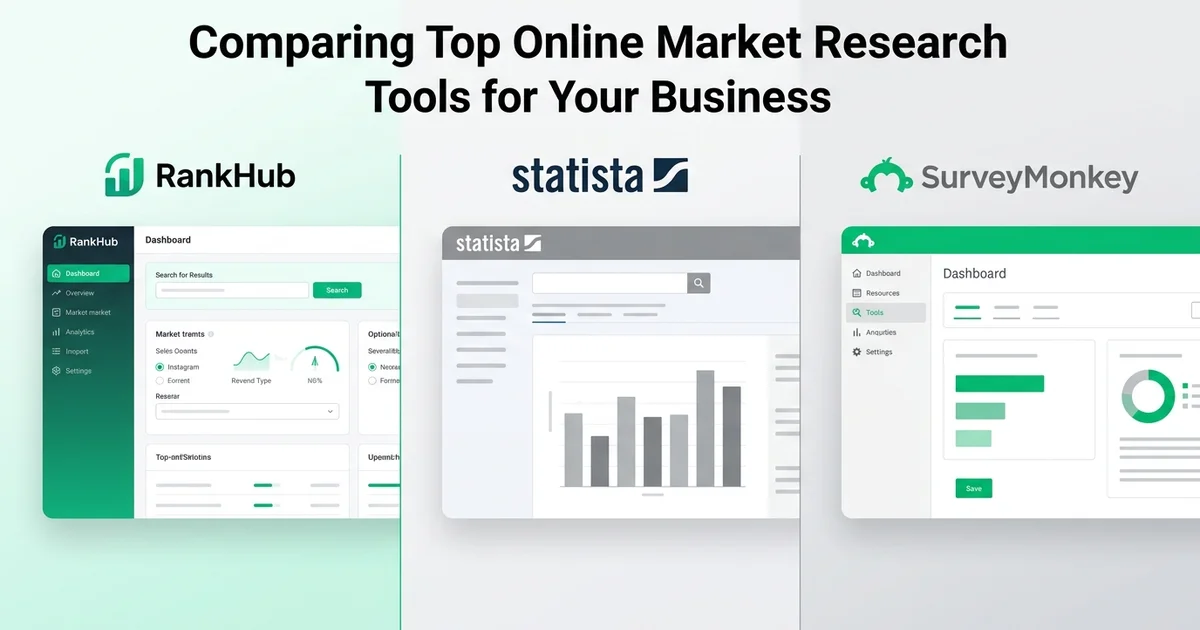
Comparing top online market research tools for your business
Introduction: choosing the right market research tool for your business
Online market research tools help businesses gather, analyze, and act on data about their markets, competitors, and customers. At RankHub, our analysis shows that the most common mistake businesses make is treating market research, SEO, and content intelligence as separate workflows when, increasingly, the best platforms are converging all three.
According to Search Engine Journal (2023), the landscape has shifted significantly toward AI-powered research that moves beyond simple data gathering toward autonomous analysis and publishing.
This matters for three distinct audiences:
- Solo founders who need fast, affordable insights without a dedicated team
- SMBs balancing budget constraints against competitive pressure
- Marketing teams managing complex, multi-channel research workflows
Most existing comparisons evaluate market research tools in isolation from content and SEO intelligence. This guide bridges that gap, evaluating each platform across consistent criteria so you can choose with confidence.
Quick comparison table: features, pricing, and best use cases
Before diving into individual reviews, here is a side-by-side snapshot of three leading platforms. This table covers the criteria that matter most to founders, SMBs, and marketing teams: cost, core purpose, data sources, automation, and fit.
| Tool | Best For | Starting Price | Core Strength |
|---|---|---|---|
| RankHub | SMBs & marketing teams | $99/month | Automated SEO content workflow |
| Statista | Enterprises & data analysts | $199/month | Verified market data & original research |
| SurveyMonkey | Customer feedback teams | $25/month | Survey creation & distribution |
| Criteria | RankHub | Statista | SurveyMonkey |
|---|---|---|---|
| Starting price | Starter tier (free 7-day trial) | $199/month (advanced) | $25/month (billed annually) |
| Primary use case | Automated SEO content publishing | Market data and statistics | Survey-based primary research |
| Data sources | AI keyword research + web | Curated third-party datasets | User-generated survey responses |
| Automation level | High: fully automated workflow | Low: manual report access | Low: manual survey design |
| Integrations | Webhook publishing ✓ | Limited ✗ | CRM and app integrations ✓ |
| Multilingual support | ✓ | ✓ | ✗ |
| Best for | Teams wanting a content marketing automation platform with zero ongoing effort | Accessing existing market statistics | Gathering original audience feedback |
RankHub: AI-powered research and automated content publishing
RankHub is built for SMBs and marketing teams that need a complete SEO and content workflow without hiring a dedicated team. It combines keyword research, competitor analysis, and automated publishing into a single platform, addressing the growing convergence of research, SEO, and content intelligence that defines modern digital marketing.
What RankHub does differently
Most online market research tools stop at data delivery. RankHub goes further by acting on that data automatically. Its AI engine identifies keyword opportunities, checks for cannibalization across existing content, and produces SEO-optimized articles with featured images included. Those articles are then published on a set schedule through webhook integrations, connecting directly to WordPress, Webflow, and other platforms without manual intervention.
This autonomous workflow is where RankHub separates itself from tools like Outrank and SEObot, which also operate in the AI content space but require more hands-on configuration and oversight. For a solo founder or a small marketing team, the difference between "mostly automated" and "fully automated" is significant.
Pricing tiers and publishing frequency
RankHub offers three plans structured around publishing cadence:
- Starter: One new post published every week, ideal for businesses just building their organic presence
- Growth: Publishing every two days, suited to teams scaling content output
- Scale: Daily publishing, designed for competitive niches requiring consistent volume
All plans include a 7-day free trial with no credit card required, and backlink credits are bundled in.
The convergence advantage
According to Search Engine Journal, the most effective research tools are those that integrate directly into execution workflows. RankHub embodies this principle. Rather than exporting a report for someone else to act on, it functions as seo content automation software that closes the loop between insight and published output, saving teams an estimated 40 or more hours per month.
Statista: comprehensive market data and original research
Statista occupies a distinct position in the market research landscape as both a data aggregator and an original research producer. Unlike tools that rely solely on third-party sources, Statista blends multiple data streams to give businesses a credible, well-rounded view of market conditions across virtually every industry.
How Statista sources its data
According to Exploding Topics (2024), Statista's data breaks down into three categories: 49% original research, 35% partnership data, and 16% publicly accessible sources. This mix matters because it means the statistics you pull are not simply recycled government datasets. A significant portion reflects proprietary research, which adds a layer of reliability that purely aggregated platforms cannot match.
That credibility is reflected in the platform's reach. Statista attracts 16.3 million monthly visits, making it one of the most referenced statistical resources available to businesses, academics, and journalists alike.
Pricing and who it suits best
Statista's advanced subscription options start at $199 per month, with individual industry reports priced at $495 each. For solo founders or small teams running lean budgets, those costs can be difficult to justify unless market sizing or investor-ready data is a recurring need.
The platform is best suited to enterprises, consultants, and researchers who require verified, citable statistics for presentations, pitch decks, or strategic planning. For teams whose primary challenge is turning research into published content consistently, a tool focused on seo automation for content teams may deliver more immediate operational value alongside Statista's data.
SurveyMonkey: survey creation and customer feedback collection
SurveyMonkey occupies a distinct position among online market research tools: it is purpose-built for gathering direct feedback from customers, prospects, and target audiences. Rather than aggregating third-party data, it puts the research instrument itself in your hands.
Pricing and plan structure
According to Explodingtopics (2024), SurveyMonkey is recognized as a leading survey option, with pricing starting at $25 per month when billed annually and scaling up to $129 per month depending on the plan tier. This range makes it accessible for solo founders running occasional feedback loops, while enterprise plans accommodate larger teams with advanced user management and compliance requirements.

Core features and capabilities
SurveyMonkey's strength lies in its breadth of survey tooling:
- Pre-built templates covering customer satisfaction, product feedback, brand perception, and employee engagement
- Multiple distribution channels including email, web links, social media embeds, and SMS
- Response analysis dashboards with filtering, cross-tabulation, and exportable reports
Where it falls short
SurveyMonkey does not offer competitor analysis, keyword research, or any form of automated content publishing. Teams that need to act on their research by producing consistent SEO content will find a gap between insight and execution. Pairing SurveyMonkey with a dedicated seo content calendar automation workflow helps bridge that divide.
Best use case
SurveyMonkey suits businesses whose primary research need is first-party data: customer satisfaction scores, product validation surveys, or audience segmentation studies. It is less relevant for teams seeking market sizing data, competitive intelligence, or content-driven growth.
Feature-by-feature comparison: what matters most
Choosing between online market research tools comes down to more than feature lists. The right tool depends on how your team collects data, acts on it, and distributes the results. The five dimensions below offer a consistent framework for evaluating every platform covered in this article.
Data sources and provenance
Where a tool gets its data shapes how much you can trust its outputs. Survey-based platforms like SurveyMonkey rely on first-party responses, which are highly specific but limited in scale. Aggregated tools pull from panels, web crawlers, or third-party databases, offering broader coverage but less granular context. According to Search Engine Journal (2023), trust and data provenance are increasingly important considerations as businesses scale their research operations.
Automation capabilities
Manual analysis works for occasional research projects, but growing teams need more. AI-assisted tools speed up keyword clustering, trend identification, and report generation. Fully autonomous platforms go further, handling publishing without ongoing input. RankHub sits at this end of the spectrum: its workflow covers AI keyword research, SEO-optimized article creation, and webhook publishing with zero ongoing attention required, making it a strong fit for small businesses without dedicated content teams. Tools like Outrank and SEObot also operate in the automated content space, though RankHub's anti-cannibalization checks and native multilingual support address specific pain points those platforms do not prominently feature.
Integrations and publishing reach
CMS connectivity, analytics dashboards, and social distribution channels determine how easily insights move into action. RankHub's webhook publishing connects directly to existing content infrastructure, which matters for any online marketing platform for small businesses looking to reduce tool sprawl.
Collaboration and access controls
Team-facing tools need role-based permissions and shareable outputs. Enterprise platforms typically lead here, while lighter tools often limit collaboration to basic sharing links.
Pricing models
Pricing structures vary considerably. Research suggests the market segments broadly into monthly subscriptions, per-report fees, and custom enterprise contracts. RankHub's tiered plans (Starter, Growth, and Scale) follow a subscription model with a 7-day free trial, keeping entry costs predictable for solo founders and SMBs.
Pricing comparison: understanding the true cost of each tool
Understanding what you actually pay, versus what you get in return, separates a good tool investment from a costly mistake. Sticker prices rarely tell the full story. Hidden costs like team seats, integration fees, data overages, and custom report add-ons can push your monthly bill well beyond the advertised rate.
See how the entry-level plan compares when it comes to online market research tools here.
Tiered pricing model and cost per published article
This platform offers three plans at different price points. The entry-level plan is the most accessible starting point, delivering one new SEO-optimized article per week, complete with featured images and webhook publishing. When you calculate cost per published article, the value proposition becomes concrete. You are not just paying for software access; you are paying for a fully automated workflow that replaces hours of manual keyword research, writing, and formatting. Most SMBs find the entry-level plan covers their baseline content needs without requiring a dedicated SEO hire.
Statista and SurveyMonkey: subscription vs. per-report costs
Statista's advanced options start at $199 per month, but individual reports can cost $495 each. For teams needing frequent data pulls, the subscription makes sense. For occasional use, per-report fees accumulate quickly. SurveyMonkey starts at $25 per month when billed annually, though team seats and advanced analytics features push costs higher on upgrade paths.
Hidden costs to watch
Across all platforms, watch for:
- Integration fees for connecting to CRMs or publishing tools
- Per-seat pricing that scales steeply for growing teams
- Data overage charges on survey responses or API calls
- Custom report costs on platforms like Statista
According to Search Engine Journal (2023), pricing remains highly segmented across entry-level, mid-market, and enterprise tiers, making direct comparisons difficult without accounting for your specific usage volume. Pairing a research tool with a content execution platform keeps your SEO writing workflow predictable and cost-efficient.
Who should choose RankHub: SMBs and marketing teams seeking automation
This platform is best suited to solo founders, small marketing teams, and content-driven businesses that need a streamlined path from keyword research to published article. Rather than stitching together separate tools for research, writing, and distribution, such solutions consolidate the entire workflow into one automated system.
Built for teams without dedicated SEO resources
Most SMBs cannot justify hiring a full SEO team or spending hours each week managing content pipelines. The entry-level plan addresses this directly by publishing one SEO-optimized article per week, complete with featured images and AI keyword research, with zero ongoing attention required. For businesses following SEO best practices that actually improve rankings, consistent publishing cadence is critical and this platform automates exactly that.
From research to published content, faster
As AI moves toward autonomous research and publishing, tools like this represent a practical early adoption of that shift. Webhook publishing and anti-cannibalization checks reduce the time between identifying a keyword opportunity and getting content live. Teams prioritizing organic growth and content velocity will find this particularly valuable. A 7-day free trial with no credit card required makes evaluation straightforward.
Who should choose Statista: enterprises and data-driven researchers
Statista is best suited to large organizations, consultants, and data analysts who need verified, publication-ready statistics without investing in primary research. It functions as a centralized data library rather than a research workflow tool, making it ideal for teams that regularly produce reports, presentations, and strategic briefs.

Access to credible, verified data
According to Exploding Topics (2024), Statista attracts 16.3 million monthly visits, reflecting its standing as a trusted reference point across industries. As trust and data provenance become increasingly important in business decision-making, having a citable, reputable source for market figures carries real weight in boardroom presentations and investor materials.
Where Statista fits in your research stack
Statista excels at saving time on data collection, particularly for competitive intelligence and industry benchmarking. However, it does not automate content production or SEO workflows. Teams that also need to act on that data through consistent content publishing may find value pairing Statista with a tool like RankHub, which handles the execution side of organic growth.
Who should choose SurveyMonkey: customer feedback and survey-focused teams
SurveyMonkey is the natural choice for businesses that need direct input from customers rather than third-party market data. Its core strength lies in making survey creation, distribution, and response analysis accessible to anyone, regardless of technical background.
What SurveyMonkey does well
The platform covers the full feedback loop: customer satisfaction tracking, product feedback collection, and early-stage market testing. Starting at $25 per month when billed annually, it offers a low barrier to entry for small teams and solo founders who need structured qualitative data quickly.
Where it fits in your research stack
SurveyMonkey is best suited to teams focused on gathering human insight rather than automating content or SEO output. If acting on that feedback through consistent content publishing is also a priority, pairing it with a dedicated tool becomes worthwhile.
The verdict: which tool wins for your business
No single tool dominates every use case. The right choice depends on your budget, team size, how often you publish, and the type of data you actually need. Here is a clear framework to help you decide.
Matching tools to business needs
- This platform is the strongest fit for SMBs and marketing teams that need integrated keyword research and automated content publishing. If inconsistent publishing or missed SEO opportunities are costing you growth, the entry-level plan delivers a fully automated workflow with zero ongoing attention required.
- Statista wins for enterprises and research-heavy teams that need verified, citable market data and original industry reports.
- SurveyMonkey is the clear choice when primary research and direct customer feedback are the core deliverables.
The decision framework
| Priority | Best tool |
|---|---|
| Automated SEO and publishing | This platform |
| Verified third-party market data | Statista |
| Customer surveys and qualitative insight | SurveyMonkey |
As research tools converge with content intelligence, as explored in Market Research Platforms in 2026: What the Data Shows, the advantage increasingly goes to teams that can move from insight to published content without friction. For most SMBs, such solutions close that gap most efficiently.
Frequently asked questions
What are the best online market research tools?
The best online market research tools depend on your goals. Statista suits data-heavy research, SurveyMonkey and Qualtrics excel at surveys, and RankHub leads for automated SEO content. According to Exploding Topics (2025), Statista alone attracts 16.3 million monthly visits, reflecting strong demand for reliable market data.
Which market research tool is best for small businesses?
SurveyMonkey starts at $25 per month, making it accessible for smaller budgets. RankHub's Starter plan is similarly suited to solo founders and SMBs needing consistent SEO output without a dedicated content team.
What is the best free online market research tool?
Google Trends and Google Analytics offer strong free capabilities for trend and audience research.
What is the difference between SurveyMonkey, Qualtrics, and Typeform?
SurveyMonkey is affordable and broadly accessible, starting at $25 per month. Qualtrics targets enterprise users at $150 per month, offering advanced analytics. Typeform prioritises conversational survey design for higher engagement rates.
Which tools combine keyword research, competitor analysis, and content creation?
RankHub combines AI keyword research, anti-cannibalization checks, and fully automated publishing in one workflow. Based on our work at RankHub, this integration saves teams 40 or more hours monthly compared to managing separate tools.
More from Our Blog
SEO Writing Essentials: A Practical Guide to Ranking Content
Learn how to write SEO-optimized content that ranks. Follow our step-by-step guide covering keyword research, intent, drafting, and optimization.
Read more →
8 SEO Best Practices That Actually Improve Your Rankings
Master SEO best practices with 13 expert tips covering on-page optimization, technical SEO, and AI-era strategies. Boost rankings and qualified traffic today.
Read more →
The Top Influencer Marketing Platforms That Drive Real Results
Compare the best influencer marketing platforms for 2025. Find tools for creator discovery, campaign management, and ROI tracking tailored to your business.
Read more →