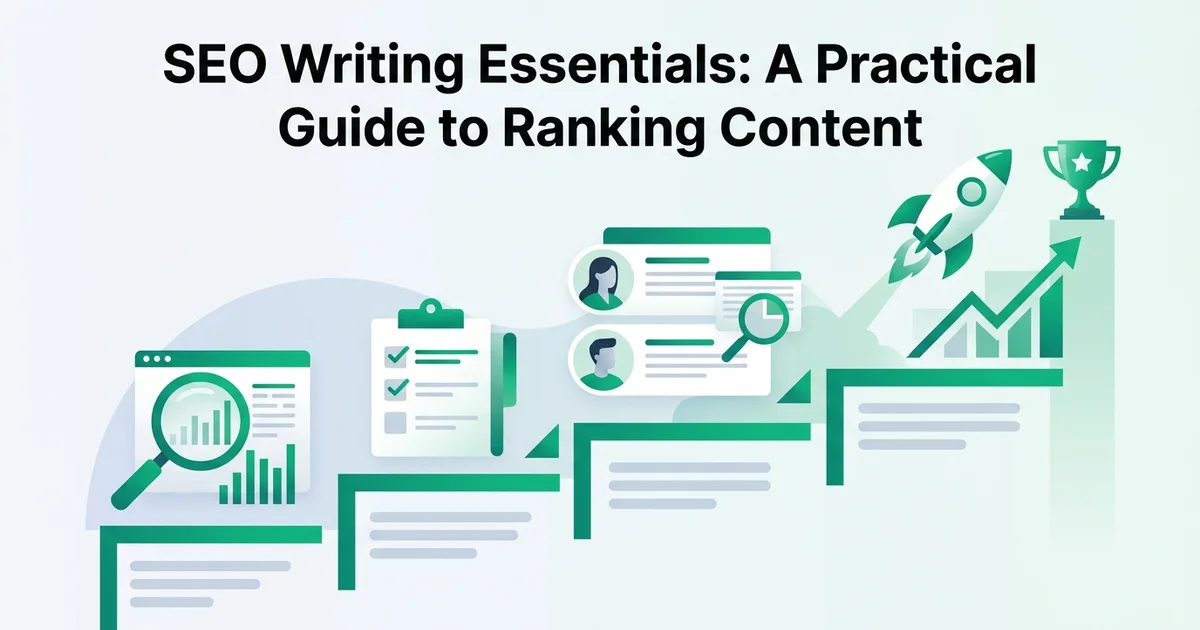
SEO Writing Essentials: A Practical Guide to Ranking Content
- Basic understanding of how search engines work
- Access to a keyword research tool (free or paid)
- Familiarity with your target audience and industry
- A content management system or blogging platform
Introduction: why SEO writing matters for your business
Organic search remains one of the most powerful, cost-effective channels available to businesses of any size. Research indicates that organic search accounts for 49% of tracked website traffic in 2024, meaning nearly half of all website visitors arrive without a single dollar spent on advertising. For solo founders, lean marketing teams, and growing SMBs, that represents an enormous opportunity.
SEO writing is a skill, not a secret
Many business owners assume ranking on Google requires technical wizardry or insider knowledge. It does not. SEO writing is a structured, learnable discipline built on understanding what your audience searches for and delivering content that genuinely answers those queries. At RankHub, our analysis shows that businesses who follow a consistent, research-driven content workflow see compounding traffic growth over time, without relying on paid channels to sustain it.
What this guide gives you
This guide walks you through a practical, step-by-step SEO writing workflow you can begin implementing today. Each section addresses a specific stage of the process, from keyword research through to publishing. Whether you are writing content yourself or looking to automate the process with a tool like RankHub, the principles here apply directly to your business.
What you'll need before you start
Before diving into the steps, gather the right resources. Having these in place from the beginning prevents unnecessary interruptions and keeps your workflow moving efficiently.
Keyword research tool
Use tools like SEMrush, Ahrefs, or Google Keyword Planner to identify search volume, difficulty, and related keywords for your target topic.
Competitor analysis resources
Open Google Search Console and have the top 10 ranking pages ready for your target keyword. These will serve as your content blueprint.
Writing and editing software
Set up your preferred writing environment—Google Docs, Notion, or a dedicated content management system—to keep your workflow organized.
SEO optimization checklist
Prepare a list of on-page SEO elements to verify: meta titles, meta descriptions, heading structure, internal links, and image alt text.
Fact-checking sources
Bookmark reliable sources, industry reports, and primary data you'll reference to verify claims and build credibility.
A keyword research tool
You will need a way to discover what your audience is actually searching for. Free options like Google Search Console and Google Keyword Planner work well for beginners. Paid platforms offer deeper data. RankHub's built-in AI keyword research handles this automatically, which is particularly useful if you lack a dedicated SEO team.
A clear picture of your target audience
Know who you are writing for before you write a single word. Consider their experience level, the problems they are trying to solve, and the language they use when searching.
Basic topic familiarity
You do not need to be an expert, but a foundational understanding of your subject helps you write with credibility and accuracy.
A publishing platform
Have your content management system ready, whether that is WordPress, Webflow, or another platform. RankHub supports webhook publishing, so content can move directly from creation to your site without manual uploads.
Realistic time expectations
Good SEO content takes time to write, edit, and optimise. Budget accordingly, or consider SEO automation tools to reduce that burden.
Step 1: research your target keyword and search intent
Before writing a single word, you need to know exactly what your audience is searching for and why. Keyword research defines the foundation of your entire piece, shaping the angle you take, the format you choose, and the depth you go into. Skip this step and you risk writing content nobody finds.
Identify your primary keyword
Use your keyword research tool to find a term with meaningful search volume and reasonable competition. This becomes the anchor for your entire piece.
Determine search intent
Ask yourself: Is the searcher looking for information, trying to make a purchase, or seeking a specific tool or service? Match your content angle to this intent.
Find related keywords and variations
Identify long-tail variations and related terms that naturally fit your topic. These will inform your outline and help you capture additional search traffic.
Document your research
Create a simple spreadsheet or document listing your primary keyword, search intent, monthly search volume, and difficulty score for future reference.
Find keywords with real search volume and manageable competition
Start by identifying a primary keyword that people actually search for. You want a term with enough monthly search volume to be worth targeting, but not so much competition that a newer site has no realistic chance of ranking.
RankHub's AI keyword research feature does this automatically, surfacing keyword opportunities based on your niche and flagging potential cannibalization conflicts before they become a problem. This is particularly useful for solo founders and small teams who do not have a dedicated SEO analyst on hand. Research suggests that 58% of SEO professionals now use AI tools to support topic and keyword research, and the efficiency gains are hard to argue with.
Understand the search intent behind your keyword
Search intent is the reason behind a query. According to Google Search Central, content should match what users genuinely want to find. Ask yourself: is the person searching to learn something, compare options, make a purchase, or find a specific page? Google's top results will tell you quickly. If the first page is filled with how-to guides, a product page will not rank there.
Identify related questions and secondary keywords
Look at the "People also ask" section in Google search results for your primary keyword. These questions reveal the sub-topics your audience cares about and give you natural headings to build around.
Document your findings clearly before moving on:
- Primary keyword: the main term your article targets
- Secondary keywords: three to five related phrases that support the primary topic
- Search intent: learning, buying, navigating, or comparing
- Content format: blog post, guide, listicle, or product page
- Related questions: pulled from "People also ask" or keyword tools
This documented list becomes your brief for the next step. If you are using RankHub, this research feeds directly into its content generation workflow, so nothing gets lost between the planning and writing stages. For a broader look at how automation fits into this process, see our guide to SEO autopilot tools that actually deliver results.
Step 2: analyze the top-ranking pages and create your outline
With your keyword research documented, the next move is to study what is already ranking. Open the top 10 Google results for your target keyword and treat them as a blueprint. Note the content structure, approximate word count, and recurring sections. This tells you exactly what Google currently rewards.
Study the top 10 Google results
Open each ranking page and note the content structure, main sections, word count, and key points covered. Look for patterns in what Google rewards.
Identify content gaps
Determine what existing content covers well and where opportunities exist to provide deeper insight, fresher data, or a unique angle.
Create your outline
Build a hierarchical outline with H2 and H3 headings based on your research. Ensure your structure flows logically and addresses reader questions at each stage.
Plan your unique angle
Decide what makes your piece different—original research, a unique framework, real-world examples, or a specific perspective that adds value.
Review the competitive landscape
Work through each result systematically and record:
- Common H2 headings that appear across multiple pages
- Average word count across the top five results
- Content format used most frequently (listicle, guide, tutorial)
- Questions answered in the body copy or FAQ sections
What you should see: a clear pattern of topics that every strong result covers. These are your non-negotiable inclusions.
Identify gaps and build your outline
Gaps are where your opportunity lives. Look for angles competitors miss, outdated statistics, or questions left unanswered. If you are using RankHub, its AI keyword research feature surfaces related questions and semantic terms automatically, so you are not relying on guesswork.
Once gaps are identified, build a detailed outline using H2 and H3 headings. Structure it to answer your primary keyword first, then layer in supporting questions. This hierarchy signals topical authority to search engines before you write a single sentence. If managing this manually feels like a full-time job, it is worth exploring an seo agency alternative that handles the heavy lifting for you.
Step 3: write your first draft with people-first content in mind
With your outline in place, the drafting phase begins. The core principle here is straightforward: write for your reader first, and trust that search engines will follow. According to Google's Search documentation, content should be helpful, reliable, unique, and created for people first. That standard should guide every paragraph you write.
Hook your reader from the first sentence
Your introduction has one job: convince the reader they are in the right place. Open with a clear statement of what the article covers, who it is for, and what they will gain by reading it. Avoid burying the value. If a reader cannot identify the benefit within the first two sentences, they will leave, and that bounce signal works against your rankings.
Write in a voice that matches your audience
Use clear, direct language that reflects how your target reader actually speaks. For solo founders and small business owners, that means skipping jargon and writing as though you are explaining something to a capable colleague. Short sentences, active verbs, and concrete examples all help. Where you have firsthand expertise or original data, include it. That specificity is what separates genuinely useful content from generic filler.
Structure your draft for scannability
Break your content into short paragraphs of three to four sentences maximum. Use your H2 and H3 headings from the outline as natural signposts. Readers scan before they commit to reading, so your subheadings need to carry meaning on their own.
For comprehensive guides targeting competitive keywords, aim for 1,500 to 2,500 words. That range gives you enough space to cover a topic thoroughly without padding for padding's sake.
If producing a well-structured, people-first draft every week feels unrealistic alongside everything else you manage, RankHub publishes SEO-optimized articles on a consistent schedule through its automated workflow, removing the bottleneck entirely. It functions as a practical seo automation platform for teams that cannot afford to let publishing slip.
Step 4: optimize your content for on-page SEO
With your draft written, the next task is to ensure search engines can correctly interpret and rank it. On-page SEO refers to the technical and structural signals you embed directly within your content, and getting these right significantly improves your chances of ranking for your target terms.

Place your primary keyword strategically
Insert your primary keyword into your H1 title, your opening paragraph, and at least one H2 subheading. This signals relevance to search engines without requiring repetition throughout the body.
Use secondary keywords naturally
Weave related terms into subheadings and body paragraphs where they fit contextually. Forcing them in creates awkward phrasing that readers notice immediately.
Write a compelling meta description
Keep your meta description between 155 and 160 characters and include your primary keyword. Treat it as a short advertisement for the page: it should communicate the article's value clearly.
Optimize your URL, images, and internal links
- URL: Keep it short, descriptive, and keyword-inclusive
- Alt text: Describe each image using relevant keywords naturally
- Internal links: Connect to related articles and pillar content to distribute authority across your site
RankHub's AI keyword research feature handles keyword placement and meta descriptions automatically within each published article, which is particularly useful if you are managing multiple pieces simultaneously. For a broader look at what this saves in practice, see What the Data Shows About SEO Automation ROI in 2026.
Step 5: fact-check, edit, and prepare for publication
Before you hit publish, verify every claim, tighten your prose, and confirm all technical details are in order. This step separates content that builds trust from content that quietly erodes it. Skipping it is one of the most common reasons otherwise well-optimized articles underperform.
Verify statistics, quotes, and claims
Cross-reference every statistic and quote against its original source. If you cannot trace a claim to a credible, current reference, remove it or rewrite it with appropriate hedging language. According to Creating Helpful, Reliable, People-First Content, Google explicitly rewards content that demonstrates expertise, accuracy, and trustworthiness.
Review AI-assisted drafts carefully
Research suggests that 50% of SEO professionals now use AI to write content, making manual review more important than ever. AI-generated text can introduce subtle inaccuracies, outdated figures, or generic phrasing that weakens your authority. Read every paragraph critically, and rewrite anything that feels vague or unverifiable. If you work with an ai seo agency, confirm their review process before content goes live.
Edit for clarity and correctness
Read your draft aloud to catch awkward phrasing, run-on sentences, and typos. Check that your headings follow a logical hierarchy and that each paragraph serves a clear purpose.
Add media and finalize metadata
Insert relevant images, tables, or charts to break up long text blocks and improve engagement. Then confirm your title tag, meta description, and featured image are all set before scheduling. RankHub includes featured images and handles metadata automatically within each published article, keeping your publishing workflow consistent without requiring manual setup each time.
Common mistakes to avoid when writing SEO content
Even well-intentioned SEO writing efforts can fall short when a few critical errors creep in. Recognizing these pitfalls before they affect your rankings saves significant time and protects the credibility you have worked hard to build.
Check out RankHub Starter's approach to seo writing RankHub Starter.
Keyword stuffing
Forcing your target keyword into every other sentence signals manipulation to search engines and makes your content unpleasant to read. Write naturally, and let your keyword appear where it genuinely fits.
Ignoring search intent
Publishing a product page when someone is searching for a how-to guide means your content will not rank, regardless of its quality. Always confirm what type of content the keyword actually demands before you write a single word.
Thin content
Short articles without genuine depth rarely compete. According to Google's helpful content guidance, content should demonstrate real expertise and provide substantial value to readers.
Neglecting internal links
Every article is an opportunity to guide readers deeper into your site. Missing those connections leaves both users and search engines without a clear path forward. Linking to related resources, such as our roundup of SEO agencies that deliver measurable organic growth, strengthens your overall site structure.
Forgetting the user experience
Prioritizing keyword placement over readability frustrates visitors and increases bounce rates. Search engines measure engagement signals, so content that reads poorly ultimately ranks poorly.
Publishing without fact-checking
In our experience at RankHub, inaccurate content is one of the fastest ways to erode audience trust and invite ranking penalties. Scaled or automated content published without human review also risks violating Google's spam policies, making a thorough editorial pass non-negotiable before any article goes live.
Why this method works: the science behind SEO writing
Every technique covered in this guide connects to a core principle: search engines reward content that genuinely serves readers. Understanding the mechanics behind each practice helps you apply them with intention rather than guesswork.
Search intent alignment converts visitors into readers
When your content matches what users actually want, they stay longer and engage more deeply. Google interprets these behavioral signals as quality indicators, which directly influences rankings. According to Google Search Central, content should be written for people first, with search engines as a secondary consideration.
Structured outlines produce tighter content
A clear outline prevents topic drift and ensures every paragraph earns its place. Well-structured content is easier for both readers and crawlers to navigate, improving comprehension and indexation simultaneously.
On-page signals communicate relevance
Title tags, headings, and internal links collectively tell Google what your content covers. Internal linking also distributes authority across your site, keeping readers engaged and reducing bounce rates.
Human review remains irreplaceable
Research suggests roughly 17% of top-ranking content is AI-generated, yet quality differentiation still matters enormously. Automated tools miss contextual errors, tonal inconsistencies, and factual inaccuracies that a trained editorial eye catches immediately. This is why platforms like RankHub combine automated SEO workflows with structured content frameworks rather than replacing human judgment entirely.
Alternative methods: when to use AI-assisted writing
AI-assisted writing can significantly accelerate your SEO workflow when applied strategically. Research suggests that 75% of marketers now use AI tools for content creation, and 52% of SEO professionals rely on AI specifically for content rewriting and repurposing. The key is knowing where AI adds value and where human expertise must lead.

Use AI for research, outlining, and first drafts
AI tools excel at compressing time-intensive tasks. Use them to generate keyword clusters, build content outlines, and produce first drafts that you then refine. This works particularly well for secondary content like FAQs, product descriptions, and supporting blog posts, rather than your flagship, authority-building pieces.
Repurpose and rewrite existing content efficiently
AI is highly effective at transforming existing content into new formats. Repurpose a long-form guide into a listicle, or refresh an outdated post with updated framing. If you work without a dedicated seo marketing agency or content team, tools like RankHub automate this workflow entirely, handling keyword research, article structure, and publishing on a consistent schedule.
Always fact-check before publishing
Treat every AI output as a starting point, not a finished product. Verify statistics, check factual claims, and edit for tone before anything goes live. AI misses contextual nuance, and publishing unreviewed content risks both credibility and rankings.
Real-world example: applying the SEO writing workflow
Learn how to apply the SEO writing workflow in practice by walking through a complete article build from start to finish. We'll use "best project management tools" as our target topic, demonstrating each step of the process to show how theory translates into actionable content creation.
Step 1: run keyword research
Open RankHub and enter your seed topic. The AI keyword research feature surfaces related terms, search volume estimates, and intent signals. For this topic, you would identify the primary keyword ("best project management tools"), supporting terms ("free project management software," "team task management apps"), and question-based phrases ("what is the best project management tool for small teams?"). These feed directly into your outline.
Step 2: build a search-intent-led outline
Structure your article around what the searcher actually needs: a comparison, not a definition. Your H2 sections should cover evaluation criteria, individual tool breakdowns, and a clear recommendation. RankHub's SEO-optimized article output maps this structure automatically, reducing the planning time significantly.
Step 3: write, optimize, and add media
Draft each section with your target keyword in the title, introduction, and at least one subheading. Add a comparison table and screenshots to support scannability. Internal links to related marketing tools content strengthen topical authority.
According to Nutshell, a practical SEO content workflow consists of outlining, writing and editing, optimizing, adding media, and publishing, followed by ongoing iteration. Before publishing, verify every statistic and review the draft for tone and accuracy.
Troubleshooting: answers to common SEO writing questions
Even well-executed SEO writing can raise questions when results do not appear as expected. The answers below address the most common sticking points for founders, marketers, and small business teams.
Why isn't my article ranking despite following best practices?
Ranking takes time, and competition matters. Check whether your target keyword is too competitive for your current domain authority. Also review your backlink profile, page speed, and internal linking structure. A tool like RankHub runs anti-cannibalization checks automatically, which helps rule out one common culprit: two of your own pages competing against each other.
How is SEO writing different from general copywriting?
Copywriting prioritizes persuasion. SEO writing balances search intent, keyword relevance, and readability to satisfy both readers and search engines simultaneously.
How long does it take new content to rank?
Research suggests most new content takes three to six months to gain meaningful traction in search results.
When should you update older content?
Refresh content when rankings drop, statistics become outdated, or the topic has evolved significantly.
How do you balance multiple keywords in one article?
Target one primary keyword per article, then support it with closely related secondary terms. Forcing unrelated keywords into a single piece dilutes focus and confuses search intent.
Conclusion: start writing SEO content today
SEO writing is a learnable skill, and every article you publish makes you sharper. The five-step workflow covered in this guide, research, outline, draft, optimize, and publish, gives you a repeatable process you can apply to your next piece immediately.
Consistency compounds over time
Quality content does not deliver results overnight, but it accumulates. Each well-optimized article builds domain authority, captures new search queries, and supports the pieces around it. The writers and teams that win in organic search are simply the ones who show up consistently.
Put this guide into practice now
Open a keyword research tool, pick one topic your audience is actively searching for, and work through each step. As Nutshell notes, a practical SEO workflow follows outlining, writing, optimizing, and ongoing iteration. If you want to remove the manual effort entirely, RankHub automates that full workflow, publishing SEO-optimized articles on a consistent schedule so you can focus on growing your business.
Frequently asked questions
What is SEO writing?
SEO writing is the practice of creating content that satisfies both search engine ranking signals and genuine reader needs. According to Google Search Central, content should be helpful, reliable, unique, and created for people first.
How do you write SEO content?
Start with keyword research, build a structured outline, write for your audience, then optimize headings, meta descriptions, and internal links. Tools like RankHub automate this entire workflow.
How do I write an SEO-friendly article?
Focus on a single primary keyword, use clear headings, answer search intent directly, and include relevant internal and external links throughout.
What are the best tools for SEO writing?
Popular options include keyword research platforms, grammar checkers, and content optimization tools. RankHub combines AI keyword research and automated publishing in one workflow, saving 40+ hours monthly.
How long should an SEO article be?
Length depends on topic complexity and competitor benchmarks. Research suggests most ranking articles fall between 1,200 and 2,500 words.
How do you use keywords in SEO writing?
Place your primary keyword in the title, opening paragraph, at least one H2, and the meta description. Distribute secondary keywords naturally throughout the body.
Can AI write SEO content?
Yes, though human review remains essential. Google Search Central advises that AI-generated content should be manually fact-checked and reviewed for accuracy before publication.
How do you optimize an article for Google?
Align content with search intent, earn quality backlinks, improve page speed, and update articles regularly to maintain relevance.
Based on our work at RankHub, consistent publishing frequency combined with strong keyword targeting produces the most reliable long-term ranking gains.
More from Our Blog
8 SEO Best Practices That Actually Improve Your Rankings
Master SEO best practices with 13 expert tips covering on-page optimization, technical SEO, and AI-era strategies. Boost rankings and qualified traffic today.
Read more →
The Top Influencer Marketing Platforms That Drive Real Results
Compare the best influencer marketing platforms for 2025. Find tools for creator discovery, campaign management, and ROI tracking tailored to your business.
Read more →
AI in Marketing: A Practical Guide for Teams Just Getting Started
Learn how AI transforms marketing with our beginner's guide. Discover practical uses, tools, and first steps to implement AI in your marketing strategy today.
Read more →