Building an SEO Career: What You Need to Know to Succeed
- Basic understanding of how search engines work
- Familiarity with Google and web browsers
- Willingness to learn new tools and stay current with industry changes
- Access to a computer and internet connection
Introduction: why an SEO career matters now
An SEO career offers genuine long-term opportunity, but succeeding in it requires understanding exactly what the market demands right now. The field is evolving fast, salaries vary widely depending on seniority, and the skills employers prioritize have shifted significantly toward technical and AI-related competencies.
The job market is growing but competitive
At RankHub, our analysis shows that demand for SEO professionals continues to climb even as the nature of available roles changes. According to Digital Information World (2025), SEO job-search interest reached 71.8 in early 2025, reflecting strong candidate interest in the field. That level of interest means competition is real, and standing out requires more than a basic understanding of keywords and rankings.
Salary potential spans a wide range
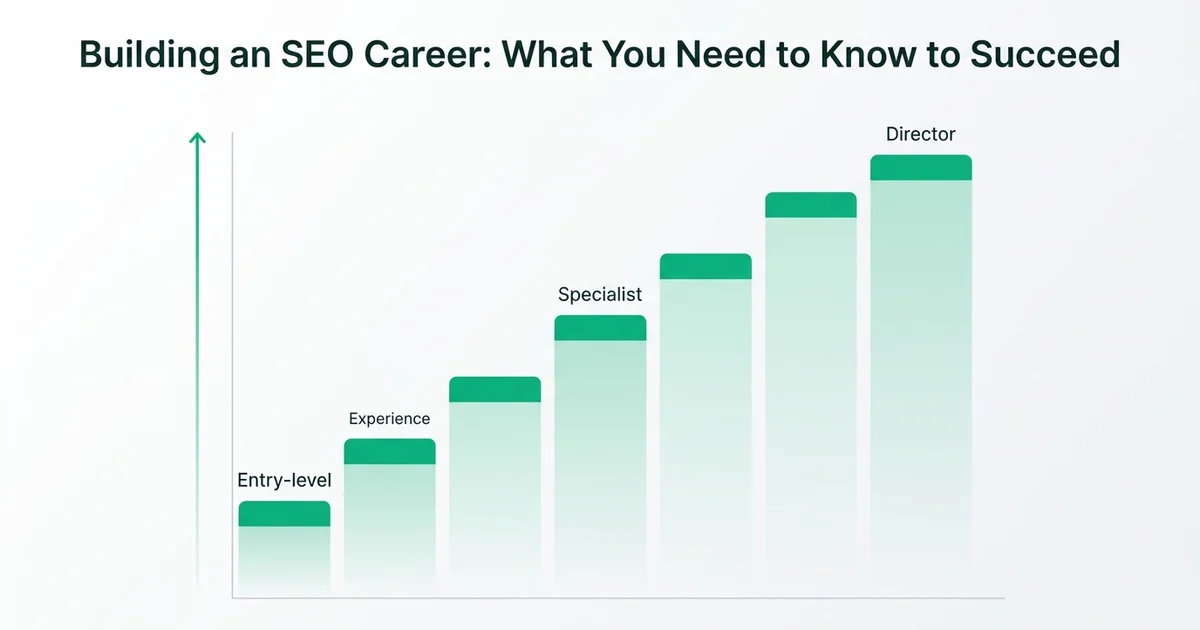
The financial rewards of an SEO career scale considerably with experience and specialization. Entry-level and specialist roles average around $67,000 annually, while VP of SEO positions command averages of $191,850 or more. That gap represents a clear progression path for professionals willing to build deep expertise over time.
Technical skills and workplace expectations have shifted
Technical SEO was listed as a requirement in 75% of job postings in Q4 2024, and AI-related skills are increasingly appearing alongside it. Equally important: only 34% of SEO roles are fully remote, with 45% requiring on-site presence and 21% operating on a hybrid basis. If you are planning an SEO career expecting full flexibility, adjusting those expectations early will serve you well.
Prerequisites: what you need before starting
Before diving into the steps ahead, confirm you have the foundational building blocks in place. These are not advanced requirements. They are the baseline competencies that will make every subsequent skill you develop stick faster and translate more readily into real-world results.
Basic understanding of search engines and user intent
You should be able to explain, in plain language, how search engines crawl, index, and rank content. More importantly, you need a working grasp of user intent: why someone types a query and what result would genuinely satisfy them. This conceptual foundation underpins every tactical decision you will make.
Familiarity with Google Search Console and Google Analytics 4
Get comfortable navigating both platforms before you begin. Google Search Console reveals how your site performs in search; Google Analytics 4 shows what users do after they arrive. Neither requires mastery at this stage, just enough fluency to interpret basic reports.
Comfort with spreadsheets and data analysis
SEO generates significant amounts of data. Sorting keyword lists, tracking ranking changes, and identifying traffic patterns all happen in spreadsheets. Proficiency here will also prepare you to evaluate best seo automation tools effectively later in your career.
A commitment to continuous learning
Algorithms shift. Tools evolve. Treat learning as an ongoing professional obligation, not a one-time task.
Step 1: master the SEO fundamentals and core skills
Build your SEO knowledge across four core disciplines: on-page optimization, technical SEO, off-page signals, and analytics. Each area addresses a distinct part of how search engines discover, evaluate, and rank content. Mastering all four gives you a complete, employable skill set from the start.
Learn on-page optimization
Master keyword research, title tag optimization, meta descriptions, header tag structure, and content optimization. Focus on how search engines parse and rank individual pages based on relevance signals.
Develop technical SEO expertise
Study site architecture, crawlability, indexation, Core Web Vitals, XML sitemaps, robots.txt, and structured data. Technical SEO appeared in 75% of SEO job listings in Q4 2024, making this a critical skill.
Understand off-page signals and link building
Learn how backlinks, domain authority, and brand signals influence rankings. Study link acquisition strategies, competitor analysis, and relationship-building for earning high-quality links.
Build analytics and reporting skills
Master Google Analytics 4, Google Search Console, and data interpretation. Learn to connect SEO actions to business outcomes and communicate results to stakeholders.
On-page SEO: keywords, titles, and content
Start by learning how search engines connect user intent to content. This means understanding:
- Keyword research: identifying terms your target audience actually searches for, including search volume, competition, and intent
- Title tags and meta descriptions: writing concise, accurate tags that improve click-through rates in search results
- Content optimization: structuring pages so both users and crawlers can extract meaning quickly
Practice by optimizing real pages, not hypothetical ones. Choose a topic, research keywords, and rewrite a page around them.
Technical SEO: crawlability, structure, and performance
Technical SEO ensures search engines can access and understand your site. According to Digital Information World (2025), technical SEO was required in 75% of SEO job listings in Q4 2024, up from 71% the previous quarter. Employers expect this knowledge.
Focus on:
- Crawlability and indexing: robots.txt, XML sitemaps, and canonical tags
- Site structure: logical URL hierarchies and internal linking
- Core Web Vitals: page speed, visual stability, and interactivity metrics that directly affect rankings
Off-page SEO: authority and trust signals
Off-page SEO covers everything that happens outside your website. Backlinks remain the primary signal, but brand mentions, reviews, and social proof also contribute to domain authority. Learn how to evaluate link quality, not just quantity.
Analytics: turning data into decisions
Proficiency in Google Analytics 4 and Google Search Console is non-negotiable. Learn to interpret organic traffic trends, identify underperforming pages, and connect ranking changes to specific actions. Pairing this skill with SEO autopilot tools that actually deliver results will sharpen your ability to act on data efficiently.
Step 2: build hands-on experience with essential SEO tools
Reading about SEO theory only takes you so far. Employers and clients want proof that you can operate the tools that drive real results. Build a test website, treat it as your sandbox, and work through each tool category systematically before applying for roles or pitching clients.
Set up a test website or blog
Create a WordPress site or similar platform to serve as your sandbox. This gives you full control to experiment with technical implementations, content strategies, and tracking without client pressure.
Install and configure SEO tools
Set up Google Search Console, Google Analytics 4, and at least one third-party SEO platform (Semrush, Ahrefs, or Moz). Learn the interface, data flows, and how to extract actionable insights.
Execute a complete SEO project from start to finish
Conduct keyword research, optimize existing content, build internal links, and monitor rankings over 3–6 months. Document every decision and result for your portfolio.
Practice competitor analysis
Analyze top-ranking competitors for your target keywords. Identify their backlink profiles, content gaps, and technical implementations to inform your own strategy.
Set up Google Search Console and Google Analytics 4
Create a free test site using WordPress or a similar platform, then connect both Google Search Console (a free tool that shows how Google crawls and indexes your site) and Google Analytics 4 (Google's current web analytics platform). Verify ownership, submit a sitemap, and monitor the Coverage and Performance reports weekly. You should see data populating within 48 to 72 hours of setup.
Practice keyword research with dedicated tools
Open a free account with Ubersuggest or take advantage of trial periods on Semrush or Ahrefs. Search for 20 to 30 keywords relevant to your test site's topic. Record search volume, keyword difficulty, and search intent for each term. Export the data and organize it in a spreadsheet, grouping keywords by topic cluster and funnel stage. This workflow mirrors what you will do for real clients, making it a practical alternative to hiring an seo agency alternative.
Learn technical auditing with a crawling tool
Download the free version of Screaming Frog (a desktop crawler that maps every URL on a website) or explore Sitebulb. Crawl your test site and identify broken links, missing meta descriptions, and duplicate content. Research suggests technical SEO appeared in 75% of SEO job listings in Q4 2024, making crawler proficiency a near-essential hiring requirement. Document your findings in a structured spreadsheet and practice writing clear, prioritized recommendations based on what the audit surfaces.
Step 3: develop AI-assisted SEO workflows and modern skills
Integrate AI tools into your daily SEO practice to stay competitive in a market that increasingly rewards this skill set. According to Digital Information World (2025), AI skills appeared in 21% of open SEO positions overall, rising to 56% among roles paying $250,000 to $300,000. Starting now gives you a measurable advantage.
Learn AI tools for content research and optimization
Open accounts with at least one AI writing assistant: ChatGPT, Jasper, or Claude are the most widely adopted. Use them to:
- Generate content briefs from a target keyword and a set of competitor URLs
- Draft and iterate meta descriptions at scale across multiple pages
- Identify semantic gaps by asking the tool to suggest related topics your draft does not cover
Treat every AI output as a first draft. Build a personal review checklist that checks for factual accuracy, brand tone, and search intent alignment before anything is published.
Understand AI-search optimization
AI-search optimization refers to structuring content so it surfaces in AI-generated answers, such as those in Google's AI Overviews or ChatGPT search. This differs from traditional SEO because prominence depends on authoritative sourcing and clear, direct answers rather than keyword density alone. According to Digital Information World (2025), AI-search skills were required in 53.6% of managerial SEO roles, making this knowledge critical for career progression.
Document your AI-assisted process
Record every workflow you build, including the prompts you use, the review steps you apply, and the results you measure. Pair this documentation with an seo automation platform to show interviewers a repeatable, scalable system rather than isolated experiments. This paper trail becomes a portfolio asset in its own right.
Step 4: create a portfolio with real-world SEO projects
Build a portfolio by launching real projects and measuring their results. Employers and clients want evidence of impact, not just theoretical knowledge. A well-documented portfolio showing measurable SEO improvements is often more persuasive than any certification or resume line.

Start a blog or website from day one
Register a domain, build a site around a topic you know well, and optimize it for search from the moment it goes live. Treat it as a live laboratory. Every decision, from URL structure to internal linking, should be intentional and documented. This gives you a controlled environment where you own the results entirely.
Document improvements with specific metrics
Record your starting position for every keyword you target, then track changes weekly. Meaningful portfolio entries include specific numbers: a 40% increase in organic traffic over three months, a target keyword moving from page four to page one, or a 15% lift in conversion rate after a content refresh. Vague claims carry little weight.
Build case studies that cover all core disciplines
Structure each case study around a clear before-and-after narrative. Include examples that demonstrate technical SEO audits, content strategy decisions, and analytics interpretation. Understanding What the Data Shows About SEO Automation ROI in 2026 can also help you frame the business value of your work in language that resonates with hiring managers and potential clients.
Step 5: pursue relevant certifications and continuous learning
Certifications validate your skills to employers and clients who cannot yet assess your work firsthand. They also force structured learning, which fills gaps that hands-on experimentation alone tends to miss. Treat them as a foundation, not a finish line.
Earn foundational platform certifications
Start with Google's free offerings. The Google Analytics certification and Google Search Console documentation both demonstrate platform fluency that hiring managers expect. Follow these with the HubSpot SEO certification, which covers broader inbound strategy, and selected Moz Academy courses for technical depth.
Stay current with algorithm updates
Search algorithms shift constantly, and an outdated approach can undermine otherwise strong work. Subscribe to industry newsletters from Search Engine Journal, Search Engine Land, and Google's own Search Central blog. Set aside time weekly to review updates and adjust your understanding accordingly.
Join active SEO communities
Learning accelerates when you engage with peers solving real problems. Participate in Reddit's r/SEO, the Moz community forums, or local SEO meetups in your area. These spaces surface practical insights that formal courses rarely cover, and they connect you with professionals who may later refer clients or opportunities your way. Teams at an ai seo agency often credit community involvement as a key driver of their ongoing skill development.
Step 6: prepare for the job market and interview process
With your skills sharpened and certifications in hand, the next priority is positioning yourself competitively. The SEO job market has shifted considerably, and candidates who understand current employer expectations, workplace structures, and salary realities will negotiate from a stronger position.
Tailor your resume to job descriptions
Highlight technical SEO skills prominently, since 75% of job listings require them. Use metrics and outcomes (traffic growth, ranking improvements, revenue impact) rather than generic responsibilities.
Prepare case studies and portfolio examples
Document 2–3 real projects with clear before/after metrics. Include keyword rankings, organic traffic growth, conversion impact, and the specific tactics you used. Be ready to explain your reasoning.
Practice answering technical and behavioral questions
Prepare for questions about your approach to technical audits, link-building strategy, analytics interpretation, and how you handle algorithm updates. Use the STAR method (Situation, Task, Action, Result).
Research company culture and SEO maturity
Understand whether the role is in-house (65% of listings) or agency-side. Learn about the company's current SEO performance, tools, and team structure to ask informed questions.
Tailor your resume to technical SEO skills
Highlight technical competencies prominently. According to Digital Information World (2025), technical SEO appeared as a requirement in 75% of SEO job listings in Q4 2024. Employers want to see demonstrated experience with:
- Site auditing and crawl analysis
- Core Web Vitals optimization
- Structured data and schema markup
- Log file analysis and indexation management
Quantify your results wherever possible. Numbers convert faster than descriptions on a recruiter's screen.
Prepare for modern interview questions
Expect interviewers to probe your understanding of AI-driven search, generative search experiences, and how you adapt workflows when algorithms shift. In our experience at RankHub, candidates who articulate a clear process for testing, measuring, and iterating consistently outperform those who rely on surface-level answers.
Understand workplace structure and salary expectations
Research the role format before applying. According to Digital Information World (2025), only 34% of SEO roles were remote in 2024, while 45% were on-site and 21% hybrid. Median salaries also declined from $90,000 in Q1 2024 to $75,000 by Q4 2024, making it important to benchmark offers carefully against role scope and location.
If freelance or agency work appeals to you, reviewing how SEO agencies that deliver measurable organic growth structure their service offerings can help you understand what skills command premium rates in practice.
Common mistakes to avoid when launching your SEO career
Even well-prepared candidates stumble in their first SEO role. Recognizing these pitfalls early gives you a meaningful advantage over peers who learn them the hard way.
Treating content as the whole job
Many beginners focus exclusively on writing and on-page optimization while neglecting technical SEO and analytics. Employers expect you to interpret crawl data, diagnose site health issues, and connect rankings to revenue. Content skills matter, but they are only one piece of the picture.
Ignoring AI tools and modern workflows
Hiring managers increasingly screen for familiarity with AI-assisted research, automation, and reporting workflows. Candidates who cannot demonstrate this fluency risk appearing behind the curve before the interview even begins.
Documenting work without documenting results
A portfolio full of published articles means little without traffic graphs, ranking improvements, or conversion data attached. Every project you include should answer one question: what measurably changed because of your work?
Assuming remote work is the default
According to Lumar (2025), 45% of SEO roles were on-site and 21% hybrid. Prepare for in-person expectations rather than assuming flexibility.
Staying too generalist for too long
According to Digital Information World (2025), 59% of analyzed listings were mid-level roles requiring genuine depth. Whether you work in-house or alongside an SEO agency, specializing early accelerates your progression significantly.
Why this career roadmap works
This roadmap is built around what employers actually verify during interviews, not just what looks good on a resume. It sequences skills deliberately, moving from core fundamentals through to advanced technical and AI-driven capabilities, so each stage reinforces the next rather than leaving gaps that hiring managers quickly expose.

Aligned with real job market demands
The roadmap prioritizes technical SEO, analytics expertise, and AI tool proficiency because these are the competencies dominating 2025 job listings. Employers, whether in-house teams or those working with an seo marketing agency, are screening for demonstrable depth in these areas from the first interview.
Built around portfolio evidence
Every stage produces tangible work samples. Rankings improved, audits completed, reports delivered. These artifacts give interviewers something concrete to evaluate rather than relying on your word alone.
Logical skill progression
Moving from fundamentals to specialization mirrors how SEO expertise actually compounds. Each skill layer builds on the previous one, reducing overwhelm and accelerating genuine competence rather than surface-level familiarity.
Alternative paths to an SEO career
Not every SEO career follows a single trajectory. The field accommodates multiple entry points and working arrangements, so you can choose a path that fits your current situation and long-term goals.
Agency route
Starting as a junior SEO specialist at an agency exposes you to diverse industries quickly. You progress toward account manager or strategist roles as you demonstrate results across multiple client accounts.
In-house route
Joining a company's marketing team and specializing in SEO over time is the most common path. According to Lumar (2025), 65% of SEO roles are in-house, making this the dominant hiring environment for specialists.
Freelance route
Building a client base independently requires a strong portfolio, reliable marketing tools, and genuine self-discipline. Your results speak entirely for themselves.
Hybrid approach
Freelancing part-time while holding a full-time position lets you accumulate real client experience and expand your professional network without sacrificing income stability.
Real-world example: building an SEO career from scratch
This composite case study illustrates how a focused, structured approach can compress years of trial and error into a single, productive year. The timeline below reflects what dedicated part-time learning and deliberate project work can realistically achieve.
Months 1 to 3: mastering the fundamentals
A marketing coordinator with no prior SEO experience commits to structured learning, completing foundational courses covering on-page optimization, keyword research, and technical audits. She documents every concept in a personal knowledge base and begins applying techniques to her employer's blog.
Months 4 to 5: building a portfolio site
She launches a niche review site, treating it as a live laboratory. Within two months, the site has a clean technical foundation, a logical content structure, and 20 published articles targeting low-competition keywords.
Month 6: documenting measurable results
The portfolio site records 150% traffic growth and achieves rankings for 40+ keywords. She integrates an AI-assisted content workflow, documenting the efficiency gains clearly in her portfolio to demonstrate modern, scalable production skills.
Month 8: landing the role
Armed with verified results and a compelling portfolio, she secures a mid-level SEO position at $65,000. Research suggests the average SEO salary sits around $67,000, meaning her outcome aligns closely with realistic market expectations for candidates with demonstrable, project-based experience.
Time and cost breakdown for your SEO career launch
Planning your investment upfront helps you avoid surprises and stay committed through the full journey. Most people can launch a credible SEO career within 6 to 9 months for under $1,000, depending on the tools and courses they choose.
Learning phase
Budget 3 to 4 months and $0 to $500. Free resources cover most fundamentals, with optional paid courses accelerating specific skills.
Portfolio building
Allocate 2 to 3 months and roughly $100 to $300 for a domain, hosting, and tool subscriptions such as a RankHub Starter plan to demonstrate real keyword tracking and reporting experience.
Job search and interview prep
Set aside 1 to 2 months and $0 to $200 for resume reviews or interview coaching.
Total investment
| Phase | Time | Cost |
|---|---|---|
| Learning | 3-4 months | $0-$500 |
| Portfolio | 2-3 months | $100-$300 |
| Job search | 1-2 months | $0-$200 |
| Total | 6-9 months | $100-$1,000 |
Conclusion: take your first step toward an SEO career
An SEO career combines strong earning potential with genuine long-term growth. Research suggests average salaries sit around $67,000, with VP-level roles reaching $191,850. The path forward is straightforward: master the fundamentals, build a portfolio with measurable results, and develop AI-assisted workflows that employers increasingly expect.
Prepare for a market where most roles are on-site or hybrid. Remote positions represent only about 34% of listings, so flexibility in your job search will open more doors.
Most importantly, certifications support your credibility but do not replace demonstrated results. A portfolio showing real traffic growth, keyword wins, and reporting experience will always carry more weight with hiring managers than credentials alone. Start small, stay consistent, and let your results speak for themselves.
Frequently asked questions
Is SEO a good career in 2026?
Yes, SEO remains a strong career choice. Demand for experienced practitioners continues to grow, and according to National University, SEO roles are expanding alongside broader digital marketing growth. The field rewards specialists who keep pace with algorithm and AI-driven changes.
How do I start an SEO career with no experience?
Begin by learning the fundamentals through free resources, then build a personal or client site to practice on. Document your results and assemble a portfolio before applying for junior roles or freelance projects. Tools like RankHub Starter make it easy to track keyword performance from day one.
What qualifications do I need to become an SEO specialist?
No formal degree is required. Industry certifications from Google, Semrush, or HubSpot demonstrate foundational knowledge, but proven results matter most to employers.
How much do SEO specialists earn?
Research suggests average SEO salaries sit around $67,000, while VP-level roles can reach approximately $191,850.
Is SEO a stressful job?
It can be, particularly when algorithm updates affect rankings unexpectedly. Managing client expectations and staying current with industry changes adds pressure, though strong processes reduce day-to-day stress significantly.
How long does it take to learn SEO?
Most people grasp core concepts within three to six months of consistent practice. Reaching a professional level typically takes one to two years of hands-on work.
What skills are required for an SEO job?
Technical SEO, content strategy, keyword research, and analytics are essential. Research suggests technical SEO appeared in 75% of job listings in Q4 2024, making it a non-negotiable skill.
Will AI replace SEO jobs?
AI is reshaping SEO rather than eliminating it. According to Lumar, nearly half of analyzed job listings now reference AI-search or AI-workflow concepts, signaling that professionals who embrace AI tools will be most competitive.
Based on our work at RankHub, practitioners who combine traditional SEO expertise with AI literacy consistently outperform those who treat the two as separate disciplines.
More from Our Blog
Comparing Top Online Market Research Tools for Your Business
Compare top online market research tools: RankHub, Statista, and SurveyMonkey. Pricing, features, and recommendations for your business.
Read more →
SEO Writing Essentials: A Practical Guide to Ranking Content
Learn how to write SEO-optimized content that ranks. Follow our step-by-step guide covering keyword research, intent, drafting, and optimization.
Read more →
8 SEO Best Practices That Actually Improve Your Rankings
Master SEO best practices with 13 expert tips covering on-page optimization, technical SEO, and AI-era strategies. Boost rankings and qualified traffic today.
Read more →