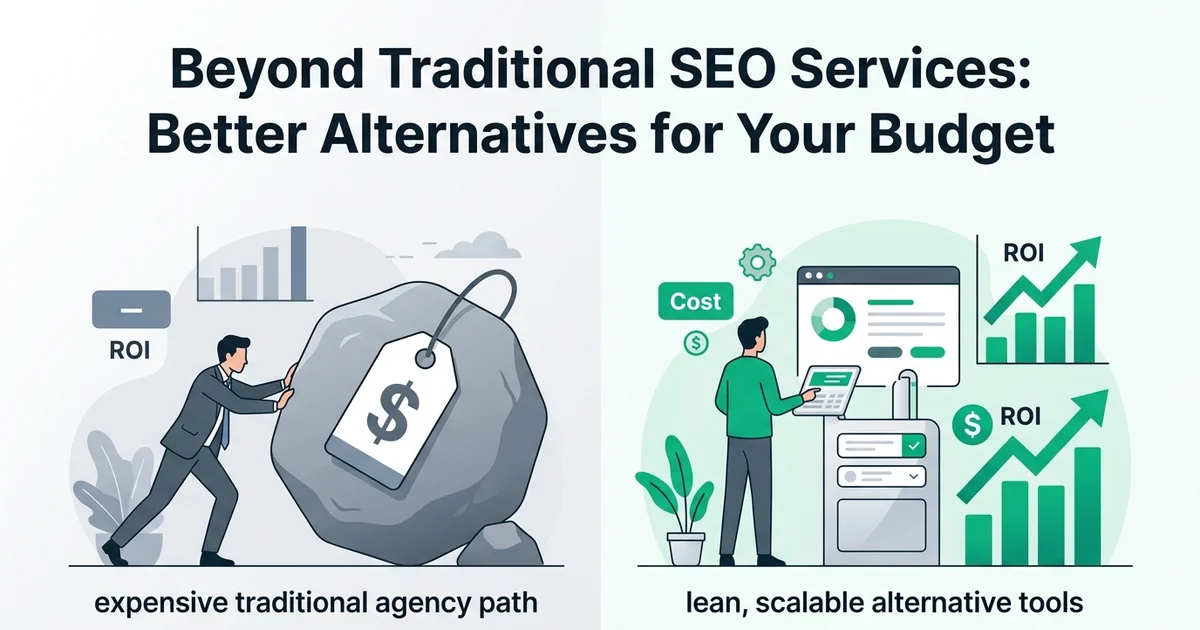
Beyond Traditional SEO Services: Better Alternatives for Your Budget
Introduction: why businesses seek SEO services alternatives
Most businesses outgrow their first SEO solution. Whether it is a freelancer who cannot scale, an agency that burns through budget, or a tool that demands constant manual input, the search for something better is a familiar journey for solo founders, marketing teams, and SMBs alike.
At RankHub, our analysis shows that the biggest frustration is not cost alone. It is the gap between what a service promises and what it actually delivers without ongoing attention from your team.
Several shifts are reshaping how businesses evaluate their options:
- Automation is expanding fast. Autonomous SEO workflows now go well beyond drafting copy, handling keyword research, publishing, and cannibalization checks end to end.
- Pricing models are changing. According to Sitelift (2026), pricing is increasingly volume-based rather than seat-based, which suits growing content operations far better.
- Human oversight remains a premium. Human-in-the-loop services still exist, but they command a significant price premium over fully automated alternatives.
No single platform fits every business model. The right choice depends on your publishing frequency, budget, team size, and tolerance for manual involvement. This guide cuts through the noise so you can make a confident, informed decision.
Quick comparison table: SEO services at a glance
The table below gives you a side-by-side snapshot of the main platforms covered in this guide. Use it to shortlist options before reading the deeper breakdowns that follow.
| Platform | Monthly Price (Base) | Articles/Month | Key Features |
|---|---|---|---|
| RankHub | $<UNKNOWN> | 4 (1/week) | Balanced automation, publishing integrations, entry-level focus |
| Outrank | $99 | 30 | Automated keyword research, backlink building, AI images, unlimited users |
| SEObot | $49–$199 | 9–50 | Programmatic SEO, YouTube conversion, internal/external linking, multi-CMS |
| Platform | Starting price | Articles per month | Key differentiator | Cost per article (entry tier) |
|---|---|---|---|---|
| RankHub | Custom (free 7-day trial) | 4 (Starter, weekly) to daily (Scale) | Full automation, backlink credits, anti-cannibalization | Lowest at entry tier |
| Outrank | $99/month | 30 | Organic growth focus, AI-driven briefs | ~$3.30 |
| SEObot | $49/month | 9 | Lightweight, developer-friendly setup | ~$5.44 |
According to Blazehive (2025), SEObot scales up to 50 articles per month at $199, while Outrank's $99 Organic Growth plan delivers 30 articles, making volume-per-dollar a meaningful differentiator for growing teams.
Key factors to weigh:
- Automation depth: RankHub handles keyword research, writing, images, and publishing with zero ongoing input, making it one of the stronger picks among best seo automation tools
- Publishing cadence: RankHub offers weekly through daily schedules depending on plan
- Human review: None of these platforms include human editorial by default at entry pricing
Why look for SEO services alternatives?
Traditional SEO services often promise results but deliver invoices first. For solo founders, small marketing teams, and growing SMBs, the mismatch between what agencies charge and what they actually produce has pushed many businesses to explore smarter, leaner options.
Cost constraints and total cost of ownership
Agency retainers can run into thousands of dollars monthly, yet the deliverables rarely scale with your budget. According to Swetrix (2026), many businesses switching away from traditional providers cite hidden costs and unclear ROI as primary frustrations. Platforms like RankHub Starter offer a predictable, flat-rate alternative that includes keyword research, writing, images, and publishing without surprise add-ons.
Publishing volume and content strategy fit
Not every business needs ten articles a week. Matching your publishing cadence to your actual strategy matters. If you need consistent, weekly output without managing a content team, SEO autopilot tools that actually deliver results are worth evaluating carefully.
Feature gaps and integration requirements
Many traditional services lack automation depth, CMS integrations, or multilingual support. Teams also frequently discover that backlink credits, anti-cannibalization checks, and webhook publishing are either absent or gated behind expensive tiers. According to Sitelift (2026), user sentiment around these gaps varies significantly between solo operators and larger teams, each prioritising different capabilities entirely.
RankHub: best for balanced automation and publishing velocity
This platform addresses the gaps that frustrate most teams exploring a genuine SEO agency alternative: inconsistent publishing, missing integrations, and features locked behind expensive tiers. It delivers a fully autonomous SEO workflow covering keyword research, content creation, and CMS publishing in a single, transparent package.
- Pros
- Entry-level pricing targets solo founders and small marketing teams
- Consistent weekly publishing cadence (1 post/week) prevents content pipeline gaps
- Balanced automation approach reduces manual input without overwhelming teams
- Integrations with publishing platforms simplify workflow
- Starter plan removes feature gatekeeping common in competitor pricing
- Designed to address frustrations with inconsistent publishing and expensive tiers
- Cons
- Lower output volume (4 articles/month) compared to competitors (30) and mid-tier alternatives ($99 plan with 20 articles)
- Limited data on advanced features like automated backlink building or AI image generation
- May not scale efficiently for teams that outgrow the weekly cadence
- Fewer details on enterprise or high-volume add-on options
- Positioning as 'entry-level' may signal feature limitations versus competitors
Plans built around your publishing pace
This platform structures its three plans around content cadence rather than arbitrary feature limits, which makes it easier to match spend to actual growth stage.
- Entry-level plan publishes one SEO-optimized post per week. It suits cost-conscious founders who need consistent output without committing to a large monthly budget. A 7-day free trial with no credit card required lowers the barrier to testing it properly.
- Mid-tier plan steps up to one post every two days, giving scaling teams a meaningful velocity increase without jumping straight to daily production.
- Premium plan delivers one post per day, designed for aggressive content strategies where compounding organic traffic is the primary growth lever.
Every plan includes AI keyword research, featured images, webhook publishing, and backlink credits. There are no hidden add-ons to budget around.
Features that matter for collaborative teams
All plans support unlimited users, which removes the per-seat friction that inflates costs on many competing tools. Anti-cannibalization checks prevent keyword overlap across your growing content library, and native multilingual support handles content creation across languages without requiring separate workflows.
For most solo founders and SMBs, the entry-level plan is the most practical starting point because it automates the full publishing cycle with zero ongoing attention required. Teams ready to scale content output aggressively will find the mid-tier and premium options deliver comparable automation at a publishing velocity few traditional services can match.
Outrank: best for high-volume content production
Outrank is built for businesses that need to publish at serious scale. Its Organic Growth plan delivers 30 articles per month at $99/month, making it a compelling option for teams that have moved past the "publish occasionally" stage and need a consistent, high-volume content engine running in the background.
- Pros
- Delivers 30 SEO-optimized articles per month at base tier, with scalable add-ons up to 90+ articles
- Includes automated keyword research, backlink building, and AI image generation in base plan
- Unlimited users enable team collaboration without per-seat costs
- Annual pricing ($999/year) offers $189 savings versus monthly billing
- Proven track record: 750m+ organic views, 750,000+ articles created, 25,000+ backlinks added
- Integrates with multiple CMS platforms for seamless publishing
- Cons
- Higher base cost ($99/month) may exceed budgets for solo founders or early-stage startups
- High-volume output requires strong editorial oversight to maintain quality
- Less suitable for teams prioritizing consistent, weekly publishing cadence over bulk production
- Scaling to 90+ articles/month ($259/month total) becomes expensive for budget-constrained teams
Core plan and pricing structure
The entry-level Organic Growth plan covers automated keyword research, AI-generated images, backlink building, and unlimited user seats. For teams that need more output, add-ons scale the volume to 60 articles for an additional $85/month or 90 articles for an additional $160/month. According to Rankpine (2026), Outrank has generated over 750,000 articles and driven more than 750 million organic views, which reflects genuine platform maturity at scale.
Human curated service and backlink plans
For businesses that want editorial oversight alongside automation, Outrank offers a Human Curated Service at $1,399/month. This tier adds human review to the AI-generated content pipeline, which suits brands where content quality and tone consistency are non-negotiable. Premium backlink plans are available separately at $199, $899, or $1,899/month depending on the authority and volume required.
Who Outrank suits best
Outrank fits marketing teams and SMBs that need raw publishing volume and are comfortable managing a broader seo automation platform stack. However, for solo founders or smaller teams who want a simpler, more guided workflow without assembling multiple add-ons, RankHub Starter remains the more practical starting point, with a 7-day free trial and no credit card required.
SEObot: best for budget-conscious startups
SEObot positions itself as a lower-cost entry point into AI-driven SEO services, making it a reasonable option for teams that want to test automation before committing to higher monthly spend. Its tiered pricing keeps the barrier low, though the feature set reflects that positioning.
- Pros
- Entry-level plan starts at $49/month for 9 articles, making it accessible to tight budgets
- Supports programmatic SEO pages, enabling scalable, template-driven content
- YouTube-to-article conversion feature adds unique content sourcing capability
- Internal and external linking automation saves manual optimization work
- Multi-CMS publishing support reduces platform lock-in risk
- Volume-based pricing ($49, $99, $199) allows teams to scale incrementally
- Cons
- Lower article volumes (9–50/month) compared to Outrank's base tier
- No AI image generation mentioned, requiring separate tool integration
- Programmatic SEO approach may produce lower-quality or less differentiated content
- Limited data on backlink automation depth compared to Outrank
- YouTube conversion feature may not suit all content strategies
Pricing and volume tiers
According to Swetrix (2026), SEObot's pricing breaks down as follows:
- $49/month for 9 articles
- $99/month for 20 articles
- $199/month for 50 articles
These rates sit below Outrank's entry point, which makes SEObot appealing for solo founders or small teams running early-stage content experiments. If you are simply testing whether SEO automation delivers measurable returns, starting at $49 is a low-risk way to find out.

Core automation features
SEObot supports programmatic SEO pages, YouTube-to-article conversion, and internal and external linking automation. It also integrates with multiple CMS platforms, reducing manual publishing steps. According to Rankpine (2026), these features make it a functional tool for teams with straightforward content pipelines.
Where SEObot falls short
The platform lacks the guided workflow and anti-cannibalization checks that more structured tools provide. For teams that need consistent publishing without ongoing management, RankHub Starter offers a more complete package, including featured images, webhook publishing, and a 7-day free trial with no credit card required.
Feature comparison matrix: side-by-side evaluation
Choosing between platforms is easier when the core variables sit side by side. The table below normalizes each tool across the criteria that matter most to solo founders, marketing teams, and SMBs making a real budget decision.
| Feature | RankHub | Outrank | SEObot |
|---|---|---|---|
| Automated Keyword Research | Yes | Yes | Yes |
| Content Generation | Yes (1/week) | Yes (30/month base) | Yes (9–50/month) |
| Backlink Building | No data | Yes (automated) | Yes (internal/external) |
| AI Image Generation | No data | Yes | No data |
| Multi-CMS Publishing | Yes | Yes | Yes |
| Unlimited Users | No data | Yes | No data |
| Programmatic SEO Pages | No data | No | Yes |
| YouTube-to-Article Conversion | No data | No | Yes |
| Feature | RankHub | Outrank | SEObot |
|---|---|---|---|
| Entry pricing | Starter plan (weekly post) | Paid tiers | Paid tiers |
| AI keyword research | Yes | Yes | Yes |
| Anti-cannibalization checks | Yes | Not confirmed | Not confirmed |
| Featured images included | Yes | Varies | Not confirmed |
| Webhook / CMS publishing | Yes | Yes | Limited |
| Multilingual content | Yes | Not confirmed | Not confirmed |
| Backlink credits | Yes | Not confirmed | Not confirmed |
| Human editorial review | Available | Available | Not confirmed |
| Free trial | 7-day, no credit card | Varies | Varies |
| Team collaboration | Available | Available | Basic |
What the matrix reveals
According to Swetrix (2026), automation scope and CMS flexibility are the two factors that most commonly drive teams to switch between these platforms.
RankHub stands out for combining anti-cannibalization logic, multilingual support, and backlink credits within a single workflow, features typically reserved for AI SEO agency engagements. Outrank and SEObot cover core automation well but require more manual configuration for teams with complex publishing needs.
How to choose the right SEO services alternative
Choosing between SEO platforms comes down to matching your operational reality to the right tool. The wrong choice often becomes clear only after you have committed to an annual contract, so a structured evaluation before you sign anything will save both money and frustration.
Check out this platform's approach to SEO services here.
Define your publishing cadence first
Start with output volume. A solo founder publishing once a week has fundamentally different needs than a marketing team targeting daily output. Entry-level plans cover the weekly cadence with a fully automated workflow, while mid-tier and premium options step up for teams needing higher frequency without adding headcount.
Calculate the true total cost of ownership
Headline pricing rarely tells the full story. According to Swetrix (2026), add-ons, backlink packages, and overage fees can significantly inflate what initially looks like a competitive monthly rate. Factor in every line item before comparing platforms side by side. Pricing in this category is increasingly volume-based rather than seat-based, so your cost will scale with output, not team size.
Assess team size and collaboration needs
Small teams benefit from platforms that require zero ongoing attention. In our experience, solo founders and lean marketing teams consistently prioritize automation scope over feature depth because manual configuration creates bottlenecks.
Match CMS compatibility and quality control standards
Confirm webhook or native integration support with your existing CMS before committing. Also decide whether automated content alone meets your standards or whether human review is non-negotiable. If quality control is critical, explore SEO agencies that deliver measurable organic growth alongside automated tools.
Always test a free trial or starter plan before signing an annual contract.
Switching guide: how to migrate from your current SEO service
Migrating between SEO services carries real risk if you skip the groundwork. A structured transition protects your rankings, preserves your content pipeline, and prevents the kind of publishing gaps that signal instability to search engines. Work through these steps before you cut over completely.
Audit your content calendar and keyword data first
Before cancelling anything, export every keyword research file, content brief, and publishing schedule from your current platform. Most tools let you download this as CSV. Cross-reference your existing topics against your new platform's anti-cannibalization checks. If you are moving to RankHub, its built-in keyword overlap detection will flag duplicates automatically during onboarding.
Set up integrations before your first piece goes live
Configure webhook or CMS connections in your new service well before launch day. A failed integration discovered mid-publish is far more disruptive than a delayed start.
Run a soft launch before full migration
Publish two or three lower-stakes posts through your new workflow first. This stress-tests your editorial approval process and gives you a rollback reference point if something breaks.
Monitor rankings throughout the transition
Track keyword positions and organic traffic weekly during the first 60 days. If you spot unexpected drops, pause new publishing and investigate before continuing. According to Swetrix (2026), maintaining a rollback workflow and reviewing early content performance are critical quality controls when switching automated SEO tools.
Working alongside a trusted seo agency during this window adds an extra layer of oversight if your traffic volume makes any ranking loss costly.
Free and open-source SEO service alternatives
For budget-constrained teams, a combination of free tools and smart automation can cover most foundational SEO needs without a large monthly commitment. The key is knowing which tools fill which gaps, and where free options start to show their limits.

RankHub Starter: automation without the agency price tag
Before diving into purely free tools, it is worth noting that RankHub sits in a category of its own. The Starter plan publishes one fully optimized post every week, complete with AI keyword research, featured images, and anti-cannibalization checks. For founders without a dedicated seo marketing agency on retainer, this removes 40+ hours of monthly manual work at a fraction of traditional service costs. A 7-day free trial requires no credit card.
Free tools from established platforms
The major platforms all offer limited free tiers worth exploring:
- Semrush Free: Basic keyword research and a capped site audit, useful for initial discovery
- Ahrefs Free: Entry-level backlink analysis and keyword explorer with daily usage limits
- Moz Free: Domain authority checker and a keyword research starter suitable for quick competitive snapshots
Self-hosted and privacy-focused analytics
For teams wary of sharing data with large platforms, self-hosted tools offer genuine independence:
- Matomo: Open-source analytics you host on your own server
- Plausible: Lightweight, privacy-focused traffic tracking with a clean dashboard
The DIY combination approach
Combining these free tools with consistent in-house content creation is viable for very early-stage businesses. However, the time cost compounds quickly. Free tools demand manual interpretation, regular audits, and disciplined publishing schedules that most small teams struggle to maintain consistently.
Enterprise SEO services: scaling beyond standard plans
For organizations that have outgrown standard plans, enterprise SEO services offer dedicated resources, custom volume tiers, and deeper integrations. The trade-off is cost: enterprise-level commitments typically start well above $1,000 per month and require longer planning cycles.
Outrank's enterprise backlink plan
Outrank's enterprise backlink plan is priced at $1,899/month, targeting large-scale link building campaigns. For organizations publishing 100+ articles monthly, custom article volume tiers are available alongside dedicated account management and priority support. According to Swetrix (2026), Outrank also offers human-in-the-loop services at $1,399/month for teams that want editorial oversight built into their workflow.
White-label and API access
Agencies reselling SEO services will find white-label options and API access useful for custom integrations and workflow automation. These features connect directly with broader marketing tools stacks, reducing manual handoffs between platforms.
Where RankHub fits for scaling teams
For most SMBs and growing marketing teams, jumping straight to enterprise pricing is unnecessary. RankHub offers a structured path through its Starter, Growth, and Scale plans, covering automated keyword research, anti-cannibalization checks, and multilingual content without the overhead of enterprise contracts. It is worth exploring before committing to four-figure monthly retainers.
What we don't recommend: common pitfalls to avoid
Not every SEO service or tool deserves your budget. Several common mistakes consistently waste money and, in some cases, actively harm your site's search performance. Knowing what to avoid is just as valuable as knowing what to choose.
Hidden pricing and opaque add-ons
Avoid any platform that buries its real costs in add-on tiers. If you cannot see a clear pricing page before signing up, assume the headline rate is not the full picture. Surprise charges for publishing integrations, reporting, or keyword credits add up quickly.
Unrealistic ranking guarantees
No legitimate service can guarantee specific rankings or timelines. Promises of "page one in 30 days" are a reliable red flag.
Low-quality backlink packages
Directory submissions and link exchanges remain a compliance risk. Google's spam policies treat manipulative link schemes as grounds for manual penalties, so avoid any package that cannot clearly explain its link sourcing.
Choosing on price alone
A cheap plan producing thin, generic content delivers poor returns. Evaluate content quality, CMS integration reliability, and publishing consistency before committing. Broken webhooks or inconsistent scheduling quietly undermine any SEO strategy.
RankHub vs. Outrank: detailed comparison for mid-market teams
For mid-market teams weighing automated SEO platforms, several capable options are available. Both handle keyword research and content production without requiring a dedicated editorial team, but they differ meaningfully in publishing rhythm, cost structure, and human oversight.
| Criteria | Platform A | Platform B |
|---|---|---|
| Publishing Model | Consistent weekly cadence (1 post/week) | High-volume production (30/month base, scalable to 90+) |
| Best For | Teams prioritizing consistency and integration | Teams needing rapid content scaling |
| Base Monthly Cost | Entry-level pricing | $99/month |
| Scaling Options | Limited data on add-on tiers | $85/month for +60 articles; $160/month for +90 articles |
| Automation Depth | Balanced approach | Full automation (keyword research, backlinks, images) |
| User Collaboration | No data | Unlimited users included |
| Contract Flexibility | No data | $999/year option ($189 savings vs. monthly) |
Publishing cadence
The first platform publishes on a weekly to daily schedule depending on your plan, giving teams a predictable, consistent content rhythm throughout the month. The second structures output around a fixed monthly volume, which suits teams that prefer batch delivery but can create uneven publishing gaps.
Cost per article at scale
On the mid-tier plan, the cost per published article normalizes favorably when measured against comparable monthly output. The alternative requires a higher monthly commitment to reach similar volume, making the first option the more cost-efficient choice for teams prioritizing frequency over bulk.
Human review options
The first platform includes standard human review as part of its workflow. The alternative offers a human-in-the-loop editorial service, but this sits behind a premium tier at $1,399 per month, a significant jump for smaller teams.
Which platform fits your team
For most SMBs and marketing teams, the first option is the stronger default because its flexible publishing cadence, backlink credits, and anti-cannibalization checks come bundled without premium add-ons. Choose the alternative if your priority is maximum monthly article volume delivered in a single batch rather than a steady, distributed publishing schedule.
Frequently asked questions
What are SEO services?
SEO services are professional or software-based solutions that improve a website's visibility in search engine results. They typically cover keyword research, content creation, technical optimization, and link building to drive organic traffic.
How much do SEO services cost?
Costs vary widely. Traditional agencies often charge $1,000 to $5,000 per month, while AI-powered tools like RankHub offer automated SEO workflows at a fraction of that price, making quality SEO accessible to solo founders and small businesses.
Are SEO services worth it for a small business?
Yes, when chosen carefully. For small businesses with limited budgets, automated SEO software typically delivers stronger return on investment than full-service agencies, because overhead costs are lower and results are measurable from the start.
What is included in SEO services?
Most SEO services include keyword research, on-page optimization, content creation, and link building. Platforms like RankHub bundle AI keyword research, SEO-optimized articles, featured images, webhook publishing, and backlink credits into a single automated workflow.
How long does SEO take to work?
Research suggests most websites begin seeing meaningful organic traffic growth within three to six months of consistent SEO activity. Sustained, regular publishing, which tools like RankHub automate, accelerates this timeline by maintaining a steady content cadence.
What is the difference between SEO services and SEO software?
SEO services typically involve human specialists managing your strategy, while SEO software automates tasks like keyword research and content publishing. Modern AI SEO tools increasingly blur this line by delivering agency-level outputs without the agency price tag.
Can AI SEO tools replace an SEO agency?
For many SMBs and solo founders, yes. AI tools handle the most time-consuming tasks automatically, saving 40 or more hours per month. Complex technical audits or highly bespoke strategies may still benefit from human expertise, but routine content and keyword work is now fully automatable.
How do I choose the best SEO service provider?
Match the provider to your publishing goals, budget, and technical requirements. Evaluate whether you need volume, consistency, multilingual support, or anti-cannibalization checks. Based on our work at RankHub, the teams that see the fastest results are those who prioritize consistent, automated publishing over sporadic manual efforts.
More from Our Blog
10 Online Business Ideas That Work for Beginners & Entrepreneurs
Discover 9 proven online business ideas for 2025, including startup costs, revenue timelines, and step-by-step validation strategies for solo founders.
Read more →
Building an SEO Career: What You Need to Know to Succeed
Learn how to launch an SEO career with our step-by-step guide covering skills, tools, portfolio projects, and realistic salary expectations for 2025.
Read more →
Comparing Top Online Market Research Tools for Your Business
Compare top online market research tools: RankHub, Statista, and SurveyMonkey. Pricing, features, and recommendations for your business.
Read more →