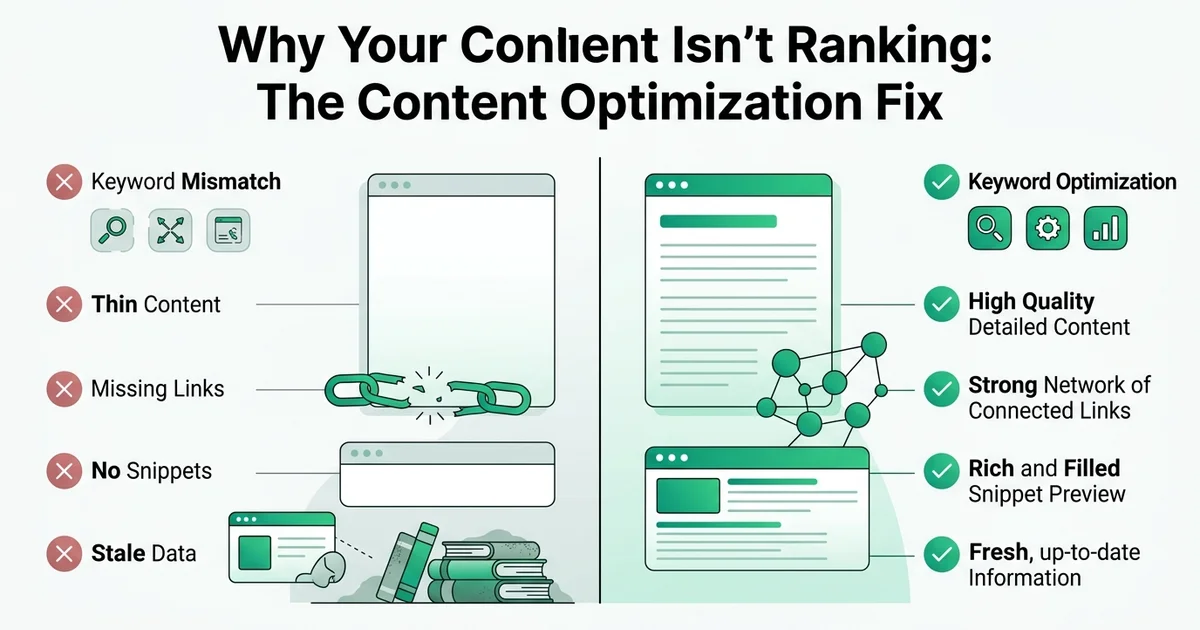
Why Your Content Isn't Ranking: The Content Optimization Fix
Introduction: why your content isn't ranking (and how to fix it)
You've spent hours researching, writing, and publishing. Yet your content sits on page three, invisible to the audience you built it for. This is one of the most common frustrations for solo founders, marketing teams, and growing businesses alike, and the root cause is almost always the same: a gap between content creation and content optimization.
At RankHub, our analysis shows that most underperforming content isn't bad writing. It's unoptimized writing. Text relevance is the most influential content-related ranking factor, meaning search engines need clear, structured signals to understand what your content is about and who it serves. Without those signals, even genuinely useful articles fail to surface.
The stakes are real. The top-ranking organic result earns an average click-through rate of 9.28%, while positions further down the page receive a fraction of that attention. The difference between ranking first and ranking tenth is often optimization, not effort.
This guide delivers specific, actionable fixes ranked by effectiveness, from quick wins you can implement today to comprehensive strategies that compound over time. One important expectation to set upfront: content optimization is not a one-time task. It is an ongoing process, and the businesses that treat it that way consistently outrank those that don't.
Quick fix: the 30-minute content optimization checklist
Before diving into root causes and comprehensive strategies, here are the highest-impact changes you can make right now. If your content is underperforming, these three checks alone can move the needle within days.
Audit keyword alignment
Search for your target keyword in your content. Verify it appears in the H1, first 100 words, and at least 2-3 times throughout the body. Check that your meta description includes the keyword and clearly states the value proposition.
Scan for SERP feature opportunities
Review the top 10 results for your keyword. Look for featured snippets, People Also Ask boxes, and knowledge panels. If your content answers common questions, format them as H3 headings with concise answers (40-60 words) to increase visibility.
Check internal linking structure
Identify 3-5 related articles on your site that support the topic. Add contextual internal links using descriptive anchor text. Ensure you're linking to and from pages that build topical authority around your core subject.
Keyword alignment (10 minutes)
Scan your title, first paragraph, and H2 headings. Your primary keyword should appear naturally in all three. If it doesn't, rewrite those elements first.
Internal links (10 minutes)
Add two to three internal links to relevant existing content. Search engines use internal links to understand site structure and distribute authority. A solid content marketing automation platform can help identify linking opportunities you might otherwise miss.
Answer structure (10 minutes)
Place a direct, concise answer to your target query within the first 100 words. Featured snippets reward clarity above everything else.
If running through this checklist feels tedious at scale, RankHub automates keyword research, article structure, and publishing so these optimizations happen by default, not by hand. The deeper fixes below explain exactly why these three areas matter so much.
Why your content isn't optimized: root causes explained
Understanding why content underperforms is the first step toward fixing it. Most ranking problems trace back to a handful of predictable mistakes, and recognizing them in your own content makes every subsequent solution far easier to apply.
Keyword mismatch and wrong search intent
Targeting a keyword with decent volume means nothing if your content doesn't match what searchers actually want. A page built around a transactional query that reads like an informational guide will struggle regardless of how well-written it is. Text relevance to the underlying intent consistently ranks above raw keyword coverage, which means alignment matters more than repetition.
Thin or unfocused content
Broad overviews that skim ten topics without going deep on any of them rarely satisfy a searcher's full question. Search engines reward content that demonstrates genuine expertise on a specific subject, not content that hedges across everything.
Missing internal linking structure
Isolated pages without strong internal links struggle to build topical authority. When your content doesn't connect to related pages on your site, both users and search crawlers have a harder time understanding where your expertise lies.
Lack of SERP feature optimization
Ignoring structured answers, featured snippets, and People Also Ask boxes leaves significant visibility on the table. According to Hike SEO, PAA boxes appeared in 51.85% of Google searches, making them one of the most consistent opportunities to capture attention above organic results.
Outdated or stale content
Content that references old statistics or ignores recent developments signals to both readers and algorithms that a page may no longer be reliable. Regular refreshes keep your content competitive.
Poor content structure
Even accurate, well-researched content fails when answers are buried deep in paragraphs, headings are vague, or the page is difficult to scan. Clear structure is not a cosmetic concern. It directly affects how quickly a reader, and a search engine, can extract value.
For teams without dedicated SEO resources, catching all six of these issues consistently is genuinely difficult. Tools like seo content automation software can systematically address structural and keyword problems before content ever goes live.
Solution 1: align content with search intent and keyword relevance
Ranking starts with understanding what a user actually wants when they type a query. Text relevance is the most influential content-related ranking factor, which means your content must directly match both the topic and the underlying intent behind a search before any other optimization effort will move the needle.
Understand the four search intents
Every search query falls into one of four categories:
- Informational: The user wants to learn something ("how does content optimization work")
- Navigational: The user is looking for a specific brand or page ("RankHub login")
- Commercial: The user is researching before buying ("best SEO tools for small businesses")
- Transactional: The user is ready to act ("buy SEO content plan")
Mismatching your content type to intent is one of the most common reasons pages fail to rank. A product page targeting an informational query will almost always lose to a well-structured guide, and vice versa.
Match content format to intent signals
Once you identify intent, align your format accordingly:
- Informational queries: long-form guides, how-tos, explainers
- Commercial queries: comparison posts, listicles, review-style content
- Transactional queries: product or service landing pages with clear calls to action
Use semantic keywords, not just exact matches
Search engines now understand context, not just keywords. Incorporate related terms, synonyms, and naturally occurring phrases that surround your primary topic. This signals topical depth and helps your content appear for a broader range of relevant queries.
Verify keyword viability before you invest time
Before writing, confirm that your target keyword has realistic search volume and manageable difficulty for your domain. According to JB Impact (2025), around 65% of businesses reported improved SEO performance when using AI-assisted content workflows, partly because those tools surface keyword data that manual research often misses.
For solo founders and small teams without dedicated SEO staff, this research step is easy to skip. SEO automation for content teams can handle keyword discovery and intent matching systematically, which is exactly what RankHub is built to do. Its AI keyword research feature identifies viable opportunities and structures content around the precise questions your audience is asking, so every published piece starts with intent alignment already built in.
Solution 2: build topical authority through internal linking
Topical authority signals to Google that your site is a reliable, comprehensive resource on a given subject. Without a deliberate internal linking structure, even well-written content gets treated as isolated pages rather than part of a cohesive knowledge base, which limits how much ranking power any single piece can accumulate.

Build pillar pages and content clusters
The hub-and-spoke model is the most effective way to demonstrate topical depth. A pillar page covers a broad topic comprehensively, while cluster pages explore specific subtopics in detail. Each cluster page links back to the pillar, and related cluster pages link to each other. This creates a web of relevance that search engines can crawl and interpret clearly.
The scale of this approach can be significant. According to SEO Case Studies 2025 (2025), Flyhomes expanded from 10,000 to more than 425,000 pages in three months using a targeted content strategy, demonstrating how structured, systematic content production compounds quickly.
Use descriptive, keyword-matched anchor text
Anchor text is not decorative. Every internal link should use anchor text that reflects the target keyword or core topic of the destination page. Generic phrases like "click here" or "read more" waste the opportunity to reinforce relevance signals.
Audit for orphaned pages
Pages with no internal links pointing to them are effectively invisible to both users and crawlers. Run a regular audit to identify orphaned content and connect it to relevant pillar or cluster pages.
Maintaining this structure consistently requires a steady publishing cadence, which is where an seo content calendar automation system becomes genuinely useful. RankHub handles this automatically, publishing SEO-optimized articles on a regular schedule with anti-cannibalization checks built in, so your internal linking architecture grows in an organised, intentional way without requiring manual oversight every week.
Solution 3: optimize for SERP features and question-based content
Beyond internal linking, how you structure individual pieces of content determines whether Google surfaces them in high-visibility SERP features. Targeting these placements, particularly People Also Ask boxes and featured snippets, can dramatically increase your click-through rate without requiring you to climb traditional ranking positions.
Explore what RankHub Starter offers for content optimization RankHub Starter.
Target People Also Ask boxes with direct answers
According to cloro.dev (2024), PAA boxes appeared in 51.85% of Google searches in August 2024, making them one of the most consistently available real estate opportunities in modern search results. To capture them, identify the related questions your audience is already asking and build dedicated subsections around each one.
The format matters as much as the content. Write a concise, 2-3 sentence answer immediately after each question heading. Google pulls PAA answers from content that is direct, specific, and self-contained, so avoid burying the answer in a long paragraph.
Use query-matching headings throughout your content
Your H2 and H3 headings should reflect the exact language your audience uses when searching. Phrases like "how to improve content optimization" or "what is topical authority" work as headings precisely because they mirror real search queries. This signals relevance to Google and increases the likelihood of your content being pulled into featured results.
In our experience at RankHub, content structured around question-based headings consistently outperforms content that uses clever but vague section titles, particularly for online marketing platform for small businesses use cases where audiences search with very specific intent.
Format content for featured snippet eligibility
Structured formats perform best for snippet capture:
- Numbered lists for step-by-step processes
- Comparison tables for product or feature breakdowns
- Bold definitions for terminology-heavy topics
Adding schema markup, specifically FAQ schema and HowTo schema, reinforces these signals and helps Google understand your content structure programmatically. RankHub generates SEO-optimized articles with this kind of structural formatting built in from the start, removing the guesswork from snippet targeting entirely. The Starter plan includes a 7-day free trial with no credit card required, making it a low-risk way to test the approach.
Solution 4: refresh and update stale content systematically
Stale content is one of the most overlooked ranking killers. Pages that once performed well can quietly slide down the SERPs as competitors publish fresher material, statistics become outdated, and Google's freshness signals shift. Systematically refreshing existing content is often faster and more impactful than creating something new from scratch.
Identify pages that have dropped in rankings
Start with Google Search Console. Filter for pages that ranked in positions 5 to 20 twelve months ago but have since slipped. These are your highest-leverage targets. They already have backlinks, internal authority, and indexed history. They just need updating.
Add current data and deepen thin sections
Replace outdated statistics with 2024 and 2025 figures. For context, research suggests that 58% of B2B marketers report content marketing has directly boosted sales, and nearly 46% expect their content budgets to increase. Weaving in current numbers like these signals relevance to both readers and search engines. Beyond statistics, expand any section that feels surface-level. Add real examples, step-by-step explanations, and remove broken links that quietly erode trust.
Signal freshness to Google
Once updates are complete, republish the post with an updated date. This tells Google the content reflects current knowledge, which matters for competitive, fast-moving topics. According to SEO Case Studies 2025 (2025), freshness combined with structural improvements consistently correlates with ranking recovery.
For teams without the bandwidth to audit and refresh content regularly, RankHub automates the publishing workflow so your site stays active and competitive without consuming hours each week. It is the kind of consistent output that supports a broader digital marketing strategy built for long-term growth.
Solution 5: leverage AI-assisted optimization with human review
AI tools have fundamentally changed how content teams operate. Research suggests that 64% of marketers now use AI in their workflows, and around 65% of business owners report that AI-generated content ranked within two months or less. Used strategically, AI accelerates production without replacing the judgment that makes content genuinely useful.

Use AI to draft and expand, not to replace expertise
The most effective approach treats AI as a first-draft engine. Use it to outline sections, expand bullet points into paragraphs, or rewrite dense passages for clarity. Where AI falls short is in original insight. Your case studies, client results, and first-hand observations are what differentiate your content from thousands of similar pages. Feed those into the process rather than letting AI generate them from scratch.
Always verify AI-generated claims against primary sources before publishing. AI tools can confidently state inaccurate statistics, and a single factual error can undermine the credibility of an otherwise strong article.
Combine AI speed with human editorial review
A systematic review process is what keeps scaled content trustworthy. Assign a human editor to check accuracy, brand voice, and logical flow before anything goes live. This two-step workflow, AI drafting followed by human refinement, lets small teams produce at a volume that was previously only possible for large content departments.
For founders and small marketing teams who want this kind of output without building an internal process from scratch, RankHub handles the full workflow automatically. Its AI keyword research, SEO-optimized articles, and consistent publishing schedule mean you can scale content production while keeping your attention on the work only you can do. If you are weighing your options, it is worth comparing this approach against traditional SEO services to understand where automation genuinely adds value.
Prevention: how to optimize content from the start
Fixing underperforming content takes significant effort. Building good habits from the beginning saves far more time than retroactive repairs ever will. A structured pre-publishing process ensures every piece you create has a realistic chance of ranking before a single word is written.
Research intent and keywords before you write
Start with search intent, not topic ideas. Identify what your target reader actually wants to find, then map keywords to that intent. This prevents wasted effort on content that attracts the wrong audience or competes with your own existing pages.
Use templates that embed SEO best practices
Build heading structures, internal link placeholders, and CTAs directly into your content templates. This removes guesswork for writers and ensures consistency across every piece, whether you publish once a week or daily.
Build internal linking into your editorial calendar
Plan link relationships between posts at the scheduling stage, not after publishing. When you map connections in advance, such as linking new content to established posts like your guide to online business ideas, you strengthen site architecture systematically.
Set a content refresh schedule
Evergreen content benefits from quarterly reviews. Trending topics need attention monthly. A documented refresh cadence prevents gradual ranking decay and keeps your library working hard over time.
Document and systematize your process
Write down every step so your optimization workflow scales beyond one person. Teams that operate from a shared playbook produce more consistent results and onboard new contributors far faster.
When to seek help: escalation and next steps
Sometimes consistent effort still does not move the needle. If rankings have not improved after two to three months of optimization, the problem may run deeper than content alone. This is the point to widen your investigation and consider bringing in additional resources.
Audit your technical SEO foundation
Content improvements cannot compensate for crawlability issues, slow page speeds, or broken internal linking. A technical SEO audit will surface problems that silently suppress rankings regardless of content quality.
Evaluate your strategy against business goals
Review whether your content targets the right audience at the right stage of the buying journey. Competitor analysis often reveals keyword gaps and topic opportunities your current strategy overlooks entirely.
Automate to maintain consistency
Inconsistent publishing is one of the most common and fixable ranking problems. RankHub handles AI keyword research, SEO-optimized article creation, and automated publishing, saving teams 40 or more hours every month. The RankHub Starter plan publishes one new post weekly with zero ongoing attention required. A 7-day free trial requires no credit card.
If you are considering building deeper SEO expertise in-house, Building an SEO Career: What You Need to Know to Succeed is a practical starting point.
Frequently asked questions
What is content optimization?
Content optimization is the process of improving existing or new content so it ranks higher in search engines, satisfies user intent, and drives measurable results. It covers keyword targeting, structure, readability, internal linking, and technical factors that influence how search engines evaluate a page.
How do you optimize content for SEO?
Start with thorough keyword research to identify what your audience is searching for. Then structure your content clearly, address search intent directly, and build internal links to relevant pages. According to Google Search Central, creating helpful, reliable, people-first content should be the primary objective rather than producing content mainly to manipulate search rankings.
What are the three steps of content optimization?
The three core steps are: research (identifying target keywords and competitor gaps), creation (writing structured, intent-matched content), and refinement (updating underperforming pages based on performance data). Repeating this cycle consistently compounds results over time.
How do I optimize existing content?
Audit pages that rank on page two or three, identify missing subtopics, refresh outdated statistics, and strengthen internal links. Small improvements to relevance and structure often produce faster ranking gains than publishing entirely new content.
What is the difference between content optimization and SEO?
SEO is the broader discipline covering technical, off-page, and on-page factors. Content optimization is a specific subset focused on making individual pieces of content more relevant, readable, and authoritative. Strong content optimization is essential for SEO success but does not replace technical or link-building work.
How often should SEO content be updated?
High-priority pages should be reviewed every six to twelve months, or sooner if rankings drop noticeably. Evergreen content benefits from annual refreshes, while news-adjacent or data-heavy content may need updates quarterly to remain accurate and competitive.
How can AI help with content optimization?
AI tools accelerate keyword research, identify content gaps, and generate structured drafts that align with search intent. Research suggests that around 65% of businesses report improved SEO performance when using AI-assisted content, making it a practical efficiency gain for teams with limited resources.
What makes content rank higher on Google?
Relevance to search intent is the single most important factor. According to Semrush, text relevance is the most influential content-related ranking factor, ranking above keyword coverage. Supporting signals include authoritative internal and external links, clear structure, fast page speed, and a consistent publishing cadence.
Based on our work at RankHub, the businesses that improve rankings fastest combine intent-focused writing with a reliable publishing schedule. RankHub automates both, handling AI keyword research, SEO-optimized article creation, and anti-cannibalization checks so founders and small teams can compete without a dedicated SEO department.
More from Our Blog
Digital Marketing Online: Your Complete Roadmap to Success
Master digital marketing online with our comprehensive guide. Learn strategies, tools, and best practices to grow your business in 2025.
Read more →
Beyond Traditional SEO Services: Better Alternatives for Your Budget
Compare top SEO services platforms: RankHub, Outrank, SEObot & alternatives. Find the best fit for your budget, team size & automation needs.
Read more →
10 Online Business Ideas That Work for Beginners & Entrepreneurs
Discover 9 proven online business ideas for 2025, including startup costs, revenue timelines, and step-by-step validation strategies for solo founders.
Read more →