
Let's be real for a second. Jumping into SEO without checking out the competition is like trying to drive to a new city without a map. You might get there eventually, but you'll probably take a lot of wrong turns. Competitor analysis in SEO isn't about being sneaky; it's about learning from what's already working for others so you can build a smarter, faster strategy for yourself.
Why Competitor Analysis Is Your Secret Weapon in SEO
First, you need to understand that your search competitors aren't always your direct business rivals. They're just the websites showing up for the keywords you want to rank for. Digging into their strategies is how you find gold. It uncovers everything from untapped keyword gaps to content ideas that you know people are already searching for.
Ultimately, this analysis gives you a clear blueprint for climbing to the top of the search results. It's the "why" behind all the practical steps we're about to cover.
The Foundation for Smarter Decisions
When you truly understand what your competitors are doing, you can stop making guesses and start making strategic moves. Instead of throwing darts at a wall of keywords, you can pinpoint the exact terms that are already sending traffic to your rivals. This means every piece of content you create has a purpose and a proven path to success.
The real win here is simple: you make better decisions, faster. By seeing which content formats, backlink sources, and on-page tactics are winning in your space, you cut out the trial and error and put your time and money where it counts.
To really get ahead, you have to keep learning. A solid grasp of essential SEO tips and strategies becomes even more powerful when you see them in action on competitor sites. This intelligence also helps you figure out which of the many search engine ranking factors are most important in your specific niche.
Staying on Top in a Crowded Field
This whole process is more critical than ever, especially when you look at the numbers. The global SEO market was valued at a massive $82.3 billion in 2023 and is expected to soar to nearly $144 billion by 2030. That’s a lot of money pouring into the industry.
With 91% of digital marketers agreeing that SEO drives real results, the fight for visibility on Google—which still dominates with a 90% market share—is getting tougher every single day. If you want more data on these trends, you can explore the complete SEO statistics on SERanking.com.
Finding Your True Search Competitors

Before we get into the nitty-gritty, let's clear up a common mistake I see all the time. Your business competitors and your search competitors are often two completely different lists. Getting this wrong from the start can throw your entire SEO strategy off track.
A real search competitor is any website—be it a blog, a news publication, or another company—that consistently shows up in the search results for the keywords you’re trying to own. They don't have to sell what you sell. They just have to be grabbing the same eyeballs you want on Google.
To get your head in the right space, it helps to start by understanding the difference between Share of Search and Share of Voice. This little distinction is key because it shifts your focus from who’s making the most noise online to who’s actually winning organic traffic for your core topics.
Ditching Guesswork for Data
So, how do you uncover these so-called "search competitors"? Simple. You let the data tell the story. Don't just Google a handful of your favorite terms and see who pops up. That's a recipe for an incomplete picture. We need to be more methodical.
First, brainstorm a list of 5-10 core topics that are absolutely central to your business. These are broad themes, not specific long-tail keywords. For a company that sells project management software, this list might include things like "agile methodology," "team collaboration tools," or "Gantt chart software."
With your topic list in hand, it's time to fire up a tool like Ahrefs or Semrush. Pop your topics into their competitor research features and let them work their magic. These tools will scan the search results for your topics and spit out a list of domains that are constantly ranking for them. Just like that, you'll see who is really dominating your turf.
Your goal isn't to find every single website that ever ranks for one of your keywords. You're looking for the consistent players—the domains that show up again and again across your most important topics. These are your primary SEO rivals.
Product Competitors vs. Content Competitors
As you sift through the data, you'll notice a pattern. Your search competitors will naturally fall into two buckets. It’s super important to separate them, because how you take them on will be completely different.
Product Competitors: These are the folks who sell something similar to you. They are your direct commercial rivals. Think Coca-Cola vs. Pepsi. You'll be fighting them for everything from feature pages to pricing comparisons.
Content Competitors: These are sites that create content around your topics but don't offer a competing product. We’re talking industry news sites, popular blogs, and maybe even educational resources. For that project management software company, this could be a Forbes article on productivity habits.
Why is this separation so critical? Because you have to know who you’re up against for certain types of keywords. It's the foundation of a smart content strategy.
| Competitor Type | Primary Keyword Intent | Example Scenario |
|---|---|---|
| Product Competitor | Commercial, Transactional | You and a rival software company both target "buy project management tool" and "best Asana alternative." |
| Content Competitor | Informational, Navigational | You compete with a popular business blog for the keyword "how to improve team workflow." |
Getting this distinction right is what separates a basic competitor analysis in SEO from one that actually drives results. It lets you create the right kind of content to outrank a product page versus an in-depth guide. By the time you're done with this step, you should have a solid, prioritized list of 5-10 true search competitors, ready for a much deeper dive.
Uncovering Your Competitor's Secret Keywords
Alright, time to roll up our sleeves and do some real detective work. Now that you know who you’re really up against in the search results, the next step is to find out exactly what keywords they're ranking for that you aren't. This is called a keyword gap analysis, and honestly, it’s where you’ll find some of the biggest "aha!" moments in your SEO strategy.
We're not just looking for random search terms here. The goal is to unearth a goldmine of content ideas—topics that you know people are searching for because your competitors are already getting traffic from them. It's like getting a cheat sheet for your content calendar.
The whole process is about turning data into an actual plan. You start with a big list of rivals and end up with a focused list of keyword opportunities that your audience is actively looking for.
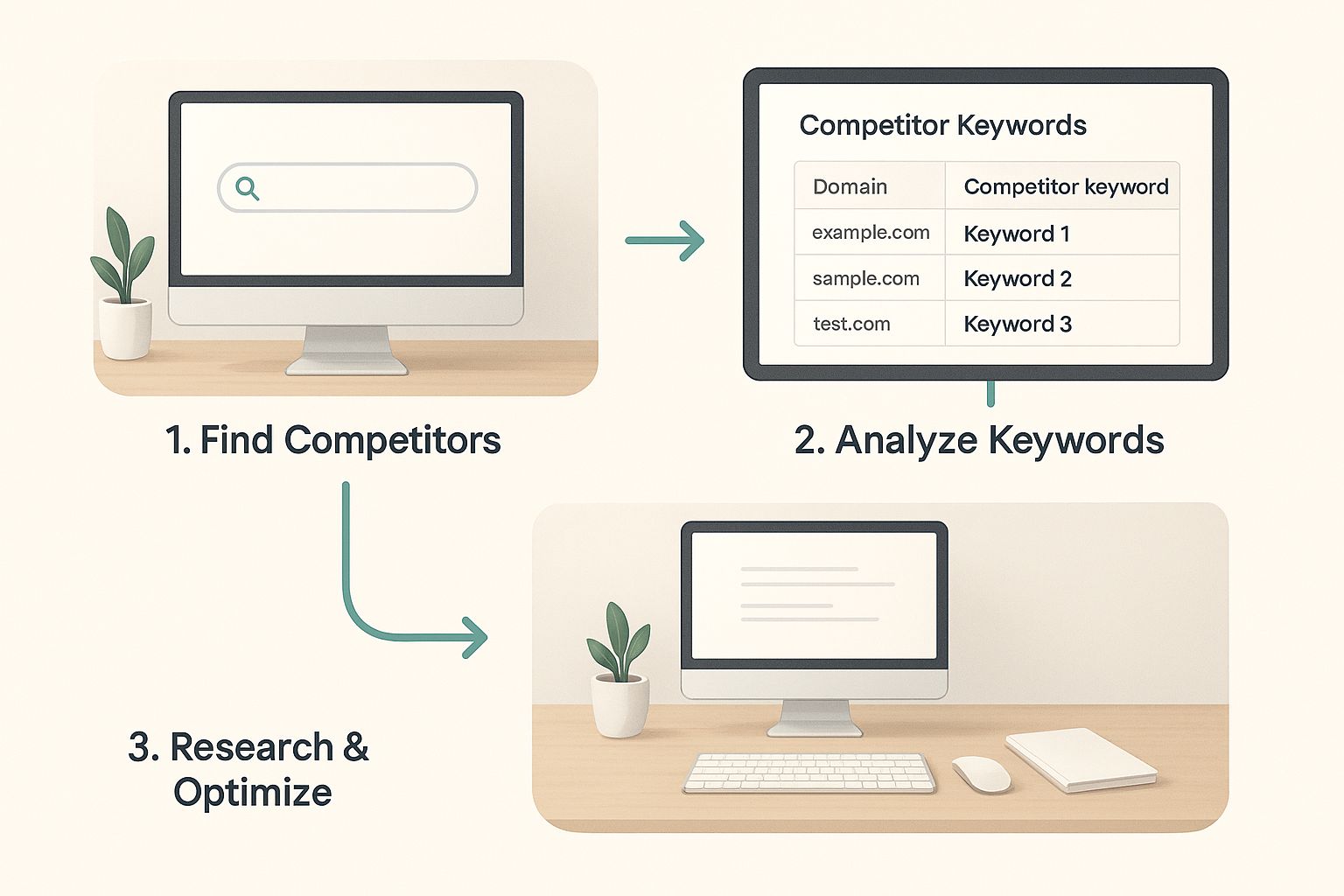
This workflow really shows how you can move from a broad list of competitors to a very specific, valuable list of keywords that will become the backbone of your content plan.
Kicking Off Your First Keyword Gap Analysis
The most straightforward way to dive in is by using an SEO tool like Semrush or Ahrefs. They both have dedicated "Keyword Gap" or "Content Gap" features built for exactly this purpose. It's pretty simple: you plug in your own domain and then add the domains of your top 3-5 competitors.
The tool does the heavy lifting, cross-referencing all the keywords each site ranks for and generating a detailed report. You’ll see which keywords your competitors rank for but you don't, terms where you’re ranking but are weak, and keywords that are unique to each competitor. It’s a treasure trove of data.
This initial export is just your raw material. Don't be surprised if it spits out thousands of keywords. The real work is sifting through the noise to find the gems.
How to Filter and Prioritize Your Opportunities
That raw list of keywords from your gap analysis can be seriously overwhelming. That's totally normal. The key now is to filter it down into a manageable, high-priority list you can actually build a content strategy around. I usually use a three-filter approach to make sense of it all.
1. Business Relevance
First thing's first: scan that list and get rid of anything that has nothing to do with your products or services. A competitor might rank for a topic that's only loosely related to their business and makes zero sense for you. Be ruthless here. A keyword with a ton of search volume is completely useless if it brings the wrong people to your site.
2. Search Volume and Difficulty
Next, you'll want to filter by monthly search volume and keyword difficulty. I always look for the sweet spot—terms that have enough search volume to be worthwhile (maybe 50-500 searches/month is a good starting point) but a keyword difficulty score that’s actually achievable for my site’s current authority.
3. User Intent
Finally, look at the intent behind the keywords left on your list.
- Are people looking for information ("how to")?
- Are they comparing options ("best X for Y")?
- Are they ready to buy ("buy X online")?
Understanding intent is crucial because it tells you exactly what kind of content you need to create to make that searcher happy.
A classic rookie mistake is only chasing high-volume informational keywords. Don't sleep on the lower-volume, high-intent commercial or transactional keywords. These are often the "money" keywords that drive the most valuable traffic.
Turning Gaps into an Actionable Content Plan
Once you have your prioritized list, it's time to build out your content roadmap. Start grouping related keywords into topic clusters. For example, if you found "best small business CRM," "CRM for startups," and "affordable CRM software," you could tackle all of those within a single, powerhouse guide.
This process feeds directly into your larger content strategy and ensures every new piece of content has a clear, data-backed purpose. For instance, I once worked with a SaaS company that found over 50 high-traffic keywords their main rivals were ranking for that they were completely missing. By creating content that targeted these terms, they boosted their organic traffic by 30% in just six months. That’s the power of a good keyword gap analysis.
Of course, finding the keywords is just one piece of the puzzle. To really make this work, you need to understand the fundamentals of building out your own keyword strategy. For a deeper dive, you can check out our guide on how to do keyword research. It'll help you bridge the gap between finding competitor terms and actually implementing them into a winning SEO plan.
Decoding Competitor Backlink Strategies

If keywords are the map, then backlinks are the high-octane fuel for your SEO engine. They’re one of the biggest signals you can send Google that your site is a credible, authoritative voice in your space. The best part? Your competitors have already blazed a trail, leaving you a breadcrumb-filled path to high-quality link opportunities.
A real competitor analysis in SEO isn't just about tallying up links. It’s about understanding the story behind them. When you dive into a competitor's backlink profile, you get a backstage pass to their entire digital PR and outreach playbook. You can see exactly who thinks they're important enough to link to, which is an incredible strategic advantage. Forget the raw numbers for a second; we're hunting for quality and context.
Identifying Patterns in Their Link Profile
First things first, you need a bird's-eye view. Grab a tool like Ahrefs or Moz, pop in a competitor’s domain, and pull their backlink report. At first glance, it’ll look like a monster spreadsheet, but trust me, patterns will emerge if you know where to look.
Start by asking yourself a few simple questions:
- What kind of sites are linking to them? Are they getting love from major news outlets, niche industry blogs, local directories, or even .edu sites?
- What’s the story behind the links? Are they coming from guest posts, resource pages, author bios, or just organic mentions in the middle of an article?
- How fast are they building links? A huge, sudden spike might mean they just launched a killer piece of content or a big PR campaign.
For example, maybe you notice your top rival is constantly featured in "best of" listicles. That’s a huge clue. It tells you that your own outreach should probably focus on building relationships with bloggers who publish that kind of roundup content. Or perhaps another competitor is pulling in links from podcast show notes, revealing an entire channel you hadn't even considered.
Your job is to reverse-engineer their success. Don't just see a link; figure out the action that probably got them that link. A link from a major publication like Forbes didn't happen by accident—it was the result of a deliberate, well-executed strategy.
Pinpointing Their Most 'Linkable Assets'
As you comb through the data, you'll start to see that not all of your competitor's pages are created equal. The 80/20 rule is almost always in play here: you’ll find that roughly 80% of their links point to only 20% of their pages. These heavy hitters are what we call "linkable assets."
These are the specific pieces of content that other sites just can't resist linking to. They usually fall into a few categories:
- Original Research & Data: Unique studies, surveys, or reports filled with juicy stats.
- In-depth Guides & Tutorials: Massive, comprehensive content that solves a real problem for their audience.
- Free Tools & Calculators: Interactive resources that give people instant value.
- Strong Opinion Pieces: Thought-provoking articles that get people talking.
Once you’ve identified these link magnets, your path is clear: create something even better. This is the core idea behind the "Skyscraper Technique," made famous by Brian Dean. You find what's already working and build on it by making your version more detailed, better designed, or more current.
Turning Intelligence into an Actionable Plan
Okay, now for the fun part—turning all this intel into your own link-building roadmap. This is where you shift from analyst to strategist.
Find the Low-Hanging Fruit with Link Intersect
Most SEO tools have a feature called "Link Intersect" or something similar. This is your secret weapon. It shows you all the websites that are linking to two, three, or even more of your competitors, but not to you. This list is pure gold. These sites have already proven they’re interested in your niche, which makes them incredibly warm prospects for your own outreach.
Replicate Their Winning Link Types
If you found that guest posting is their bread and butter, it's time to start pitching those same blogs with your own unique ideas. If they’re killing it with media mentions, that’s your cue to look into digital PR. When analyzing these links, remember to explore different acquisition methods, including earned media. To get a better handle on this, exploring strategies for acquiring PR and media features can show you exactly how your rivals are landing those powerful, high-authority links.
Build a Better Mousetrap
Take their most-linked-to content and create your own, superior version. Make it more comprehensive, update the data, add better visuals—whatever it takes. Then, you can reach out to all the sites linking to their now-outdated resource and offer yours as a better alternative. This isn't just a one-off trick; it's a systematic way to build a powerful backlink profile that will stand the test of time.
Picking Your SEO Competitor Analysis Tools
Trying to run a serious competitor analysis without the right tools is like trying to build a house with just a hammer. You’ll get frustrated, miss a ton of crucial details, and waste a lot of time. You need good software to dig through the data and hand you the insights that actually matter.
Let's cut through the marketing fluff. I'm going to walk you through the top tools in the game, but this isn't just a feature list. I’ll give you my honest take on which platforms are best for specific jobs, whether you’re hunting for keyword gaps or dissecting a competitor's backlink strategy. The idea is to help you pick a tool that lets you peek directly into your competition's playbook.
All-in-One Suites vs. Specialized Tools
First things first, you need to decide if you want an all-in-one suite or a handful of specialized tools. There’s no single right answer here—it really boils down to your budget and what kind of competitor analysis in SEO you're doing.
All-in-One Suites: Think of platforms like Semrush, Ahrefs, and Moz Pro as the Swiss Army knives of SEO. They do a bit of everything: keyword research, rank tracking, backlink audits, technical checks, you name it. They're incredibly powerful but often come with a bigger price tag and a bit of a learning curve.
Specialized Tools: These tools are masters of one trade. For example, SpyFu is phenomenal for digging into historical competitor data and ad spend. You can often build a really effective, budget-friendly toolkit by mixing and matching a few of these.
The best choice really depends on your team's workflow. If you love having everything in one dashboard, a suite is probably your best bet. If you're on a tighter budget or have a very specific need, like deep-diving into PPC campaigns, a specialized tool is likely the smarter move.
Top SEO Competitor Analysis Tool Comparison
To make sense of the main players, it helps to see them side-by-side. These all-in-one platforms are the go-to choices for most SEO professionals because they offer a comprehensive view of the competitive landscape.
Here's a quick comparison of the heavyweights to help you see where each one really shines.
| Tool | Best For | Key Feature | Starting Price (Approx.) |
|---|---|---|---|
| Semrush | All-around market intelligence | Keyword Gap & PPC analysis tools | $130/month |
| Ahrefs | Backlink analysis & content gaps | Industry-leading backlink index | $99/month |
| Moz Pro | On-page SEO & authority building | User-friendly interface & Domain Authority | $99/month |
Ultimately, while they all have overlapping features, their core strengths differ. Semrush gives you a fantastic 360-degree view, especially if you’re also running paid ads. Ahrefs is the undisputed king of backlink data, and Moz is incredibly intuitive for those newer to SEO or focused on foundational metrics.
Making the Right Choice for Your Needs
Don't get dazzled by the tool with the longest feature list. The real secret is matching the tool to the job you need to do most.
If your main goal is to find and fill content gaps, you need a tool with top-notch keyword analysis. If you’re all-in on building domain authority, then a platform with the best backlink index is an absolute must-have.
My personal take: Semrush is a powerhouse for an end-to-end view, especially if you're analyzing paid search alongside organic. But when I need to do a really deep dive into link-building opportunities, I still lean on Ahrefs for its legendary backlink index.
Remember, these tools just give you the "what." It's your job to figure out the "why" and, more importantly, the "how." A big part of that is keeping a close eye on your progress for the keywords you decide to go after. For a closer look at that process, you can learn more about how to track keyword rankings effectively in our detailed guide.
Frequently Asked Questions
Even with the best game plan, you're bound to have questions. It just comes with the territory. Let's tackle some of the most common ones I hear when people are digging into their first big competitor analysis in SEO.
How Often Should I Do An SEO Competitor Analysis?
This is a great question, and I usually tell people to think about it in two ways.
First, you have your deep-dive analysis. This is the big one, the full-on investigation. You really only need to do this quarterly. It’s perfect for lining up with your bigger strategic goals and helps you spot major market shifts or new competitors who've suddenly appeared on the scene.
But you can't just set it and forget it. I’m a big fan of doing lighter, more frequent checks. A quick peek weekly or bi-weekly is usually enough. Just track a handful of your top competitors—say, your top five—for about 20 of your most important keywords. This keeps you agile and lets you react fast when they launch a new piece of content or jump in the rankings.
What Is The Most Important Metric To Track?
If you twisted my arm and made me pick just one, I'd have to cheat and say it's a tie between keyword gaps and new referring domains. I know, I know—not a single metric. But honestly, these two give you the most bang for your buck in terms of actionable intel.
Finding those keyword gaps is like being handed a pre-vetted content plan. You immediately see what topics are already working for your competition, so you're not just throwing content at the wall and hoping it sticks.
On the flip side, watching their new referring domains is like getting a direct feed of their PR and link-building strategy. You see exactly who is linking to them right now, which gives you a fresh, warm list of high-value sites to go after for your own campaigns.
Should I Look At Competitors On Social Media?
Yes, 100%. But you have to know what you're looking for. A ton of likes on a post isn't a direct SEO ranking factor, but it's a huge indirect signal you'd be crazy to ignore.
A strong social presence drives traffic, and you better believe Google pays attention to traffic. It also builds brand recognition and can lead to a windfall of natural backlinks when a post goes viral and everyone starts sharing it.
Look closely at what types of content are getting the most engagement for them. Is it video? Infographics? Simple text posts? This is gold. It tells you what kind of content resonates in your niche and what you should create to earn those valuable shares and links yourself.
Stop guessing and start winning. RankHub uses AI to read your entire website and deliver a prioritized list of keyword opportunities in under a minute. Ditch the manual research and get actionable insights with our pay-as-you-go platform. Try RankHub today and see your competition in a new light.
More from Our Blog
Beyond Traditional SEO Services: Better Alternatives for Your Budget
Compare top SEO services platforms: RankHub, Outrank, SEObot & alternatives. Find the best fit for your budget, team size & automation needs.
Read more →
10 Online Business Ideas That Work for Beginners & Entrepreneurs
Discover 9 proven online business ideas for 2025, including startup costs, revenue timelines, and step-by-step validation strategies for solo founders.
Read more →
Building an SEO Career: What You Need to Know to Succeed
Learn how to launch an SEO career with our step-by-step guide covering skills, tools, portfolio projects, and realistic salary expectations for 2025.
Read more →