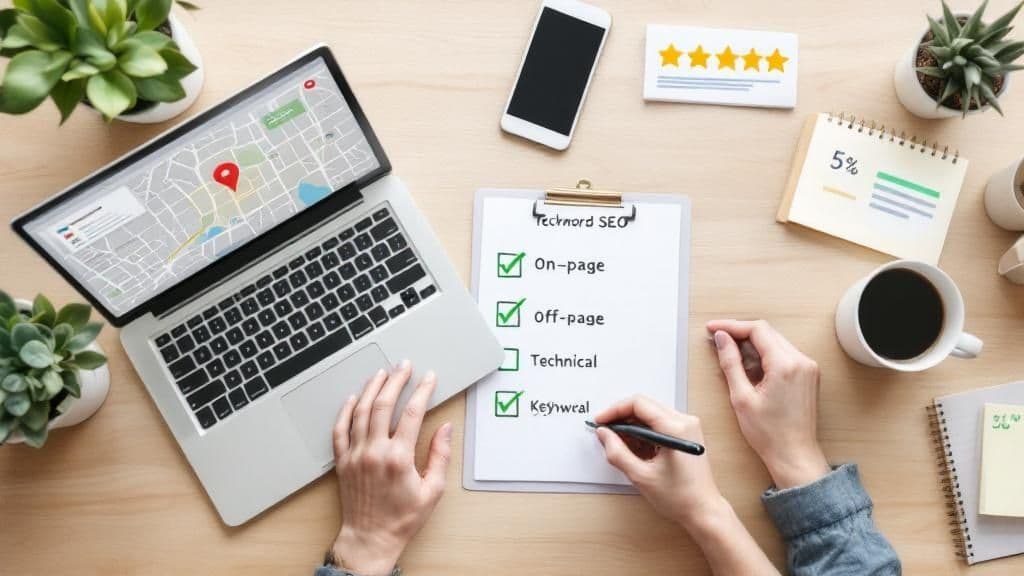
Ready to get more local customers through your door? It's tougher than ever to stand out in a crowded local market. You've got a great business, but if potential customers can't find you on Google Maps or in those crucial "near me" searches, you're leaving serious money on the table. The good news? You don't need a massive marketing budget to compete; you just need a smarter, more focused strategy.
That’s where this comprehensive local SEO checklist comes in. Forget vague advice and generic tips. We've packed this guide with 8 battle-tested, actionable steps that go far beyond just having a website. This is a practical, step-by-step game plan designed to give you a real competitive edge. We'll cover everything from fully optimizing your Google Business Profile to generating a steady stream of positive reviews and leveraging local social media buzz. For an even more in-depth guide on conquering local search, consider exploring this ultimate local SEO checklist for advanced strategies.
Whether you're a plumber trying to get more service calls, a restaurateur wanting to fill more tables, or a retail shop owner aiming to increase foot traffic, following this checklist is your roadmap. It will help you systematically climb the local search rankings, attract more qualified customers in your service area, and ultimately, turn online searches into loyal, real-world patrons. Let's get started.
1. Claim and Optimize Your Google Business Profile
Think of your Google Business Profile (GBP) as the digital front door to your local business. It’s often the very first interaction a potential customer has with your brand, appearing prominently in Google Search results and on Google Maps. Getting this right is non-negotiable and the absolute first step on any local SEO checklist. It’s a free, powerful tool that directly influences how you appear to customers searching for services or products like yours in their area.
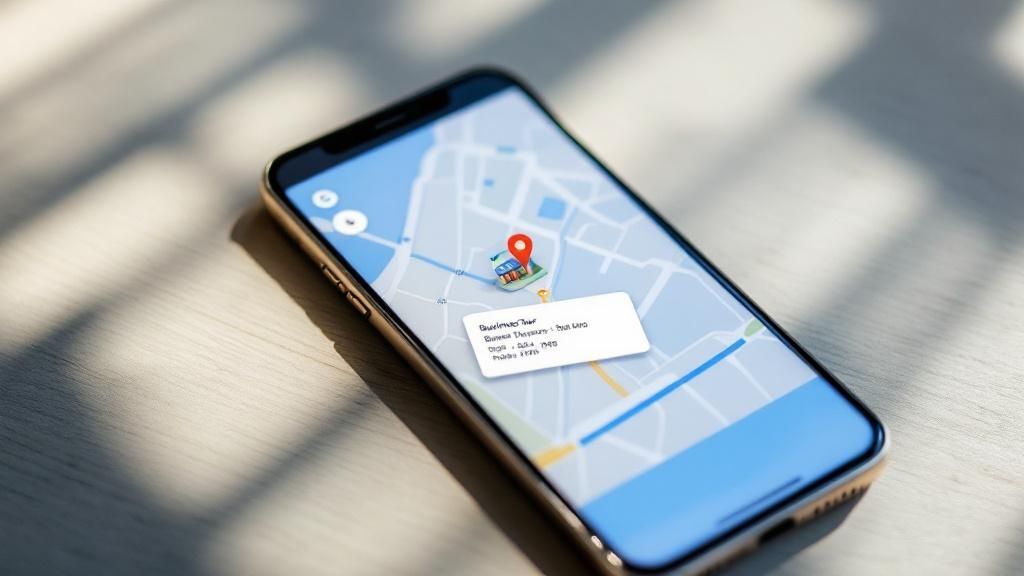
Neglecting your GBP is like leaving your physical storefront with a broken sign and no one to answer the phone. A fully optimized profile, on the other hand, can dramatically increase foot traffic, phone calls, and website clicks. For instance, some local restaurants have seen foot traffic jump by over 35% after a thorough optimization, while home service businesses often report a 50% surge in calls directly from their profile.
How to Get Started with GBP
The process begins with claiming or creating your profile. If a profile for your business already exists, you'll need to claim it and verify ownership. If not, you can create one from scratch. Verification usually involves Google sending a postcard with a code to your physical address, ensuring only legitimate business owners can manage a profile.
Once you’re verified, the real work begins. Your goal is to fill out every single section available. The more complete your profile is, the more Google trusts your business and the more likely it is to show your listing for relevant searches. For a deeper dive into maximizing your presence on Google, explore these proven strategies to optimize your Google Business Profile for top rankings.
Actionable GBP Optimization Tips
To turn your profile into a customer-generating machine, follow these steps:
- NAP Consistency: Ensure your Name, Address, and Phone number (NAP) are 100% accurate and consistent with your website and other online directories.
- Categories & Attributes: Choose the most accurate primary category, then add all relevant secondary categories. Use attributes to highlight key features like "wheelchair accessible," "free Wi-Fi," or "outdoor seating."
- Photos & Videos: Upload high-quality images of your business exterior, interior, products, services, and team. Aim for at least 10 photos to start.
- Manage Reviews: Actively encourage customers to leave reviews and respond to all of them-good and bad-within 24-48 hours. This shows you value customer feedback.
- Use Google Posts: Regularly share updates, offers, events, or news using Google Posts. These act like mini-ads that appear directly on your profile in search results.
2. Maintain NAP Consistency Across All Online Directories
After setting up your Google Business Profile, the next critical step in any local SEO checklist is ensuring your core business information is identical everywhere online. This is known as NAP consistency, which stands for Name, Address, and Phone number. Search engines like Google cross-reference this information across hundreds of websites and directories to verify that your business is legitimate and located where you say it is.

Think of each online mention of your business as a "citation." When these citations are consistent, they build trust with search engines, which boosts your local rankings. Inconsistent information, like using "St." on one site and "Street" on another, can create confusion and erode that trust, directly harming your visibility. For instance, some local law firms have reported a 25% ranking improvement simply by conducting a thorough audit and fixing their NAP inconsistencies across the web.
How to Get Started with NAP Consistency
The first step is to establish a single, master version of your business information. Create a document that specifies the exact formatting for your business name, address (including any suite numbers or abbreviations), and phone number. This will be your single source of truth that you and your team will use for every online profile and directory submission.
Once you have your master NAP, you need to find where your business is listed online and correct any discrepancies. This process, often called a citation audit, can be done manually by searching for your business, but it's much more efficient to use a specialized tool. Platforms like BrightLocal or Moz Local are designed to scan the web for your business listings, identify inconsistencies, and help you manage them from a central dashboard.
Actionable NAP Consistency Tips
To ensure your citations are clean and powerful, follow these key steps:
- Create a Master NAP Document: Define the one true version of your Name, Address, and Phone number. Decide on details like "Suite 101" vs. "Ste. 101" and stick to it religiously.
- Prioritize Major Directories: Start by auditing and correcting your listings on high-authority sites like Yelp, Yellow Pages, Facebook, and any major industry-specific directories relevant to your business.
- Use Citation Management Tools: For businesses with many locations or those looking for efficiency, invest in a tool like BrightLocal to automate the auditing and correction process across dozens of directories.
- Regularly Audit Your Listings: Schedule a quarterly or bi-annual check-up of your top 20-30 directory listings to catch and fix any new inconsistencies that may have appeared.
- Update Immediately After Changes: If your business moves, changes its name, or gets a new phone number, updating your online citations should be a top priority, starting with your GBP and website.
3. Generate and Manage Customer Reviews Strategically
Customer reviews are the digital equivalent of word-of-mouth marketing, and they pack a serious punch in the local SEO arena. Think of them as trust signals for both potential customers and Google. Positive reviews not only heavily influence consumer decisions but also serve as a direct ranking factor, telling search engines that your business is legitimate, valued, and relevant to the community.
Neglecting your reviews is a massive missed opportunity. A strategic approach to generating and managing reviews can transform your local presence. For instance, service businesses that maintain a consistent 4.5-star rating or higher often see a 30% improvement in their local pack rankings. Similarly, some restaurants have boosted their review response rate by 40% simply by adding QR codes linking to review platforms on their receipts.
How to Get Started with Review Management
The first step is to shift your mindset from passively receiving reviews to actively encouraging them. This doesn't mean incentivizing them, which is against most platforms' policies, but rather making the process easy and timely for your happy customers. The goal is to build a steady stream of fresh, positive feedback that showcases your commitment to customer satisfaction.
Once you have a system for generating reviews, you must have a plan for managing them. This involves monitoring your profiles, responding promptly and professionally to all feedback, and using the insights to improve your operations. Beyond simply managing reviews, understanding their profound impact on your local search rankings is crucial; discover the critical role user reviews play in local search optimization to fully grasp their importance in any local SEO checklist.
Actionable Review Generation & Management Tips
To turn your customer feedback into a powerful marketing asset, follow these steps:
- Timely Requests: Ask for a review within 24-48 hours of a positive customer interaction when the great experience is still fresh in their mind.
- Multiple Touchpoints: Create several easy ways for customers to leave a review, such as a direct link in a follow-up email, an SMS message, or a simple verbal request at the point of sale.
- Respond to Everyone: Make it a policy to respond to every single review within 24 hours. Thank positive reviewers and address negative ones constructively by offering to resolve the issue offline.
- Leverage Key Platforms: Focus your efforts on the platforms that matter most. For nearly every local business, this means Google first, followed by industry-specific sites like Yelp, TripAdvisor, or Angi.
- Train Your Team: Empower your staff to identify happy customers and naturally ask for a review. Make it part of their customer service process.
- Use Management Tools: Consider using tools like Podium or BirdEye to automate review requests and consolidate all your reviews into a single dashboard for easier management.
4. Create Location-Specific Content and Landing Pages
Simply stating that you serve a particular city isn't enough to convince Google or your potential customers that you're a true local authority. This is where location-specific content comes in. It involves creating dedicated web pages or blog posts that target the specific neighborhoods, towns, and service areas you cover. This strategy signals to search engines that you are highly relevant to users in those exact locations, making it a crucial part of any comprehensive local SEO checklist.

This goes far beyond just swapping out a city name on a generic template. When done right, this approach builds immense trust and authority. For instance, HVAC companies have seen their pages rank #1 for hyper-local searches like "HVAC repair [neighborhood name]" by creating unique service pages for each area. Similarly, law firms have boosted local leads by over 60% by developing city-specific practice area pages that speak directly to the community's needs.
How to Get Started with Local Content
The first step is to map out your key service areas. Don't just think in terms of cities; drill down to specific neighborhoods, suburbs, or even well-known districts where your customers are concentrated. For each of these locations, you will create a dedicated landing page on your website (e.g., yourwebsite.com/service-area/neighborhood-name).
The goal is to make each page a valuable, standalone resource for someone in that specific location. It should prove that you understand their unique local context and aren't just a faceless national chain. This approach is fundamental to a robust strategy, and you can explore more ways to leverage your expertise in this guide to content marketing for small businesses.
Actionable Local Content Tips
To create location pages that rank and convert, infuse them with local flavor:
- Go Hyperlocal: Mention specific street names, local landmarks, community centers, and well-known parks. This proves you have on-the-ground knowledge.
- Show, Don't Tell: Include high-quality photos and videos of your team working in that specific area or images of local scenery to build visual connection.
- Use Social Proof: Embed local customer testimonials or case studies from clients within that neighborhood or city.
- Provide Unique Value: Don't just list services. Talk about local building codes, common issues in the area (e.g., "Hard water problems in Northwood"), or sponsor a local event and write about it.
- Optimize for Local Keywords: Naturally weave in terms like "[service] in [neighborhood]" and "[service] near [landmark]" throughout the page's headings, body text, and image alt text.
- Make it Substantial: Ensure each page has at least 500 words of unique, helpful content to avoid being flagged as thin or duplicative.
5. Build High-Quality Local Citations and Backlinks
If your Google Business Profile is the digital storefront, then local citations and backlinks are the word-of-mouth referrals and community endorsements that build your reputation. Citations are online mentions of your business's Name, Address, and Phone number (NAP), while backlinks are links from other websites back to yours. Together, they act as powerful trust signals to search engines, proving your business is a legitimate and relevant part of the local community. This step is a cornerstone of any effective local SEO checklist.
A strong portfolio of local citations and backlinks tells Google that your business is established and respected within its geographic area. For instance, a local restaurant featured on a city tourism website can see its online visibility triple, while a law firm listed in the local Bar Association directory gains immense authority. These high-quality signals are far more impactful than hundreds of low-quality directory listings. Neglecting this aspect leaves you invisible in a crowded market.
How to Get Started with Local Citations & Backlinks
The first step is to ensure your core business information is 100% consistent everywhere. Any variation in your NAP across different platforms can confuse search engines and dilute your authority. Begin by auditing your existing citations to correct any inconsistencies.
Once your NAP is standardized, the focus shifts from quantity to quality. Instead of submitting your business to every directory imaginable, prioritize platforms that are highly relevant to your location and industry. A backlink from the local Chamber of Commerce or a feature in a neighborhood blog is worth more than dozens of links from generic, low-authority sites. This strategic approach builds a strong, defensible local SEO foundation.
Actionable Citation & Backlinking Tips
To build a profile that boosts your local authority, follow these steps:
- Focus on Quality Over Quantity: Prioritize authoritative local sites like your city's Chamber of Commerce, industry-specific associations, and well-regarded local directories.
- Sponsor Local Events: Sponsoring a local charity run, a community festival, or a youth sports team often results in high-quality backlinks from their websites.
- Pitch Local Media: Develop relationships with local bloggers, journalists, and news outlets. Pitch them compelling story ideas, such as a unique business milestone or a community initiative you're leading.
- Partner with Neighbors: Collaborate with complementary, non-competing local businesses for cross-promotional opportunities that can include mutual website links.
- Create Linkable Assets: Develop valuable local content that others will want to link to, such as a comprehensive guide to local parks, a report on the local housing market, or an events calendar. This often starts with solid research into what people are searching for. For more on this, check out these strategies on how to find profitable keywords for your local content.
- Leverage Industry Directories: Beyond general directories, ensure you are listed on respected sites specific to your field, such as Avvo for lawyers or Houzz for home contractors.
6. Optimize for Mobile and Voice Search
The way customers search for local businesses has fundamentally changed. Gone are the days of sitting down at a desktop; today, searches happen on the go, often with a quick tap on a smartphone or a spoken command to a voice assistant. Optimizing for mobile and voice search means ensuring your business is visible and accessible in these moments. It’s a critical part of any modern local SEO checklist, focusing on speed, convenience, and conversational language.
Failing to optimize for these platforms is like having a business that's only open on weekdays from 9 to 5, you miss out on a massive, modern audience. A local coffee shop that optimizes for voice queries like "coffee shop near me open now" can capture early-morning commuters, while a plumber targeting "best emergency plumber near me" can become the go-to for urgent, voice-activated searches. This isn't just theory; businesses with fast-loading mobile sites see significantly higher conversion rates, and those structured for voice search are capturing a rapidly growing segment of hands-free queries.
How to Get Started with Mobile and Voice Optimization
The foundation for both mobile and voice search is a fast, responsive website. Since Google's shift to mobile-first indexing, your mobile site is the primary version Google uses for ranking. Your site must load quickly and provide an excellent user experience on small screens. For voice search, the focus shifts to content structure and anticipating how real people talk. It's about answering direct questions clearly and concisely.
Start by analyzing your site's mobile performance with Google's PageSpeed Insights. For voice search, begin by brainstorming the common questions your customers ask. A great starting point is creating a dedicated FAQ page that directly answers these queries in a natural, conversational tone. For more advanced techniques, you can explore guides on implementing schema markup for voice search to help search engines better understand your content.
Actionable Mobile and Voice Search Tips
To capture this valuable traffic, focus on these key optimizations:
- Prioritize Mobile Speed: Ensure your mobile site loads in under 3 seconds. Compress images, leverage browser caching, and minimize code to improve speed.
- Target Conversational Keywords: Optimize content for question-based queries using words like "who," "what," "where," and "how." Think about how you would ask for your service out loud.
- Use Natural Language: Write your website copy, especially on service pages and FAQs, in a conversational style that mirrors natural speech patterns.
- Implement Local Business Schema: Add structured data to your website. This helps search engines understand your NAP, hours, and services, making it easier to pull this information for voice search results.
- Optimize for "Near Me" Searches: Create location-specific content and ensure your Google Business Profile is fully optimized. This is crucial for both mobile map searches and voice queries seeking local options.
7. Leverage Local Social Media and Community Engagement
Think of your social media presence not just as a global megaphone, but as your local town square. It's where you can connect with your community, build genuine relationships, and embed your brand into the local fabric. Leveraging social media for community engagement goes beyond just posting ads; it's about actively participating in local conversations and becoming a recognized, trusted neighborhood entity. This strategy is a crucial part of any modern local SEO checklist because it builds brand awareness and drives local interest, which can lead to more branded searches and direct website traffic-both strong signals to Google.
Ignoring local social engagement is like setting up a stall at a farmers market and then turning your back on everyone who walks by. An active, community-focused social strategy, however, builds trust and loyalty that search rankings alone cannot. For example, a local gym that uses Instagram to showcase member success stories and promote community fitness challenges creates a loyal following that translates into new memberships. Similarly, a restaurant using Facebook to promote a collaboration with a local brewery can tap into both customer bases, driving significant foot traffic.
How to Get Started with Local Social Engagement
The first step is to identify where your local audience spends their time online. Are they in local Facebook groups, following neighborhood news on Instagram, or watching local trends on TikTok? Don't spread yourself too thin; pick one or two platforms where you can genuinely and consistently engage.
Once you've chosen your platforms, your goal is to become a valuable community member, not just a business selling something. This means your content strategy should be about 80% community value and 20% promotion. Share useful information, celebrate local happenings, and engage directly with followers and other local businesses. Building these authentic connections is key to turning online followers into loyal, in-person customers.
Actionable Local Social Media Tips
To transform your social channels into powerful community-building tools, implement these tactics:
- Geotag Everything: Use location-specific hashtags (e.g.,
#dallasfoodie,#chicagofitness) and tag your physical location in every relevant post and Story. This makes your content discoverable to people in your area. - Engage with Local Accounts: Actively follow, comment on, and share content from other local businesses, community pages, and local influencers. This creates a network effect and shows you're part of the community.
- Showcase Your Community: Feature your customers! Share user-generated content (with permission), post testimonials, and run contests that encourage local participation.
- Promote Local Partnerships: Collaborate with non-competing local businesses on promotions or events. A joint giveaway or co-hosted event can expose your brand to an entirely new local audience.
- Be Responsive and Human: When people comment or send messages, respond promptly and personally. Ditch the corporate-speak and talk to them like a neighbor.
8. Monitor and Track Local SEO Performance
Executing a local SEO strategy without tracking its performance is like driving with your eyes closed. You might be moving, but you have no idea if you're headed in the right direction. Monitoring key metrics is essential for understanding what’s working, what isn’t, and how to allocate your resources effectively. It’s the feedback loop that transforms your efforts from guesswork into a data-driven strategy.
Tracking your performance is a crucial part of any comprehensive local seo checklist. It provides the proof of your return on investment (ROI) and highlights new opportunities. For instance, a multi-location retailer might use enterprise tools to monitor hundreds of storefronts, while a local restaurant could discover from their GBP Insights that posts published on Fridays generate the most engagement, allowing them to optimize their posting schedule for maximum impact.
How to Get Started with Local SEO Tracking
Begin by defining what success looks like for your business. Is it more phone calls, more form submissions, more foot traffic, or higher rankings for specific keywords? Setting up the right tools is the next step. Google Analytics and Google Business Profile Insights are the foundational, free tools that every local business must use.
Once you have your goals and tools in place, establish a regular monitoring cadence. Some metrics, like new reviews, should be checked daily, while others, like keyword rankings or competitor benchmarks, can be reviewed monthly or quarterly. The key is consistency. For a detailed guide on setting up and interpreting this data, you can learn more about how to track keyword rankings and performance.
Actionable Performance Tracking Tips
To get a clear picture of your local SEO health, integrate these tracking habits into your routine:
- Set Up Goal Tracking: In Google Analytics 4 (GA4), configure conversion events for key actions like phone number clicks, direction requests, and contact form submissions.
- Monitor GBP Insights Weekly: Check your Google Business Profile Insights to see how customers find you, what actions they take (calls, website clicks, direction requests), and which search queries trigger your listing.
- Track Local Keyword Rankings: Use a rank tracking tool to monitor your position for your most important local keywords (e.g., "plumber in Brooklyn," "best pizza near me") at least once a month.
- Use Call Tracking: Implement a dedicated call tracking number for your GBP and other local listings to accurately measure how many phone leads your SEO efforts are generating.
- Benchmark Against Competitors: Quarterly, analyze the top 3-5 local competitors. Look at their reviews, GBP activity, and keyword rankings to see where you stand and identify areas for improvement.
Local SEO Checklist Comparison Matrix
| Strategy | Implementation Complexity 🔄 | Resource Requirements ⚡ | Expected Outcomes 📊 | Ideal Use Cases 💡 | Key Advantages ⭐ |
|---|---|---|---|---|---|
| Claim and Optimize Your Google Business Profile | Medium - requires ongoing updates | Low - free tool, moderate time | Increased local visibility and traffic | Local businesses seeking map presence | Free, direct local ranking impact |
| Maintain NAP Consistency Across All Online Directories | High - constant monitoring needed | Medium - time and tools | Improved search trust and rankings | Multi-location or established brands | Builds search engine trust |
| Generate and Manage Customer Reviews Strategically | Medium to High - active management | Medium - tools and staff time | Higher trust, improved rankings, better conversions | Service-based and retail businesses | Boosts credibility and rankings |
| Create Location-Specific Content and Landing Pages | High - content intensive | High - writing and SEO expertise | Better geo-targeted rankings, relevant traffic | Businesses with multiple service areas | Enhances local relevance and expertise |
| Build High-Quality Local Citations and Backlinks | Medium to High - outreach needed | Medium to High - relationship building | Increased local authority and discoverability | Businesses wanting local authority | Improves rankings and referral traffic |
| Optimize for Mobile and Voice Search | High - technical SEO expertise | Medium to High - web development | Captures mobile/voice traffic, better UX | Mobile-focused or voice search users | Future-proofs SEO, improves engagement |
| Leverage Local Social Media and Community Engagement | Medium - consistent content creation | Medium - content and engagement | Improved brand awareness and local engagement | Community-oriented/local brands | Builds loyalty and social signals |
| Monitor and Track Local SEO Performance | Medium - technical setup and analysis | Medium - tracking tools and expertise | Data-driven insights, better optimization | All local businesses | Measures ROI and competitive insights |
Turn Your Checklist into Local Dominance
You’ve just navigated the ultimate local SEO checklist, and if your brain feels a little full, that’s a good sign. We’ve covered a ton of ground, from the foundational bedrock of a perfectly optimized Google Business Profile to the nuanced art of building genuine community engagement. It’s easy to look at a list this comprehensive and feel a wave of overwhelm, but let's reframe that. This isn't a mountain you have to climb in a single day; it’s a detailed roadmap to sustainable, long-term success in your local market.
The real magic happens when you stop seeing these points as isolated tasks and start viewing them as interconnected parts of a living, breathing digital ecosystem that represents your business online. Each element amplifies the others, creating a powerful compounding effect that your competitors simply can't replicate overnight.
From Checklist to Action: Your Next Moves
So, where do you begin? The key is to avoid analysis paralysis. Don't try to tackle everything at once. Instead, pick your battles and build momentum.
Here’s a practical way to start turning this checklist into tangible results:
Start with Your Foundation: If you do nothing else this week, go back to item #1 and item #2. A fully optimized Google Business Profile and consistent NAP (Name, Address, Phone Number) information are the non-negotiables. They are the core of your local identity, and without a solid foundation, everything else you build will be on shaky ground.
Focus on Quick Wins: What’s the lowest-hanging fruit? For many businesses, it’s reviews (item #3). Implementing a simple, automated system to request reviews from happy customers can dramatically boost your social proof and local rankings in a matter of weeks. It’s an action with an immediate and visible impact.
Build a Content Habit: Don’t overthink your location-specific content (item #4). You don't need to write a novel. Start by creating one simple blog post or landing page focused on a specific service in a specific neighborhood. Document a local project, write about a community event you sponsored, or create a guide to something unique in your area. Commit to creating one piece of local content per month. That's it. This consistency is what builds authority over time.
The Real Value: Beyond the Rankings
Mastering your local SEO isn't just about getting to the top of the Google Maps pack. It's about fundamentally transforming how your community perceives and interacts with your business. When a potential customer searches for a service you offer and sees your business with a polished profile, glowing reviews, and helpful local content, you’ve done more than just rank. You’ve built instant trust and credibility.
You are no longer just another option; you become the local authority, the obvious choice. This translates directly into more foot traffic, more phone calls, more website visits, and ultimately, more revenue. This local SEO checklist is your blueprint for becoming an indispensable part of your local economy. It’s about building a digital presence so strong and so helpful that you become the go-to resource for your community. Every checkmark is a step toward making your business a local landmark. Now, it's time to put in the work and claim your spot.
Feeling overwhelmed with keyword research and content ideation for all those new local pages? RankHub takes the guesswork out of the equation with its powerful Auto Research feature, analyzing your site and competitors to instantly uncover high-impact, location-specific content opportunities. Stop guessing and start ranking by visiting RankHub to see how it can streamline your local SEO workflow.
More from Our Blog
The Complete Guide to Setting Up JCPenney Email Alerts
Master JCPenney email alerts with this step-by-step checklist. Learn to sign up, customize preferences, troubleshoot missing alerts, and unsubscribe.
Read more →
Expert Insights: 6 Critical Differences Between Transcription and Translation
Learn the key differences between transcription and translation with expert tips for podcasters, students, and professionals. Includes AI workflows and best practices.
Read more →
Why German to English Translation Fails—and How to Fix It
Learn how to translate German to English effectively. Compare AI tools, human translation, and hybrid workflows for books, PDFs, and manuscripts.
Read more →