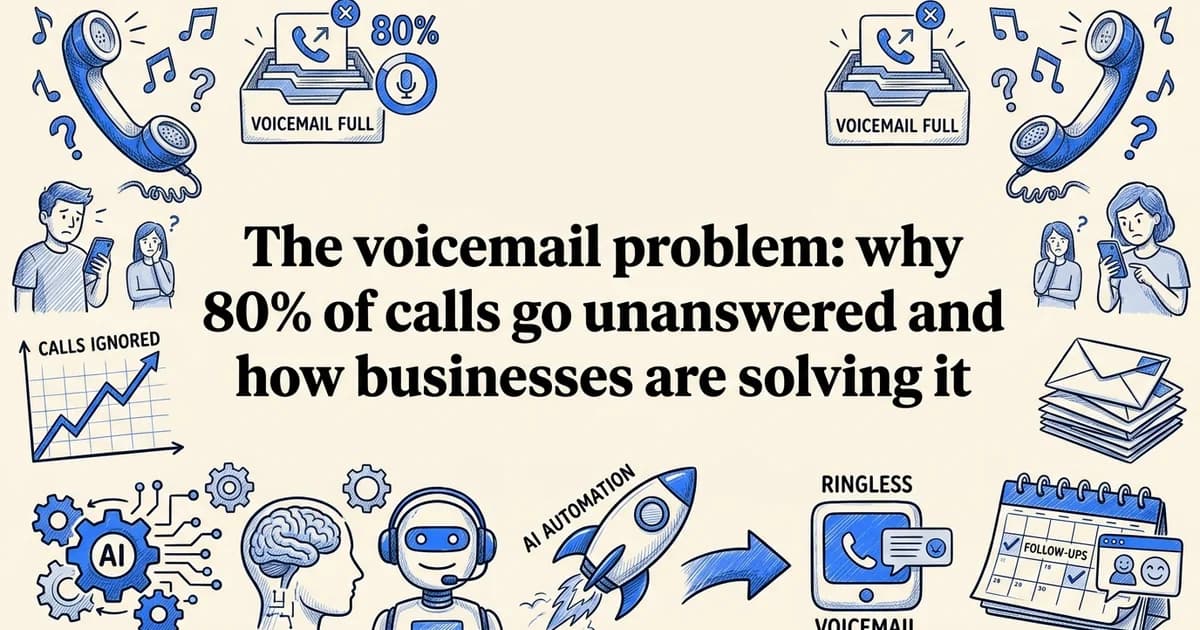
The voicemail problem: why 80% of calls go unanswered and how businesses are solving it
Introduction: the voicemail crisis in modern communication
Every single day, 10.8 billion phone calls around the world end the same way: with a beep and a recording prompt that most people will never hear. That staggering figure, verified by SellCell's 2024 research, points to a communication crisis hiding in plain sight.
The scale of the problem is hard to ignore. According to SellCell, 80% of global phone calls go to voicemail, a statistic that affects everyone from solo entrepreneurs to multinational enterprises. Yet the deeper issue is not simply that calls go unanswered. It is what happens next. Research from Numa reveals that 67% of people do not listen to their voicemails at all, meaning the vast majority of those 10.8 billion daily messages vanish into a digital void, unheard and unacknowledged.
This creates a striking paradox at the heart of modern business communication. Organizations invest heavily in outreach, customer service, and sales calls, only to find their efforts absorbed by a system that most recipients actively avoid. At VoiceMyMail, our analysis of this landscape consistently shows that the voicemail problem is not just a technology issue. It is a behavioral one, shaped by shifting communication preferences and a growing resistance to traditional phone interactions.
So why has voicemail fallen so far from its original promise? And more importantly, what are forward-thinking businesses doing to adapt?
This article explores the root causes behind voicemail's declining effectiveness, examines the real-world costs for businesses that ignore the trend, and highlights the practical solutions and emerging technologies that are helping organizations turn a communication bottleneck into a genuine competitive advantage.
Why voicemail is failing: understanding the disconnect
Voicemail is failing because a fundamental expectation gap has emerged between callers and recipients. Most people who reach voicemail today assume their message will never actually be heard, and the data confirms that instinct is well-founded. This psychological barrier is reshaping how people communicate entirely.
The numbers tell a stark story. According to SellCell, only 20% of US callers will actually leave a voicemail when prompted. That means four out of every five people simply hang up. The reasoning is circular but powerful: callers don't leave messages because they don't expect a response, and recipients don't check voicemail because there's rarely anything worth hearing. The system has become self-defeating.
This expectation gap is reinforced by a broader cultural shift in communication preferences. Research from Numa found that 80% of people now prefer to send a text rather than leave a voicemail. Voice messages feel slow, awkward, and effortful compared to a quick text or instant message. There's also a listening burden involved. Unlike reading a text in seconds, voicemail requires the recipient to dial in, navigate a menu, and listen in real time, often without the ability to skim.
The psychology runs deeper than convenience, though. Voicemail carries a social anxiety component for many people. Leaving a message feels exposed and unpolished, particularly in professional contexts. Recipients, meanwhile, experience their own friction: a blinking notification that demands time and attention they'd rather spend elsewhere.
The consequences for sales and customer relationships are significant. When 67% of people don't listen to voicemails at all, according to Numa, entire pipelines of potential business simply evaporate. A prospect who hangs up without leaving a message is a lead that never existed. A customer who can't reach support and won't leave a voicemail is a relationship quietly eroding.
Understanding this disconnect is the first step toward addressing it.
The business impact: lost opportunities and reduced engagement
The financial and relational costs of voicemail abandonment are measurable and significant. Across industries, businesses are discovering that unanswered calls and ignored voicemails translate directly into lost revenue, weakened customer relationships, and competitive disadvantage in markets where responsiveness is increasingly a differentiator.
Sales teams bear the heaviest burden
For sales professionals, the voicemail problem is a daily frustration with real consequences. Cold calling campaigns that rely on voicemail as a touchpoint often see dismal returns. However, data from Gong reveals a nuanced picture: when voicemail is used strategically alongside email outreach, email reply rates more than double, rising from 2.73% to 5.87%. The lesson is not that voicemail is useless, but that it must be deployed thoughtfully rather than reflexively.
The challenge is that most sales teams lack the tools or strategy to make that distinction. They leave voicemails out of habit, with no coordination with other channels, and wonder why callbacks never come.
Customer satisfaction takes a quiet hit
The damage to customer relationships is often invisible until it is too late. A customer who reaches voicemail during a service inquiry and hangs up without leaving a message rarely announces their frustration. They simply move on, often to a competitor.
One pest control company confronted this reality directly. By implementing call analytics and real-time monitoring to make smarter staffing decisions, they reduced voicemail abandonment by 87% within 12 months, according to a Brightmetrics case study. The result was not just fewer missed calls but measurably higher customer satisfaction scores.
Real estate: a case study in callback transformation
The real estate industry offers another compelling example. A sales team using ringless voicemail technology saw their callback rate climb from 3% to 18%, according to Drop Cowboy case study data. That sixfold improvement did not come from more calls. It came from smarter delivery.
These numbers tell a consistent story: the voicemail problem is not simply about missed calls. It is about missed relationships, missed revenue, and missed opportunities to build the kind of trust that keeps customers coming back.
Modern solutions: how technology is transforming voicemail
Technology is reshaping voicemail from a passive, often-ignored inbox into an active communication channel. Through AI-powered transcription, intelligent routing, and seamless integrations with business platforms, modern tools are closing the gap between the messages businesses send and the responses they actually receive.
AI-powered transcription and intelligent routing
The most immediate transformation is happening at the point of delivery. AI-powered voicemail transcription converts audio messages into readable text in seconds, allowing recipients to scan, prioritize, and respond without ever pressing play. For businesses handling high call volumes, this shift alone dramatically reduces the friction that causes messages to pile up unread.
Intelligent call routing takes this further by analyzing incoming calls in real time and directing them based on context, caller history, and agent availability. Rather than defaulting to a generic voicemail box, calls reach the right person or trigger the right automated response. The result is a system that works proactively rather than reactively.

Ringless voicemail: reaching inboxes without interruption
Ringless voicemail technology delivers audio messages directly to a recipient's voicemail inbox without the phone ever ringing. This approach respects the recipient's time while ensuring the message arrives intact. The real estate industry example from the previous section illustrates the impact clearly: callback rates climbing from 3% to 18% using this method alone.
The appeal is straightforward. Asynchronous communication gives recipients control over when they engage, which research consistently shows increases the likelihood they actually will.
CRM integration and business intelligence
Modern voicemail platforms now connect directly with CRM systems, automatically logging calls, attaching transcriptions to contact records, and triggering follow-up workflows. A sales representative no longer needs to manually update a contact after leaving a message. The system handles it, keeping pipelines accurate and response times fast.
This integration also feeds business intelligence platforms with actionable data. Managers can track which messages generate callbacks, identify patterns in unanswered calls, and adjust staffing accordingly. One pest control company used call analytics and real-time monitoring to reduce voicemail abandonment by 87% within 12 months, according to Brightmetrics case study data published in 2025.
Voicemail-to-text for accessibility and efficiency
Voicemail-to-text services extend these benefits to accessibility, allowing users with hearing impairments or noisy environments to engage with messages they would otherwise miss entirely. For businesses, the efficiency gains compound quickly: faster response times, better documentation, and a communication trail that supports compliance and quality assurance.
Together, these technologies do not simply patch the voicemail problem. They reframe what voicemail can be.
Best practices for effective voicemail strategy
Technology alone cannot rescue a poor voicemail strategy. The businesses seeing the strongest results combine smart tools with disciplined execution: clear messaging, thoughtful timing, multi-channel coordination, and a firm grasp of compliance requirements. Getting these fundamentals right is what separates voicemail that converts from voicemail that gets deleted.
Craft messages that earn a callback
A professional voicemail is brief, specific, and action-oriented. Research consistently shows that messages under 30 seconds perform best, giving the listener just enough context to act without overwhelming them.
Follow these guidelines for every message:
- Open with your name and company so the recipient immediately knows who is calling
- State one clear reason for the call rather than cramming in multiple points
- Include a specific call to action, whether that is returning your call, checking an email, or visiting a link
- Repeat your callback number slowly, twice, at the end of the message
- Keep the tone conversational, not scripted or robotic
Time your outreach strategically
Voicemail does not work in isolation. Data from Gong shows that leaving a voicemail during cold outreach more than doubles email reply rates, lifting them from 2.73% to 5.87%. That uplift comes from coordination, not coincidence. Pairing a voicemail with a follow-up email sent within the same hour reinforces your message across channels and gives the recipient multiple ways to respond.
Avoid clustering voicemails too tightly. Spacing follow-up attempts two to three days apart reduces friction and prevents your number from being flagged as spam.
Use data to improve continuously
In our experience at VoiceMyMail, the businesses that improve fastest are those treating voicemail as a measurable channel, not an afterthought. Track callback rates, response times, and conversion outcomes to identify what messaging and timing combinations perform best.
Stay compliant
For ringless voicemail campaigns, compliance is non-negotiable. In the United States, the Telephone Consumer Protection Act governs automated messaging. Always obtain prior written consent, maintain opt-out mechanisms, and audit your contact lists regularly to avoid regulatory exposure.
The future of voicemail: emerging trends and innovations
Voicemail is not disappearing. It is transforming into something smarter, faster, and far more integrated with the broader communication ecosystem. The businesses that thrive will be those that anticipate these shifts rather than react to them after competitors have already adapted.
AI-powered routing is becoming the new baseline. Intelligent systems can now analyze caller intent in real time, routing urgent messages to on-call staff while queuing routine inquiries for scheduled follow-up. What once required a human receptionist working a switchboard is increasingly handled automatically, with accuracy that improves the longer the system operates.

Asynchronous communication is also reshaping expectations on both sides of the call. Callers increasingly prefer leaving a message on their own schedule rather than waiting on hold, and businesses are building workflows that honor that preference. Ringless voicemail delivery, which places audio messages directly into inboxes without triggering a ring, saw a real estate team increase callback rates from 3% to 18%, according to data from Drop Cowboy (2025). That kind of lift signals a broader shift in how outbound communication will be structured.
Several other trends are accelerating this evolution:
- Emergency escalation systems that detect keywords or sentiment in voicemail transcriptions and trigger immediate multi-channel alerts for time-sensitive messages
- Platform integration that connects voicemail data with CRM tools, ticketing systems, and team messaging apps, creating a unified communication record
- Accessibility improvements driven by transcription technology, making voicemail content searchable, shareable, and actionable without ever pressing play
The common thread running through all of these innovations is intent. Future voicemail systems will not simply store audio. They will interpret, prioritize, and route information intelligently, closing the gap between a missed call and a meaningful response.
Conclusion: adapting to the voicemail evolution
The evidence is clear: with 80% of global phone calls going to voicemail, businesses that cling to outdated communication habits are leaving real opportunities on the table. The good news is that the gap between a missed call and a meaningful connection has never been easier to close.
Throughout this article, the pattern has been consistent. The businesses winning at voicemail are not simply working harder. They are working smarter, using data, automation, and channel diversification to meet audiences where they actually are. The results speak for themselves. A real estate team that increased callback rates from 3% to 18% using ringless voicemail did not achieve that by accident. They adapted.
The path forward requires honest evaluation. Ask yourself:
- Are your current voicemail practices generating responses, or just filling inboxes?
- Do you have visibility into how many calls are going unanswered and why?
- Are you combining voicemail with complementary channels like SMS and email?
Adapting to the voicemail evolution does not mean abandoning the phone call. It means recognizing that voicemail is no longer a passive storage system. It is an active touchpoint that, when handled strategically, can strengthen relationships and drive measurable results.
Start by auditing what you have. Then build toward what your audience actually needs.
Frequently asked questions
This section addresses the most common questions businesses and individuals ask about voicemail strategy, response rates, and modern solutions. The answers draw on verified data and practical experience to help you make informed decisions about how you handle missed calls.
Is leaving a voicemail worth it for sales?
Yes, particularly when combined with other outreach channels. Research from Gong shows that leaving a voicemail during cold calling campaigns increases email reply rates from 2.73% to 5.87%, more than doubling engagement. Voicemail works best as part of a multi-touch sequence rather than a standalone tactic.
What percentage of voicemails are actually listened to?
According to Numa, 67% of people do not listen to their voicemails at all. That means only roughly one in three messages ever reaches its intended audience, which underscores why relying on voicemail alone as a communication strategy carries significant risk.
How can businesses reduce voicemail abandonment?
Real-time call monitoring, smarter staffing decisions, and callback systems can make a dramatic difference. One pest control company reduced voicemail abandonment by 87% within 12 months using call analytics and data-driven staffing, according to a Brightmetrics case study.
What is the average length of an effective voicemail message?
Research suggests voicemails between 20 and 30 seconds perform best. Longer messages tend to lose listener attention quickly, while very short messages may not convey enough context to prompt a callback.
How does voicemail affect customer satisfaction?
Unanswered calls and unreturned voicemails are a leading driver of customer frustration. When customers feel ignored, trust erodes and churn increases. Businesses that implement proactive callback systems consistently report higher satisfaction scores.
Should I use ringless voicemail for marketing?
Ringless voicemail can be effective in the right context. A real estate team using ringless voicemail saw callback rates jump from 3% to 18%, according to Drop Cowboy. However, compliance with local regulations is essential before deploying this approach at scale.
What are the best practices for leaving a professional voicemail?
Keep your message concise, state your name and purpose clearly within the first five seconds, and always include a specific call to action. Avoid rambling, and consider pairing your voicemail with a follow-up text or email to increase your chances of a response.
How can AI improve voicemail handling?
AI can transcribe voicemails instantly, prioritize messages by urgency, and trigger automated follow-up sequences without human intervention. Based on our work at VoiceMyMail, businesses that integrate AI-powered voicemail tools into their communication stack consistently recover missed opportunities that would otherwise be lost entirely.
More from Our Blog
Convert Your Newsletter to Audio Today: A Proven Method
Learn how to convert your newsletter to audio in minutes using AI text-to-speech tools. Step-by-step guide with tools, tips, and automation strategies.
Read more →
The Growing Trend of EPUB Voice Readers
Explore 2025's EPUB voice reader trends: AI narration growth, audiobook market expansion, and emerging technologies reshaping digital publishing.
Read more →
Beyond Sportsurge: The Best Alternatives Reddit Users Actually Use
Discover the top Sportsurge alternatives recommended by Reddit users. Compare features, safety, and stream quality for live sports streaming in 2025.
Read more →