AI in Marketing: A Practical Guide for Teams Just Getting Started
- No prior knowledge needed
- Basic understanding of marketing channels (email, social media, content)
- Access to a computer and internet connection
Introduction: Welcome to AI-powered marketing
If the phrase "AI in marketing" makes you picture complex algorithms or a team of data scientists, take a breath. AI is a tool, much like a spreadsheet or a scheduling app, and this guide exists to show you how to use it practically, without needing a technical background or a large budget.
AI adoption is already mainstream
You are not behind the curve by learning about this now. According to the 2025 State of Marketing AI Report (2025), 86.4% of marketing teams already use AI in at least some areas, and 95% of marketing professionals use generative AI (tools that create content, copy, or ideas on demand) at least monthly. This is standard practice, not a niche experiment.
What to expect from this guide
At RankHub, our analysis shows that most teams see meaningful results within the first few weeks of implementing even basic AI workflows. The learning curve is real but manageable. This guide will walk you through clear definitions, practical use cases, and honest timelines so you can build confidence at a steady pace, one step at a time.
What is AI in marketing? A clear definition
Artificial intelligence in marketing means using software that can learn, reason, and make decisions to handle tasks that would otherwise require human time and judgment. Think of it as a tireless assistant that gets smarter the more data it processes, helping your team work faster and target more precisely.
How AI applies to marketing work
At its core, AI in marketing automates and improves the decisions behind reaching the right audience with the right message at the right moment. That covers a wide range of everyday tasks: writing blog posts, segmenting email lists, predicting which leads are most likely to convert, and personalizing website content for individual visitors.
According to HubSpot's 2026 State of Marketing Report (2026), the majority of marketers now use AI tools to save time on repetitive tasks and improve campaign performance, making it one of the fastest-adopted technologies in the industry.
The three types of AI you will encounter
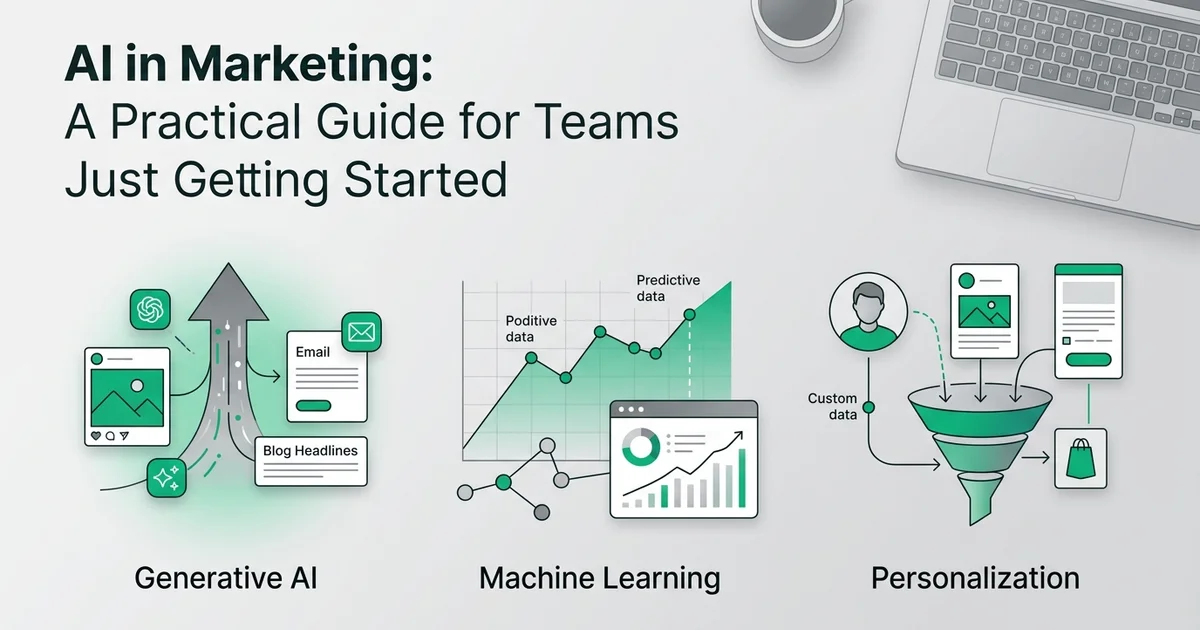
Not all marketing AI works the same way. It helps to know the three main categories:
- Generative AI: Creates new content, including text, images, and video, based on prompts you provide. Tools in this category can draft a product description or write a social caption in seconds.
- Predictive AI: Analyzes historical data to forecast future behavior, such as which customers are likely to churn or which subject line will get the highest open rate.
- Personalization engines: Dynamically adjust what a user sees, whether that is a product recommendation or a homepage headline, based on their individual behavior and preferences.
Examples you already know
You encounter AI in marketing every day without realizing it. Netflix recommending your next show, Spotify building your weekly playlist, and Amazon surfacing products you are likely to buy are all personalization engines at work. In your own marketing, the same logic applies: serve each person content that feels relevant to them, and engagement follows naturally.
For teams looking to put this into practice, exploring the best AI marketing tools available in 2026 is a useful starting point before committing to any single platform.
Key terms you need to know
Before diving deeper, it helps to speak the language. AI in marketing comes with its own vocabulary, and a few definitions will make everything that follows much easier to follow.
Generative AI
Generative AI refers to systems that create new content, such as text, images, or video, rather than simply analysing existing data. Think of it as a creative assistant that produces original output based on instructions you give it.
Machine learning
Machine learning (ML) is how AI systems improve over time. Instead of following fixed rules, they learn patterns from data. In marketing, ML powers things like predicting which customers are likely to churn or which subject lines drive more opens.
Personalization and automation
Personalization means delivering content or offers tailored to an individual. Automation means running repeatable tasks without manual effort. Together, they allow small teams to do the work of much larger ones.
AI agents versus standalone tools
A standalone tool does one job, such as writing a caption. An AI agent, by contrast, can handle multi-step workflows independently, making decisions along the way. Tools like RankHub sit closer to the agent end, running 15 automated steps monthly to research keywords, write SEO articles, and publish them without manual input.
Prompt engineering
Prompt engineering simply means writing clear, specific instructions to get better results from an AI tool. Better inputs consistently produce better outputs. It is a learnable skill, not a technical one.
Why AI matters for your marketing
AI is not just a productivity shortcut. For small teams and solo founders, it fundamentally changes what is possible with limited time and budget. Tasks that once required a dedicated specialist, or simply went undone, can now run on autopilot while you focus on strategy and growth.
Save time on repetitive tasks
Content drafting, keyword research, social captions, email subject lines: these tasks eat hours every week. AI handles the heavy lifting so your team can focus on creative direction and decision-making. Tools like RankHub, for example, automate the full SEO content workflow, from keyword research to publishing, saving users 40 or more hours every month.
Improve personalization without extra headcount
Personalization used to mean hiring more people. According to the 2025 State of Marketing AI Report (2025), nearly half of marketers now use AI specifically for personalized content creation, delivering tailored experiences at a scale no small team could manage manually.
Stay competitive as adoption accelerates
AI in marketing is moving from early adopter territory to standard practice. According to CoSchedule's State of AI in Marketing Report (2025), 74% of marketers consider AI critically or very important to their work. Waiting to engage with these tools means falling behind competitors who are already using them. For a broader view of where things are heading, see AI Marketing Trends in 2026: What's Actually Changing.
Common AI marketing use cases explained
AI in marketing covers a wide range of practical tasks, from writing first drafts to predicting which campaigns will perform best. Understanding the most common use cases helps you decide where to start and which tools are worth your time.
Content creation and drafting assistance
AI writing tools can generate blog posts, ad copy, product descriptions, and social media captions in minutes. You feed the tool a topic, tone, and target audience, and it produces a working draft you can refine. This does not replace your voice or judgment, but it removes the blank-page problem that slows most teams down.

Keyword research and SEO optimization
AI tools analyze search trends, competitor rankings, and content gaps to surface keywords your audience is actually using. According to CoSchedule's State of AI in Marketing Report (2025), 40.60% of marketers are actively updating their SEO strategies for AI-powered search. A tool like RankHub automates this process end to end: it runs AI keyword research, checks for content cannibalization (where two of your own pages compete for the same keyword), and produces SEO-optimized articles with featured images included. For teams without a dedicated content resource, this kind of content marketing automation platform removes a significant bottleneck.
Email personalization and segmentation
AI analyzes subscriber behavior, purchase history, and engagement patterns to group your audience into segments (distinct groups with shared characteristics). It then helps you write tailored messages for each group, so a first-time visitor receives different content than a loyal customer.
Social media scheduling and copywriting
AI tools suggest optimal posting times based on audience activity data and generate platform-specific copy variations from a single brief. This saves hours of manual scheduling each week.
Customer data analysis and insights
AI surfaces patterns in your customer data that would take a human analyst days to find, including churn signals, buying triggers, and campaign attribution gaps.
Campaign performance prediction
Before you spend budget, AI models can forecast which creative formats, audiences, and channels are most likely to convert, based on historical performance data. According to CoSchedule's State of AI in Marketing Report (2025), 48.57% of marketers are already creating personalized content with AI, signaling that predictive and personalization capabilities are quickly becoming baseline expectations rather than competitive advantages.
Getting started: Your first steps with AI in marketing
Knowing what AI can do is one thing. Actually putting it to work is another. According to the 2025 State of Marketing AI Report (2025), while 85% of marketers are using generative AI, only 15% have fully integrated it into their daily workflows. The gap between experimenting and embedding AI into real processes is where most teams get stuck.
Choose one specific marketing task to automate
Start narrow, not broad. Pick a single task that takes up time each week—like writing social media captions, drafting email subject lines, or creating blog post outlines. This focused approach helps you see results quickly and builds confidence before expanding to other areas.
Select a beginner-friendly AI tool
Look for platforms with intuitive interfaces and clear templates. You don't need the most powerful tool; you need one that's easy to learn. Many tools offer free trials or freemium plans—use these to test before committing budget.
Set up a simple workflow with guardrails
Define what success looks like for this task. Create a basic checklist of quality standards the AI output must meet before you use it. This prevents low-quality content from reaching your audience and keeps your brand reputation intact.
Test, measure, and iterate
Run the AI tool on 5-10 pieces of content. Track how long it saves you and how much editing is needed. Adjust your prompts or settings based on what you learn. This data-driven approach helps you optimize before scaling.
Document your process and share learnings
Write down what worked, what didn't, and why. If you're on a team, share these insights. This creates institutional knowledge and makes it easier to train others or expand AI use across your marketing operation.
Here is how to close that gap without overwhelming your team.
Pick one task and start there
Resist the urge to automate everything at once. Choose a single, repeatable task where AI can save you the most time. Content creation and SEO are natural starting points for most small teams. If organic search is a priority, a tool like RankHub handles the heavy lifting on its Starter Plan by running AI keyword research, writing SEO-optimized articles, and publishing them automatically every week. That is one workflow removed from your plate immediately.
Set up a review process before anything goes live
AI output always needs a human check. Before you publish anything, assign someone to review for accuracy, brand voice, and factual claims. Even a simple two-step approval, one person drafts with AI and another approves, dramatically reduces errors. This is especially important when you are exploring seo content automation software for the first time.
Document your workflow and measure results
Write down exactly how you are using each tool, what prompts work, what the review steps are, and where content gets published. This keeps your process consistent as your team grows. Then track results: organic traffic, engagement, or time saved. Measuring outcomes tells you what is actually working and where to expand AI next.
Common beginner mistakes to avoid
Even teams with the best intentions can stumble when first introducing AI into their marketing workflows. Knowing what to watch for saves you time, protects your brand reputation, and helps you get better results faster.
Explore what Starter Plan offers for ai in marketing Starter Plan.
Publishing AI content without human review
AI can produce plausible-sounding text that contains factual errors, outdated information, or subtle inaccuracies. Always have a human read, fact-check, and approve content before it goes live. No tool, however sophisticated, replaces editorial judgment.
Using AI without adapting it to your brand voice
Generic AI output sounds generic. If you paste a prompt in and publish the result unchanged, your content will feel flat and interchangeable. Customize your prompts with specific tone guidelines, audience details, and brand language every time.
Ignoring disclosure and transparency requirements
Regulations and platform policies around AI-generated content are evolving quickly. According to CoSchedule's State of AI in Marketing Report (2025), transparency is increasingly expected by both audiences and regulators. When in doubt, disclose.
Treating AI as a replacement for human creativity
AI is a productivity multiplier, not a creative director. Strategy, storytelling, and genuine audience insight still require human thinking. In our experience at RankHub, the teams that get the most from AI are those who use it to handle repetitive production tasks, like SEO automation for content teams, while keeping humans firmly in charge of creative direction.
Failing to refine your prompts over time
Your first prompt is rarely your best one. Track which prompts produce strong results and which fall flat, then iterate. Treating prompts as fixed and unchangeable is one of the most common reasons teams plateau early.
Tools and resources for beginners
The right tools make AI in marketing far less intimidating. Beginners benefit most from platforms designed with simplicity in mind, where you can see results quickly without needing technical expertise. Here is a practical breakdown of where to start.
AI writing tools
For general content creation, tools like ChatGPT, Claude, and Jasper give you a solid starting point. They help you draft blog posts, social captions, and ad copy in minutes. Use them to generate first drafts, then edit for your brand voice.
AI SEO and keyword research platforms
According to the HubSpot 2026 State of Marketing (2026), 40.60% of marketers are actively updating their SEO strategies to account for AI-powered search. Tools like Semrush and Ahrefs offer beginner-friendly keyword research dashboards. For teams who want full automation, RankHub handles AI keyword research, anti-cannibalization checks, and SEO-optimized article production on autopilot. Its Starter Plan delivers one new post every week, complete with featured images and webhook publishing, making it a practical fit for small teams without dedicated content staff. Pairing it with a structured seo content calendar automation approach keeps your pipeline consistent.
AI email and personalization tools
Platforms like Mailchimp and Klaviyo now include built-in AI features for subject line suggestions, send-time optimization, and audience segmentation.
AI analytics and reporting platforms
Google Analytics 4 and HubSpot both incorporate AI-driven insights that surface trends without requiring manual data digging, ideal for founders and small teams watching multiple channels at once.
Next steps: Where to go from here
You have explored the tools. Now it is time to think about how AI fits into your broader marketing operation over the coming months. The goal is to move from experimenting with individual tools to building a coordinated, scalable approach that grows with your business.

Move from single tasks to full workflows
Start connecting the tools you already use. Instead of running AI keyword research separately from content creation, look for platforms that handle multiple steps automatically. For example, RankHub's Starter Plan runs 15 automated steps monthly, covering keyword research, article writing, featured images, and webhook publishing to your site, saving you the manual effort of coordinating each stage yourself.
Build governance and quality standards
Set clear guidelines for how your team reviews, edits, and approves AI-generated content before it goes live. Consistency matters more as you scale.
Plan for AI search and SEO changes
Search is evolving quickly. According to the AI and the Future of Marketing: 2025 Edition (2025), 70.2% of marketers believe they can adapt their organic search strategy to AI-driven changes. Tools like RankHub include anti-cannibalization keyword checks, which help protect your existing content as you publish more. Pairing this with a reliable online marketing platform for small businesses keeps your entire strategy aligned.
Explore AI agents for end-to-end automation
Only 19.20% of marketers currently use AI agents that coordinate multiple marketing functions end-to-end. Getting there early puts your team in a strong competitive position.
Myths and misconceptions about AI in marketing
Before committing to AI tools, it helps to separate fact from fiction. Several persistent myths cause teams to hesitate or dismiss AI in marketing entirely, and clearing them up can save you weeks of unnecessary doubt.
Myth: AI will replace marketers
AI augments human creativity rather than replacing it. Tools handle repetitive tasks like drafting, scheduling, and data analysis, freeing marketers to focus on strategy, storytelling, and relationship-building.
Myth: AI is too expensive for small businesses
Many capable AI tools have free tiers or affordable entry-level plans. Cost is rarely the barrier it once was.
Myth: AI content is always low quality
Quality depends entirely on human oversight. Well-prompted, carefully reviewed AI content can match or exceed manually written work.
Myth: You need technical skills to use AI
Most modern tools are built for non-technical users. Drag-and-drop interfaces and plain-language prompts are now standard.
Myth: AI is too new and unproven
According to the HubSpot 2026 State of Marketing (2026), 86.4% of marketing teams already use AI in at least some marketing areas. This is mainstream technology, not an experiment.
Quick start checklist for your first AI marketing project
You now have the knowledge to take action. Use this checklist to move from learning to doing, one step at a time. Keep it simple, stay focused on a single project, and build confidence before expanding.
Define your goal and success metric
What specific outcome are you targeting? (e.g., 'Generate 20 blog post outlines per month' or 'Reduce email copywriting time by 50%'). Write it down.
Identify the task and current time investment
What task will AI handle? How many hours per week does it currently take? This baseline helps you measure ROI.
Research and select your AI tool
Compare 2-3 options that fit your budget and use case. Read reviews from marketers in your industry. Sign up for a free trial.
Create a quality checklist
List the standards AI output must meet before you publish or send it. Include brand voice, accuracy, tone, and any compliance requirements.
Run your first batch of tests
Use the AI tool on 5-10 real pieces of content. Track time saved and quality issues. Document your prompts and settings.
Review results and refine your approach
Did the AI meet your quality standards? What adjustments would improve output? Update your process based on findings.
Plan your next phase
Once this task is working smoothly, identify the next marketing task to automate. Build incrementally rather than trying to automate everything at once.
Choose one task to automate
Pick the marketing task that costs you the most time each week. Common starting points include:
- Writing social media captions
- Drafting email subject lines
- Creating SEO blog content
Resist the urge to automate everything at once. One focused project teaches you far more than five scattered experiments.
Select and sign up for a tool
Match your tool to your chosen task. For SEO content specifically, RankHub's Starter Plan handles the full workflow automatically, from AI keyword research to publishing a finished, image-ready article every week, without requiring any technical setup.
Create 3-5 test prompts
Write prompts tailored to your specific use case. Be specific about tone, audience, and goal. Vague prompts produce vague results.
Review outputs before publishing
AI drafts are starting points, not finished work. Edit for accuracy, brand voice, and factual correctness every time.
Document your results
Note what worked, what fell flat, and what surprised you. A simple spreadsheet is enough.
Plan your next experiment
Once your first project runs smoothly, choose a second task and repeat the process.
Frequently asked questions
What is AI in marketing?
AI in marketing refers to the use of artificial intelligence technologies, such as machine learning and natural language processing (the ability of computers to understand and generate human language), to automate, personalize, and optimize marketing tasks. This includes everything from writing content to analyzing customer behavior.
How is AI used in marketing?
Marketing teams apply AI to content creation, email personalization, SEO research, social media scheduling, ad targeting, and customer segmentation. According to the HubSpot 2026 State of Marketing (2026), 86.4% of marketing teams now use AI in at least some areas of their work.
What are the benefits of AI in marketing?
AI saves time, reduces costs, and helps teams produce more personalized content at scale. It also surfaces data-driven insights that would take humans significantly longer to identify manually.
What are examples of AI marketing tools?
Popular tools include ChatGPT for copywriting, Jasper for content generation, Canva's AI features for design, and platforms like RankHub for automated SEO content. Each tool addresses a specific workflow, so start with the one that matches your biggest bottleneck.
How can small businesses use AI for marketing?
Small businesses can use AI to punch above their weight by automating repetitive tasks like keyword research, blog writing, and email drafts. A tool like RankHub is particularly useful here, delivering a new SEO-optimized article every week without requiring a dedicated content team.
Will AI replace marketers?
No. AI handles repetitive, data-heavy tasks, but strategy, creativity, and relationship-building remain deeply human skills. Think of AI as a capable assistant that frees you to focus on higher-value work.
How does AI improve SEO and content marketing?
AI accelerates keyword research, identifies content gaps, and generates optimized drafts faster than traditional methods. According to the HubSpot 2026 State of Marketing (2026), 70.2% of marketers believe their organization can adapt its organic search strategy to AI-driven changes like AI Overviews.
What are the disadvantages or risks of using AI in marketing?
Key risks include factual inaccuracies in AI-generated content, over-reliance on automation, and potential brand voice inconsistencies. Always review outputs before publishing and maintain human oversight at every stage.
Based on our work at RankHub, teams that treat AI as a collaborator rather than a replacement consistently see the strongest, most sustainable results.
More from Our Blog
Market Research Platforms in 2026: What the Data Shows
Explore the latest data on online market research platforms: market size, AI adoption, mobile trends, and what researchers are investing in now.
Read more →
Affiliate Marketing for Beginners: Everything You Need to Know to Start
Learn affiliate marketing from scratch. Discover how to choose a niche, join programs, create content, and earn your first commission today.
Read more →
7 Proven Strategies SEO Experts Use for Content Marketing
Learn proven SEO content marketing strategies from experts. Discover AI-assisted tactics, content refresh techniques, and measurement frameworks that drive 29-169% growth.
Read more →