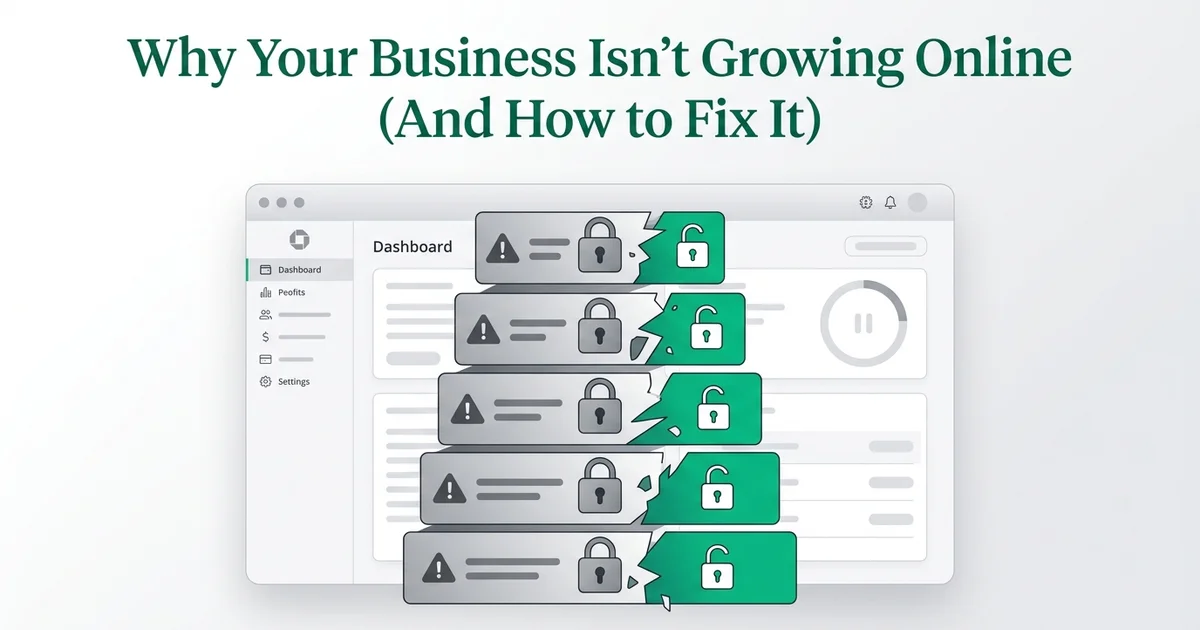
Why Your Business Isn't Growing Online (And How to Fix It)
Introduction: why Chase Business Online access matters for your business
At RankHub, our analysis shows that banking access problems are among the most underestimated obstacles to small business growth. When you cannot log in, set up your account, or process payments through Chase Business Online, the ripple effects hit fast and hard.
The frustration is real. You have invoices to send, payroll to run, and vendors waiting on transfers. Every hour you spend locked out of your account is an hour your cash flow sits frozen. Payment processing delays can strain supplier relationships, delay fulfillment, and ultimately cost you customers who simply cannot wait.
You are far from alone in this. According to JPMorgan Chase (2024), the bank served 7.0 million small business clients, making Chase Business Online one of the most widely used digital banking platforms in the country. That scale means access issues are a shared, solvable problem with well-documented fixes.
This guide cuts straight to those fixes. Whether you are dealing with a locked account, a failed enrollment, or a payment processing error, the solutions below are practical, prioritized, and designed to get your business moving again as quickly as possible.
Quick fix: immediate solutions for the most common problems
Before diving into root causes, here is a fast-reference table for the three issues that account for the majority of Chase Business Online complaints. Find your symptom, apply the fix, and get back to running your business.
Symptom-to-fix table
| Symptom | Most likely cause | Quick fix |
|---|---|---|
| Cannot log in | Locked credentials | Reset password via "Forgot password" on login screen |
| Account setup stalled | Incomplete verification | Check email for pending document requests |
| Permission denied | User role restrictions | Contact primary account admin to adjust access |
One-click troubleshooting path
If you are unsure where to start, follow this sequence:
- Clear your browser cache and retry login
- Check Chase's service status page for outages
- Call 1-800-CHASE-38 to speak with a business banking specialist directly
Most users resolve their issue at step one or two. If you reach step three, have your account number and business EIN ready to speed up verification.
Why Chase Business Online problems happen: understanding the root causes
Understanding what causes Chase Business Online problems in the first place helps you resolve them faster and prevent them from recurring. Most issues fall into a handful of predictable categories, each with its own logic and fix.
Browser compatibility and cookie problems
Modern banking platforms rely on strict security protocols that interact poorly with outdated browsers, aggressive ad blockers, and corrupted cache data. When your browser stores conflicting session cookies, the platform may reject your credentials even when they are entirely correct. Chromium-based browsers in incognito mode, or a freshly cleared cache, resolve the majority of these conflicts before they escalate.
Account verification delays and documentation requirements
Chase applies rigorous identity and business verification standards, particularly for new accounts or recently updated ownership details. Delays often occur when submitted documentation, such as articles of incorporation or EIN confirmation letters, does not precisely match the information on file. Having clean, current records ready significantly shortens resolution time.
Permission and user role configuration errors
Multi-user business accounts depend on carefully configured role hierarchies. When a primary administrator sets permissions incorrectly, secondary users may find themselves locked out of payroll, wire transfers, or reporting features entirely. These errors are common after staff changes or account restructuring.
Integration issues with accounting software
Connectivity between banking platforms and tools like QuickBooks or Xero breaks down more often than most business owners expect. According to Apiture (2025), 85% of small businesses want their online banking platforms to integrate more tightly with accounting systems, reflecting how frequently this friction point disrupts daily operations. Mismatched API credentials, expired OAuth tokens, and permission scope misconfigurations are the most common culprits.
Solution 1: fix login and access issues in Chase Business Online
Login failures are the most immediate barrier between you and your business finances. Before escalating to Chase support, work through these targeted fixes in order. Most access problems resolve within minutes once you identify the correct cause.
Clear your browser cache and cookies
Cached data can interfere with login authentication. Open your browser settings, navigate to Privacy or History, and select the option to clear browsing data. Make sure to include cookies and cached images. Then close your browser completely and reopen it before attempting to log in again.
Verify your username and password
Ensure you're using the correct username (often your email address) and that Caps Lock is not accidentally enabled. If you're unsure of your credentials, use the 'Forgot Username' or 'Forgot Password' link on the Chase login page. You'll receive a reset link via email within minutes.
Check for account locks or security holds
Multiple failed login attempts trigger automatic security locks. Wait 24 hours before trying again, or contact Chase Business support immediately to unlock your account. They can verify your identity and restore access faster than waiting.
Test with a different browser or device
Browser compatibility issues can prevent login. Try accessing Chase Business Online from Chrome, Firefox, Safari, or Edge. If login succeeds on a different browser, the problem is browser-specific and you may need to update or reinstall your original browser.
Disable browser extensions and VPN services
Security extensions, ad blockers, and VPN services can block Chase's authentication process. Temporarily disable these tools and attempt login. If successful, add Chase to your extension's whitelist or adjust VPN settings to allow Chase's domain.
Reset your password the right way
A forgotten or corrupted password is the most common culprit. Follow these steps precisely:
- Navigate to the Chase Business Online login page and click "Forgot username/password"
- Enter the email address associated with your account
- Choose your verification method: text, email, or voice call
- Create a new password using at least eight characters, including uppercase letters, numbers, and symbols
- Log in immediately and update any saved credentials in your password manager
Avoid reusing recent passwords. Chase flags recycled credentials as a security risk and may prompt another reset cycle.
Clear your browser cache and cookies
Outdated cached data frequently causes login loops and blank screens. Here is how to clear it across common browsers:
- Chrome: Settings, Privacy and Security, Clear Browsing Data, select Cookies and Cached Images, click Clear Data
- Firefox: Settings, Privacy and Security, Cookies and Site Data, Clear Data
- Safari: Develop menu, Empty Caches, then Preferences, Privacy, Manage Website Data, Remove All
After clearing, restart the browser completely before attempting to log in again.
Troubleshoot two-factor authentication (2FA)
If your verification code is not arriving, check that your registered phone number is current. Codes expire within 30 seconds, so timing matters. If you use an authenticator app, ensure your device clock is synced correctly. According to Chase Business Banking Support, you can update your contact information directly through account settings once you regain access.
Recover a locked account
After multiple failed attempts, Chase temporarily locks accounts for security. Call the number on the back of your business debit card to speak with a specialist who can unlock access immediately.
Mobile app vs. web login
The Chase mobile app and browser portal use separate session tokens. If one fails, try the other. App-specific issues often resolve with a simple uninstall and reinstall. Given that According to JPMorgan Chase, 70.813 million customers actively use their digital platforms, server-side congestion during peak hours can also affect mobile logins specifically.
Once your access is restored, you will be positioned to tackle the deeper operational challenges that slow business growth, including the kind of digital marketing platform decisions that determine how effectively you reach customers online.
Solution 2: resolve account setup and enrollment problems
Account setup and enrollment issues are among the most common reasons small business owners cannot access Chase Business Online at all. Before troubleshooting features or payments, you need a fully activated, properly enrolled account. Getting this foundation right saves significant time and frustration down the line.
Confirm all required business documentation is complete
Chase requires specific documents for account setup: business license, EIN letter, ownership verification, and personal identification. Review the Chase Business Online enrollment checklist to ensure every document is included, current, and legible. Missing or expired documents are the most common enrollment blockers.
Verify your business information matches Chase records
Discrepancies between your application and Chase's verification databases cause enrollment delays. Double-check that your business name, address, phone number, and EIN exactly match what you submitted. Even minor spelling differences can trigger manual review holds.
Wait for verification and follow up if needed
Chase typically completes verification within 1-3 business days. If you don't receive enrollment confirmation within this timeframe, contact Chase Business support with your application reference number. They can check verification status and identify any documentation gaps.
Ensure your email address is active and monitored
Chase sends enrollment confirmations and access credentials to your registered email. Check your inbox and spam folder for messages from Chase. If you haven't received anything after 3 business days, verify the email address on file is correct and reachable.

Verify business documentation requirements
Chase requires specific documentation to verify your business identity during enrollment. Depending on your business structure, you will typically need your Employer Identification Number (EIN), business formation documents such as articles of incorporation or a DBA certificate, and a government-issued personal ID. Sole proprietors may use a Social Security Number in place of an EIN. Gathering these before starting the enrollment process prevents mid-application delays.
Complete identity verification steps
During online enrollment, Chase runs identity verification checks on both the business and its authorized representatives. If the system cannot automatically verify your information, you may be prompted to visit a branch or upload additional documentation. Respond to these requests promptly, as incomplete verification will stall activation entirely.
Activate your business checking account online
Once documentation is submitted and verified, activating your business checking account through Chase Business Online requires logging in with your new credentials and following the account confirmation prompts. Some features, including wire transfers and bill pay, may remain restricted until activation is fully complete.
Link existing business accounts
If you already hold Chase business accounts, you can link them to your Chase Business Online profile through the "Account Services" menu. This consolidates visibility across all balances and transactions in a single dashboard.
Timeline expectations for account activation
Most enrollments are processed within one to three business days. Complex business structures or flagged verification steps can extend this to up to seven business days. During this waiting period, focusing on other growth priorities, such as evaluating content writing tools that boost your SEO rankings, keeps your momentum moving forward.
Solution 3: manage user permissions and team access errors
Permission errors are among the most disruptive obstacles growing businesses face with online banking. When team members cannot access the accounts they need, payments stall, approvals get delayed, and operational momentum breaks down. Resolving these issues quickly is essential for maintaining financial agility.
Review and adjust user role assignments
Each team member needs the correct role (Admin, Approver, Viewer, etc.) to access their required functions. Log in as the primary account holder, navigate to User Management, and verify each team member's role matches their responsibilities. Incorrect role assignments are the leading cause of permission errors.
Confirm user enrollment is complete
New team members must complete their own enrollment before accessing accounts. Send them the enrollment link via email and confirm they've clicked it and created their login credentials. Incomplete enrollment prevents access even if permissions are correctly assigned.
Check for account-level access restrictions
Some accounts have transaction limits or approval requirements that restrict certain users. Review your account settings to see if specific transactions require additional approval layers. Adjust these settings if they're preventing necessary team access.
Reset user credentials if access remains blocked
If a team member still cannot access their account after role verification and enrollment confirmation, reset their credentials. Have them log out completely, use the password reset function, and attempt login with new credentials. This resolves most persistent permission issues.
Adding authorized users to your business account
Start by navigating to the user management section within your Chase Business Online dashboard. From there, you can invite team members by entering their name, email address, and role. Each user receives a secure invitation to set up their own login credentials, keeping your master account protected while expanding access appropriately.
Configuring role-based permissions correctly
Not every team member needs the same level of access. Chase Business Online allows administrators to assign specific permissions by role, such as view-only access for bookkeepers or full transaction authority for finance managers. According to Chase Business Online Banking Support, businesses can specify transaction amount limits and configure payment preferences from a centralized dashboard, reducing the risk of unauthorized activity.
In our experience at RankHub, misconfigured roles are the most common source of "permission denied" errors. Always verify that each user's assigned role matches their actual responsibilities before assuming a technical fault.
Setting transaction limits and approval workflows
For added security, configure transaction limits for individual users and establish multi-step approval workflows for high-value payments. This creates accountability without slowing down routine operations.
Removing inactive users and auditing access controls
Conduct a quarterly review of all authorized users. Remove former employees or contractors promptly, and adjust permissions whenever team roles change. Keeping your access list current reduces security vulnerabilities and ensures your financial data stays protected as your business scales.
Solution 4: connect accounting software and resolve integration issues
Disconnected accounting tools create blind spots in your financial data and slow down decision-making. According to Apiture (2025), 85% of small businesses want their online banking platforms to integrate more tightly with accounting systems. Getting this connection right is essential for growth.
Integrating QuickBooks with Chase Business Online
Chase Business Online supports direct integration with QuickBooks, allowing transactions to sync automatically. To connect, navigate to your QuickBooks settings, select your bank, and authenticate using your Chase credentials. Once linked, transactions flow into your accounting records without manual entry, saving time and reducing errors.
Troubleshooting failed integration connections
If your integration stops syncing, start with these checks:
- Re-authenticate your credentials by disconnecting and reconnecting the account
- Verify API permissions are enabled within your Chase Business Online settings
- Check for expired tokens, which often cause silent sync failures
- Review your Chase account status, as restricted accounts can block third-party connections
According to Chase Business Online Support, resolving authentication issues typically restores data flow quickly.
Understanding sync delays and data limitations
Real-time sync is not always guaranteed. Pending transactions may take one to two business days to appear in your accounting software. Build this lag into your reconciliation schedule to avoid discrepancies and keep your books accurate.
Prevention: how to avoid Chase Business Online problems in the future
Avoiding Chase Business Online disruptions is far easier than troubleshooting them after the fact. A few consistent habits, established early, can protect your access, your data, and your team's productivity before problems have a chance to surface.

Enable multi-factor authentication from the start
Set up multi-factor authentication the moment you open your account. This single step blocks the vast majority of unauthorized access attempts and is one of the most effective security measures available to small business owners.
Maintain strong password practices
Use a unique, complex password for your Chase Business Online account and store it in a reputable password manager. Avoid reusing passwords across platforms, and update credentials immediately if you suspect any compromise.
Keep your browser and operating system updated
Outdated software is a common cause of login failures and display errors. Schedule regular updates for your browser and operating system to ensure full compatibility with Chase's platform.
Review user permissions regularly
Audit which team members have account access at least once per quarter. Remove permissions for former employees promptly and adjust access levels as roles evolve within your business.
Document your account setup and recovery information
Keep a secure record of your account details, linked email addresses, and recovery phone numbers. This documentation becomes critical if you ever need to restore access quickly during a disruption.
When to seek additional help: escalation and support options
Sometimes preventive measures are not enough, and you need direct support from Chase. Knowing which support channel matches your situation saves time and gets your Chase business online access restored faster.
Use online chat for immediate assistance
Chase's online chat support is the fastest route for straightforward issues. Access it directly through the Chase Business portal for quick troubleshooting without waiting on hold.
Call the business banking phone line for complex problems
For account lockouts, transaction disputes, or technical errors that chat cannot resolve, calling Chase's dedicated business banking line connects you with trained specialists.
Visit a local branch for in-person help
Branch visits work best for identity verification issues or situations requiring document review. Bring government-issued ID and any relevant account information.
Escalate to a business relationship manager
Enterprise accounts or recurring problems warrant escalation to a dedicated relationship manager, who can coordinate solutions across Chase's internal teams on your behalf.
Conclusion: getting back online and moving forward
Most online access problems businesses encounter with Chase have clear, actionable solutions. Whether the issue is a forgotten password, a locked account, or a browser compatibility conflict, the path to resolution is shorter than it might initially feel.
The key takeaways from this guide are straightforward:
- Start simple. Clear your cache, verify your credentials, and check device compatibility before escalating.
- Use self-service tools first. Chase's online resources resolve the majority of common issues without a support call.
- Act proactively. Regular account reviews and updated contact information prevent most lockouts before they happen.
For ongoing guidance, Chase's Business Banking Support and FAQs is a reliable first stop whenever new questions arise.
Your online banking access is foundational to daily operations. Keeping it healthy means fewer disruptions, faster decisions, and more time focused on growing your business.
Frequently asked questions
How do I open a Chase business checking account online?
You can apply for a Chase business checking account directly through Chase's website by submitting your business details, ownership information, and identification documents. The process is straightforward and typically takes only a few minutes to complete.
What is Chase Business Online?
Chase Business Online is Chase's digital banking platform designed specifically for business account holders. It gives you centralized access to account management, payments, transfers, and reporting tools in one secure location.
How do I log in to Chase Business Online?
Visit chase.com and enter your username and password on the business login page. According to Chase's Business Banking Support and FAQs, additional verification steps may apply depending on your security settings.
Can I connect personal accounts to Chase Business Online?
Yes, Chase allows you to view personal and business accounts under a single login for convenience. Keeping them linked makes it easier to monitor overall cash flow without switching between separate sessions.
How do I add users and set permissions in Chase Business Online?
Account administrators can add employees or accountants as authorized users and assign specific access levels. This includes setting transaction amount limits, which helps maintain control over spending without restricting day-to-day operations.
How many days of activity can I view in Chase Business Online?
Chase Business Online typically provides access to several months of transaction history, giving you enough data to track trends and reconcile accounts accurately. Check your specific account type for exact date ranges.
Is Chase Business Online secure?
Yes. Chase uses multi-factor authentication, encryption, and real-time fraud monitoring to protect business accounts. Regularly updating your password and reviewing authorized users adds an additional layer of protection.
How do I manage statements in Chase Business Online?
Statements are accessible directly within the platform under your account settings. You can view, download, or enroll in paperless delivery to simplify recordkeeping and reduce clutter.
Based on our work at RankHub, businesses that pair strong banking tools with a structured digital growth strategy see measurably faster results. If you are just getting started, the Starter Plan is a practical next step toward building that foundation.
More from Our Blog
Top Content Optimization Tools to Improve Your Rankings
Compare the best content optimization tools for SEO. We reviewed 8 top platforms with pricing, features, and rankings to help you choose.
Read more →
How to Build an SEO Content Strategy That Ranks
Learn how to build an effective SEO content strategy from scratch. Follow our 7-step process to plan, create, and optimize content for organic search success.
Read more →
How to Choose the Right Digital Marketing Platform for Your Small Business
Step-by-step guide to selecting and setting up a digital marketing platform that automates content, social, and SEO for small businesses.
Read more →