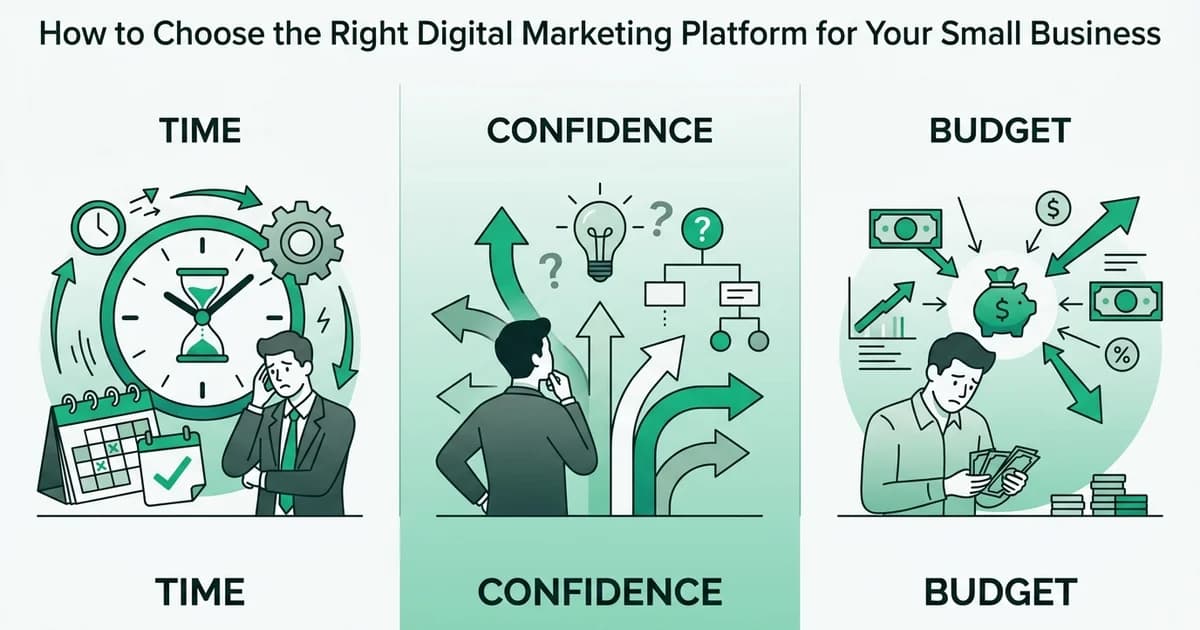
How to choose the right digital marketing platform for your small business
- Basic understanding of your business goals and target audience
- Access to social media accounts (Facebook, Instagram, LinkedIn, or TikTok)
- Monthly budget of $50-500 for a marketing platform
- Willingness to spend 2-3 hours on initial setup
Introduction: why small businesses need a digital marketing platform
Choosing the right digital marketing platform for your small business is one of the most consequential decisions you can make for growth. The right platform eliminates guesswork, saves time, and creates the consistency that turns browsers into buyers.
The strategy confidence gap
Most small businesses are marketing without a clear signal that it is working. According to Sixth City Marketing (2025), 73% of small businesses worldwide aren't sure their current marketing strategy is effective. That uncertainty is costly, both in wasted budget and missed opportunity.
The time problem
At RankHub, our analysis shows that time scarcity is the single biggest barrier preventing small businesses from marketing consistently. According to LocaliQ (2025), 56% of SMBs have only an hour or less each day to dedicate to marketing. Manual tasks like keyword research, content creation, and scheduling consume that hour fast.
The opportunity ahead
Despite these challenges, momentum is building. Some 63% of small businesses plan to increase their marketing budgets over the next year. A dedicated digital marketing platform helps you spend that budget wisely by automating repetitive tasks, maintaining a consistent publishing cadence, and surfacing the data you need to make smarter decisions.
What you'll need before getting started
Before you evaluate a single platform, gather a few essentials. Having these in place means your first hour of research translates directly into action rather than circling back to answer basic questions later.
A clear picture of your audience and goals
Write down who your ideal customer is, what problem you solve for them, and what a successful marketing outcome looks like in concrete terms. "More sales" is a starting point. "Ten new leads per month from organic search" is something a platform can actually help you measure.
A website (or a plan to build one)
According to Sixth City Marketing (2025), only 40% of small businesses have a dedicated website, yet most digital marketing channels funnel traffic somewhere. If you do not have a site yet, factor setup into your timeline.
A realistic budget
Most capable platforms sit in the $50 to $500 per month range depending on features. SEO content automation tools like RankHub fit the lower end of that range while handling time-intensive tasks such as keyword research and weekly article production automatically.
A shortlist of marketing channels
Identify three to five channels you want to prioritize:
- Organic search (SEO)
- Email marketing
- Social media
- Paid advertising
- Content marketing automation
Time to commit
Budget two to three hours for initial setup, then roughly 30 minutes per week for ongoing management. Platforms with automation built in keep that weekly number low.
Step 1: Define your marketing goals and channels
Before evaluating any platform, you need a clear picture of what you want to achieve and where you plan to show up. Defining your goals and channels first prevents you from paying for features you will never use and ensures every platform decision ties back to a measurable business outcome.
Audit your current marketing efforts
List all the channels you're currently using (social media, email, website, etc.) and document what's working and what isn't. Note which channels consume the most time and which generate the most qualified leads.
Set SMART marketing goals
Define specific, measurable, achievable, relevant, and time-bound goals. Examples: 'Generate 20 qualified leads per month through local SEO' or 'Increase email subscribers by 15% in 90 days.' Avoid vague targets like 'get more customers.'
Identify your priority channels
Rank the 2-3 channels where your target audience is most active and where you can realistically maintain consistent presence. For most small businesses, this is a combination of local SEO, social media, and email.
Document your audience and buyer journey
Create a simple profile of your ideal customer: demographics, pain points, where they search for solutions, and what messaging resonates. This informs which platform features matter most.
Set specific, measurable goals
Vague goals like "get more customers" make platform selection impossible. Replace them with targets you can track:
- Lead generation: 50 new leads per month via contact form submissions
- Traffic growth: 25% increase in organic website visitors within 90 days
- Email list growth: 200 new subscribers per quarter
- Engagement: 10% increase in social media click-through rate
Write these down before you open a single platform comparison page.
Map your channels to the time you actually have
According to LocalIQ (2025), 56% of SMBs cite limited time as their primary marketing constraint. That reality should shape which channels you commit to.
For each channel on your shortlist, ask:
- How often do I need to publish? Email newsletters may require one send per week; SEO content typically demands one well-optimized post per week to build momentum.
- Can this channel be automated? Channels like organic search are strong candidates for seo content automation software, which removes the manual workload entirely. RankHub's Starter Plan, for example, handles AI keyword research, article creation, and webhook publishing automatically, delivering one new SEO-optimized post every week without you writing a word.
- What is the realistic payoff timeline? Social media can drive engagement within days; SEO typically compounds over three to six months.
Document your target audience and buyer personas
Every goal needs an audience attached to it. For each persona, record:
- Demographics: Age, location, business size, role
- Pain points: What problem are they trying to solve?
- Preferred channels: Where do they spend time online?
- Content preferences: Short-form video, long-form articles, email digests?
This documentation becomes your filter when a platform claims to "do everything." If your primary persona lives on LinkedIn and reads industry newsletters, a platform built around Instagram Reels scheduling is the wrong fit regardless of its price point.
Step 2: Evaluate platform features against your needs
With your goals and audience documented, you can now measure platforms against concrete requirements rather than marketing copy. Work through each feature category systematically, scoring how well each platform addresses your specific use case before committing to a subscription.
Create a feature scorecard
List your priority channels and goals in rows, then score each platform (1-5 scale) on how well it supports each requirement. Weight scores by importance—a platform's SEO tools matter more if SEO is your primary goal.
Test core workflows, not just feature lists
Don't just read feature descriptions. Simulate the actual work: Can you schedule a social post in under 2 minutes? Can you pull a performance report without exporting to spreadsheets? Does the interface match how your brain works?
Evaluate integration capabilities
Check whether the platform connects to your existing tools (CRM, email service, analytics, payment processor). Poor integrations create manual data entry and tracking gaps that undermine your entire system.
Assess scalability and pricing tiers
Confirm the platform can grow with you. Review what features unlock at higher price tiers and whether the cost-to-value ratio remains reasonable as you scale. Avoid platforms where essential features are locked behind enterprise pricing.
Compare core feature sets
Look for these capabilities in any platform you shortlist:
- Content automation: Scheduled publishing, content calendars, and template libraries
- Social scheduling: Multi-channel queuing, optimal send-time suggestions, and engagement tracking
- Email marketing: List segmentation, drip sequences, and deliverability reporting
- SEO tools: Keyword research, on-page optimization guidance, and rank tracking
- Analytics: Unified dashboards that connect channel performance to revenue outcomes
Check for AI-powered capabilities
According to LocalIQ (2025), 59% of small businesses are now incorporating AI into their marketing strategies. Prioritize platforms with AI features that reduce manual work. For SEO content specifically, tools like RankHub run 15 automated steps monthly, handling keyword research, article creation, and featured image generation on autopilot. This matters significantly for teams without dedicated content resources. Explore how seo automation for content teams can close that gap.
Assess integrations and ease of use
Confirm the platform connects cleanly with your existing CRM, email service, and website. Webhook support, as offered on RankHub's Starter Plan, allows seamless publishing to virtually any platform without manual intervention. Also evaluate the learning curve honestly: a feature-rich tool your team never fully adopts delivers no value.
Calculate true cost per feature
Compare pricing tiers by dividing the monthly cost by the number of features your business will actually use. A lower headline price with critical features locked behind higher tiers often costs more in practice.
Step 3: Test the platform with a free trial or demo
Most digital marketing platforms offer free trials ranging from 7 to 30 days. Use this window deliberately, not just to browse the interface, but to simulate real work and surface any limitations before you commit.
Sign up and run a sample campaign
Start by creating a sample campaign or a single piece of content that mirrors your actual workflow. This reveals friction points that feature lists never show.
If SEO content is a priority, test how the platform handles keyword research and publishing. RankHub's Starter Plan automates this end-to-end: its AI keyword research tool identifies opportunities, generates an SEO-optimized article with a featured image, and publishes via webhook, all without manual input. Pairing this with a structured seo content calendar automation approach helps you evaluate whether the platform can sustain consistent output.
Test scheduling, publishing, and analytics
Run the platform's scheduling and publishing tools against a real deadline. Then check the analytics dashboard: can you find the metrics you need within two or three clicks? If the data is buried or unclear during a trial, it will remain that way after purchase.
Document gaps and integration issues
Keep a simple log of any missing features, broken integrations, or confusing steps. This record becomes your comparison sheet when evaluating multiple platforms side by side.
Step 4: Set up your account and connect your channels
Once you have selected your platform, complete the initial setup thoroughly before publishing anything. A fully configured account ensures accurate tracking, consistent branding, and smooth publishing from day one. Rushing this step creates data gaps that are difficult to fix later.
Complete all profile and branding settings
Upload your logo, brand colors, and company information across all connected channels. Consistent branding builds recognition and trust. Set up UTM parameters and tracking codes before publishing anything.
Connect all data sources and channels
Link your social media accounts, email service, website analytics, and CRM. Verify that data is flowing correctly by checking that historical data appears in the platform's dashboard.
Configure user roles and permissions
If you have a team, set appropriate access levels. Restrict who can publish, approve content, or access sensitive data. This prevents costly mistakes and maintains security.
Set up tracking and attribution
Configure conversion tracking, goal tracking, and attribution models so you can measure which channels and campaigns drive actual business results. Without this, you're flying blind.

Complete your business profile
Fill in every field your platform offers: business name, logo, website URL, industry, and time zone. A complete profile ensures that reports, scheduled posts, and automated emails all reflect your brand correctly.
Connect your social media accounts
According to Sixth City Marketing (2025), 96% of small businesses use social media promotion, so linking every active channel matters. Connect Facebook, Instagram, LinkedIn, and TikTok in one session to avoid publishing gaps.
Link your website and SEO tools
According to Sixth City Marketing (2025), over 73% of small businesses have a website, making this connection essential. If your chosen online marketing platform for small businesses supports webhook publishing, tools like RankHub's Starter Plan can push SEO-optimized articles directly to your site automatically, removing the need for manual uploads each week.
Set up analytics and conversion goals
Define at least two or three conversion goals before your first campaign goes live: newsletter sign-ups, contact form submissions, or product page visits. Connect Google Analytics or your platform's native tracking, then confirm that goal events fire correctly by completing a test action yourself.
Step 5: Create your content calendar and automation rules
A content calendar transforms sporadic posting into a predictable system. According to Sixth City Marketing (2025), small businesses with a marketing plan are 6.7 times more likely to report marketing success, making advance planning one of the highest-leverage activities you can do.
Plan your content 4-8 weeks ahead
Map out a minimum of four weeks of content before you publish anything. Assign each piece to a specific channel, date, and goal. A simple spreadsheet works, but most digital marketing platforms include a visual calendar view that makes gaps and imbalances immediately obvious.
Set posting frequency rules
Define clear automation rules from the start:
- Social media: 3 posts per week, scheduled in advance
- Email newsletter: 1 send per week, drafted at least 5 days prior
- Blog or SEO content: 1 post per week, automated where possible
For SEO content specifically, tools like RankHub run 15 automated steps monthly on their Starter Plan, handling keyword research, article creation, and webhook publishing so your blog calendar fills itself without manual effort. This pairs well with the best seo automation tools available for small teams.
Build in buffer time for real-time content
Reserve roughly 20 percent of your calendar slots for trending topics, seasonal moments, or timely responses to industry news. A rigid calendar with no flexibility often produces content that feels stale by the time it publishes.
Step 6: Launch your first campaign and monitor performance
With your calendar built and automation rules in place, it is time to go live. Publish your first scheduled batch of content, then shift your focus to observation. The data you collect in the first seven days will shape every strategic decision that follows.
Monitor engagement metrics daily in week one
Check your platform's analytics dashboard each morning during the first week. Track open rates, click-throughs, social engagement, and any conversion events. Look specifically for patterns in which content types and posting times generate the strongest response.
Research suggests that 73% of small businesses worldwide aren't sure their current marketing strategy is working, which makes this early monitoring phase especially valuable. You are building an evidence base, not guessing.
Adjust strategy based on early performance data
Use what you observe to refine your approach immediately. If a particular format outperforms others, produce more of it. If certain posting windows underperform, shift them.
For SEO content specifically, SEO autopilot tools that actually deliver results can help you stay consistent without adding manual workload. RankHub's AI keyword research and webhook publishing features mean your blog continues generating optimised posts automatically while you focus on interpreting results.
Set up weekly reporting
Configure a recurring weekly report inside your platform before the end of day one. Align the metrics it tracks directly to the goals you defined in earlier steps. This discipline is what separates businesses that improve steadily from those that stay stuck.
Common mistakes to avoid when implementing a digital marketing platform
Even with the right platform selected, small businesses frequently undermine their own results during implementation. Recognising these pitfalls before they cost you time and budget is one of the most practical advantages you can give yourself.
Check out Starter Plan's approach to digital marketing platform for small businesses Starter Plan.
Choosing a platform before defining your goals
Selecting tools before clarifying objectives leads directly to feature bloat and wasted spend. You end up paying for capabilities you never use while missing the ones you actually need. Define your goals first, then evaluate platforms against them.
Neglecting content strategy and scheduling random posts
Publishing without a coherent plan produces noise, not results. According to Sixth City Marketing (2025), 73% of small businesses worldwide aren't sure their current marketing strategy is working. A documented content strategy, even a simple one, changes that equation significantly.
Underestimating setup time
Most platforms require 3 to 5 hours for full, proper implementation. Budgeting 30 minutes and rushing the process creates configuration gaps that distort your analytics from day one.
Failing to integrate all your channels
Running disconnected tools creates data silos. Incomplete analytics mean you are optimising based on partial information, which compounds errors over time. Integration is not optional.
Setting it and forgetting it
A digital marketing platform for small businesses is not a one-time deployment. It requires weekly optimisation, content refreshes, and active engagement. In our experience at RankHub, businesses that schedule a fixed weekly review session consistently outperform those that check in reactively.
Ignoring automation features
According to LocaliQ (2025), 56% of SMBs have an hour or less each day for marketing. For time-constrained teams, skipping automation entirely defeats the core purpose of adopting a platform. Tools like automated SEO content publishing, a practical seo agency alternative for lean teams, exist precisely to reclaim those hours at scale.
Why this method works for small businesses
A unified digital marketing platform gives small businesses a structural advantage: fewer tools to manage, less context-switching, and more time focused on growth. According to Sixth City Marketing (2025), small businesses with a marketing plan are 6.7 times more likely to report marketing success, and a consolidated platform is what makes consistent execution realistic.
Consolidation reduces cost and complexity
Running separate tools for email, social, SEO, and analytics multiplies both subscription costs and the learning curve. A single platform eliminates redundant logins, disconnected data, and duplicate workflows, making the entire operation leaner.
Automation frees up strategic capacity
Repetitive tasks like keyword research, content scheduling, and publishing can be fully automated. RankHub's Starter Plan runs 15 automated steps monthly, including AI keyword research and SEO-optimized article publishing via webhook, functioning as a practical seo automation platform for resource-constrained teams.
Unified analytics sharpen decisions
When all channel data lives in one place, patterns become visible faster. Small businesses can reallocate budget toward what performs, enabling them to compete effectively against larger competitors who rely on volume rather than precision.
Alternative approaches: agency vs. in-house platform
Choosing how to manage your digital marketing is just as important as choosing which platform to use. The right model depends on your budget, team size, and how much hands-on involvement you want in day-to-day execution.

Full-service agency
Agencies handle everything but carry the highest price tag, typically $2,000 to $10,000+ per month. This suits founders who want results without managing execution themselves.
Freelance marketer plus platform
Pairing a part-time freelancer with a platform like RankHub costs roughly $500 to $2,000 per month. The freelancer handles strategy while RankHub's Starter Plan automates weekly SEO content publishing, AI keyword research, and anti-cannibalization checks, saving 40+ hours monthly without requiring a full content team.
DIY platform approach
Managing everything internally costs $50 to $500 per month but demands real expertise. Tools like RankHub reduce that burden significantly through its 15 automated monthly steps.
Hybrid model
Many small businesses find success combining platform automation for content and SEO with agency support for strategy. This balances cost control with professional guidance, and as your needs grow, upgrading from the Starter Plan to Growth or Scale unlocks additional capacity. Research on SEO automation ROI supports this approach for resource-constrained teams.
Real-world example: implementing a platform for a local service business
Consider a local plumbing company with a single part-time marketer and a $300/month budget. Their goal: generate 20 qualified leads per month through local SEO and social media. According to the BrightLocal SMB Marketing Report (2025), 72% of SMBs say SEO has a medium-to-high impact on their business, making it a logical priority.
Setting up the platform
The marketer signs up for RankHub's Starter Plan and completes initial setup in roughly 4 hours. Using RankHub's AI keyword research feature, they identify high-intent local search terms like "emergency plumber near me." From there, RankHub's 15 automated monthly steps handle SEO-optimized article creation, featured image generation, and webhook publishing directly to the company website, removing the need for a dedicated content team.
Managing ongoing activity
Weekly management takes just 30 minutes. The marketer reviews RankHub's scheduled post, then queues three social media updates targeting the local area. Automated email nurture sequences handle follow-up with enquiries.
Results
Within 6 to 8 weeks, the business sees consistent blog content improving local search visibility, a steady social posting cadence, and a structured lead nurture process, all within budget.
Time and cost breakdown for platform implementation
Understanding the true investment required helps you plan realistically before committing to a platform. Costs and time vary significantly depending on your approach, but most small businesses can build a functional digital marketing operation for far less than they expect.
Initial setup time
Expect to spend 3 to 5 hours getting started. This covers account creation, connecting your channels, and mapping out a basic content calendar. Front-loading this effort pays dividends in smoother day-to-day management.
Ongoing weekly and monthly time
According to Sixth City Marketing (2025), 56% of SMBs have only an hour or less each day for marketing. With that constraint in mind, realistic time commitments look like this:
- Weekly management: 30 to 60 minutes for content scheduling, audience engagement, and a quick analytics check
- Monthly optimisation: 2 to 3 hours for performance analysis, strategy adjustments, and refining goals
Tools like RankHub reduce weekly content time considerably. Its Starter Plan automates AI keyword research, produces one SEO-optimised article per week with featured images included, and publishes via webhook, removing manual content production from your weekly routine entirely.
Platform and content costs
| Cost category | DIY approach | Outsourced approach |
|---|---|---|
| Platform subscription | $50 to $500/month | $50 to $500/month |
| Content creation | $0 | $500 to $2,000/month |
Automated SEO tools like RankHub's Starter Plan sit comfortably within the lower end of platform costs while replacing a significant portion of what outsourced content would otherwise cover.
Troubleshooting: common issues and solutions
Even well-chosen platforms create friction during setup and daily use. Most problems small business owners encounter fall into predictable categories, and each has a straightforward fix that gets you back on track quickly.
Platform not integrating with your email service
Check whether your platform supports a native API connection to your email tool. If not, use Zapier as a middleware bridge to pass data between systems without custom development.
Low engagement on scheduled posts
Review your posting schedule against platform analytics to confirm you are publishing when your audience is active. Audit content quality and tighten audience targeting filters before increasing post frequency.
Overwhelmed by features
Start with the three core features that directly support your current goal. Add advanced functionality only after those workflows feel routine.
Analytics not tracking correctly
Verify that tracking codes are installed on every relevant page and that conversion goals are configured with the correct trigger conditions.
Team not using the platform consistently
Create a one-page workflow document covering daily tasks and expected outputs. Short screen-recorded walkthroughs reduce the learning curve significantly and improve adoption across the team.
Conclusion: take action and scale your marketing
You now have a complete framework for selecting, implementing, and optimizing a digital marketing platform for your small business. The six-step process covers everything from auditing your current tools to troubleshooting adoption issues, giving you a clear path forward rather than a guessing game.
Start with a plan, then act
According to Sixth City Marketing (2025), small businesses with a marketing plan are 6.7 times more likely to report marketing success. Define your goals first, then test platforms using free trials to reduce financial risk before committing.
The timing has never been better
According to BrightLocal (2025), 63% of small businesses plan to increase their marketing budget over the next year. Your competitors are investing now.
Your immediate next steps are straightforward:
- Define your primary marketing goal for the next 90 days
- Start a free trial on one platform that matches that goal
- Launch one focused campaign and measure results before expanding
If SEO content is part of your strategy, tools like RankHub automate keyword research and weekly article production, saving 40-plus hours monthly so you can focus on growth rather than content logistics.
Frequently asked questions
What is the best digital marketing platform for small businesses?
There is no single best platform. The right choice depends on your goals, budget, and audience. Prioritize platforms that address your biggest growth gap, whether that is SEO, email, or social media, and expand from there.
How do I create a digital marketing strategy for my small business?
Start by defining one measurable goal, identifying your target audience, and selecting one or two channels to focus on. Research suggests small businesses with a documented plan are significantly more likely to report success, so write yours down before spending anything.
How can a small business use digital marketing on a low budget?
Focus on high-return, low-cost channels first: SEO-optimized content, email marketing, and organic social media. Automation tools reduce the labor cost of marketing considerably, making consistent output achievable even without a dedicated team.
What tools do I need for small business digital marketing?
At minimum, you need an email marketing tool, a social scheduling platform, basic analytics, and an SEO content solution. Tools like RankHub handle keyword research and weekly article production automatically, covering SEO without requiring a content team.
How do I choose a digital marketing platform for my small business?
Match the platform to your primary goal, confirm it fits your budget, and verify it integrates with tools you already use. Test one platform thoroughly before adding others.
How can small businesses automate their digital marketing?
Use platforms with built-in automation for email sequences, social posting, and SEO content. RankHub, for example, runs 15 automated steps monthly to research keywords, write articles, and publish them via webhook, saving 40-plus hours of manual work each month.
Which is better for small businesses: hiring an agency or using marketing software?
Marketing software is typically more cost-effective at the early stage, giving you direct control and faster iteration. Agencies add value once you have proven channels and need specialist expertise to scale them.
How long does it take for digital marketing to work for a small business?
Paid advertising can generate results within days, while SEO and content marketing typically take three to six months to build meaningful traction. Consistency matters more than speed. Based on our work at RankHub, businesses that publish optimized content weekly see compounding organic growth that accelerates significantly after the six-month mark.
More from Our Blog
7 Content Writing Tools That Boost Your SEO Rankings
Discover the top 9 SEO content writing tools to automate drafting, optimization, and publishing. Boost rankings with AI-assisted workflows.
Read more →
Zoho Marketing Automation Explained: Is It Right for You?
Compare Zoho Marketing Automation vs HubSpot on pricing, features, ease of use, and automation depth. See which wins for small teams and solo founders.
Read more →
Looking for an SEO Company? Here Are Your Best Options
Compare top SEO companies, AI platforms, and agencies. Find the best fit for your budget, from $49/month tools to full-service retainers.
Read more →