
Let’s get one thing straight right away: there's no single, magic number for how many keywords for SEO you should cram onto a page. Honestly, anyone who tells you there is, is selling you snake oil.
The real secret? It’s all about quality and relevance over sheer quantity. The goal isn't to hit a specific keyword count but to create the single best, most helpful resource on the internet for your topic. When you completely nail the searcher's question, you've won half the battle.
Forget The Magic Number, Focus On The Topic
I like to think of a webpage like a great conversation. You have one main topic you're discussing (your primary keyword), but you naturally bring in related ideas and sub-topics to make your point (your secondary keywords). It flows. It's natural. It makes sense.
You wouldn't just repeat the same phrase over and over in a conversation, would you? Of course not. The same goes for your content. Your main job is to build topical authority by covering a subject from all the right angles, which naturally brings in a variety of relevant terms and phrases.
The aim isn't to check a box on a keyword count spreadsheet. It's to become the definitive answer for a specific search. Get that right, and Google will reward you.
This whole idea of balancing your keyword use is a deep topic. If you want to explore it further, this article on How Many Keywords for SEO and Where to Use Them is a fantastic read that adds a ton of extra context.
Keyword Count Quick Reference Guide
Still, I know having a ballpark idea can be helpful, especially when you're just starting out. Think of the following table not as a set of rigid rules, but as a flexible guide to get you pointed in the right direction. It shows how the optimal keyword approach can change depending on what you're trying to accomplish with the page.
| Page Type | Primary Keywords | Secondary/LSI Keywords | Primary Goal |
|---|---|---|---|
| Blog Post | 1 | 5-15+ | Inform & Engage |
| Service Page | 1 | 3-8 | Convert Visitors |
| Homepage | 1 | 2-5 | Brand & Navigate |
| Product Page | 1 | 3-10 | Drive Sales |
Ultimately, these numbers just give you a framework. The real art is in using them to build comprehensive, user-focused content. To learn more about how to do this for different page types, check out our guide on how many keywords per page is optimal.
Building Your Keyword Toolkit
Think of your keywords like the tools and materials you'd use to build a house. You wouldn’t just start nailing boards together without a plan, would you? In SEO, your primary keyword is that essential blueprint—it’s the single concept that defines the entire page's purpose and structure. Everything else gets built around this core idea.
Your primary keyword is the star of the show. It’s the main phrase you want the page to rank for, and it captures the central topic perfectly. For instance, if you sell outdoor gear, a product page's primary keyword might be "waterproof hiking boots for men." Every single element on that page, from the title to the product description, should support that one focused concept.
But a blueprint alone doesn't build a house. You need the lumber, the nails, and a solid crew to bring it all together. This is where secondary keywords come into play.
Assembling Your Supporting Cast
Secondary keywords are all the related terms, synonyms, and long-tail variations that add context and depth to your content. They aren't the main event, but they're absolutely vital for creating a comprehensive page that search engines understand is an authority on the topic.

For our "waterproof hiking boots for men" page, some secondary keywords might look like this:
- Best ankle support hiking boots
- Lightweight trail shoes for wet conditions
- How to choose hiking boots
- Durable trekking footwear
These terms all support the main topic without trying to steal the spotlight. They help you answer the user's next question before they even ask it and capture a much wider range of related searches. The trick is to pick terms that fit naturally into the conversation, reinforcing your expertise. A huge part of this is knowing exactly what your audience is searching for, and our guide on how to do keyword research breaks down that process step-by-step.
The real question isn't "how many keywords for SEO," but rather "which keywords best cover my topic?" Shifting your focus from quantity to topical relevance is the secret to creating content that truly ranks.
When you pair one strong primary keyword with a smart cast of secondary terms, you create a powerful, cohesive message. This strategy signals to search engines exactly what your page is about, making it far more likely to get in front of the right people.
Where to Place Keywords for Maximum Impact
Alright, so you've got your list of keywords. Now what? The big question is where to actually put them on the page. Knowing how many keywords to use is just one piece of the puzzle. Getting the placement right is what makes your content feel natural to readers while still hitting all the right notes for Google.
Think of it like seasoning a dish. You don't just dump all the salt in one spot. You sprinkle it in strategic places to bring out the flavor of the entire meal. It's the same with keywords.
Certain spots on your page have more SEO clout than others. These are the prime locations where your main keyword absolutely needs to be.
- Title Tag: This is your page’s headline in the search results. It’s the single most important place for your keyword.
- H1 Heading: This is the main title on the page itself. It should clearly state what the page is about, and yes, it needs that primary keyword.
- First 100 Words: Don't beat around the bush. Get your primary keyword into the opening paragraph to set the stage immediately for both readers and search engines.
This graphic really helps visualize that balance between smart keyword use and just creating genuinely helpful content.
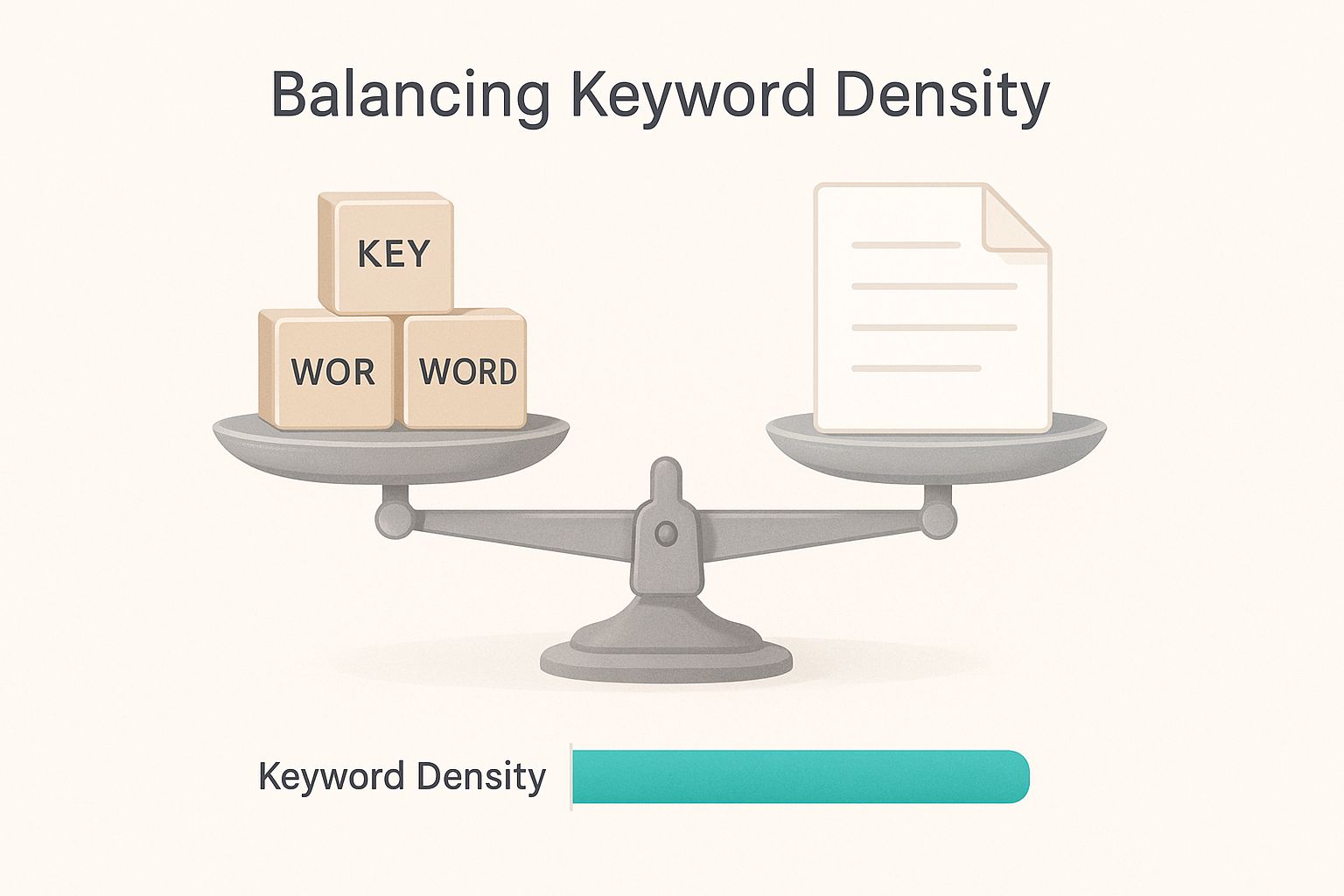
As you can see, the goal isn't to cram keywords everywhere. It's about finding a natural rhythm where the keywords support the main point of your content.
Weaving in Your Secondary Keywords
Once your primary keyword is locked into those high-impact spots, it’s time to weave in your secondary keywords. These are the supporting terms that add context and show search engines you're covering the topic in detail.
A good rule of thumb is to aim for roughly one to four SEO keywords per page, which often works out to mentioning a keyword variation every 100-150 words or so. This mix of primary and secondary terms shows you’re exploring the topic from all angles. If you want to dive deeper into this, Writesonic has a great breakdown on the subject.
Great keyword placement is invisible to the reader but crystal clear to search engines. The content should feel helpful and conversational, not "optimized."
Here are a few other fantastic places to sprinkle in those secondary and long-tail keywords:
- Subheadings (H2s, H3s): Use them to break up your article and introduce related sub-topics. It’s a perfect, natural fit.
- Body Paragraphs: Just drop them in where they make sense. If you're writing about a topic, these related terms should flow into your sentences without any effort.
- Image Alt Text: This is a huge one. Describe your images for screen readers and give search engines more context by including a relevant keyword.
- Internal Link Anchor Text: When you link to another page on your own website, use a keyword variation in the link text. It helps build a strong site structure.
How Content Length Affects Your Keyword Strategy
Let's be real: you can't cram an epic keyword strategy into a 500-word blog post. It just doesn't work. Think of it like packing for a trip. A short blog post is a carry-on bag—you can only fit the absolute essentials. A massive, 3,000-word ultimate guide? That's your oversized checked luggage. You have room to pack for every possible occasion.
The more you write, the more opportunities you naturally create to cover a topic from all sides. This is where the magic happens. You can effortlessly weave in a whole bunch of secondary and long-tail keywords without your writing sounding clunky or forced. Instead of just hitting one main keyword, you're suddenly answering dozens of related questions all in one place, which helps you show up for a much wider variety of searches.
Matching Word Count to Keyword Goals
So, what's the magic number? It totally depends on what you're writing. A quick blog update might naturally fit five to seven keywords. But a sprawling, in-depth guide can easily handle 20 or more without breaking a sweat.
This brings up the concept of keyword density. Don't get too hung up on this as a hard rule. Instead, think of it as a helpful guardrail to keep you from stuffing your content with keywords and sounding like a robot. It’s just a simple percentage to make sure you're staying focused on the reader. Getting this right starts with a solid foundation, which you can build by checking out our keyword research best practices guide.
Here’s a general guideline to help you visualize how word count and keyword count often scale together.
| Word Count | Typical Page Type | Suggested Total Keywords |
|---|---|---|
| 500 - 1,000 | Short Blog Post, FAQ Page | 5 - 10 |
| 1,000 - 2,000 | Standard Blog Post, Service Page | 10 - 15 |
| 2,000 - 3,000+ | Pillar Page, Ultimate Guide | 15 - 25+ |
Remember, this isn't a strict formula, but it's a fantastic starting point for planning your content.
The goal isn’t to hit a specific keyword density percentage. The true aim is to write such a thorough piece of content that the keywords appear naturally because they are essential to covering the topic well.
At the end of the day, you're writing for people, not just algorithms. The best way to make your keywords count is to learn how to write compelling website copy that actually connects with your audience. When you match your keyword ambitions to your content's length, you create something that both your readers and Google will love.
Let's Talk About What Really Matters: User Intent
If you’re still getting hung up on exactly how many keywords to cram onto a page, I’ve got some news for you: you're playing the wrong game. Modern SEO isn't about counting keywords; it’s about understanding user intent.
Think about it. When someone types something into Google, they have a goal. They're trying to solve a problem, find an answer, or buy something. Your job is to figure out that underlying why and give them exactly what they need.
Someone searching for "best running shoes for flat feet" isn’t just looking for a page that repeats that phrase a dozen times. They want a solution. They're looking for expert advice, real comparisons, and the confidence to make a good purchase. Answering their core need is what gets you to the top of the search results, not just matching their words.
This shift in focus is critical. In fact, the smart move is to cover about 90% of the user intent categories for a topic, not try to hit 90% of every possible keyword. If you want to dive deeper into this user-first mindset, the team at Moz has a fantastic guide on keyword research that’s well worth a read.
The Three Main Flavors of Search Intent
To get this right, you have to know what kind of mission the searcher is on. Generally, searches fall into one of three buckets, and each one demands a totally different type of content.
Informational Intent: These folks are in learning mode. Their searches often start with "how to," "what is," or "best way to." They want answers, tutorials, and straightforward explanations.
Navigational Intent: This is simple. The user already knows where they want to go and is just using Google as a shortcut. Think "RankHub blog" or "Amazon login."
Transactional Intent: This user has their wallet out (or is about to). They're ready to buy, sign up, or take action. You'll see words like "buy," "price," "discount," or "for sale" in their searches.
When you match your content to the user's intent, you naturally stop worrying about keyword counts and start creating pages that actually help people. That's what Google wants to see, and that's what gets rewarded with better rankings.
It just makes sense, right? A page targeting "how to choose hiking boots" (informational) should be a detailed, helpful guide. But a page for "buy waterproof hiking boots" (transactional) needs to be a product page with clear pricing and an easy way to check out. Once you put the user’s goal first, the right keywords practically fall into place.
A Few Common Questions About Keywords
Even when you think you've got your keyword strategy locked down, questions inevitably pop up. It happens to everyone. Let's walk through some of the most common ones I hear about keyword counts and SEO in general.

My goal here is to clear up that confusion so you can move forward with confidence.
What Exactly Is Keyword Stuffing?
Ah, keyword stuffing. It’s an old, black-hat SEO trick that just won't die. It’s the practice of jamming your main keyword into a page over and over again, hoping to trick search engines into ranking you higher.
It reads terribly. Something like: "We sell the best blue running shoes. Our best blue running shoes are the best on the market for anyone who wants best blue running shoes." It’s clunky, robotic, and a nightmare for the reader. Thankfully, search engines got wise to this years ago and will actually penalize your site for it.
Here's a simple rule of thumb: read your content out loud. If it sounds unnatural or forced, you're probably stuffing a keyword where it doesn't fit. Always write for humans first.
Can My Page Rank for Keywords I Didn’t Even Use?
You bet it can! This is where the magic of topical authority and semantic search comes into the picture. Google is way past just matching the exact words on your page to a search query. It’s smart enough to understand the meaning and context of your entire article.
When you write a genuinely helpful, in-depth piece on a topic, you'll naturally start ranking for all sorts of related terms, synonyms, and long-tail variations you never explicitly wrote.
For instance, if you publish a killer guide on "how to bake sourdough bread," you might also find yourself ranking for things like:
- "Sourdough starter feeding schedule"
- "What is a baker's lame"
- "Best temperature for baking bread"
Why? Because you've shown Google you’re an expert on the whole topic, not just one isolated keyword.
How Often Should I Update My Keywords?
Your keyword strategy shouldn't be a "set it and forget it" kind of thing. The web is always changing, and your content needs to keep up.
As a general guideline, I recommend doing a content audit every 6 to 12 months. Look at what's working and what isn't. Is your page still ranking for its primary keyword? Has the way people search for this topic changed? Are there new sub-topics you should cover?
If you're in a really competitive or fast-moving industry, you might need to check in quarterly. The main goal is to make sure your page continues to be the best, most relevant answer out there for your target audience.
Stop guessing and start ranking. RankHub analyzes your entire website in seconds, delivering a prioritized keyword strategy so you can focus on creating content that wins. Get started with RankHub today!
More from Our Blog
7 Content Writing Tools That Boost Your SEO Rankings
Discover the top 9 SEO content writing tools to automate drafting, optimization, and publishing. Boost rankings with AI-assisted workflows.
Read more →
Zoho Marketing Automation Explained: Is It Right for You?
Compare Zoho Marketing Automation vs HubSpot on pricing, features, ease of use, and automation depth. See which wins for small teams and solo founders.
Read more →
Looking for an SEO Company? Here Are Your Best Options
Compare top SEO companies, AI platforms, and agencies. Find the best fit for your budget, from $49/month tools to full-service retainers.
Read more →