
An SEO competitor analysis isn't just about sneaking a peek at who's ranking number one. It's a full-on strategic deep dive. We're talking about figuring out your goals, pinpointing who you're really up against in the search results, and then systematically digging into their keywords, content, and backlinks. The whole point is to use what you find to build an actionable plan that gets you better rankings.
Setting the Stage for a Winning Analysis
Before you even think about firing up your favorite SEO tool, let's get one thing straight. This isn't about corporate espionage; it's about gathering smart intel. You’re trying to understand the lay of the land in the search results so you can find the easiest path to the top. Without a clear goal, you’re just going to get lost in a sea of data. Of course, to make any sense of this, you need a solid grasp of the basics. If you're still a bit fuzzy, take a moment to understand What is SEO? at its core.
A good analysis starts with good questions. What are you actually trying to accomplish here?
Define Your Primary Goal
Every analysis needs a North Star. Are you about to launch a new feature and need to see who you'll be up against? Maybe your traffic has taken a nosedive, and you have a hunch a competitor is eating your lunch.
Your goal dictates everything that comes next. Here are a few common objectives I see:
- Win back lost rankings: Figure out which competitor knocked you off your perch for those money-making keywords.
- Find new content ideas: Uncover topics your audience is looking for that competitors are covering, but you've completely missed.
- Grow overall organic traffic: Get a bird's-eye view of the strategies that help top players pull in a huge audience.
- Strengthen your backlink profile: Find out which high-quality sites are linking to your rivals so you can get in on the action.
Seriously, just pick one main goal to start. It keeps you from getting bogged down in a purely academic project. You can always come back and run another analysis for a different purpose later on.
My Two Cents: Get specific. Don't just say, "I want to beat Competitor X." A much better goal is, "I want to identify the top five keywords Competitor X ranks for on page one where we're nowhere to be found, and then build a content plan to go after them." See? Now you have a real, actionable starting point.
Identify Your True SEO Competitors
This is a big one, and it’s where a lot of people trip up. Your direct business competitors—the ones who sell the same stuff as you—are not always your main SEO competitors.
Think about it this way: an SEO competitor is any website that’s fighting for your audience’s attention in Google for the same search terms.
Let’s say you run a small boutique hotel. Your business rivals are the other hotels down the street. But when someone searches for "best things to do downtown," you’re suddenly competing with travel blogs, city guides, and local news sites. They aren’t trying to book rooms, but they are absolutely dominating the search results you want to be in.
The easiest way to find them? Just Google your top 5-10 most important keywords. See which domains keep showing up on page one. Those are your real SEO rivals. Pick 3-5 of the most consistent players to focus on for your first analysis. This keeps things manageable and ensures the insights you gather will actually lead to results.
Uncovering Your Competitors' Keyword Secrets
Alright, you know who you’re up against. Now for the fun part—the detective work. This is where we stop just looking at our competitors and start digging into the exact keywords that are sending them all that sweet organic traffic.
The single most powerful tool in our arsenal for this is the keyword gap analysis.
Its goal is simple: find the valuable, high-intent keywords your competitors are ranking for that you’ve completely missed. This isn’t about just copying what they’re doing. It's about finding that sweet spot where their success and your opportunities overlap.
This graphic really breaks down how you can turn a long list of a competitor's keywords into your own, actionable content plan.
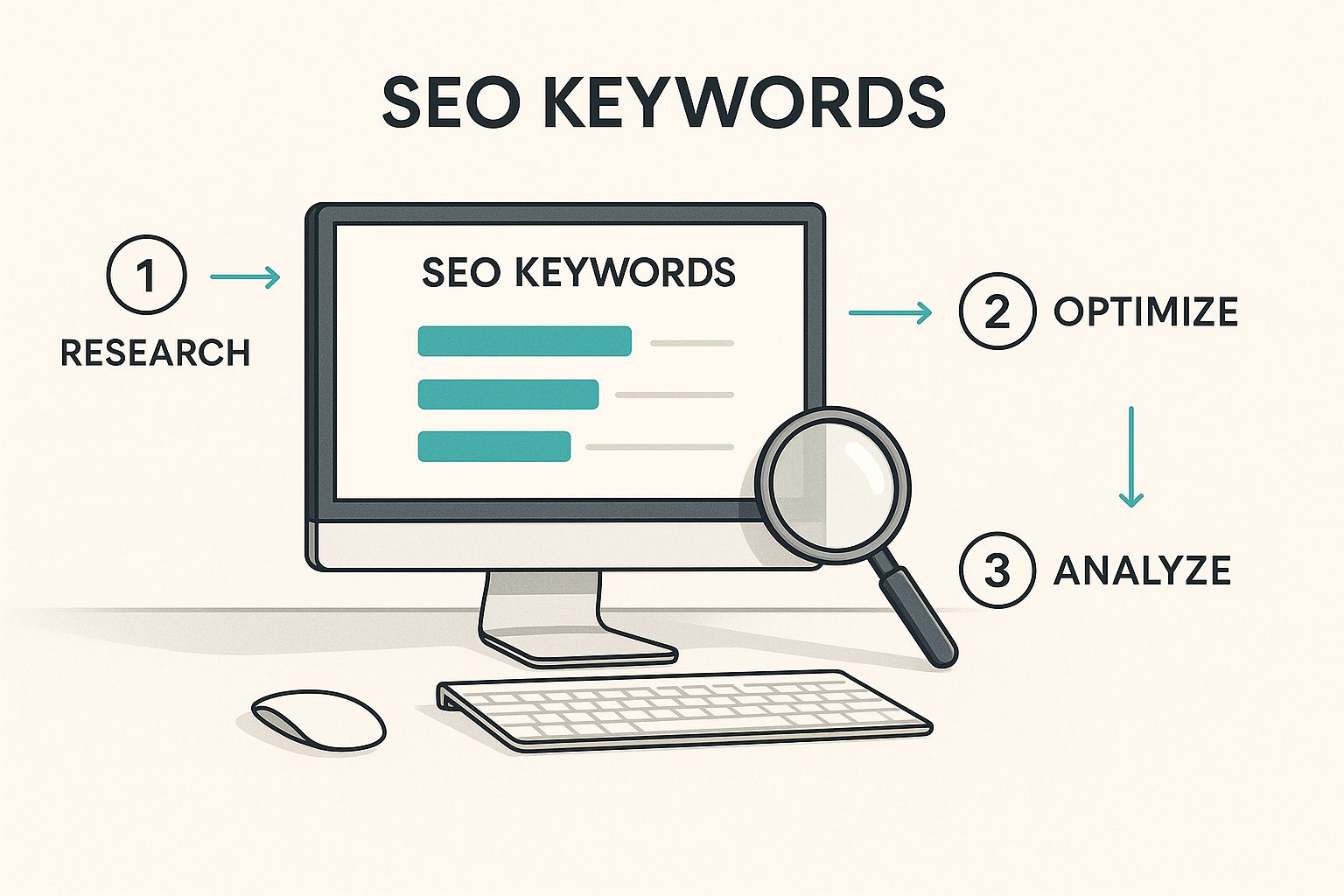
It’s all about finding what they rank for that you don't. That’s the starting line for building a smarter content strategy that actually gets results.
Finding the Keyword Gap
First thing's first: jump into an SEO tool like Semrush or Ahrefs and fire up a keyword gap report. All you have to do is plug in your domain and the domains of the 3-5 main SEO competitors you found earlier.
The tool will then spit out a massive list of keywords where they show up in search results, but you're nowhere to be found.
Don't freak out when you see the size of this list. The goal isn't to chase down every single term. We're about to pan for gold.
A huge "aha!" moment for many people is realizing their direct business rivals might not be their biggest SEO threat. For instance, I once worked with a SaaS company that found its true SEO competitors weren't the big, well-known brands in their space. Instead, it was a handful of smaller, niche blogs that were ranking for over 50 high-traffic keywords they had completely overlooked.
After they strategically created content to target these terms, they saw a 30% jump in organic traffic in just six months. It’s amazing what you can find when you look in the right places.
Prioritizing Your Keyword Opportunities
With that giant list of keywords in hand, it's time to filter and prioritize. This is how we turn a messy spreadsheet into a focused, get-it-done action plan.
I always sort potential keywords by looking at a few key things:
- Relevance: Is this keyword a perfect match for what you sell or do? A high-volume keyword that attracts the wrong crowd is just a waste of time.
- Search Volume: How many people are actually searching for this? This gives you a ballpark idea of the potential traffic on the table.
- Keyword Difficulty: How big of a fight will it be to rank? Most tools give you a score here to gauge the competition.
- Search Intent: What does the user really want? Are they just looking for information (informational), comparing their options (commercial), or ready to pull out their credit card (transactional)?
Looking at these factors together helps you build a real strategy instead of just chasing big, flashy numbers. If you want to dive deeper into this part of the process, our guide on how to do keyword research is a great next step.
Pro Tip: Don't get hypnotized by massive search volumes. Some of my clients' most profitable keywords get less than 100 searches a month, but they are so specific and high-intent that they convert like crazy.
Building Your Action Plan
Okay, you've got a prioritized list. Now the real work begins. It’s not enough to just know the keywords; you have to create something that actually deserves to rank for them.
To help you get from analysis to action, here's a quick framework I use to sort through the opportunities.
Competitor Keyword Gap Analysis Framework
This simple table can help you quickly decide what to do with the keywords you've found, ensuring you tackle the most impactful ones first.
| Priority Level | Keyword Type | Actionable Next Step |
|---|---|---|
| High | Transactional intent, low difficulty, high relevance | Create a dedicated landing or product page for this immediately. |
| Medium | Informational intent, medium difficulty, high relevance | Plan a comprehensive blog post or guide to build topical authority. |
| Low | Informational intent, high difficulty, moderate relevance | Add to a "nice-to-have" content idea list for the future. |
This framework helps you stop staring at data and start making moves. For every high-priority keyword you identify, just ask one simple question: "Can I create a piece of content that is 10x better and more helpful than what's ranking right now?"
If the answer is a resounding "yes," then you've just found yourself a winning opportunity.
Cracking the Code on Competitor Backlinks
If keywords are the map, then backlinks are the high-octane fuel for your SEO engine. A solid backlink profile sends a massive signal to Google that your site is a credible, authoritative source. By breaking down what your competitors are doing, you can uncover their exact link-building playbook and adapt it to fuel your own growth.

But this isn't just about counting links. A single, powerful link from a major industry publication can easily outweigh a hundred low-quality links from spammy directories. What we're really after is the quality and the strategy behind their links.
This whole game is only getting more competitive. The global SEO market was valued at a whopping $82.3 billion in 2023 and is projected to skyrocket to $143.9 billion by 2030. That tells you just how much everyone is investing to get an edge. And with Google still dominating over 90% of the search market, understanding every advantage—especially backlink strategy—is non-negotiable.
Spotting Their High-Authority Links
First things first, you need a bird's-eye view of where their best links are coming from. Jump into a tool like Ahrefs or Semrush, plug in a competitor’s domain, and you’ll get a firehose of data on every site linking to them.
Don't get overwhelmed. Your first move is to filter for their most powerful links. I always start by looking for backlinks from sites with high Domain Authority (DA) or Domain Rating (DR). These are the heavy hitters—the links from respected industry blogs, news outlets, and .edu or .gov sites.
Jot down a list of these top-tier domains. These are the relationships giving your competitor their biggest SEO boost.
Identifying Their Link-Building Patterns
Okay, now that you have a list of their best links, it’s time to put on your detective hat. How did they actually get these links? Sifting through their profile will reveal their go-to tactics.
You'll start to see patterns emerge. Keep an eye out for these common strategies:
- Guest Posting: Are you seeing multiple links from different industry blogs, all with author bios pointing back to your competitor's team? That’s a dead giveaway they have a solid guest posting program.
- Resource Page Links: Do a bunch of their links come from pages literally called "Helpful Resources" or "Useful Links"? This means they’re actively hunting down these pages and pitching to be included.
- Digital PR & Media Mentions: Are they getting quoted in news articles or popping up in industry roundups? This points to a real PR effort where they're providing expert commentary or unique data.
- Podcast Appearances: Check if links are embedded in podcast show notes. This is a fantastic and increasingly popular way to build relevant, high-quality links and a personal brand at the same time.
Once you spot these patterns, you know exactly where they’re focusing their efforts. If a competitor is crushing it with guest posts, that's a huge clue that it's a winning strategy in your niche.
A rookie mistake I see all the time is only looking at links pointing to a competitor's homepage. You have to dig deeper. Analyze which specific blog posts or pages are attracting the most links. This is how you find their "linkable assets"—those ultimate guides, free tools, or original research reports that people can't help but link to.
Finding Opportunities You Can Replicate
This is where the real magic happens—turning analysis into action. Now that you know how they're getting links, you can find opportunities to earn similar (or even better) ones for yourself. This isn't about "stealing" their links; it's about earning your own spot at the table.
For example, if you found your main rival landed five guest posts on top industry blogs, you now have a list of five publications that are clearly open to contributions. It's time to brainstorm your own unique article ideas and start pitching.
Or, if they’re listed on ten different resource pages, you can reach out to those same site owners. The key is to show them why your resource is an even better, more comprehensive fit for their audience. To get a complete picture of this whole process, check out our ultimate guide to competitor analysis in SEO for better rankings.
Here’s a simple way I like to organize these findings to create an outreach plan:
| Link Type | Competitor's Link Source | Your Target URL | Outreach Angle |
|---|---|---|---|
| Guest Post | IndustryBlog.com | Your Expert Guide | Pitch a fresh, data-driven take on a related subject. |
| Resource Page | NicheResources.net | Your Free Calculator Tool | Suggest adding your tool as a value-add for their readers. |
| Podcast | MarketingMindsShow.com | Your Homepage | Pitch yourself as a guest to discuss a recent industry trend. |
By systematically deconstructing your competitors' backlink profiles, you turn what feels like a monumental task into a clear, actionable roadmap for building your own site's authority.
Taking Apart Your Competitor's Content Strategy
Knowing your competitor's keywords tells you what they rank for. But digging into their content strategy tells you the far more important story of why they rank.
A great piece of content is the engine behind every high-ranking page. By looking under the hood of your competitor’s approach, you can figure out how to build something way better. This isn't just about skimming their blog for topic ideas; it's about understanding the strategic bets they're making to win over your shared audience.
Let's be real: strong SEO performance is almost never a fluke. It’s the result of a smart, intentional content plan. When you look past individual keywords, you start to see the bigger picture—how they're building authority and where they're placing their chips.
What Are Their Core Content Pillars?
Every solid content strategy is built on a handful of core topics, or what we call content pillars. These are the big, foundational subjects a business wants to be known for. Think of them as the main problems their customers have and the solutions they sell.
So, how do you find them? Just look for the patterns in their best-performing content. A quick browse through their blog categories or even their main website navigation often gives it away.
Are they constantly hammering topics like "startup project management" or "automating email campaigns"? Those recurring themes aren't an accident. Those are their pillars.
Spotting these pillars shows you exactly where they're focusing their energy and resources. It's like seeing their battle plan laid out on the table. This is gold because it helps you decide if you want to go head-to-head or find a less crowded angle of attack.
Figuring Out Their Winning Content Formats
Here’s a hard truth: not all content is created equal. The format—whether it’s a blog post, a video, a downloadable template, or an interactive tool—is a massive part of its success. A critical part of your analysis is documenting which content types are actually getting them traffic and shares.
Take a good look at their top pages in a tool like Ahrefs or Semrush. Are they getting all their wins from:
- Massive “Ultimate” Guides: Those super long, in-depth articles that cover a topic from A to Z.
- Listicles: "Top 10" or "7 Best" posts that are super scannable and easy to share.
- Case Studies: Real-world stories that show off their results and build a ton of trust.
- Free Tools or Calculators: Interactive goodies that give people instant value and pull in backlinks like crazy.
- Videos or Webinars: Engaging visual content that makes complicated stuff feel simple.
For example, if you see that your main competitor’s five highest-traffic pages are all detailed "how-to" guides, that's a huge tell. It means their audience loves practical, step-by-step instructions. If you try to compete with short, fluffy blog posts, you're going to get crushed.
My Two Cents: Your job is to match the content format to what the searcher actually needs. If someone's googling "how to fix a leaky faucet," they want a step-by-step guide with pictures or a video. A generic sales page will never win. Your competitors' successes show you which formats are already working for your audience.
Pouncing on Their Content Gaps
This is where it gets really fun. The best part of this whole process is finding the "content gaps"—all the valuable topics your competitors have completely ignored or the formats they haven't bothered to try. This is your opening.
A content gap can show up in a few different ways:
- Unanswered Questions: They wrote a big article on a topic but totally missed the specific, nitty-gritty questions people are actually asking. Google's "People Also Ask" box is a goldmine for finding these.
- Missing Formats: They have 20 blog posts about a topic but zero videos or infographics. If the subject is really visual, that's a massive opportunity for you to create something far more engaging.
- Stale, Outdated Content: Their top-ranking guide was written two years ago and is now full of broken links and old stats. You can easily swoop in by creating a fresh, comprehensive, and up-to-date version.
Once you have this intel, you can finally move from just analyzing to actually creating. All these insights are the perfect blueprint for building out your editorial calendar. If you want to dive deeper into turning these findings into a rock-solid plan, check out our guide on how to create a content strategy that actually works.
The goal isn't just to plug the gaps. It's to create content that is noticeably better, more helpful, and more valuable than anything they’ve ever published.
Choosing the Right Tools for Your SEO Analysis
Let's be real for a second. Trying to conduct a serious SEO competitor analysis manually is a one-way ticket to a massive headache and a ton of missed opportunities. To get the data you actually need to make smart decisions, having the right tools isn't a "nice-to-have"—it's a must.
Think of these platforms as your secret weapon. They let you peer over your competitor's shoulder (ethically, of course) to see exactly what's working for them. Without a good toolset, you're just guessing. With one, you're building a strategy based on cold, hard data.

A dashboard like this is your command center. It gives you that crucial at-a-glance view of the competitive battlefield and shows you exactly where you stand.
The Heavy Hitters in SEO Analysis
When you start looking at comprehensive SEO tools, you'll hear a few names pop up again and again. Each has its own personality and strengths, so the "best" choice really comes down to what you're trying to accomplish and what your budget looks like.
These aren't just simple data pullers anymore; they're incredibly deep analytics platforms. For instance, Semrush is a fantastic all-in-one suite that covers both SEO and PPC, which is why so many marketers love it. It's brilliant for finding keyword gaps, running backlink audits, and even getting a peek at your rivals' ad campaigns, with plans starting around $139.95 a month.
Let's quickly touch on the core strengths of the most popular options:
- Semrush: I think of this as the Swiss Army knife for digital marketing. It's my go-to for keyword gap analysis and seeing what competitors are doing with their paid search.
- Ahrefs: Honestly, nobody does backlinks better. If you’re serious about dissecting a competitor’s link-building strategy, Ahrefs is the undisputed king. Its backlink index is massive and incredibly fresh.
- Moz Pro: Known for being super user-friendly, Moz is perfect if you're looking for strong on-page SEO guidance and reliable rank tracking without a steep learning curve. Their educational resources are top-notch, too.
Matching the Tool to the Task
Here's the thing: just paying for a subscription won't magically give you an edge. You have to know what you're looking for and which part of the tool will help you find it.
The goal is to use these tools not just to collect data, but to find actionable stories within that data. A list of 1,000 keywords is useless; a prioritized list of 10 keywords your competitor ranks for with weak content is a goldmine.
To put it into practice, here’s a simple way to connect your goals to specific features:
| If You Want To... | Then You Need This Feature... | A Great Tool for It Is... |
|---|---|---|
| Find keywords you're missing out on | Keyword Gap Analysis | Semrush |
| Figure out their link-building strategy | Backlink Profile Explorer | Ahrefs |
| Make your own pages better than theirs | Site Audit / On-Page Grader | Moz Pro |
Picking your software is a big deal; it shapes your entire workflow. It's worth taking the time to explore some of the top marketing tools for analysis to see what fits your style best. At the end of the day, the right tool is the one that turns confusing data into clear actions that help you outrank the competition.
A Few Common Questions I Get Asked About SEO Competitor Analysis
https://www.youtube.com/embed/U02T9s3Woh8
When you first get into the weeds of competitor analysis, a few questions always bubble to the surface. Let's run through the ones I hear most often so you can move forward with confidence.
How Often Should I Actually Do This?
This isn't a "set it and forget it" task. Think of it as a living part of your SEO strategy.
I recommend doing a full, deep-dive analysis once a quarter. This is where you really dig into everything and look for major shifts in the search results.
But don't stop there. You should also be doing lighter, monthly check-ins. This doesn't need to be a huge time-suck. It could be as simple as keeping an eye on a core list of money keywords or seeing what new backlinks your top rivals have landed.
My Take: If you wait three months to discover a competitor launched a massive new content hub, you're already way behind. Regular check-ins let you spot threats and opportunities in near real-time.
This rhythm keeps you nimble and prevents you from getting blindsided.
Wait, Aren't Business and SEO Competitors the Same Thing?
This is a big one, and it trips a lot of people up. They are absolutely not the same.
A business competitor is who you'd traditionally think of—the company down the street selling the same thing you do. McDonald's and Burger King are classic business competitors.
An SEO competitor is any website that shows up for the search terms you want to own. They might not even sell a product.
Here’s a real-world example: A local plumber's business competitors are, of course, other plumbers in the area. But if someone searches "how to fix a leaky faucet," their SEO competitors are suddenly home improvement blogs, DIY YouTubers, and the content section of Home Depot's website. If you want to win in search, you have to beat your SEO competitors.
What's the Single Most Important Metric to Watch?
If you twisted my arm and made me pick just one, I'd say the keyword gap. It’s the most immediately useful piece of data you can get.
Why? Because it hands you a ready-made list of keywords that your competitors are getting traffic from, but you aren't even targeting.
Sure, things like domain ratings and the number of backlinks are important for understanding the big picture. But the keyword gap gives you a direct, actionable roadmap for your content plan. It literally shows you the conversations your audience is having that you're completely absent from. It's often the quickest path to closing the gap.
I've Gathered a Mountain of Data... Now What?
Awesome! But data is useless if you don't do anything with it. The most critical part of this whole process is turning that pile of insights into an actual battle plan. Don't let your hard work die in a spreadsheet.
I like to sort my findings into a few simple buckets:
- Keywords We Need to Target: A ranked list of terms we're going after next.
- Content to Create or Overhaul: Specific blog post ideas or pages on our site that need a major refresh.
- Link Building Hot List: A curated list of websites we need to get links from.
Don't just list them out. For each keyword, assign a priority. For every content idea, jot down a few notes on how you'll create something 10x better than what's already out there. For each link target, brainstorm a unique angle for your outreach. This is how you turn research into results.
Stop drowning in spreadsheets and start finding high-value keywords in under a minute. RankHub uses AI to read your entire website, understand your business, and deliver a prioritized list of keyword opportunities your competitors are missing. Get the insights you need without the manual work.
Start your AI-powered research on RankHub
More from Our Blog
7 Content Writing Tools That Boost Your SEO Rankings
Discover the top 9 SEO content writing tools to automate drafting, optimization, and publishing. Boost rankings with AI-assisted workflows.
Read more →
Zoho Marketing Automation Explained: Is It Right for You?
Compare Zoho Marketing Automation vs HubSpot on pricing, features, ease of use, and automation depth. See which wins for small teams and solo founders.
Read more →
Looking for an SEO Company? Here Are Your Best Options
Compare top SEO companies, AI platforms, and agencies. Find the best fit for your budget, from $49/month tools to full-service retainers.
Read more →