
So, you want to land a featured snippet. The core idea is simple: find the questions your audience is actually asking, and then give them a fantastic, direct answer.
A good rule of thumb is to identify those question-based keywords, structure your content with clean, logical headings, and then pop a concise, factual answer—think 40-60 words—right underneath the most relevant heading. It’s a surprisingly straightforward formula once you get the hang of it.
Why Bother With Featured Snippets Anyway?
Winning a featured snippet, often called "Position Zero," is a game-changer. It rockets your content straight to the top of the search results, often appearing even above the traditional number one spot.
Think of it as Google putting a gold star on your answer. It's an incredible way to boost your visibility and paint your brand as the go-to authority, sometimes without having to fight tooth and nail on every single technical SEO factor.
This isn't just vanity, either. We're talking about prime digital real estate with real benefits. As of 2025, featured snippets show up for a whopping 19.2% of Google searches. That means nearly one out of every five search queries triggers one of these answer boxes. Grabbing that spot can drive around 8% more traffic than a standard organic listing, which is a serious lift for any site.
The screenshot above is a perfect example of a list-based snippet. Google loves this format for "how-to" questions because it’s so easy for users to scan and understand. The big takeaway here is that Google didn’t just randomly pick this content; it chose it because the page was structured in a logical, step-by-step way that was easy for its algorithm to digest and present.
The Strategic Advantage of Position Zero
Nabbing a featured snippet is more than just a quick traffic win. It's a strategic play that seriously levels up your site's credibility in the eyes of both users and Google.
When your content gets that top billing, it sends a powerful message: your information is trustworthy and top-notch. This can kick off a chain reaction of good things:
- Skyrocketing Brand Authority: Suddenly, you're the definitive source for that topic.
- Better Click-Through Rates (CTR): Even when people don't click, your visibility is massive. But for those looking for more detail, you're the most obvious choice.
- Winning at Voice Search: Guess where voice assistants like Siri and Google Assistant pull their answers from? Yep. Featured snippets.
If you're ready to really dig in and make this happen, you'll find even more expert tips and proven strategies for featured snippet optimization that can walk you through the whole process.
To get you started, here's a quick cheat sheet of the core tactics.
Core Snippet Optimization Tactics at a Glance
This table breaks down the essential actions you need to take to start targeting featured snippets. Think of it as your quick-start guide to the fundamental pillars of this strategy.
| Tactic | Why It Works | Quick Example |
|---|---|---|
| Question-Based Keyword Research | Snippets exist to answer questions. Find what people are asking. | Instead of "social media marketing," target "how does social media marketing work?" |
| Direct Answer Paragraph | A concise, 40-60 word paragraph directly below a heading gives Google the perfect "snippet" to grab. | Place a clear definition of a term right under an H2 heading like "What Is [Term]?" |
| Structured Content (Lists/Tables) | Google loves formats that are easy to scan and present. Bullet points and numbered lists are gold. | Use a numbered list for a "how-to" guide or a bulleted list for "top benefits." |
| Logical Heading Hierarchy | Using H2s and H3s properly helps Google understand the structure and flow of your information. | An article about baking could have H2s for "Ingredients" and "Instructions," with H3s for each step. |
Mastering these basics is the foundation for consistently winning snippets. It's all about making your content as clear and useful as possible for both your readers and for Google.
Finding Snippet Opportunities Hiding in Plain Sight
You can't just stumble into a featured snippet. The real trick isn't just writing good content; it's about pinpointing the exact search queries where Google is already giving that prime real estate to someone else. This is where we go from basic keyword brainstorming to actively hunting for opportunities.
The easiest place to start? Questions. Think "how," "what," "why," and "can." These are your best friends because they signal that someone is looking for a quick, direct answer—which is exactly what featured snippets are designed to provide.
Uncovering Target Keywords
Your search for these golden opportunities is part old-school digging, part new-school tech. SEO tools like Ahrefs or Semrush are fantastic for this. You can take your existing keyword list and filter it down to only show the ones that already have a featured snippet. Just like that, you've got a list of SERPs where you know Google wants to show a snippet.
But don't just rely on the tools. A simple Google search can be just as powerful. Pop in one of your main topics and look for the "People Also Ask" (PAA) box. This is basically Google handing you a cheat sheet of what people are actually wondering about.
Pro Tip: Think of every single "People Also Ask" question as a potential featured snippet waiting to happen. A killer strategy is to weave answers to several of these PAA questions into one big, helpful article. You could end up snagging multiple snippets from a single piece of content.
Let's say you search for "how to repot a plant." You'll almost certainly see PAA questions pop up, like:
- When is the best time to repot a plant?
- Should you water a plant right after repotting?
- What kind of soil do you use to repot plants?
Boom. Each one of those is a perfect H3 subheading for your article. Just place a clear, concise answer right below it. This is a fundamental part of learning how to do keyword research for today's SEO.
Focus on High-Intent Questions
While any question is a good starting point, some are pure gold. A 2020 study that looked at millions of keywords found that featured snippets showed up for 12.29% of all searches. But here's the kicker: a whopping 77.6% of snippets were triggered by "why" questions. This tells you that content that clearly explains the reason behind something has a massive advantage. You can dig into more snippet statistics on My Codeless Website.
So what does this mean for you? Prioritize keywords that are all about explanations. When you come across a query like "why are my plant's leaves yellow," you know you're onto something big.
The next move is to check out the competition. Look at the content that currently owns the snippet. Is their answer rambling and long-winded? Is it hidden in a wall of text? Is the formatting a mess? That's your chance to swoop in with something that's clearer, better organized, and way more helpful.
Structuring Your Content to Win Snippets
Having the right information is a great start, but it's not enough. You have to present it in a way that Google can easily grab and feature. Honestly, the structure of your content is probably the single most important factor here. You're essentially creating the perfect little cheat sheet for Google's crawlers.
The backbone of this is a smart, logical hierarchy of headings—think H2s and H3s. Each heading should act like a signpost, framing a specific question your audience is asking. This guides both real people and search engine bots through your article. If you want to go deeper on this, digging into various on-page optimization techniques is a must.
Creating the Perfect "Snippet Bait"
One of the most effective tricks in the book is creating what we call "snippet bait." It's a simple concept: you write a dedicated, super-concise paragraph placed right under a question-based heading.
The magic number for these paragraphs is somewhere between 40 and 60 words. Why? It's just long enough to provide a complete answer but short enough that Google can lift it directly into the search results without cutting it off. Your goal is to write a definition or answer so crisp and clean it could have been pulled straight from a dictionary.
This simple visualization breaks down the process of structuring your content to win snippets, from initial research to final formatting.
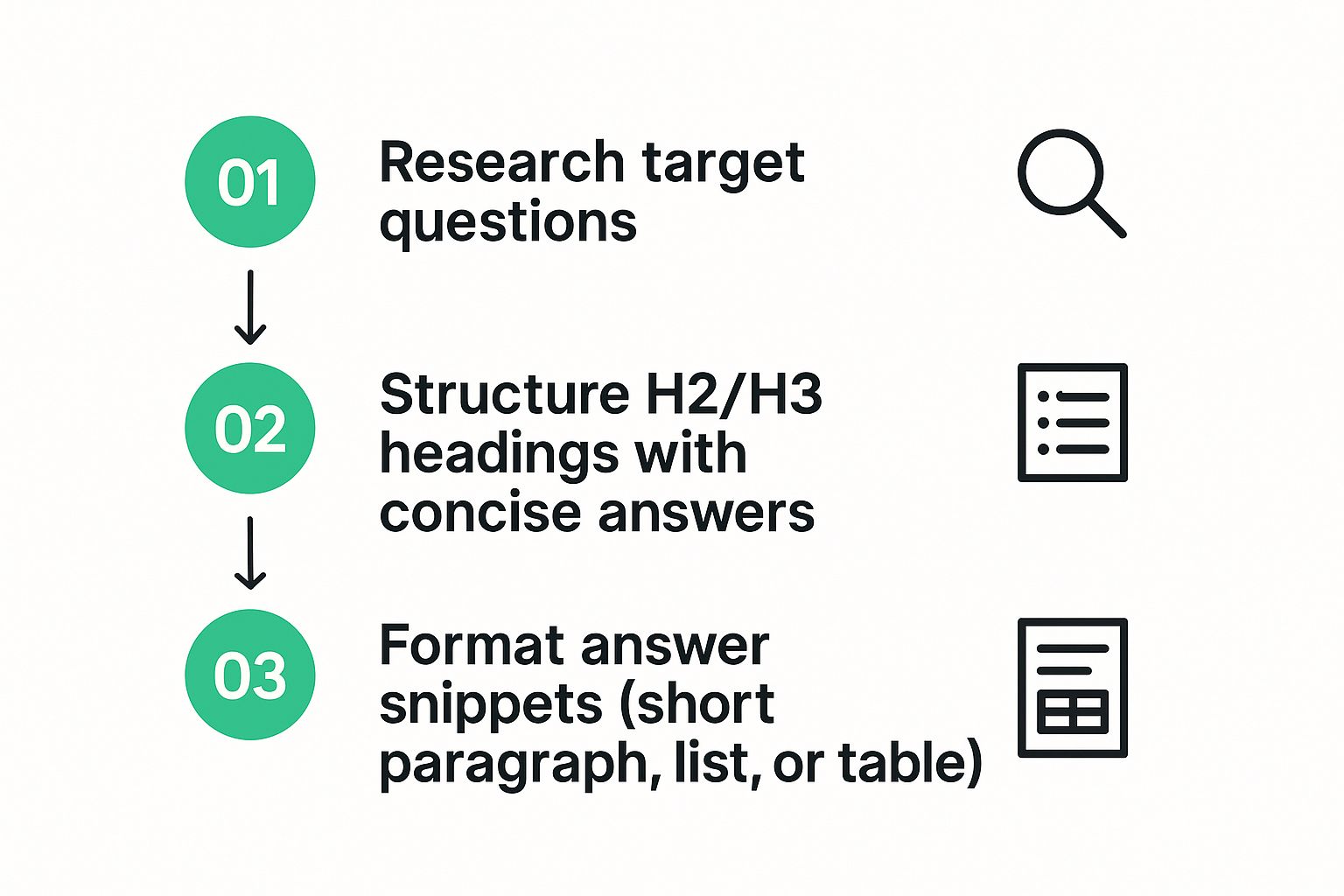
As you can see, it all comes down to connecting the questions people are asking directly to your headings and the snippet-ready formats that follow.
How to Format Lists and Tables for Google
Paragraph snippets are great, but don't forget about lists and tables. Google loves to feature these for queries that involve steps, comparisons, or any kind of structured data.
For these formats, clean HTML isn't just a nice-to-have; it's essential. Google has to be able to parse your code effortlessly to understand the structure.
Let's look at a quick before-and-after for a simple list.
Messy HTML (What to Avoid):
A classic mistake is just using manual line breaks <br> inside a paragraph tag. It looks okay to a human, but it’s a mess for a crawler.<p>Step 1 - Mix ingredients<br>Step 2 - Bake at 350<br>Step 3 - Let it cool</p>
Clean HTML (The Right Way):
Using the proper <ul> for bullet points or <ol> for numbered steps, along with <li> for each item, makes your structure perfectly clear.
- Mix ingredients
- Bake at 350
- Let it cool
This same logic applies to tables. Always use standard <table>, <tr>, and <td> tags to lay out your data. This simple, organized structure dramatically increases the odds of Google pulling your information for a table snippet.
Formatting for snippets isn't just about making your content look good—it's about engineering it to be easily understood by search engines. To make this even clearer, here's how different formats stack up.
Snippet-Friendly Formatting Comparison
| Snippet Type | Standard Formatting | Optimized Formatting |
|---|---|---|
| Paragraph | Long, rambling paragraphs that mix multiple ideas. | A tight, 40-60 word paragraph directly answering a question. |
| Numbered List | A paragraph describing steps, or a list using dashes or line breaks. | A proper HTML ordered list (<ol>) with <li> tags for each step. |
| Bulleted List | A comma-separated list within a sentence, or a "list" using asterisks. | A proper HTML unordered list (<ul>) with <li> tags for each item. |
| Table | Data presented in paragraphs or with inconsistent spacing. | A well-structured HTML <table> with clear rows (<tr>) and data cells (<td>). |
By mastering these structural elements, you're no longer just writing content. You're strategically building it to land that coveted "position zero."
Adapting Your Strategy for AI Overviews

The SERPs are changing. That classic featured snippet we’ve all been chasing isn’t the only game in town anymore. With the rollout of AI Overviews, what it means to be at the top of Google is getting a major facelift. Your old playbook might not cut it.
This isn't about throwing out everything you know. It's about a strategic shift. We're moving from targeting a single, perfect answer to building out comprehensive, multi-faceted content. The new goal? Make your content so thorough and authoritative that it becomes a go-to source for these AI-generated summaries.
The New Position Zero
So, what exactly are AI Overviews? Think of them as Google's attempt to stitch together the best bits of information from several top-ranking pages into one single, cohesive answer right on the results page. Instead of just pulling a neat paragraph from your site, the AI is now a curator, grabbing key points from multiple sources to build what it thinks is the ultimate response.
This change isn't a small one. We're seeing some pretty dramatic numbers. Recent data shows that a whopping 83% of traditional featured snippets have been replaced by AI Overviews. This has helped push zero-click searches up by 71%. For some niches, like health, the replacement rate is a staggering 94%. It's a clear sign of how quickly this is all moving.
What this means for us is that our content can't just be good. It has to be an undeniable authority. To really get ahead of this, it's worth taking the time to gain a deeper understanding of generative AI, since that's the engine driving all of this.
The name of the game is to become an indispensable source. You want the AI to look at your content and see it as a foundational piece of the puzzle it’s building for the user.
Evolving Your Optimization Efforts
To start winning with AI Overviews, you need to double down on depth, clarity, and authority. Here’s how you can start tweaking your featured snippet strategy for this new AI-driven world.
Build Real Topical Authority: Don't just answer one question. Create entire content clusters that cover a core topic from every conceivable angle. Think about all the related sub-topics and follow-up questions a user might have. This is how you signal to Google that you’re the expert in the room.
Get Serious About Factual Accuracy: AI models are trained to value well-researched, factual content. Back up your claims. Cite your sources. Link out to other authoritative websites. This isn't just good for SEO; it builds trust with your readers and the AI.
Structure for Both Humans and Robots: Keep using clean headings (H2s, H3s) and structured data—that's still crucial. But now, you also need to make sure the narrative of your content flows logically. Connect the dots between different ideas and answers to provide the rich context an AI needs to understand the bigger picture. If you're looking for ways to streamline this process, our guide on https://rankhub.ai/blog/how-to-use-ai-for-seo has some great pointers.
Technical SEO Tweaks That Boost Your Snippet Chances
While amazing content and smart formatting do most of the heavy lifting, a few behind-the-scenes technical SEO tune-ups can really give you an edge. Think of these as the finishing touches that signal to Google your site isn't just helpful, but also well-built and authoritative.
These tweaks can be the final push your content needs to land in that coveted "position zero."
One of the most powerful tools you have for this is Schema markup. It’s basically a special vocabulary you add to your site’s code that helps search engines understand what your content is about. Don’t let the word "code" scare you off; you don't need to be a developer to pull this off.
Getting a Hand from Schema
When you're chasing snippets, two types of Schema are your best friends: FAQPage and HowTo.
- FAQPage Schema: This is a no-brainer for any page structured around questions and answers. It explicitly tells Google, "Hey, this content directly answers these specific questions," making it a perfect match for those Q&A-style snippets.
- HowTo Schema: If your content walks someone through a process step-by-step, this is the one you want. It neatly packages your instructions in a way Google can easily grab and display as a numbered or bulleted list.
Putting this into practice is surprisingly simple. You can use a free tool like the Schema Markup Generator to do the hard work for you. Just plug in your questions and answers (or your steps), and it will generate a script you can paste right into the <head> section of your page.
By clearly labeling your content with Schema, you're not just hoping Google figures it out on its own. You're handing it a blueprint. This cuts through the noise and dramatically improves your odds of getting featured.
Beyond Schema, a few other technical fundamentals are non-negotiable. Page speed is a big one. Google’s own data shows that when a page’s load time jumps from one to three seconds, the bounce rate spikes by 32%. Featured snippets are all about delivering quick answers, and a slow-loading site completely undermines that experience.
Mobile-friendliness is just as critical, especially since so many searches happen on phones.
Finally, let's talk about your internal linking strategy. When you consistently link from your related blog posts back to a central "pillar" page on a topic, you're sending powerful signals to Google. It shows which page you consider the ultimate authority.
This tactic helps funnel link equity and essentially tells Google, "This is the most important page we have on this subject." A smart internal linking structure is a subtle but incredibly effective way to guide both users and search engines to your most snippet-worthy content. As you build out these topic clusters, you might want to dive deeper into how many keywords for SEO to use on a page to make sure every piece is perfectly optimized.
Holding Onto Your Hard-Earned Featured Snippets
That feeling when you finally snag a featured snippet? It's awesome. But don't pop the champagne just yet. Holding onto that prime "position zero" spot is a whole new ball game. Think of it less like a finish line and more like becoming the defending champion—everyone is gunning for your title.
You’ve got to switch from offense to defense. This isn't a "set it and forget it" kind of win; it's about actively protecting your turf and making sure that snippet becomes a long-term asset, not a fleeting victory.

Keep a Close Eye on Performance
So, how do you know if your snippet is actually doing its job? Your first port of call should always be Google Search Console. It’s packed with the raw data you need. Dive into the performance report and filter for the specific query you won the snippet for. You’ll want to watch clicks and impressions like a hawk.
Ever see a huge number of impressions but a disappointingly low click-through rate (CTR)? It’s a classic sign that your snippet is so good it answers the entire question right there in the SERP. While that’s great for brand exposure, it doesn't help get people to your site. You might need to adjust your "snippet bait" to leave them wanting a little more, teasing the deeper info that awaits them after the click.
If you want to get a bit more sophisticated, tools like Semrush or Ahrefs are fantastic for this. You can set up alerts that email you the second you lose a snippet. This is a game-changer because you can react immediately instead of stumbling upon the loss weeks down the road.
Defending a featured snippet is rarely about a massive content overhaul. It’s all about small, consistent tweaks. A quick data update, a refreshed example, or a clearer sentence can be all it takes to keep your content fresher and more valuable than the competition.
Your Go-To Content Refresh Checklist
I make it a habit to check in on my snippet-winning content at least once a quarter. It's a simple, non-negotiable routine that helps me stay ahead.
Here’s a quick checklist I run through:
- Update Your Data: Are you citing stats from last year? Find the latest numbers. Just adding the current year to your content sends a powerful signal to Google that your information is fresh.
- Hunt Down Broken Links: Nothing says "this page is neglected" like a link that goes to a 404 error. Run a quick crawl and fix any dead ends.
- Spy on the New Winner: If you got booted from the top spot, it's time for some recon. Look at the page that replaced you. How is their answer structured? Is it more concise? Did they use a list where you used a paragraph? Learn from their win.
- Sharpen Your "Snippet Bait": Read your answer out loud. Can you make it punchier? Can you cut a few words to make it even more direct? Go for it.
Running through these quick checks on a regular basis makes your content a much harder target for competitors to take down. It shows Google that you're actively maintaining the best answer out there.
Featured Snippet FAQs
Alright, you've got the strategy down, but a few questions always seem to pop up when you're deep in the trenches of snippet optimization. Let's clear the air and tackle the ones I get asked most often.
How Long Does It Take to Actually Get a Featured Snippet?
This is the big one, isn't it? The honest answer is: it really depends. I’ve personally seen brand new content grab a snippet in less than a week. On the flip side, I've worked on pages that took a few months of patient tweaking to finally get there.
A few things can speed up or slow down the process:
- Your Site's Authority: If Google already sees your site as a trusted source, it's going to notice and feature your new, optimized content much faster.
- The Competition: Trying to steal a snippet for a high-traffic term from a household name is a marathon. Targeting a less competitive, long-tail question can get you a quick win.
- Google's Crawl Rate: How often does the Googlebot swing by your site? The more frequently it visits, the sooner it will see the changes you've made.
As a rule of thumb, if your page is already hanging out on the first page of Google, you could realistically see it pop into the snippet box within a few weeks of optimization.
The absolute non-negotiable? You have to be on page one. The data is overwhelming on this: over 99% of all featured snippets are pulled from the top 10 results. So, focus on solid, foundational SEO first. The snippet is the prize for already being a top contender.
Can You Lose a Featured Snippet Once You've Won It?
Oh, absolutely. And it stings when it happens. Winning a featured snippet is more like renting than owning; you don't get a permanent deed to that prime real estate.
Google's algorithm is always on the lookout for a better, clearer, or more current answer. A competitor could come along with a fantastic piece of content that's better structured or more up-to-date, and just like that, they can snatch the spot right from you.
This is exactly why you can't just "set it and forget it." Keeping an eye on the snippets you hold is critical. If you see one disappear, your first move should be to pull up the new winner and see what they're doing differently. Did they use a better format? Is their data fresher? Figure it out, then improve your page to take it back.
Do Featured Snippets Really Matter for Voice Search?
Yes, they matter a lot. Think about it: when you ask Google Assistant, Siri, or Alexa a question, where does that answer come from? More often than not, the device reads the featured snippet out loud.
In a way, optimizing for featured snippets is optimizing for voice search. You're crafting the perfect, bite-sized, conversational answer that an AI assistant can easily read back to a user. As more and more people use voice commands to get information, owning that snippet means your brand's voice is literally the one providing the answer. It's a massive advantage.
Ready to stop guessing and start winning? RankHub analyzes your entire site in seconds to find high-value keyword opportunities your competitors are missing. Get actionable, AI-driven strategies without the complexity. Try it now at https://www.rankhub.ai.
More from Our Blog
7 Content Writing Tools That Boost Your SEO Rankings
Discover the top 9 SEO content writing tools to automate drafting, optimization, and publishing. Boost rankings with AI-assisted workflows.
Read more →
Zoho Marketing Automation Explained: Is It Right for You?
Compare Zoho Marketing Automation vs HubSpot on pricing, features, ease of use, and automation depth. See which wins for small teams and solo founders.
Read more →
Looking for an SEO Company? Here Are Your Best Options
Compare top SEO companies, AI platforms, and agencies. Find the best fit for your budget, from $49/month tools to full-service retainers.
Read more →