
Ever heard the term "keyword gap analysis" and felt a little intimidated? Don't be. It sounds way more complicated than it actually is.
Think of it as some good old-fashioned SEO detective work. You're essentially finding out which valuable keywords your competitors are ranking for in search results, but you aren't. It’s a straightforward way to uncover a goldmine of content ideas you’re completely missing out on.
What Is Keyword Gap Analysis Anyway?

Let's break it down. At its heart, keyword gap analysis is about ethically spying on the search terms that are already sending traffic to your competition. You take that list of keywords and hold it up against your own.
The whole point is to find the holes in your content strategy. Where are the gaps? This isn't about guesswork; it's about creating a data-backed roadmap to fill those gaps with smart, targeted content. No more throwing spaghetti at the wall to see what sticks. This is precision.
Why Finding These Gaps Is a Game-Changer
Running a keyword gap analysis is a foundational move for any serious content plan, especially if you're in a crowded niche. It’s not about being jealous of your competitors' rankings—it’s about turning their success into your strategic advantage. The insights you get can sharpen both your SEO and paid ad campaigns by focusing on what's already proven to work.
Specifically, this kind of analysis helps you:
- Find Untapped Topics: You'll uncover entire subject areas your audience is searching for that you haven't even considered.
- Prioritize Your To-Do List: It helps you spot keywords with that sweet-spot combination of decent search volume and realistic ranking difficulty.
- Learn Your Audience's Lingo: You get to see the exact phrases and questions your potential customers are typing into Google.
- Steal Market Share: This is your chance to strategically intercept traffic that's currently heading straight to your rivals.
This isn't just about collecting a list of keywords. It's about truly understanding the competitive landscape. You'll see what you're missing, but you'll also see where your competitors are strong, which gives you a much clearer path forward.
A keyword gap analysis provides some seriously immediate benefits. It's one of those rare SEO tasks where you can quickly move from data to action.
Keyword Gap Analysis Quick Wins
| Benefit Type | What You Gain |
|---|---|
| Content Strategy | A data-backed backlog of content ideas that are already proven to attract your target audience. |
| Competitive Insight | A clear picture of your competitors' SEO strengths and weaknesses. |
| Audience Understanding | Direct insight into the exact language, questions, and pain points of your potential customers. |
| Traffic Growth | A prioritized roadmap for capturing low-hanging-fruit keywords and boosting organic traffic. |
| Resource Efficiency | You stop wasting time on content that might work and focus on topics with proven demand. |
As you can see, the value goes far beyond a simple keyword list. It’s about making smarter, more efficient decisions across the board.
Turning Raw Data Into Real Growth
The real magic happens when you turn this analysis into action. Systematically finding and targeting the keywords your competitors own is a reliable way to boost your own organic visibility. In fact, some studies suggest that a well-executed strategy based on these findings can lead to a 25-30% jump in organic traffic in just a few months. You can dig into more details on how this competitive strategy plays out over at NetworkSolutions.com.
Ultimately, a keyword gap analysis swaps confusion for clarity. It gives you an evidence-based hit list of content to create, ensuring your marketing resources are spent wisely for maximum impact and sustainable growth.
Pinpointing Your True SEO Competitors
Before you can find any keyword gaps, you first need to know who you’re really competing against in the search results. This is a crucial step where a lot of people go wrong. It’s easy to assume that your direct business rivals are your main SEO adversaries, but the SERPs often tell a different story.
Think about it this way: a local boutique hotel’s business competitor is the big chain hotel down the street. But on Google? They’re probably fighting for rankings with TripAdvisor, major travel blogs, and even local news sites that have a "best places to stay" guide. These are your content competitors—they're all vying for the same eyeballs, even if they aren't selling the same exact thing.
Finding Competitors Beyond the Obvious Suspects
So, the first real job is to build a list of who you're actually up against online. A great way to get your head in the right space for this is by building a comprehensive competitor analysis framework. It pushes you to think beyond just your product or service rivals.
Honestly, a simple Google search is your best friend here. Pop your most valuable keywords into the search bar and see who consistently lands on page one. Those are the sites you need to pay attention to.
Your list will probably be a mix of a few different types:
- Direct Competitors: Yep, the ones who sell what you sell. They’re still important.
- Content Competitors: Niche blogs, industry publications, or review sites dominating your topics.
- Aspirational Brands: The big dogs in your industry whose SEO game you admire and want to learn from.
Don't get tunnel vision and only focus on the companies you know. The real goal is to find any domain that’s grabbing your audience's attention for the searches you care about. Getting this right from the start makes your entire analysis so much more powerful.
Let RankHub Do the Heavy Lifting for You
Once you have a few ideas, a tool like RankHub can really open your eyes and show you competitors you didn’t even know existed. You can run an initial analysis, and RankHub will often suggest other domains that keep showing up for the same keywords you're tracking.
This is where the picture of your competitive landscape starts to get crystal clear. If you're drawing a blank on which keywords to even start with, taking a step back and reviewing the fundamentals of how to do keyword research can give you a much stronger foundation.
Inside the RankHub dashboard, you just plug in your domain next to the competitors you've found. The tool immediately starts comparing your keyword footprints. Right away, you get a visual breakdown of shared, missing, and untapped keywords. This instantly tells you if you picked the right competitors and points you straight toward the biggest opportunities.
Alright, you've got your list of true SEO competitors. Now for the fun part. This is where we roll up our sleeves and start the real detective work.
Let’s fire up RankHub’s Keyword Gap tool. The first step is simple: pop in your own domain, then plug in the competitor domains you just identified.
Once you hit "Analyze," RankHub crunches the numbers, pitting your keyword profile against theirs. What you get back isn't just a boring list of terms. It's a strategic map that pinpoints the exact holes in your content strategy. The initial dashboard gives you a fantastic, at-a-glance view of where you stand.
You’ll see a clean, visual breakdown of your keyword opportunities, much like this:
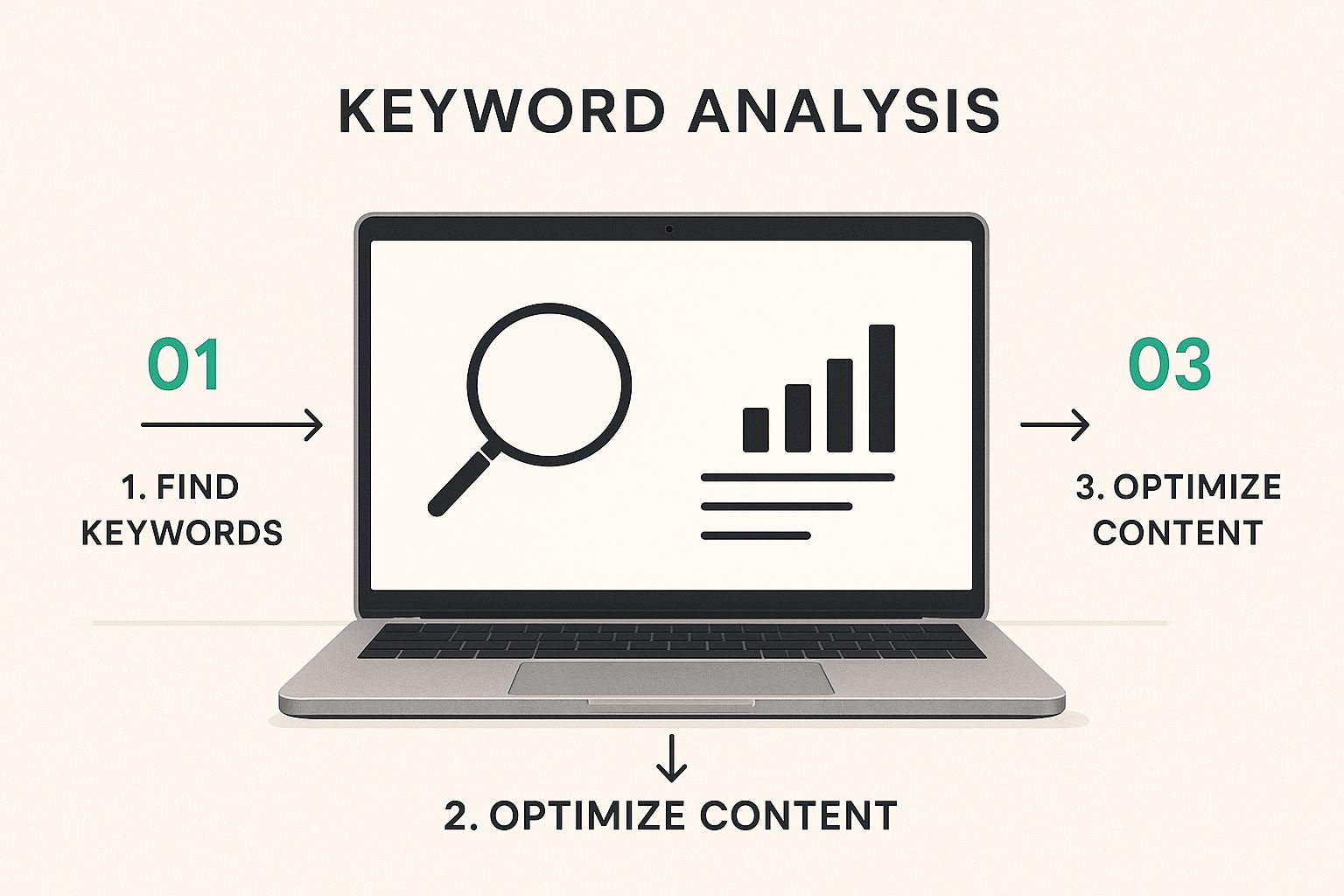
The immediate benefit of a view like this is clarity. You instantly see where your biggest content gaps—and therefore, your biggest opportunities—are hiding.
Interpreting Your Keyword Opportunities
The results page is where the magic happens. It sorts all that raw data into a few critical buckets. Knowing what these mean is the key to turning this analysis into a concrete action plan.
Let’s stick with our example from before. Imagine you run a new online course platform and you’re analyzing heavy hitters like Coursera and edX. Your results will likely fall into a few categories, and it's crucial to know how to react to each one.
Here’s a quick reference table to help you decode what you’re seeing in RankHub.
| Common Keyword Gap Categories in RankHub |
| :--- | :--- | :--- |
| Gap Category | What It Means | Action to Take |
| Missing Keywords | Your competitors rank for these keywords, but you don't show up at all. These are pure, untapped opportunities. | Create new, targeted content from scratch to address these topics. |
| Weak Keywords | You both rank, but your competitors are outperforming you (e.g., they're on page 1, you're on page 3). | Optimize your existing content. Improve on-page SEO, add depth, or update it to make it more competitive. |
| Strong Keywords | You’re outranking your competitors for these terms. These are your wins. | Protect these rankings. Keep the content fresh and build internal links to it. |
| Shared Keywords | You and your competitors are both ranking, often in similar positions. These are the battlegrounds. | Monitor these closely. Look for opportunities to gain a slight edge through content updates or link building. |
Understanding these distinctions helps you prioritize your efforts effectively. Instead of just chasing every keyword, you can focus on the actions that will deliver the most impact.
A keyword gap analysis isn’t just about finding what you’re missing. It’s a powerful tool for competitive benchmarking. You’re no longer guessing what works for your rivals; you're seeing the exact terms that fuel their organic traffic.
And this isn't just theory. The proof is in the numbers. One 2024 industry survey found that nearly 75% of companies see this as an essential part of their strategy. The data suggests that closing these gaps can boost organic traffic by as much as 35%, simply by creating content that your audience is already looking for.
Turning a Massive List into a Smart Strategy
After the analysis, you're going to be staring at a potentially huge list of keywords. Don't get overwhelmed. The next step is all about filtering this data down to find the real gems.
This is where you zero in on the low-hanging fruit. I always start by filtering for terms with a decent search volume that aren't hyper-competitive. Think "high-reward, low-effort."
For instance, our hypothetical course provider might discover that competitors rank for "best project management certificate," but they have no content on it. Boom. That's a clear signal to create a comprehensive guide on that very topic.
While the process itself is straightforward, the real skill comes from choosing the right keywords to pursue. If you want to get better at that part, our guide on keyword research best practices is a great place to start. It’ll give you a solid foundation for making smarter choices.
Turning Raw Data Into an Actionable Content Plan
https://www.youtube.com/embed/dSS0EyvC1bM
Alright, so you’ve run the analysis and now you're staring at a spreadsheet with thousands of keywords. It’s a bit much, right? It's just a wall of noise. This is where the real work—the smart work—begins. We need to turn that raw data into a clear, prioritized content plan your team can actually get behind and execute.
The goal here isn't just to find keywords; it's to find the right keywords. We're moving from a giant, messy list of possibilities to a focused content calendar that directly supports your business goals. It’s all about making smart, deliberate choices.
Prioritizing Your Keyword Opportunities
Let's be real: not all keyword gaps are created equal. Some are golden opportunities just waiting for you, while others are complete distractions. Your first job is to cut through the noise and sort them intelligently. Don't just chase the biggest search volume numbers—that's a rookie mistake. A more balanced approach always wins.
I always filter my keyword list using three main criteria:
- Business Relevance: How directly does this keyword connect to what you sell? A keyword with tons of traffic is worthless if it brings in people who will never buy from you.
- Search Volume: Is a decent number of people actually searching for this? You're looking for a sweet spot. It doesn't have to be a massive number, just enough to make a difference.
- Keyword Difficulty (KD): Can you actually win this one? I always tell people to start with keywords that have lower KD scores. These are your low-hanging fruit, perfect for building momentum and getting some quick wins.
Let's say you sell artisanal coffee beans. The keyword "how to brew pour-over coffee" (Volume: 5k, KD: 25) is a fantastic target. It’s specific, relevant, has solid search volume, and is way more achievable than a monster keyword like "coffee" (Volume: 1.2M, KD: 95).
From Keywords to Content Clusters
Okay, once you have that prioritized list, it's time to start grouping related keywords into thematic clusters. This is a game-changer. It helps you build real authority on a topic and lets you create deeper, more helpful content that your audience will love.
Think of it like a wheel and spoke model:
- The Hub: This is your big, main topic—often a broader, higher-volume keyword. This will be your pillar page or cornerstone guide.
- The Spokes: These are all the specific, long-tail keywords that branch off from that main topic. Each one of these can become its own supporting blog post, a detailed FAQ, or even just a section within your main pillar page.
This whole approach shifts you from writing random, one-off blog posts to building an interconnected web of content. It’s a huge signal to search engines that you’re an expert on the subject, which helps the entire cluster of pages rank better.
What's great is that this clustering method is also a huge time-saver. By focusing your efforts on keywords your competitors have already proven are valuable, you slash your research time. I’ve seen reports that this strategy can save 30-40% of the time and resources that teams normally sink into keyword research. You can read more about this efficiency boost on seranking.com.
Building Out Your Content Calendar
Now for the fun part. With your keyword clusters all mapped out, you can start plugging them into your content calendar. Give each cluster a priority level based on how much it can impact your business. For every cluster, you should have a plan for the main hub page and all the supporting spoke content.
This is how you turn a theoretical analysis into a real, actionable roadmap. You’ll know exactly what to create, why you're creating it, and how it all fits into your bigger SEO picture.
And remember, once you’ve published everything, you're not done. The crucial final step is a solid content performance analysis to see what actually worked. This closes the loop, gives you a ton of insight, and helps you refine your strategy for the next round.
Common Mistakes to Avoid in Your Analysis

A keyword gap analysis feels like you’ve been handed a treasure map. The path to SEO gold seems clear, but it's surprisingly easy to take a wrong turn. Trust me, I've seen it happen countless times. Steering clear of a few common mistakes right from the get-go will save you a world of headaches and help you build a strategy that actually works.
Think of this section as my "things I wish someone told me" list. The biggest and most common blunder? Picking the wrong competitors. We touched on this earlier, but it’s worth repeating: your biggest business rival isn’t always your top SEO enemy. For a much deeper look at this, our ultimate guide to competitor analysis in SEO will help you nail down who you’re really up against in the search results.
Ignoring Search Intent
It’s so tempting to get hung up on search volume and keyword difficulty. But those numbers are just one piece of a much larger puzzle. You have to step back and ask the most important question: why is someone typing this into Google? That’s search intent, and if you ignore it, you’re basically throwing your content budget into a black hole.
For example, a keyword might look perfect in your spreadsheet. But then you Google it and see the entire first page is dominated by video carousels from YouTube. Your shiny new blog post doesn't stand a chance. The key is to match your content format to what Google is already showing its users it likes.
My best advice? Always, always manually check the SERPs for your highest-priority keywords. See what’s ranking. Is it all blog posts? Product pages? Videos? Free tools? This simple check tells you exactly what type of content you need to create to even get in the game.
Chasing Only High-Volume Keywords
Ah, the siren song of high-volume keywords. We all want to rank for them. But focusing only on these monster terms is like trying to win the lottery—the odds are stacked against you, and they're usually surrounded by sharks. The real strategic wins are often found in the less glamorous, but far more valuable, long-tail keywords.
These longer, more specific phrases might have lower search numbers, but they almost always come with much stronger purchase intent. Someone searching for “best waterproof trail running shoes for wide feet” is way further down the buying funnel than someone just typing “shoes.”
Forgetting to Look Beyond Keywords
A truly great keyword gap analysis doesn't just stop with a list of terms. It's about peeling back the layers to understand the strategies your competitors are using to win. Don't just see what they rank for; dig into how they're doing it.
When you're snooping around, keep an eye out for these things:
- Content Clusters: Are they creating topic authority with a central pillar page and a web of supporting articles?
- Unique Angles: How are they making their content stand out? Are they using expert interviews, original research, or compelling case studies?
- SERP Features: Are they owning the search results page by grabbing featured snippets, "People Also Ask" boxes, or image packs?
Your analysis should uncover not just keyword gaps, but strategic gaps. This is where the real magic happens. It gives you the insight to build a content plan that doesn't just copy what's out there, but improves upon it to create something genuinely better.
Answering the Questions I Always Get
Once you start doing keyword gap analysis, you’ll find the same questions tend to pop up. I hear them all the time. Let's dig into a few of the most common ones, because getting these right can make a huge difference in your strategy.
"So, How Often Should I Actually Do This?"
This is probably the number one question I’m asked. It's easy to think of this as a one-time project, but that's a mistake. SEO is always in motion—your competitors are publishing new stuff, and search trends are constantly changing.
My go-to advice? Run a full-scale keyword gap analysis every quarter. That's frequent enough to spot new trends and competitor moves without it becoming a total time-suck for your team. For your top 1-2 rivals, you might even want to peek at their progress with a quick check-in every month.
"What If I Don't Really Have Any Direct Competitors?"
This is a fantastic question, and it comes up a lot with folks in really unique or brand-new niches. If you're struggling to find a direct, apples-to-apples competitor, you just have to think a little differently. The trick is to look at aspirational brands or indirect competitors.
Here's what I mean:
- Aspirational Brands: Who do you look up to in a related field? Let's say you build high-end, custom bicycles. You might not compete head-to-head with a giant like Trek, but you can bet they're creating content that targets the exact same cycling enthusiasts you are. Analyzing them can uncover some serious gold.
- Indirect Competitors: This is about thinking outside the box. Who else is trying to solve your customer's problem, even if their solution is different? If you sell financial planning software, you could analyze popular finance blogs like NerdWallet or even YouTube creators in the space. They are all competing for your audience's attention.
Looking at it this way helps you understand the entire world your audience interacts with, not just your tiny corner of it. You’ll find content ideas you never would have thought of otherwise.
"Is This Really Just an SEO Thing?"
Not at all. While a keyword gap analysis is born from the world of SEO, the insights you get can spread across your entire marketing plan—and sometimes, even influence the business itself. It’s pure, unfiltered customer intelligence.
Just think about what you're seeing: the keywords your competitors rank for are a direct line to what people in your market are searching for. That data can inform all sorts of things:
- Product Development: Seeing competitors rank for terms about features you don't have? That’s a massive clue about what the market wants. It could directly influence your next product update.
- PPC Campaigns: The high-intent keywords you find are often killer targets for your Google Ads campaigns. They can be much more cost-effective than just bidding on the same broad terms as everyone else.
- Market Positioning: How do your competitors talk about what they do? Analyzing their language can help you find a totally different angle for your own brand messaging so you can stand out.
At the end of the day, a keyword gap analysis is one of the most versatile tools in your marketing toolkit. It might start with SEO, but it gives you a data-driven look into your market, your customers, and all the opportunities you've been missing.
Ready to stop guessing and start winning? RankHub takes the complexity out of keyword gap analysis, giving you a clear, actionable roadmap in under a minute. Discover your biggest opportunities today.
More from Our Blog
7 Content Writing Tools That Boost Your SEO Rankings
Discover the top 9 SEO content writing tools to automate drafting, optimization, and publishing. Boost rankings with AI-assisted workflows.
Read more →
Zoho Marketing Automation Explained: Is It Right for You?
Compare Zoho Marketing Automation vs HubSpot on pricing, features, ease of use, and automation depth. See which wins for small teams and solo founders.
Read more →
Looking for an SEO Company? Here Are Your Best Options
Compare top SEO companies, AI platforms, and agencies. Find the best fit for your budget, from $49/month tools to full-service retainers.
Read more →