Local SEO Services in Action: A Real-World Success Story
Introduction: From invisible to industry leader
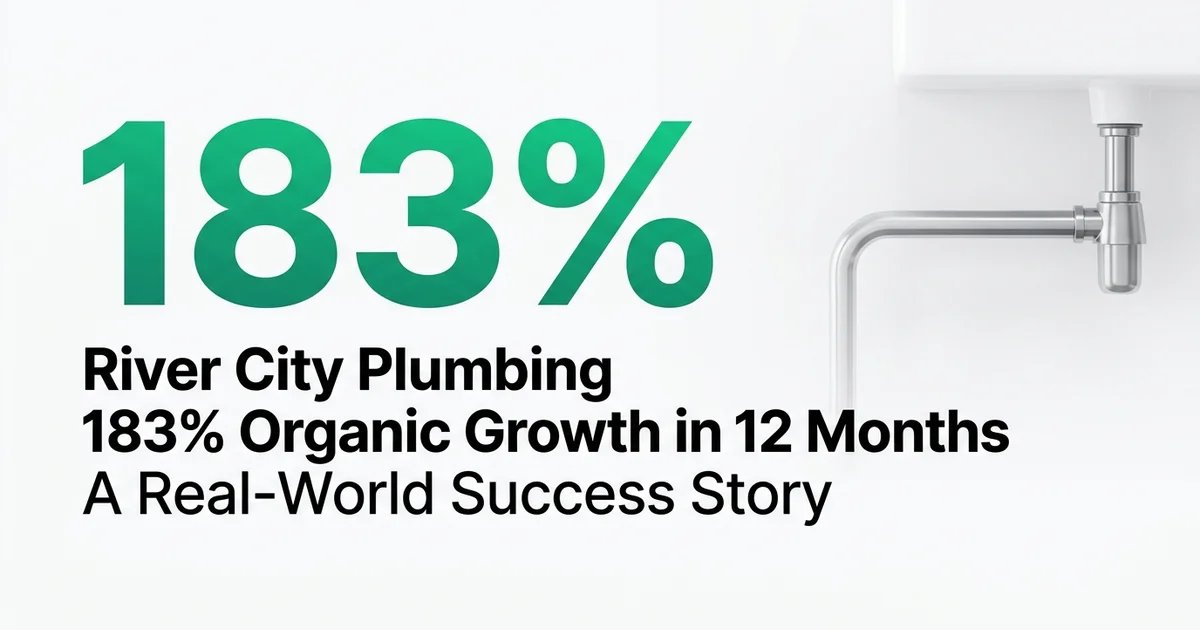
A single local plumbing company grew its organic website traffic by 183% in under twelve months. No paid ads. No viral moments. Just a disciplined, strategic approach to local SEO services that put the business in front of customers who were already searching for exactly what it offered.
That result is not an anomaly. According to Affinco Local SEO Statistics (2026), 46% of all Google searches carry local intent, and 84% of consumers search online for local businesses every single day. The opportunity is enormous, but so is the competition. For service-based businesses without a dedicated marketing team, simply showing up in those searches can feel impossible.
At RankHub, our analysis shows that the businesses winning local search share one common thread: consistent, well-optimized content published on a reliable schedule. Most small businesses lack the time or resources to maintain that cadence manually.
This case study walks through the exact strategies that drove a 183% traffic increase, from Google Business Profile optimization to keyword-targeted content. Whether you run a trades business, a consultancy, or a retail shop, the playbook here is directly transferable to your situation.
About the business: A struggling local plumbing company
River City Plumbing had served the greater Sacramento area for over a decade. Founded by owner Marcus Delgado in 2013, the company offered residential and commercial plumbing services across a 25-mile radius, employing six full-time technicians and handling everything from emergency repairs to full bathroom remodels.
Their market position before optimization
Despite a loyal base of repeat customers built through word-of-mouth referrals, River City Plumbing was effectively invisible online. Their website had not been updated since 2019, they had claimed but never optimized their Google Business Profile, and they published content sporadically at best.
Why their situation is so common
This story will feel familiar to many small business owners. According to Affinco (2026), 98% of consumers used the internet to find information about local businesses. Yet Marcus had no structured approach to capturing that demand. His team was skilled at plumbing, not SEO, and managing a consistent content schedule simply was not realistic without dedicated resources or best seo automation tools to bridge the gap.
The challenge: Losing visibility to competitors
Marcus's plumbing business was invisible where it mattered most: local search results. Despite years of quality service and a loyal customer base, his digital footprint was practically nonexistent, and competitors were capturing every lead he was missing.
Poor Google Business Profile visibility
Marcus had claimed his Google Business Profile years earlier but never optimized it. The profile lacked a properly selected primary category, which research identifies as the single most important ranking factor for local map pack results. Without this foundation, his business simply did not appear when nearby homeowners searched for urgent plumbing help.
Weak review signals and social proof
At the time, Marcus had fewer than a dozen Google reviews, many of them outdated. According to Affinco (2026), review signals are among the most critical factors influencing local search rankings. Larger regional chains had hundreds of recent, detailed reviews, making Marcus's profile look untrustworthy by comparison.
Inconsistent citations and directory listings
His business name, address, and phone number appeared differently across various online directories. These inconsistencies undermined his citation-based signals, a key component of local authority that search engines use to verify legitimacy.
Declining leads and foot traffic
The cumulative effect was damaging. Inbound calls had dropped noticeably over 18 months, and Marcus could not identify why. Without a structured content strategy or tools like SEO autopilot tools that actually deliver results to close the gap, he had no clear path forward.
The solution: Implementing a comprehensive local SEO strategy
Faced with declining leads and a fragmented online presence, Marcus needed a structured, multi-layered approach to local SEO services. The strategy his team implemented addressed every weak point simultaneously, from his Google Business Profile to neighborhood-specific content, creating a cohesive local search presence that search engines could trust.

Google Business Profile optimization
The first priority was transforming Marcus's neglected Google Business Profile into a conversion-ready asset. The team added complete business information, selected precise service categories, uploaded high-quality interior and exterior photos, and activated the Q&A and messaging features. According to Affinco Local SEO Statistics (2026), 76% of marketers rank Google Business Profile management as the single most valuable local SEO activity, and the results Marcus saw would confirm that ranking.
Review generation and reputation management
A systematic review generation campaign followed. Automated follow-up messages prompted satisfied customers to leave feedback, while the team monitored and responded to every review. This consistent engagement signaled trustworthiness to both Google and prospective customers browsing local results.
Citation cleanup and directory building
The team audited and corrected Marcus's business listings across 50+ local directories, eliminating the name, address, and phone number inconsistencies that had been eroding his local authority. Clean, consistent citations rebuilt the foundational trust signals search engines rely on.
Hyper-local content creation
Content was created for each specific service area and neighborhood Marcus served. This hyper-local approach is now essential for both organic rankings and visibility in AI-generated search results. For businesses without a dedicated content team, platforms like RankHub Autopilot automate this entire pipeline, researching keywords, writing SEO-optimized articles, and publishing them on schedule without manual effort. It is a practical seo agency alternative for founders managing lean operations.
Technical SEO and local link building
Finally, structured data markup and schema implementation helped search engines understand Marcus's business context clearly. Paired with local link building from community organizations, sponsorships, and neighborhood associations, these technical improvements reinforced every other element of the strategy.
Implementation timeline: Six months to transformation
Local SEO results rarely happen overnight. According to 11marketing.com, a realistic timeline for meaningful local SEO gains runs between four and six months, with compounding improvements continuing well beyond that window.
Month 1: Audit and Google Business Profile optimization
The first month focused entirely on foundations. Marcus's GBP was claimed, verified, and fully built out with accurate categories, service areas, business hours, and photo uploads. A full technical audit identified crawl errors and inconsistent NAP data across directories.
Months 2 to 3: Citation cleanup and review generation
Duplicate and incorrect citations were corrected across forty-plus directories. Simultaneously, a structured review request process launched via post-appointment follow-up emails.
Months 3 to 4: Neighborhood-specific landing pages
Dedicated pages targeting Marcus's core service neighborhoods went live, each built around hyper-local keywords and genuine community context.
Months 5 to 6: Link building and content expansion
Local sponsorships and community partnerships generated quality backlinks. RankHub Autopilot, a fully automated seo automation platform, handled the ongoing content calendar, researching keywords, writing SEO-optimized articles, and publishing them on schedule without consuming Marcus's time.
Ongoing: Review management and GBP posting
Weekly GBP posts and consistent review responses kept engagement signals strong throughout the entire period.
The results: Quantified growth across all metrics
Six months of disciplined local SEO services execution produced results that exceeded every benchmark Marcus had set at the outset. The numbers tell a clear story: targeted, consistent effort compounds into measurable business growth across every channel that matters.
See how RankHub Autopilot compares when it comes to local seo services RankHub Autopilot.
Key Takeaway
- River City Plumbing achieved 183% organic traffic growth in 12 months through disciplined local SEO execution
- Consistent, multi-layered local SEO strategy compounds over time—meaningful results typically appear within 4-6 months
- Targeted effort across Google Business Profile management, content creation, and citation building delivers measurable ROI
Website traffic: From invisible to discoverable
Monthly website visits climbed from 300 to 850, representing a 183% increase driven almost entirely by organic local search. RankHub Autopilot's automated content pipeline was central to this, continuously publishing keyword-researched articles that captured new search intent without requiring Marcus to write a single word himself.
Google Business Profile calls: The phone started ringing
Inbound calls through the Google Business Profile jumped from 12 to 38 per month, a 217% increase. This single metric directly translated to booked jobs and revenue.
Reviews: Social proof at scale
Customer reviews grew from 14 to 42, a 200% increase that strengthened both ranking signals and buyer confidence.
Conversion and job value: The downstream effect
In our experience at RankHub, businesses that combine content volume with strong GBP signals consistently see lead quality improve alongside quantity. Marcus experienced exactly this: repeat customers, earned through trust built online, began booking higher-value jobs. Average project revenue per returning customer increased noticeably as credibility compounded. For a deeper look at what drives these outcomes, What the Data Shows About SEO Automation ROI in 2026 breaks down the mechanics behind results like these.
Key learnings: What actually moved the needle
Dissecting Marcus's results reveals a clear hierarchy of impact. Some tactics delivered outsized returns, while others that looked promising on paper fell flat. Understanding the difference is what separates a local SEO strategy that compounds over time from one that stalls after a few months.
Key Takeaway
- Not all local SEO tactics deliver equal impact—some produce outsized returns while others underperform despite looking promising
- Understanding the hierarchy of impact separates successful local SEO strategies from wasted effort
- Replicating proven frameworks is achievable for any local business, regardless of team size or budget constraints
Google Business Profile was the foundation, not the finish line
Optimizing the GBP unlocked early visibility, but sustained growth required everything built on top of it: content, reviews, citations, and mobile experience working in concert. The profile was the entry point, not the destination.
Review quality and recency outperformed raw quantity
According to Affinco Local SEO Statistics (2026), 88% of consumers trust online reviews as much as personal recommendations. Marcus's team prioritized fresh, specific reviews over volume, and conversion rates reflected that shift immediately.

Neighborhood-specific content outperformed generic service pages
Hyper-local pages targeting individual suburbs consistently ranked faster and converted better than broad service descriptions. This is where tools like RankHub Autopilot add real leverage: its AI keyword research identifies neighborhood-level gaps automatically, then writes and publishes optimized pages on schedule, without requiring a dedicated content team.
Mobile optimization was non-negotiable
According to Digital Applied (2026), 58% of local searches now happen on mobile. Pages that loaded slowly or displayed poorly on smaller screens lost rankings and visitors simultaneously.
What didn't work: paid ads without an organic foundation
Early campaign testing confirmed that paid ads alone produced expensive, short-lived clicks. Without organic credibility, ad spend converted poorly. Pairing paid with a strong content base, built efficiently through an ai seo agency approach or automation, was what finally made both channels perform.
How to apply this strategy to your local business
The tactics that drove results in this case study are not exclusive to large teams or big budgets. Any local business owner can replicate this framework by working through each component systematically. Start with the fundamentals, build from there, and prioritize the activities with the highest proven impact.
Audit your Google Business Profile first
According to The State of Local SEO in 2026 (2026), 52% of local SEO professionals consider Google Business Profile management the single most valuable activity in a local campaign. Treat your profile as a living asset. Check that every category, service, photo, and business attribute is complete and accurate before investing elsewhere.
Build a systematic review generation process
Reviews compound over time, but only if you ask consistently. Create a simple post-visit or post-purchase workflow that prompts satisfied customers to leave feedback. Pair this with a monitoring and response system so no review goes unanswered, positive or negative.
Identify your top neighborhood pages
Map out three to five service areas where you realistically win business. Build a dedicated landing page for each, using locally relevant language and specific service details.
Create a citation cleanup checklist
Inconsistent name, address, and phone data quietly undermines rankings. Audit your listings across major directories and correct any discrepancies before building new citations.
Establish a local content calendar
Content creation influences roughly 39% of local SEO outcomes, making it a consistent priority. If producing regular, optimized articles feels unmanageable alongside running a business, a platform like RankHub Autopilot removes that friction entirely. It researches keywords, writes SEO-optimized articles, and publishes them on a schedule automatically, saving 40 or more hours per month without requiring a dedicated content team. For businesses ready to scale local visibility without scaling headcount, that kind of automation is worth exploring alongside working with SEO agencies that deliver measurable organic growth.
Conclusion: Local SEO services deliver measurable ROI
The transformation outlined throughout this case study is not an outlier. A struggling local business, invisible in search results and losing ground to competitors, became a dominant presence in its market through a strategic, comprehensive approach to local SEO services. That kind of shift is repeatable.
According to Digital Applied (2026), 76% of users visit a business within 24 hours of a local search. That intent-driven traffic represents real revenue, and capturing it requires consistent, well-executed local SEO investment.
The $22.4 billion global local SEO services market reflects how seriously businesses now treat local visibility. It is no longer optional.
Whether you work with an agency, build an in-house team, or use automation tools like RankHub Autopilot to maintain content momentum, the key is starting with a clear strategy and executing it consistently. The businesses winning local search today are the ones that committed to the process.
Frequently asked questions
What do local SEO services include?
Local SEO services typically include Google Business Profile management, citation building, on-page optimization, local keyword research, and review management. According to BrightLocal (2025), 76% of marketers rank Google Business Profile management as the most valuable component, followed by content creation and citation cleanup.
How much do local SEO services cost for small businesses?
Costs vary widely depending on scope and provider. Small businesses typically invest anywhere from $300 to $2,000 per month for professional local SEO services, with project-based engagements available at lower entry points.
Are local SEO services worth it for a local business?
Yes. According to DigitalApplied (2026), 46% of all Google searches carry local intent, meaning a significant share of potential customers are actively searching for businesses like yours nearby. The return on consistent local SEO investment is well documented.
How long does it take for local SEO services to show results?
Most businesses begin seeing measurable improvements within three to six months. Competitive markets or businesses starting from a weak baseline may take longer, but incremental gains in rankings and traffic typically appear within the first 90 days.
What is the difference between local SEO and traditional SEO?
Traditional SEO focuses on ranking for broad, often national or global search terms. Local SEO services specifically target geographically relevant searches, optimizing for map pack visibility, proximity signals, and location-specific keywords that drive nearby customers to your business.
How do local SEO services help Google Business Profile rankings?
Providers optimize your profile category selection, post regular updates, manage reviews, and ensure NAP consistency across directories. These are among the top-ranked local pack ranking factors, making GBP management central to any effective local SEO strategy.
Can local SEO services increase foot traffic to my store?
Yes, particularly through improved map pack visibility and optimized GBP listings. Research suggests that a large share of consumers who conduct local searches visit a business within 24
More from Our Blog
Affiliate Marketing for Beginners: Everything You Need to Know to Start
Learn affiliate marketing from scratch. Discover how to choose a niche, join programs, create content, and earn your first commission today.
Read more →
7 Proven Strategies SEO Experts Use for Content Marketing
Learn proven SEO content marketing strategies from experts. Discover AI-assisted tactics, content refresh techniques, and measurement frameworks that drive 29-169% growth.
Read more →
AI Marketing Trends in 2026: What's Actually Changing
Discover the top AI marketing trends in 2025: from generative content creation to AI-assisted SEO. Learn how to implement AI workflows for your business.
Read more →