
Let's be honest, chasing after those big, flashy, one-word keywords feels like the goal, right? Who wouldn't want to rank for something like "boots"? It seems like the jackpot, promising a firehose of traffic.
But I've been in the SEO game long enough to tell you that this approach is usually a fast track to burnout. You end up in a brutal, expensive fight against massive brands that have been building authority for years. It's a tough, uphill battle.
The smarter play, and where I've seen the most consistent success, is in long-tail keyword research. This is how you find the people who are ready to buy, not just browse.
The Real Power of Niche Search Queries
Instead of duking it out for "boots," imagine you target a phrase like "waterproof hiking boots for women." Better, right? Now, let's get even more specific: "best waterproof hiking boots for women under $100."
See the difference? This isn't just a longer search query. It reveals a completely different person behind the screen.
Getting Inside the Searcher's Head
Someone typing "boots" into Google is just window shopping. They're at the very beginning of their journey, maybe not even sure what kind of boots they want. But the person searching for "best waterproof hiking boots for women under $100" has already made several key decisions.
They know:
- What they need: Hiking boots
- A must-have feature: Waterproof
- Who it's for: Women
- How much they'll spend: Under $100
This person isn't just looking; they're hunting for a solution. They're much further down the buying funnel and have their credit card practically in hand. This is where you can swoop in and be the perfect answer to their very specific problem.
By focusing on these hyper-specific phrases, you're not trying to be everything to everyone. You're trying to be the perfect resource for the right person—the one who is most likely to click, convert, and become a fan of your brand.
Why Specificity Wins Every Time
This difference in user intent has a massive impact on your results. When your page title and content perfectly mirror a detailed search, people can't help but click. It feels like you read their mind.
And the data doesn't lie. Research shows that long-tail keywords can have a 36% conversion rate, which is phenomenal. According to one study highlighted in MyCodelessWebsite's keyword research findings, the click-through rates (CTR) tell a similar story. Longer phrases get about 1.76 times more clicks than short terms, and super-specific searches (10-15 words) can get a whopping 2.62 times more clicks than single-word queries.
To put it in perspective, let's break down the performance you can expect.
Short-Tail vs Long-Tail Keyword Performance
| Metric | Short-Tail Keywords (e.g., 'boots') | Long-Tail Keywords (e.g., 'waterproof hiking boots for women') |
|---|---|---|
| Search Volume | Very High | Low to Moderate |
| Competition | Extremely High | Low |
| Searcher Intent | Low (Informational, Browsing) | High (Commercial, Transactional) |
| Conversion Rate | Very Low (< 1-2%) | High (Often 10%+) |
| Cost-Per-Click (Ads) | High | Low |
| Ranking Difficulty | Very Difficult | Achievable |
It's pretty clear from this breakdown that while the search volume for long-tail keywords is lower, the quality of the traffic and the return on your effort are dramatically higher.
A Smarter Way to Compete
So, while your competitors are burning through their marketing budgets trying to get a sliver of the attention for a term like "boots," you can be quietly winning dozens of smaller battles. Each piece of content you create around a long-tail keyword is another net in the water, catching a steady stream of people who are actively looking for what you offer.
Think of it this way: Chasing short-tail keywords is like trying to fish in the middle of the ocean with one giant net. Long-tail keyword research is like discovering a dozen hidden, well-stocked ponds where you're the only one with a fishing rod. The cumulative effect of all those smaller wins will almost always outperform a single, high-volume keyword—and you'll end up with customers who are a much better fit.
Building Your Foundation with Seed Keywords

Every solid SEO strategy starts somewhere. For long-tail keywords, that starting point is your list of seed keywords. These are the big, broad topics—usually just one to three words—that define what you're all about. They are the bedrock of your entire research process.
Think of them like the main ingredients in a recipe. They aren't the final dish, but you can't get there without them. Nailing this initial list is so important because everything else you do will sprout from these core ideas.
The good news? You don't have to get it perfect right away. The goal is simply to brainstorm the main pillars of your business. Let's dive in.
Thinking Like Your Customer
First things first, get out of your own head. The single best way to brainstorm seed keywords is to put yourself directly in your customer's shoes. Ditch all the internal jargon and fancy industry terms you use with your team.
How would a real person with a real problem describe what they're looking for on Google?
Let's say you sell high-end, artisanal coffee beans. Your team might throw around terms like "single-origin micro-lots," but your potential customer is probably typing something much simpler into the search bar.
Your first-pass seed keyword list could look something like this:
- whole bean coffee
- espresso beans
- french press coffee
- cold brew concentrate
See how straightforward those are? They’re the perfect starting point. Just aim to list out 5-10 of these core terms that get to the heart of what you sell or do.
Digging into Your Own Data
Believe it or not, your own website is a goldmine for seed keyword ideas. The people who are already finding you are leaving behind a trail of clues. It’s time to play detective on your own turf.
A great place to start is your Google Search Console Performance Report. Tucked away in that data are the actual search queries people used to land on your site. You might find you're already showing up on page two or three for valuable terms you never even thought to target. That's a huge head start.
Pro Tip: Don't just fixate on the queries with huge impression numbers. Hunt for the terms that perfectly describe one of your products or services, even with low volume. These are direct signals of what people want and make for incredibly powerful seed keywords.
Ethically Spying on Your Competition
Your competitors have already spent time and money figuring out what works. Analyzing their content can give you a shortcut to identifying core topics you might have overlooked. Don't just glance at their homepage—dig deep into their blog, resource articles, and product category pages.
What are the big themes they keep coming back to? What terms do they use in their main navigation menu? These are flashing signs pointing to the seed keywords they're building their strategy around.
For example, if a direct competitor has a massive pillar page called "The Ultimate Guide to Cold Brew," you can bet that "cold brew" is a critical seed keyword for them. Add it to your list. This isn't about blindly copying them; it's about understanding the competitive landscape so you can find your own angle and create something even more valuable.
By mixing what you know about your customers, what your own data tells you, and what your competitors are doing, you'll build a powerful list of seed keywords. This list is your map, pointing the way to the less-traveled (and more profitable) paths of long-tail keywords.
Using Smart Tools to Dig for Keyword Gold
Alright, you've got your seed keywords. Now the real fun begins. It's time to move past brainstorming and start actively digging for the long-tail keywords your audience is actually using. We'll use a mix of free and more powerful paid tools to uncover a treasure trove of opportunities.
This is where we let technology do the heavy lifting. Think about it: a detailed study of 24 million keywords found that queries with three, four, and even five words make up the vast majority of all unique searches. You can read more about this in an in-depth analysis of search query length. There's no way you could find all those variations by hand. A smart, tool-assisted approach is the only way to scale this process effectively.
This process isn't just a straight line. It's more of a cycle, moving from broad ideas to super-specific phrases and back again as you learn more about what people are searching for.
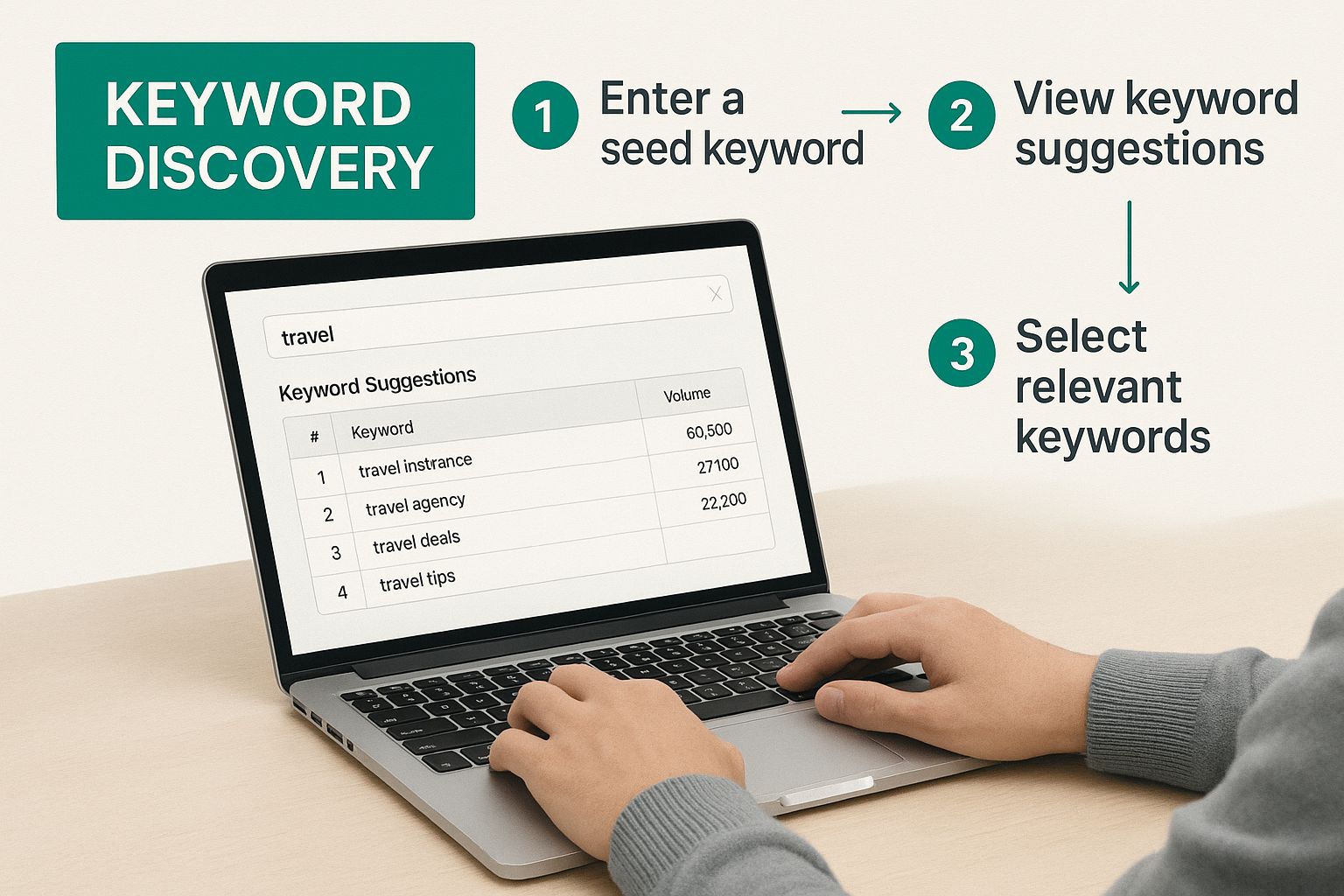
The key is to keep refining your search as you go, building on what you discover.
Start with the Free Stuff (It’s Surprisingly Powerful)
You don't need to break the bank to get started. Some of the best insights come straight from the source: Google itself.
Pop one of your seed keywords into the Google search bar and scroll down. See those “People Also Ask” (PAA) boxes? That's pure gold. These are questions real people are asking, which means they're perfect for content ideas that solve actual problems.
A pro tip I've used for years: every time you click on a question in the PAA box, Google loads more related ones. You can go down a rabbit hole here, quickly mapping out an entire topic cluster just by clicking around. It's like having a direct line into your audience's brain.
Another fantastic free tool is AnswerThePublic. It takes your seed keyword and visualizes all the questions and phrases around it, neatly organized into categories like who, what, why, and how. It’s a brilliant way to see how people are thinking about a topic at a glance.
Leveling Up with Advanced SEO Platforms
Once you've exhausted the free options, it's time to get serious. This is where advanced platforms like Ahrefs, Semrush, or our own RankHub come in. These tools are built for scale and precision, giving you crucial data like search volume, keyword difficulty, and estimated traffic potential.
One of my go-to tactics inside these tools is playing with keyword modifiers. After you drop a seed term into a keyword explorer, you can tack on words that signal specific intent.
Try adding these to your seed keywords:
- "Vs" or "Alternative": Instantly finds comparison keywords (e.g., "mailchimp vs convertkit").
- "For [Audience]": Helps you find niche-specific searches (e.g., "project management software for small business").
- "How to" or "Best": Uncovers informational and purchase-intent queries.
- "Near me": A must for identifying valuable local SEO opportunities.
This simple trick can transform a generic keyword into a list of highly-specific, low-competition long-tail phrases that you can actually rank for.
Let’s Walk Through a Quick Example
Imagine your business sells leather care products, and your seed keyword is "leather conditioner."
First, I'd check Google's PAA. I might see questions like, "What can I use instead of leather conditioner?" or "How do you apply leather conditioner to a couch?" Boom, two distinct blog post ideas right there, targeting different needs.
Next, I'd jump over to AnswerThePublic. It would likely spit out comparisons like "leather conditioner vs oil" and prepositional phrases like "leather conditioner for cars," revealing more specific use cases.
Finally, I’d fire up Ahrefs or RankHub. Plugging in "leather conditioner" and filtering for questions could surface a gem like "how often should you use leather conditioner." From there, I can see exactly who ranks for that term and how hard it would be to outrank them.
By layering these tools, you go from a single vague term to a rich, context-aware map for your entire content strategy. You’re not just collecting keywords; you're starting to understand the entire conversation your audience is having.
How to Qualify and Prioritize Your Keywords
Getting a huge list of keywords is the easy part. Honestly, anyone can do it. The real challenge—and where a lot of people stumble—is figuring out which ones are actually worth your time. This is where you separate the gold from the gravel.
A raw export from a keyword tool is just data. It's not a strategy. To turn it into a real content plan, you need a system for sorting through the noise. It’s about asking the right questions to find the terms that will actually move the needle for your business.
Your goal isn't a massive spreadsheet of "maybes." It's a targeted hit list. Let's walk through how to build one.
The Three Pillars of a Great Keyword
Before you even think about writing, every single keyword on your list needs to pass a simple three-point inspection. I call them the three pillars: Relevance, Intent, and Competition. Nailing this is the foundation of any successful keyword strategy.
Relevance: This sounds obvious, but you'd be surprised how easy it is to get sidetracked. Does this keyword directly relate to what you sell or a problem you genuinely solve for your customers? A keyword with perfect relevance doesn't just bring traffic; it brings the right traffic.
Intent: What is the person typing this into Google really trying to do? Are they ready to buy something (commercial)? Are they trying to figure something out (informational)? Or are they just looking for a specific site (navigational)? You absolutely have to match your content's goal to the searcher's intent. It's non-negotiable.
Competition: This is the big one: can you realistically rank for this? And I don't just mean looking at a "keyword difficulty" score. It means taking a hard, honest look at who’s on page one and asking yourself if you can create something way, way better.
The sweet spot is right where these three pillars intersect. You're looking for keywords that are super relevant, have a clear intent you can satisfy, and face competition you can actually beat.
This whole process shifts your mindset. You stop chasing vanity metrics and start building a smart strategy around real opportunities.
Why You Should Ignore High Search Volume (Most of the Time)
It’s so tempting to sort your keyword list by search volume and work your way down. That’s a classic rookie mistake. While everyone is duking it out for the same handful of high-volume head terms, the real magic is happening in the long tail.
A Backlinko study found something pretty wild: about 91.8% of all search queries are long-tail keywords. That means that while each individual long-tail term doesn't get a ton of searches, they make up the overwhelming majority of everything people are actually typing into Google. If you want more stats on this, check out this overview of long-tail keyword data.
The data couldn't be clearer. Your biggest wins will often come from keywords that tools say get maybe 10 or 20 searches a month. These are the queries your big-budget competitors completely ignore, leaving the door wide open for you.
The Art of the Manual SERP Check
SEO tool metrics like "Keyword Difficulty" are a fine starting point, but never, ever treat them as gospel. The only way to truly know what you're up against is to roll up your sleeves and manually check the Search Engine Results Page (SERP).
Here’s what I look for to spot a weak SERP and a golden opportunity:
Old, Dusty Content: Look at the dates on the top-ranking articles. If you see posts from 2019 or even older, that's a huge sign. It tells you Google is hungry for a fresh, updated piece of content on this topic.
Thin or Lame Content: Click on the top few results. Are they short? Poorly written? Do they lack helpful images or real examples? If you can honestly say, "I can make something 10x better than this," you've just found a winner.
Forum and Q&A Posts: This is my favorite signal. Are you seeing pages from Quora, Reddit, or other forums on page one? That’s a massive green light. It means Google can't find a truly great, authoritative article and is forced to serve up user-generated content instead.
When you start checking the SERPs by hand, you stop guessing and start making informed, strategic decisions. This hands-on work is what separates good keyword research from great keyword research, and it gives you the confidence to know which battles are truly worth fighting.
Turning Your Research into Content People Actually Read

Okay, so you've put in the work and unearthed a fantastic list of long-tail keywords. That’s a huge win, but a spreadsheet full of terms isn't going to get you traffic on its own. Now for the fun part: turning that research into real-world content.
This is where the rubber meets the road. We need to take these phrases and weave them into the fabric of your website, creating articles and pages that solve problems, build your authority, and actually rank. It's less about "placing keywords" and more about using them as a blueprint to create the best possible resource on a topic.
From Keywords to Topic Clusters
One of the biggest mistakes I see people make is trying to create a separate blog post for every single keyword variation. That's a fast track to creating a bunch of thin, repetitive articles that just end up competing with each other—a frustrating problem we call keyword cannibalization.
A much more powerful strategy is to group your related keywords into topic clusters. You pick a broad, central "pillar" topic and then create a series of more specific "cluster" posts that dive deep into individual long-tail queries.
Let’s say you’re in the email marketing space. Instead of a dozen tiny posts, your plan would look more like this:
- Pillar Page: "The Ultimate Guide to Email Marketing Software"
- Cluster Content (Your supporting articles):
- "best email marketing software for small business"
- "mailchimp vs convertkit detailed comparison"
- "how to migrate from mailchimp to klaviyo"
- "free email marketing tools for startups"
Each of those cluster posts is laser-focused on a long-tail keyword, and they all link back to your main pillar page. This sends a powerful signal to Google that you're an expert on the entire "email marketing software" topic, which helps everything rank better.
Picking the Right Content Format
Long-tail keywords have different personalities, and so should your content. The user intent you figured out earlier is your guide here. Matching your content format to what the searcher actually wants to see is critical for keeping them on the page and earning that top spot.
Think about it this way:
- "How to" Keywords: If someone searches for "how to clean suede boots at home," they need a step-by-step how-to guide. Bonus points for pictures or a video.
- "Best" or "Vs" Keywords: For a query like "best project management tools for agencies," the user is expecting a comparison post or a listicle that breaks down the pros, cons, and pricing.
- Question-Based Keywords: A search for "what is a keyword difficulty score" is practically begging for a straightforward explainer article or even just a clear definition in a larger "Beginner's Guide to SEO."
The best advice I can give is to ask yourself: "If I searched for this phrase, what kind of page would make me feel like I hit the jackpot?" Your answer tells you exactly what kind of content to build.
On-Page SEO That Doesn’t Sound Like a Robot
Alright, you've got your topic and your format. Time to write. The real art is sprinkling your main long-tail keyword and its variations throughout the content without it sounding clunky or forced.
You want to be strategic, placing your keywords where they have the most punch for both your readers and the search engines.
Your Strategic Keyword Placement Checklist
| Where to Put It | My Go-To Practice & Example |
|---|---|
| Page Title (Title Tag) | Get your main long-tail keyword in there, preferably near the beginning. Example: "Best Waterproof Hiking Boots for Women Under $150 (2024 Review)" |
| URL Slug | Keep it short and sweet. Just include the core of the keyword. Example: yourdomain.com/best-waterproof-hiking-boots |
| Main Heading (H1) | This should echo your title but can be phrased a bit more conversationally. Example: "We Tested 12 Pairs: The Best Waterproof Hiking Boots for Women" |
| Subheadings (H2, H3) | Perfect spots to use related long-tail keywords to break up your content. Example: "How to Choose the Right Fit" or "Comparing Gore-Tex vs. eVent Waterproofing" |
| Introduction | Drop your primary keyword somewhere in the first paragraph (the first 100-150 words) to instantly confirm to the reader they're in the right place. |
| Body Content | Naturally work in synonyms and related terms (LSI keywords). For a post on "hiking boots," you should be talking about "traction," "ankle support," and the "break-in period" anyway. |
Above all else, write for a human being. If a sentence sounds weird when you read it out loud, rewrite it. A genuinely helpful article will always crush a keyword-stuffed page that people hate reading. Think of your keyword research as the map, not a script you have to follow word-for-word.
A Few Lingering Questions About Longtail Keywords
Even after you've got a process down, some questions always seem to pop up during keyword research. Let's tackle a few of the most common ones I get asked. Honestly, getting the answers right can be the difference between a good strategy and a great one.
Think of this as your back-pocket guide for when you hit those little roadblocks and need to make a smart call.
How Many Longtail Keywords Should I Cram Onto One Page?
This is the classic question, but the question itself is a bit flawed. Instead of thinking about a number of keywords, you should be thinking about a single topic. Don't ask how many keywords you can stuff in; ask how well you can solve a user's entire problem.
A single, really well-written article can naturally rank for its main longtail keyword plus dozens of related variations. For example, if you write a killer guide on "how to clean suede boots at home," you'll almost certainly end up covering things like "best suede cleaner for shoes" and "can you use water on suede boots" along the way.
The goal isn't to hit some imaginary keyword quota. It's to create the absolute best, most helpful resource on the internet for that specific search. When you focus on covering a topic so thoroughly that you answer all the follow-up questions, you'll find you’ve woven in tons of longtail keywords without even trying.
What if a Perfect Longtail Keyword Has Zero Search Volume?
Don't toss it out just yet! This is where you have to trust your gut and your deep knowledge of your audience more than the tools. SEO tools often show "0" for super niche queries because their data set is too small, not because literally no one is searching for it.
If a keyword perfectly describes a pain point that your product or service solves, that "zero-volume" keyword could be pure gold. The handful of people who do search for it are probably your dream customers—they know exactly what they need and are likely ready to convert.
These hyper-specific terms often bring in your highest-quality traffic and most valuable leads because you might be the only one providing a direct solution.
Should I Make a New Blog Post for Every Single Longtail Keyword?
Definitely not. This is a huge, and very common, mistake. Creating separate posts for every tiny keyword variation creates a messy situation called keyword cannibalization. This is where your own pages start competing against each other in the search results, which just confuses Google and spreads your authority way too thin.
The smarter move is to group keywords that are thematically related. The easiest way to check? Just Google the two phrases. If the search results for "how to fix a leaky faucet" and "repairing a dripping tap" look nearly identical, they share the same user intent and belong on the same page.
- Group keywords with the same intent onto one powerful, comprehensive page.
- Create new content only for truly different topics that need a unique answer or angle.
- Update and expand your existing posts with new longtail variations when they fit the core topic.
This strategy helps you build much stronger, more authoritative pages that can rank for a whole cluster of terms, rather than having a bunch of weak, competing articles that go nowhere.
Ready to stop guessing and start finding the longtail keywords that will actually grow your business? RankHub analyzes your entire site in just minutes, handing you a prioritized list of opportunities your competitors are sleeping on. Try RankHub today and turn your keyword research from a chore into a real strategy.
Article created using Outrank
More from Our Blog
Zoho Marketing Automation Explained: Is It Right for You?
Compare Zoho Marketing Automation vs HubSpot on pricing, features, ease of use, and automation depth. See which wins for small teams and solo founders.
Read more →
Looking for an SEO Company? Here Are Your Best Options
Compare top SEO companies, AI platforms, and agencies. Find the best fit for your budget, from $49/month tools to full-service retainers.
Read more →
Marketing AI Tools Compared: Which Delivers Real Results?
Compare top marketing AI tools for SEO content creation. See pricing, features, and which tool fits solo founders, SMBs, and marketing teams.
Read more →