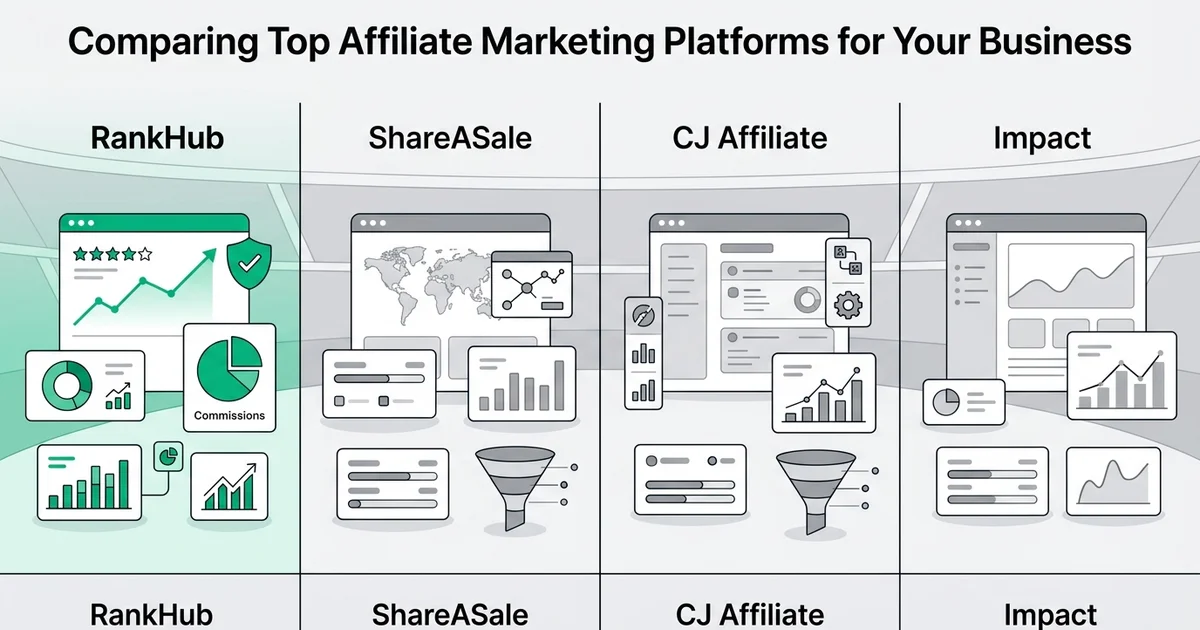
Comparing Top Affiliate Marketing Platforms for Your Business
Introduction: choosing the right affiliate marketing platform for your needs
Affiliate marketing has grown into one of the most reliable revenue channels for businesses of every size, and the numbers reflect that momentum. According to Affiliate Marketing Statistics 2026 (2026), the global affiliate marketing platform market is valued at $22.6 billion in 2025, with US spending alone projected to reach $13.81 billion in 2026. For solo founders, marketing teams, and SMBs alike, the opportunity is significant, but only if you choose the right platform to support it.
At RankHub, our analysis shows that platform selection is one of the most consequential decisions an affiliate program manager makes. The wrong choice leads to tracking gaps, poor partner experiences, and wasted budget. The right one scales with your business and compounds returns over time.
The affiliate landscape is also shifting. Creator-led programs are overtaking traditional coupon-heavy models, which means your platform needs to support diverse partner types, flexible commission structures, and strong reporting capabilities.
This comparison evaluates leading affiliate marketing platforms across four consistent criteria:
- Pricing and overall cost of ownership
- Core features including tracking, automation, and integrations
- Ease of use for both merchants and affiliates
- Support quality and onboarding resources
By the end, you will have a clear picture of which platform fits your specific business model and growth stage.
Quick comparison table: feature and pricing overview
The table below gives you an at-a-glance view of how four leading platforms stack up across pricing, core features, and ideal use cases. Note that hybrid commission structures are rising in popularity, so feature support for mixed models is included as a distinct criterion.
| Platform | Pricing Model | Core Strength | Best For | Network Size |
|---|---|---|---|---|
| RankHub | Subscription ($99-$499/mo) | Automated content creation & SEO | Content-driven affiliate revenue | Integrated content network |
| ShareASale | Commission-based (5-30%) | Established merchant network | Affiliate recruitment at scale | 10,000+ merchants |
| CJ Affiliate | Commission-based (5-35%) | Advanced tracking & reporting | Performance-focused programs | 3,500+ brands |
| Impact | Custom pricing | Enterprise relationship management | Large-scale program management | 500+ enterprise brands |
| Platform | Entry price | Automated content | Hybrid commissions | CPC tracking | Best for |
|---|---|---|---|---|---|
| Automated Content Solution | From $49/mo | ✓ | ✓ | ✓ | SMBs scaling affiliate content |
| Outrank | Custom pricing | ✗ | ✓ | ✓ | Content-focused SEO teams |
| SEObot | From $29/mo | ✓ | ✗ | ✓ | Solo founders automating SEO |
| Impact | Custom pricing | ✗ | ✓ | ✓ | Enterprise affiliate programs |
This type of platform stands out for teams that need a combined content marketing automation platform and affiliate engine under one roof. For pure tracking depth, Impact leads, though its pricing reflects that enterprise focus.
RankHub: automated affiliate content at scale
RankHub occupies a distinct position in the affiliate marketing platform landscape. Where most platforms focus on tracking commissions and managing partner relationships, RankHub is built around a different premise: that the real bottleneck for affiliate marketers is not finding offers, but consistently producing the SEO content that drives organic traffic to those offers.
- Pros
- Fully automated content research, writing, and publishing eliminates manual content creation bottlenecks
- SEO-optimized articles drive organic search traffic without relying on affiliate networks
- Predictable subscription pricing with no commission fees or variable costs
- Ownership of published content and audience relationships
- Scalable to hundreds of articles per month with minimal team overhead
- Cons
- Requires understanding of SEO and content strategy to maximize ROI
- Limited to content-based affiliate models; not ideal for coupon or deal-focused campaigns
- Smaller built-in affiliate network compared to established platforms
- Success depends on organic search visibility, which takes time to build
- Less suitable for businesses seeking rapid affiliate recruitment
SEO-first architecture
RankHub Autopilot approaches affiliate growth as a content and search problem first. The platform automates keyword research, identifies high-intent search opportunities relevant to your niche, and then publishes optimised articles designed to rank and convert. This is a meaningful distinction. Most affiliate networks hand you a link and leave the traffic acquisition entirely to you. RankHub treats content production as a core platform function rather than an afterthought.
For solo founders and small marketing teams, this matters considerably. According to Track360 (2026), AI-assisted content production is moving toward standard operating practice across affiliate programmes, with teams that automate content workflows gaining a measurable competitive advantage over those still producing articles manually. RankHub is built precisely for that shift, functioning as a purpose-built seo content automation software layer on top of an affiliate engine.
Affiliate network integration and tracking
RankHub connects with major affiliate networks, pulling in your tracked links and embedding them within published content automatically. The platform also supports first-party tracking configurations, which is increasingly important as third-party cookies continue to deprecate across browsers. This keeps attribution reliable without requiring a separate analytics stack.
Reducing the content bottleneck
For SMBs running lean teams, the content creation bottleneck is often what limits affiliate revenue growth. RankHub Autopilot removes that constraint by handling research, drafting, and publishing at scale. Teams interested in understanding the return on this approach can explore What the Data Shows About SEO Automation ROI in 2026 for a detailed breakdown.
Traditional affiliate platforms: commission-focused networks
Established networks like ShareASale, CJ Affiliate, and Impact have built their reputations on one core strength: scale. They connect merchants with thousands of active affiliates and offer mature commission infrastructure that has been refined over decades. For businesses that prioritize breadth of reach, these platforms remain a serious option.
- Pros
- Massive pre-built networks of active affiliates ready to promote immediately
- Mature commission tracking and payment infrastructure
- Hands-on support for program management and affiliate recruitment
- Flexible commission structures (CPC, CPA, hybrid models) to match business needs
- Deep performance analytics and real-time reporting dashboards
- Cons
- Commission fees (5-35%) reduce profit margins on every sale
- Less control over brand messaging and content quality
- Dependent on affiliate network size and activity levels
- Higher operational overhead for managing partner relationships
- Ad blocker impact: ~37% of desktop users run ad blockers, creating ~30% blind spot in revenue reporting
Merchant networks and affiliate pools
The primary draw of traditional networks is access. ShareASale hosts tens of thousands of merchants across virtually every niche. CJ Affiliate and Impact similarly offer large, vetted affiliate pools, giving brands immediate exposure to publishers who are already monetizing their audiences. This makes them particularly appealing for SMBs that want to launch quickly without building affiliate relationships from scratch.
Commission structures and payment models
These platforms support a range of commission models, from revenue share to flat-fee payouts. According to Affiliate Marketing Statistics 2026 (2026), cost-per-click arrangements account for around 39% of segment share, sitting alongside cost-per-sale and cost-per-lead models. This flexibility allows businesses to align incentives with their specific growth goals.
Setup complexity and learning curve
The tradeoff for that scale is complexity. Onboarding on platforms like Impact typically involves contract negotiations, compliance reviews, and integration work that can take weeks. Reporting dashboards are powerful but dense, and solo founders or lean marketing teams often find the learning curve steep. It is also worth noting that around 37% of desktop users run ad blockers, which can create attribution blind spots that these platforms do not always handle transparently.
For teams already investing in content-driven acquisition, pairing a traditional network with seo automation for content teams can help close those reporting gaps while maintaining publishing momentum.
Feature-by-feature comparison: what matters most
Choosing the right affiliate marketing platform comes down to more than price or network size. The features that directly affect your revenue, your partners' experience, and your team's daily workflow deserve careful, side-by-side scrutiny. Here is how leading platforms stack up across the criteria that matter most.

Tracking accuracy and attribution models
Tracking is the foundation of any affiliate program. If conversions are miscounted, commissions are wrong, and partner trust erodes quickly. According to Track360 (2026), first-party and server-to-server tracking is rapidly becoming the default standard, largely because it sidesteps the attribution blind spots caused by browser privacy updates and ad blockers. Platforms that still rely primarily on third-party cookies are increasingly unreliable. When evaluating options, look for:
- Server-to-server (S2S) or postback tracking as a native feature, not an add-on
- Multi-touch attribution models that credit the full conversion journey
- Cross-device tracking to capture mobile-to-desktop purchase paths
Fraud prevention and data security
Affiliate fraud, including click stuffing and cookie hijacking, can silently drain budgets. Stronger platforms offer real-time fraud scoring, IP filtering, and anomaly detection. Data security certifications such as SOC 2 or GDPR compliance documentation are worth verifying before signing any contract.
Ease of setup and onboarding time
For solo founders and small marketing teams, setup time is a real cost. Some enterprise-grade platforms require weeks of technical integration, while newer tools prioritize guided onboarding and pre-built templates. If your team is also managing content output, pairing a streamlined platform with seo content calendar automation can reduce the operational load considerably.
Reporting dashboards and analytics depth
Granular reporting separates good platforms from great ones. Look for customizable dashboards, real-time data refresh rates, and the ability to segment performance by partner, channel, or campaign.
Integration capabilities and support quality
Compatibility with your existing e-commerce stack or SaaS tools, whether Shopify, WooCommerce, or a CRM, determines how smoothly the platform fits into daily operations. Equally important is support responsiveness: live chat and dedicated account managers are worth prioritizing over ticket-only systems, especially during launch periods.
Pricing comparison: understanding cost structures
Understanding what you will actually pay for an affiliate marketing platform requires looking beyond the headline subscription fee. Pricing structures vary significantly across platforms, and the model you choose can either protect margins or quietly erode them as your program scales.
Subscription vs. commission-based models
Most platforms fall into one of two camps. Subscription models charge a flat monthly or annual fee regardless of affiliate volume, making budgeting predictable. Commission-based models take a percentage of each transaction, which keeps upfront costs low but compounds quickly at scale. According to Digital Applied (2026), cost-per-click arrangements account for roughly 39% of affiliate pricing structures, reflecting strong demand for performance-tied spend.
Hybrid structures are increasingly common, combining fixed platform fees with recurring commissions and performance bonuses. These suit mid-market businesses well but require careful ROI modelling before committing.
Hidden fees and scaling costs
Watch for charges tied to affiliate seat limits, API calls, or advanced reporting. For SaaS businesses, subscription pricing typically offers the clearest unit economics. For eCommerce and DTC brands with high transaction volumes, a flat fee model often delivers better margins at scale.
In our experience at RankHub, founders running lean programs benefit most from transparent, tiered pricing that grows with them rather than front-loaded enterprise contracts. If you are exploring broader growth tools, our guide to online marketing platforms for small businesses covers complementary cost considerations worth reviewing.
Who should choose RankHub: ideal use cases
This platform suits marketers who want to build affiliate revenue through content ownership rather than coupon codes or paid placements. If your growth strategy centers on organic search and editorial authority, automated content workflows align closely with how modern affiliate programs are actually winning.
Content-first affiliates and SEO-focused marketers
Such solutions are built for marketers who treat content as a long-term asset. According to Track360 (2026), creator-led affiliate programs are overtaking coupon-heavy models, making owned-media strategies increasingly valuable. If you are investing in search visibility, pairing these tools with the best seo automation tools compounds that advantage significantly.
Solo founders scaling without hiring writers
Automated content platforms handle AI-assisted content production end-to-end, meaning a solo founder can maintain publishing consistency without building a content team. This is particularly relevant for lean operations where headcount is a constraint but growth targets are not.
Teams needing automated content workflows
Marketing teams managing multiple affiliate verticals benefit from these tools' ability to systematize content output. Automated workflows reduce bottlenecks, keep campaigns active across channels, and free strategists to focus on partnerships rather than production.
Brands pursuing an owned-media affiliate strategy
If your goal is to reduce dependency on third-party platforms and build a durable affiliate channel through branded content, such solutions support that model directly.
Who should choose traditional platforms: when they win
Traditional affiliate platforms remain the stronger choice for businesses that need robust network infrastructure, deep performance tracking, and hands-on program management. They are built for scale, compliance, and complexity in ways that content-first tools are not designed to match.
Merchants with large affiliate networks
Brands managing hundreds or thousands of affiliate relationships need dedicated tracking, fraud prevention, and payment infrastructure. Traditional platforms provide the commission management and reporting depth that large networks demand. According to Affiliate Marketing Statistics 2026 (2026), global affiliate spend is projected to reach $19.4 billion, with North America accounting for 36.0% of that market. That volume requires serious tooling.

Performance marketers focused on CPA and CPL
If your primary goal is optimizing cost-per-acquisition or cost-per-lead rather than building content-driven traffic, traditional platforms offer the granular conversion tracking and payout flexibility those models require.
Agencies managing multiple client programs
Agencies running affiliate programs across several brands benefit from the multi-account structures and white-label reporting that established platforms provide. The operational overhead is higher, but the control and client visibility justify it.
Established brands with dedicated budgets
Organizations with the resources to staff a program manager and absorb platform fees will extract strong returns from traditional platforms. For leaner teams looking to complement affiliate efforts with automated content, pairing a traditional platform with SEO Autopilot Tools That Actually Deliver Results can bridge the gap effectively.
The verdict: which platform should you choose?
The right affiliate marketing platform depends almost entirely on your business model, team size, and growth goals. With affiliate marketing spend growing 11.3% year-over-year in 2026 and the market projected to reach $35.7 billion by 2033, choosing the right foundation now matters more than ever.
Choose an automated content platform if you are content-driven and scaling
Solo founders, lean marketing teams, and SMBs building organic, scalable affiliate strategies will find such solutions the stronger fit. These tools remove the operational overhead that typically slows smaller teams down, making them compelling seo agency alternative options for businesses that need results without the headcount.
Choose a traditional platform if you run a high-volume merchant network
Established brands managing large affiliate rosters, complex commission structures, and dedicated program managers will get more from a traditional platform's breadth of integrations and publisher reach.
A simple decision framework
- Budget under $1,000/month + small team: Automated content platform
- Dedicated affiliate manager + 50+ partners: Traditional platform
- Hybrid content and partner strategy: Consider both in parallel
Start by auditing your current team capacity and traffic goals, then select the platform that matches where your business is today, not just where you hope to be.
Frequently asked questions
What is the best affiliate marketing platform?
The best affiliate marketing platform depends on your business model, team size, and budget. Smaller teams and solo founders often benefit from automated tools like RankHub Autopilot, while larger operations with dedicated affiliate managers may prefer traditional networks with broader publisher reach.
How do affiliate marketing platforms work?
Affiliate platforms connect merchants with publishers who promote their products in exchange for a commission. They track referrals through unique links or codes, then attribute and pay out commissions based on agreed performance metrics such as clicks, leads, or sales.
How much does an affiliate marketing platform cost?
Pricing varies widely, from free entry-level plans to enterprise contracts exceeding several thousand dollars per month. Research suggests the cost-per-click model represents roughly 39% of the market's pricing structures.
Which affiliate platform is best for Shopify?
Shopify merchants typically benefit from platforms that offer native app integrations and straightforward commission management. Several dedicated tools connect directly to the Shopify dashboard, reducing manual setup considerably.
Which affiliate platform is best for SaaS?
SaaS businesses need platforms that handle recurring commission structures and subscription attribution accurately. Look for tools that integrate with your billing system and support tiered or lifetime commission models.
What features should an affiliate marketing platform have?
A strong affiliate marketing platform should include reliable tracking, automated payouts, fraud detection, customizable commission structures, and clear reporting dashboards. Integrations with your existing CRM or ecommerce stack are equally important for reducing operational friction.
Is affiliate marketing still profitable in 2026?
Yes. According to Digital Applied citing Forrester (2026), global affiliate spend reached an estimated $19.4 billion in 2026, rising from $17.1 billion in 2025, signaling strong and sustained growth across industries.
What is the difference between an affiliate network and an affiliate platform?
An affiliate network acts as a marketplace connecting merchants with a pre-existing pool of publishers, while an affiliate platform is software you use to manage your own program independently. Networks offer immediate reach; platforms offer greater control and customization.
Based on
More from Our Blog
Market Research Platforms in 2026: What the Data Shows
Explore the latest data on online market research platforms: market size, AI adoption, mobile trends, and what researchers are investing in now.
Read more →
Affiliate Marketing for Beginners: Everything You Need to Know to Start
Learn affiliate marketing from scratch. Discover how to choose a niche, join programs, create content, and earn your first commission today.
Read more →
7 Proven Strategies SEO Experts Use for Content Marketing
Learn proven SEO content marketing strategies from experts. Discover AI-assisted tactics, content refresh techniques, and measurement frameworks that drive 29-169% growth.
Read more →