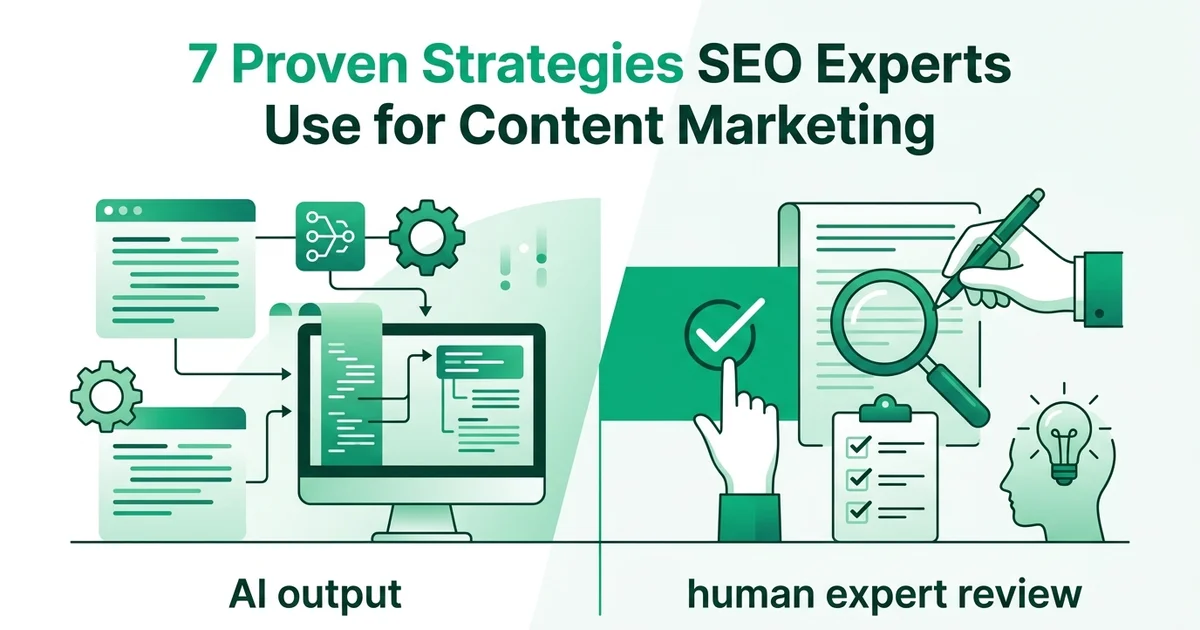
7 Proven Strategies SEO Experts Use for Content Marketing
Introduction: Why SEO content marketing matters now
SEO content marketing in 2025 is no longer two separate disciplines running in parallel. They have fully converged into a single, unified practice where search visibility and content quality are inseparable. Publishing more content is not enough. Publishing smarter, more strategically structured content is what separates businesses that grow organically from those that stagnate.
The AI content advantage is real, but context matters
At RankHub, our analysis consistently shows that the businesses gaining the most ground are those combining AI efficiency with genuine human expertise. The data supports this: websites using AI-assisted content recorded 29.08% year-over-year organic traffic growth, compared to 24.21% for those without. That gap is not trivial at scale. According to Conductor's State of SEO (2025), the central standard Google holds content to is whether it is helpful, reliable, and people-first. AI accelerates production; human judgment ensures quality.
What this guide delivers
The seven strategies ahead are drawn from real expert practice and measurable results. Each one addresses a specific challenge, whether that is keyword research, content structure, or publishing consistency. Expect actionable frameworks you can apply immediately, regardless of whether you run a solo operation or manage a full marketing team.
Top 3 quick wins for immediate SEO content impact
Before building out a full SEO content marketing strategy, three high-leverage actions can move the needle within weeks. These are not long-term plays. They are targeted interventions that compound quickly, and they work whether you are a solo founder or a growing marketing team.
Refresh existing high-traffic pages before creating new content
The fastest path to more organic traffic is often already sitting in your analytics dashboard. Updating underperforming or outdated pages consistently outperforms publishing new content from scratch, because you are working with established authority rather than building it from zero.
According to the SEO Content Refresh Case Study from Inflow, a structured content refresh program delivered a 268% increase in organic clicks and a 176% increase in impressions. The approach involved updating outdated information, strengthening internal linking, and realigning content with current search intent. No new pages. No new domain authority. Just smarter use of existing assets.
Where to start: Identify pages ranking between positions 5 and 20 in Google Search Console. These are your best candidates. They already have traction but are not yet capturing their full potential.
Implement AI-assisted content workflows with human editorial review
AI-assisted content creation, when paired with genuine editorial oversight, produces results that neither humans nor AI can achieve alone. According to Avid Demand's SEO case study, an AI-assisted content workflow drove a 945% increase in organic blog traffic, growing monthly sessions from 40 to 418 in a matter of months.
Tools like RankHub automate the time-intensive steps, including AI keyword research, article generation, and featured image creation, while keeping human judgment in the loop for quality control. For teams without a dedicated content resource, this kind of SEO autopilot approach removes the bottleneck without sacrificing editorial standards.
Structure content for AI Overviews and featured snippets
AI Overviews are reshaping how searchers interact with results. Research indicates they are associated with a 34.5% reduction in clicks for affected queries, which means content that does not appear within or alongside these features risks being bypassed entirely.
The strategic response is not to avoid these queries but to structure content so it earns placement. Use clear question-and-answer formatting, concise definition paragraphs under 50 words, and numbered steps for process-based content. Position your brand, product, or unique insight immediately after any snippet-optimized block so that readers who do click through land on something distinctly valuable.
AI-assisted content creation: Balancing automation with expertise
The most consequential skill in seo content marketing right now is not knowing how to use AI. It is knowing when to stop letting it run. Experts who consistently outperform competitors draw a hard line between AI-assisted content, where human judgment shapes every stage, and AI-generated content, where automation handles everything including publication.

According to Conductor's State of SEO in 2025, 74% of new web content is now created with generative AI, while only 26% remains entirely human-written. That same research found 87% of marketers used AI tools, with AI users publishing 42% more content per month than those who did not. The volume advantage is real. The quality risk is equally real.
Understanding the AI-assisted versus AI-generated distinction
AI-assisted content uses automation to accelerate research, surface keyword clusters, generate outlines, and produce working drafts. A human expert then interrogates every claim, adds first-hand evidence, and rewrites for voice and accuracy. AI-generated content skips that layer entirely. The distinction matters because search engines and readers are both becoming more effective at identifying thin, unreviewed material.
Implementing quality gates before publication
Treat your editorial pipeline like a manufacturing process with checkpoints. A practical quality gate structure looks like this:
- Research phase: Use AI to identify topic gaps, cluster related queries, and surface competitor angles
- Draft phase: Generate a working draft, then flag every factual claim for independent verification
- Expert review: A subject-matter expert adds original insight, corrects inaccuracies, and injects real-world examples
- Final edit: A human editor checks tone, structure, and brand consistency before any content goes live
Tools like RankHub build anti-cannibalization keyword checks and SEO-optimized article generation into a single automated workflow, which removes the research burden without removing editorial control. Its Starter Plan is particularly useful for founders and small teams who need consistent output without a dedicated content department.
Scaling production without diluting expertise
The competitive gap is not between businesses that use AI and those that do not. It is between teams that treat AI output as a finished product and those that treat it as a first draft. Businesses that maintain original expertise, cite proprietary data, and include genuine practitioner perspective will consistently outrank mass-generated content, regardless of volume.
If you are weighing whether to build this capability in-house or through a partner, reviewing a credible seo agency alternative can clarify which approach fits your current resources and growth stage.
Content strategy and measurement: From traffic to conversions
Ranking on page one means little if that traffic never converts. The most effective SEO content marketing strategies build a measurement framework that connects every piece of content to a business outcome, tracking not just positions and pageviews but qualified leads, assisted conversions, and revenue influenced.
Move beyond vanity metrics
Most teams default to tracking rankings and total organic traffic. These numbers feel good but rarely tell the full story. A more useful framework layers in:
- Qualified organic traffic: visitors who match your target buyer profile
- Assisted conversions: content that contributed to a sale even if it was not the last touchpoint
- Content production efficiency: output per hour or per dollar spent
According to Position Digital (2024), a strategic content overhaul for Don't Panic London produced a 36.7% traffic increase alongside a 169% increase in conversions, demonstrating that aligning content topics with buyer intent stages matters far more than chasing volume alone.
Align topics with buyer journey stages
Content that ranks but attracts the wrong audience wastes your entire acquisition budget. Map every content topic to a specific stage: awareness, consideration, or decision. High-intent keywords, those with clear purchase or evaluation signals, should anchor your conversion-focused pages. Informational content should feed those pages through internal linking.
Tools like RankHub run anti-cannibalization keyword checks automatically, preventing the common mistake of publishing competing articles that split authority and confuse search intent.
Refresh existing content to lift conversions
New content gets most of the attention, but your existing traffic is often the fastest conversion opportunity. Updating underperforming pages with stronger calls to action, updated data, and better keyword alignment can produce significant gains without starting from scratch.
A content marketing automation platform can surface which pages already attract traffic but convert poorly, making refresh prioritization a data-driven decision rather than a guess.
Common mistakes to avoid in SEO content marketing
Even well-resourced teams fall into predictable traps that quietly erode their SEO content marketing results. Recognizing these patterns early saves significant time, budget, and ranking momentum. The mistakes below are not theoretical. They show up repeatedly across businesses of every size.
Check out Starter Plan's approach to seo content marketing Starter Plan.

Publishing volume without quality controls
Scaling content output is a legitimate goal, but programmatic publishing without editorial review creates compounding brand and search risk. Thin articles, factual errors, and inconsistent brand voice signal low quality to both readers and search systems. According to The State of SEO in 2025, search visibility is diversifying well beyond traditional blue links, meaning AI-generated answers and featured placements now demand tighter content standards, not looser ones. Every piece you publish is a signal about your authority.
Skipping content refreshes in favor of new pages
Creating new content feels productive, but neglecting existing pages is one of the most common and costly oversights in SEO content marketing. According to Go Inflow's content refresh case study, a structured refresh program produced a 268% increase in organic clicks without publishing a single new page. Updating outdated statistics, improving keyword alignment, and strengthening internal links often outperforms new content creation in the short term.
Treating SEO and content as separate disciplines
When SEO lives in one team and content in another, the result is articles that read well but rank poorly, or pages optimized for crawlers that no human wants to read. In our experience at RankHub, the most effective content programs integrate keyword research, entity clarity, and structural formatting from the first draft, not as an afterthought. RankHub's seo content automation software builds this integration directly into the production process, running anti-cannibalization checks and SEO structuring before a single word is published.
Measuring vanity metrics instead of business outcomes
Sessions and keyword rankings feel meaningful, but they do not pay salaries. Teams that optimize for traffic without connecting content performance to leads, signups, or revenue often struggle to justify their budgets. Replace vanity dashboards with conversion-focused reporting that ties specific content pieces to pipeline outcomes.
Neglecting first-hand evidence in AI-assisted content
AI-assisted content that lacks citations, original data, or clear entity signals is increasingly difficult for search systems to trust and rank. Adding first-hand experience, verified statistics, and named sources is not optional polish. It is a core quality requirement for content that competes in modern search, including AI Overviews. If you are working with a lean team, partnering with an seo marketing agency can help establish the editorial standards needed to make AI-assisted content genuinely credible.
Tools and resources for scaling SEO content marketing
Scaling SEO content marketing requires the right stack of tools working together. The right combination of automation, research platforms, and analytics can transform a lean team's output without sacrificing quality. Here is how to build that infrastructure deliberately.
Autopilot content automation
Consistent publishing is one of the hardest disciplines to maintain when you are running a business alongside a content program. RankHub addresses this directly with its Starter Plan, which runs 15 automated steps monthly to deliver SEO-optimized articles, featured images, and webhook publishing to your platform. For founders and small teams without a dedicated content resource, this kind of automation removes the bottleneck entirely.
Research suggests that AI-assisted workflows enable 42% more content per month, which compounds significantly over a 12-month period.
AI writing assistants and keyword research tools
AI writing tools work best as research and outlining accelerators, not final-draft generators. Pair them with dedicated SEO platforms for keyword gap analysis and cannibalization checks. RankHub's built-in anti-cannibalization keyword checks prevent the common problem of new posts competing against existing ones.
For broader marketing tools selection, prioritize platforms that surface performance data alongside content recommendations.
Analytics and conversion tracking
Publishing without measurement is guesswork. Set up analytics to track both direct conversions and assisted conversions, which reveal how early-funnel content contributes to eventual sales. According to Position Digital (Year), a structured content marketing approach delivered a 169% increase in conversions, underscoring why measurement frameworks matter as much as the content itself.
Align your content calendar with buyer journey stages and seasonal demand signals so every piece serves a measurable purpose.
Conclusion: Building a sustainable SEO content marketing engine
The most effective SEO content marketing programs share a common thread: they prioritize quality, measurement, and consistency over sheer volume. The strategies covered in this article reflect a clear industry shift, where expertise and intent matter far more than output alone.
Human judgment remains irreplaceable, even as AI accelerates production. The strongest results come from teams that use automation to handle repetitive tasks while focusing their energy on strategy, storytelling, and audience insight. Tools like RankHub support this balance by running 15 automated steps monthly, freeing you to concentrate on the decisions that actually move rankings.
Your next steps are straightforward:
- Audit your existing content for gaps and refresh opportunities
- Build a measurement framework before publishing new pieces
- Adopt proven best seo automation tools to scale without sacrificing quality
Consistency compounds. Start with one framework, measure what works, and build from there.
Frequently asked questions
What is SEO content marketing?
SEO content marketing is the practice of creating and distributing valuable content that is strategically optimized to rank in search engines and attract a targeted audience. It combines keyword research, on-page optimization, and audience-focused storytelling to drive organic traffic that converts.
How does content marketing improve SEO?
Quality content earns backlinks, increases dwell time, and signals topical authority to search engines. Each well-optimized piece you publish expands your site's keyword footprint and builds cumulative ranking power over time.
What type of content is best for SEO?
Long-form guides, comparison articles, and data-driven posts consistently perform well because they address search intent thoroughly. The best format depends on your audience and the query type, whether informational, navigational, or transactional.
How often should you publish SEO content?
Consistency matters more than volume. Even one well-researched, optimized article per week can compound meaningfully over 12 months. Tools like RankHub are built around this principle, delivering one SEO-optimized post weekly through full automation.
Can AI-generated content rank on Google?
Yes, when it prioritizes genuine value. According to Avid Demand (2025), an AI-assisted content program produced a 945% year-over-year increase in organic blog traffic. Google's own guidance emphasizes helpful, people-first content regardless of how it is produced.
How do you create an SEO content strategy?
Start with keyword research to identify audience intent, group topics into clusters, and map each piece to a stage of the buyer journey. Build in a measurement framework from day one so you can track what drives rankings and revenue.
What is the difference between SEO and content marketing?
SEO focuses on technical and on-page signals that help search engines find and rank your pages. Content marketing focuses on creating material that engages and converts an audience. Effective seo content marketing unites both disciplines so every piece is discoverable and genuinely useful.
How do you measure the ROI of SEO content marketing?
Track organic sessions, keyword rankings, conversion rates, and assisted revenue attributed to organic traffic. Compare these figures against content production costs to calculate a clear return. RankHub's automated reporting makes this straightforward by consolidating keyword performance data in one place.
Based on our work at RankHub, the teams that measure ROI from the first published piece, rather than waiting months to review results, are the ones that scale fastest and make smarter content investments.
More from Our Blog
AI Marketing Trends in 2026: What's Actually Changing
Discover the top AI marketing trends in 2025: from generative content creation to AI-assisted SEO. Learn how to implement AI workflows for your business.
Read more →
How to Select Marketing Tools That Actually Work for Your Business
Learn how to select marketing tools that fit your budget, goals, and team size. Our guide walks you through evaluating, comparing, and implementing the right stack.
Read more →
Why Your Business Isn't Growing Online (And How to Fix It)
Fix Chase Business Online login issues, account setup problems, and access errors. Step-by-step solutions for small business owners.
Read more →