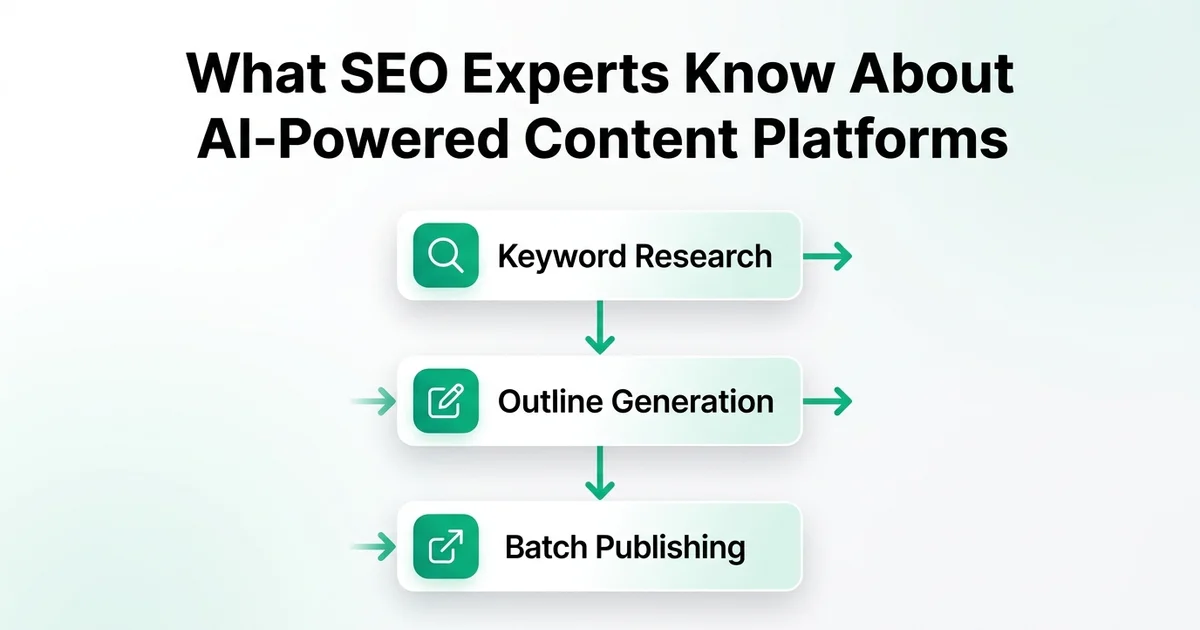
What SEO Experts Know About AI-Powered Content Platforms
Introduction: why AI-powered SEO platforms are reshaping content strategy
The conversation around AI in SEO has matured rapidly. What began as a handful of standalone writing assistants has evolved into something far more consequential: end-to-end platforms that handle keyword research, content creation, image generation, and publishing within a single, automated workflow. For solo founders, lean marketing teams, and growing SMBs, that shift changes everything.
From isolated tools to integrated workflows
Not long ago, producing a single optimised article meant juggling a keyword tool, a brief template, a writer, an editor, and a CMS. AI-powered SEO content platforms collapse that chain into one continuous process. The result is not just convenience. It is a structural change in how content strategy gets executed, moving from reactive, resource-constrained publishing to consistent, scalable output.
AI as a force multiplier for content capacity
The numbers reflect this shift clearly. Research suggests that companies using AI for content produce approximately 42% more content per month than those that do not, and 67% of small-business owners and marketers are already using AI for content marketing or SEO. Crucially, 76% of businesses report that AI-generated content has ranked at least once, confirming that the credibility gap is closable with the right approach.
Why human oversight still determines outcomes
Ranking with AI content is achievable. Sustaining that performance requires strategic implementation: accurate targeting, quality control, and consistent publishing cadence. Automation handles the volume; human judgment shapes the direction. Platforms like RankHub Autopilot, which automate the full pipeline from keyword research to scheduled publishing, are designed precisely to support that balance, freeing teams to focus on strategy rather than production.
Top 3 quick wins: immediate value from AI-powered platforms
The fastest way to understand what an AI-powered SEO content platform can do is to look at where it delivers results within the first few weeks. Three capabilities consistently stand out: faster keyword discovery, accelerated content planning, and hands-off publishing at scale.
Tip 1: Automate keyword research to uncover far more opportunities
Manual keyword research is thorough but slow. An AI platform can surface hundreds of relevant, low-competition terms in the time it would take a human researcher to evaluate a handful. Research suggests that marketers using AI tools for content tasks report significant gains in output volume, with some studies indicating increases of over 40% in total content produced. The practical implication is straightforward: more keywords discovered means more ranking opportunities pursued.
For solo founders and small teams without a dedicated SEO analyst, this shift is particularly meaningful. Rather than spending days building a keyword list, you can redirect that time toward evaluating which opportunities align with your business goals.
Tip 2: Generate structured content outlines in minutes
A well-structured outline is the foundation of any high-performing article. AI platforms can produce detailed, SEO-informed outlines, complete with suggested headings, subtopics, and target queries, in minutes rather than hours. This dramatically compresses the editorial planning cycle and makes it realistic to maintain a consistent publishing schedule even with a lean team.
Tools like RankHub Autopilot take this further by combining keyword research and article generation into a single automated workflow, removing the handoff friction that typically slows content teams down. For businesses exploring a content marketing automation platform, this kind of end-to-end integration is worth prioritizing.
Tip 3: Batch-publish on a consistent schedule without manual uploads
Consistency is one of the most underrated ranking factors. According to Diggity Marketing, a structured AI-driven publishing approach produced over 1,400% growth in monthly AI traffic, with scheduling discipline playing a central role in that outcome.
Platforms with webhook publishing integration, such as RankHub Autopilot, allow teams to set a content queue once and let the system handle delivery to the CMS automatically. For businesses evaluating whether AI tooling can serve as a credible seo agency alternative, this kind of reliable, low-maintenance output is often the deciding factor.
Keyword research and discovery tips: finding untapped opportunities at scale
Effective keyword research is no longer about finding high-volume terms and hoping for the best. AI-powered platforms now surface granular, intent-specific keyword clusters that most competitors overlook entirely, giving businesses a genuine first-mover advantage in underserved content territory.
Identify long-tail clusters your competitors are missing
Most SEO tools surface the same obvious keywords. AI platforms go deeper, grouping semantically related long-tail variations into clusters that reveal what real users are searching for at each stage of the buying journey. These clusters are often lower competition, higher intent, and far more actionable than broad head terms. For solo founders and small teams without dedicated SEO staff, this kind of automated discovery removes a significant research bottleneck.
RankHub Autopilot's AI keyword research feature is built around this principle, identifying topic clusters and feeding them directly into its content pipeline, so discovery and production happen within a single workflow rather than across disconnected tools.
Cross-reference AI suggestions with intent data before committing
AI keyword suggestions are a starting point, not a final answer. Before allocating content resources, validate each cluster against search volume trends and user intent signals. A keyword with modest volume but strong transactional intent will consistently outperform a high-volume informational term for conversion-focused businesses.
Find white-space opportunities through competitor gap analysis
AI platforms can systematically audit competitor content to reveal topics they rank for that you do not, and topics neither of you covers well. These white-space opportunities are where sustainable organic growth tends to originate. Pairing this analysis with seo content automation software allows teams to act on gaps quickly rather than letting insights sit in a spreadsheet.
Monitor emerging trends before competitors catch on
Setting up automated keyword monitoring within your seo automation platform means your content strategy responds to rising search trends in near real time. Platforms that combine trend detection with anti-cannibalization checks, as RankHub Autopilot does, ensure that new keyword opportunities are pursued without undermining existing content performance.
Content generation and optimization tips: maintaining quality while scaling
Scaling content production with AI is only valuable if quality keeps pace with volume. The most effective teams treat AI as a capable first drafter, not a finished publisher. They layer in human judgment, proprietary insight, and systematic testing to turn raw AI output into content that genuinely earns rankings and reader trust.

Always review and fact-check before publishing
Research suggests that 93% of marketers review AI-generated content before it goes live, and that discipline pays off. AI models can produce confident-sounding claims that are outdated, imprecise, or simply wrong. Building a review step into your workflow, even a lightweight one, protects your brand authority and prevents the kind of factual errors that erode reader trust over time.
For seo automation for content teams, the goal is not to eliminate human oversight but to make it faster. Review for accuracy, tone, and relevance rather than rewriting from scratch.
Customize outputs with your unique voice and data
Generic AI content blends into the background. What separates high-performing articles from forgettable ones is specificity: proprietary data, real case studies, and a consistent brand voice that readers recognize. After AI generates a structural draft, inject examples your audience cannot find elsewhere. That layer of originality is also what signals credibility to both readers and search engines.
RankHub Autopilot handles the heavy lifting of SEO-optimized article writing and featured image generation, which frees up the time you would otherwise spend on structure and formatting. That recovered time is better spent adding the human insight that AI cannot replicate.
Test variations and optimize for generative engines
AI makes it practical to generate multiple content variations quickly. Use that capability deliberately: test different headlines, calls to action, and content formats to identify what drives engagement. Studies indicate that 79% of businesses report improved content quality after introducing AI into their workflows, partly because iteration becomes faster and less costly.
Beyond traditional rankings, optimize for generative-engine optimization (GEO). According to Xponent21's AI SEO Case Study (2024), structuring content to answer specific questions directly, using clear attribution and authoritative sourcing, significantly improves visibility in AI-generated search responses. This matters because What the Data Shows About SEO Automation ROI in 2026 points to generative engine traffic becoming an increasingly significant share of total organic visits.
Publishing and automation tips: scaling without sacrificing control
Scaling content output with AI is only valuable if what reaches your audience is accurate, on-brand, and strategically timed. The experts who get this right treat automation as a production line with quality gates, not a free-for-all content tap. Here is how to build that discipline into your workflow.
Explore what RankHub Autopilot offers for ai powered seo content platform RankHub Autopilot.
Set up approval workflows before you publish anything
Every piece of AI-generated content should pass through at least one human checkpoint before it goes live. Build a simple editorial review stage into your process: assign a reviewer, define what they are checking for (factual accuracy, tone, structural coherence), and make approval a hard requirement rather than an optional step. This single habit prevents the compounding reputational damage that comes from publishing confidently wrong content at scale.
Use scheduling to create publishing consistency
Irregular publishing signals inconsistency to both search engines and readers. A predictable cadence, whether that is two posts per week or daily, compounds over time. Tools like RankHub Autopilot are built specifically for this: once configured, the platform researches keywords, writes articles, generates featured images, and publishes on schedule via webhook integration, removing the manual effort that typically breaks publishing routines. Pairing this with a structured seo content calendar automation approach gives you visibility across your entire pipeline.
Implement quality-control checklists at every stage
Before any article publishes, run it through a consistent checklist covering originality, fact verification, and brand-voice alignment. Treat this as non-negotiable, even when volume increases.
Track AI-generated traffic separately
Segment your analytics so AI-generated content has its own reporting view. This lets you measure ROI accurately, identify which topics and formats perform best, and refine your strategy with real data rather than assumptions.
Common mistakes to avoid: pitfalls that derail AI-powered SEO strategies
Even with the right tools and workflows in place, several predictable mistakes consistently undermine AI-powered SEO strategies. Recognizing these pitfalls early can mean the difference between compounding gains and wasted effort. Here are the four most damaging errors SEO experts see teams make.
Mistake 1: Publishing AI content without human review
Skipping the review step is the fastest way to erode trust. Research suggests that roughly 93% of marketers review AI content before publishing, which means approximately 7% do not, and that group almost certainly encounters factual errors, inconsistent brand voice, or unintentional plagiarism. A single inaccurate article can damage credibility that took years to build. No automation workflow, however sophisticated, eliminates the need for a human editor to verify claims and catch what the model missed.

Mistake 2: Ignoring generative-engine optimization
Ranking on Google is no longer the only measure of visibility. ChatGPT, Perplexity, and Google AI Overviews are now primary discovery channels for millions of users. According to Techmagnate (2024), adapting content for generative search produced a 20.64% increase in AI-originated traffic. Teams that optimize exclusively for traditional search rankings are leaving a significant and growing share of organic reach uncaptured.
Mistake 3: Using AI to replace strategy
An ai powered seo content platform is a production tool, not a strategist. It cannot define your audience, identify your competitive gaps, or determine which topics actually move your business forward. Keyword targeting, audience research, and competitive analysis must still come from human judgment. Platforms like RankHub Autopilot automate execution, including keyword research, article writing, and scheduled publishing, but the strategic brief that guides that execution remains your responsibility.
Mistake 4: Neglecting content differentiation
AI-generated content is, by default, commodity content. It draws from the same training data every competitor's tool uses. Without original insights, proprietary data, or genuine subject-matter expertise layered in, your content blends into the background. The teams producing standout results are those using AI to handle structure and scale, while reserving human contribution for the perspectives, examples, and analysis that no model can replicate.
Tools and resources: platforms and workflows for implementation
Knowing which tools to use, and how they connect, separates teams that scale efficiently from those that stay stuck in manual workflows. The industry is shifting toward end-to-end platforms that handle research, creation, and publishing in a single pipeline rather than stitching together a dozen separate tools.
Core AI-powered SEO platforms
For research and competitive analysis, Semrush and Ahrefs remain the benchmarks. For content generation at scale, Jasper and Copy.ai handle long-form drafting, while RankHub Autopilot takes a more complete approach: it researches keywords, writes SEO-optimized articles, generates featured images, and publishes on a schedule through webhook integrations. For teams looking at the best seo automation tools, that kind of end-to-end automation meaningfully reduces production overhead.
Quality-control tools
Never skip the verification layer. Originality.ai handles plagiarism and AI-detection checks. Fact-checking APIs and grammar tools like Grammarly add another filter before anything goes live. These are non-negotiable when publishing at volume.
Analytics and monitoring
Google Search Console, Semrush, and SE Ranking are the core trio for tracking how AI-generated content performs over time. Monitor impressions, click-through rates, and ranking movement consistently.
Workflow automation
Zapier and Make connect your content tools to your CMS, keeping scheduling and publishing on autopilot without manual handoffs at every stage.
Conclusion: scaling your content strategy with AI-powered platforms
The evidence is clear: businesses that adopt an ai powered seo content platform consistently outpace those relying on manual workflows. Research suggests that 68% of businesses report increased content-marketing ROI from AI adoption, and according to Diggity Marketing, a structured AI SEO approach can deliver a 1,400% increase in monthly AI-referral traffic. These are not outlier results reserved for enterprise teams with large budgets.
Start small, then scale deliberately
Begin with keyword research automation. Once that process runs reliably, layer in content generation and publishing. This staged approach prevents workflow bottlenecks and gives your team time to build effective approval processes before volume increases. Platforms like RankHub Autopilot handle the full sequence, from keyword discovery through to scheduled publishing, which removes the manual handoffs that typically slow scaling efforts.
Measure, refine, and iterate
Track AI-generated content separately in Google Search Console from day one. Isolate what is performing, identify patterns in what is not, and refine your approval workflows accordingly. Consistent iteration compounds over time.
If you are ready to move beyond one-off content experiments, explore SEO autopilot tools that actually deliver results to find the right fit for your growth stage.
Frequently asked questions
What is an AI-powered SEO content platform?
An AI-powered SEO content platform is a tool that automates the end-to-end process of creating search-optimized content. This typically includes keyword research, article writing, image generation, and scheduled publishing, all within a single workflow.
Can AI-generated content rank on Google?
Yes. Research suggests that approximately 76% of businesses report their AI-generated content has ranked at least once on Google, indicating strong viability when content is properly optimized and reviewed before publishing.
Is AI content good for SEO?
When edited for accuracy and structured around genuine user intent, AI content performs well. Studies indicate 79% of businesses report improved content quality after adopting AI tools.
How do AI SEO tools research keywords?
Most platforms analyze search volume, competition, and topical gaps to surface high-opportunity keywords. Tools like RankHub Autopilot also include anti-cannibalization checks to prevent targeting overlapping terms across your existing content.
What is the best AI SEO content tool for small businesses?
The best fit depends on your workflow, but platforms offering complete automation from keyword research to publishing, like RankHub Autopilot, are well-suited to small teams without dedicated content staff.
How do you optimize AI-generated content for search engines?
Focus on matching search intent, adding original insights, and structuring content with clear headings and internal links. Human review before publishing remains essential for quality and accuracy.
Can AI automatically publish SEO articles to my website?
Yes. Platforms like RankHub Autopilot support webhook publishing integrations, enabling fully automated delivery to your website on a set schedule with minimal manual involvement.
How do you keep AI-generated content accurate and original?
Establish a human review step, cross-reference factual claims against authoritative sources, and use plagiarism checks. Accuracy protocols protect both your credibility and your long-term search performance.
More from Our Blog
Why Small Business Owners Struggle with SEO (And How to Fix It)
Discover the best SEO tools for small business owners. Compare features, pricing, and ease of use to boost your organic visibility without breaking the bank.
Read more →
Cost-Effective SEO Solutions Built for Startup Growth
Compare top budget-friendly SEO tools for startups. Find the best affordable solutions with pricing, features, and ROI analysis.
Read more →
Best Social Media Management Tools for Teams & Entrepreneurs
Compare social media management tools including Hootsuite, Buffer and Sprout Social. Review pricing sources, features and team workflow fit.
Read more →