
If you want to seriously check rankings for multiple keywords, you have to look past your handful of "money" terms. The only real way to do this at scale is with a dedicated rank tracking tool. This gives you a bird's-eye view of your entire organic presence and, more importantly, helps you spot those goldmine opportunities you'd otherwise miss.
Why Modern SEO Is a Numbers Game (More Keywords = More Wins)

Obsessing over just a few high-volume, high-competition keywords is a recipe for frustration. That's old-school SEO thinking. These days, winning in organic search means understanding how your site performs across a huge spectrum of queries. We're not talking about vanity metrics here; this is about mapping your entire digital footprint.
When you check rankings for multiple keywords, you stop putting all your eggs in one basket. It’s about building a robust, resilient traffic strategy. Think of it as diversifying your investment portfolio. A broader approach makes your site far less susceptible to the whiplash of a sudden Google update that might tank your rankings for one specific cluster of terms.
Let's break down the core advantages of expanding your keyword tracking. It's not just about more data; it's about smarter, more strategic data.
Core Benefits of Tracking Multiple Keywords
| Benefit | Why It Matters for Your Business |
|---|---|
| Complete Visibility | You see the full picture of your SEO health, not just a tiny, biased snapshot. |
| Risk Diversification | A single algorithm update is less likely to cripple your traffic if you rank for hundreds of terms. |
| Capture Entire Funnel | You can connect with customers at every stage, from initial research to final purchase. |
| Find Hidden Gems | Uncover low-competition, high-intent keywords that your competitors are completely ignoring. |
| Smarter Content Strategy | Your keyword data tells you exactly what topics to cover next to drive maximum impact. |
Ultimately, tracking a wide net of keywords transforms your SEO from a guessing game into a predictable growth engine.
Catch Customers at Every Step of Their Journey
People don't all use Google the same way. Their search terms change depending on where they are in the buying process. A smart, broad tracking strategy lets you show up at every critical moment.
- Top of Funnel (Awareness): Think about informational queries like "how to fix a leaky faucet." Tracking these helps you become a trusted resource for people just starting their research.
- Middle of Funnel (Consideration): Here, you’ll see comparison keywords pop up, such as "copper vs PEX pipes." Being visible here helps you guide users as they weigh their options.
- Bottom of Funnel (Decision): This is where transactional keywords like "plumber near me" come in. You absolutely have to be ranking here when someone is ready to pull out their wallet.
By covering all these stages, you're building a relationship with potential customers long before they even realize they need to hire you. That’s where the real, sustainable growth happens.
Unearth Your Next Big SEO Win
I can't tell you how many times I've found a client's most valuable keywords weren't the ones they thought they were. A broad analysis almost always reveals "striking distance" keywords—these are terms hanging out on the second or third page of Google. With just a little bit of on-page optimization or a few internal links, you can push them to page one and see a massive traffic boost.
This is especially powerful if you're creating long-form content. Some great research on SEO statistics shows that articles over 3,000 words tend to rank for more keyword variations, earning three times more traffic and 3.5 times more backlinks. When you pair that in-depth content with broad keyword monitoring, you have a killer combo for dominating your niche.
My Two Cents: Think of broad keyword tracking as your safety net. It insulates you from volatility, shows you how real people actually search for what you offer, and points you directly to your next big win. It turns rank tracking from a chore into your secret weapon for strategic discovery.
So, Which Rank Tracker Should You Actually Use?

Let's get one thing straight: manually plugging keywords into an incognito window isn’t an SEO strategy. It’s a tedious chore that gives you wildly inaccurate results. Personalization, search history, and especially your physical location completely skew what you see.
To get a real sense of how you’re performing for hundreds or thousands of keywords, you absolutely need a dedicated, automated tool. This isn't just a nice-to-have; it's a must-have for any serious SEO work.
But here’s the thing—not all rank trackers are built the same. A basic tool might just show you a number, but a truly great one becomes the command center for your entire organic search operation. It’s the difference between a blurry, out-of-date snapshot and a live, high-definition feed of your performance. You're not just looking for data; you're looking for intelligence.
What to Look for in a Serious Rank Tracker
When you start comparing tools, there are a few features that are completely non-negotiable. If a tool is missing these, you’re essentially flying blind and leaving huge opportunities on the table.
- Daily Updates: Google's results can change in an instant. A tool that only pings your rankings weekly is showing you old news. You need daily updates to spot trends as they happen, react fast to sudden drops, and connect your SEO efforts to actual results.
- Hyper-Accurate Local Tracking: Ranking number five nationally is great, but it means nothing if all your customers are in Austin, Texas. Your tool has to let you get granular, tracking rankings down to the city or even zip code level, so you can see exactly what your target audience sees.
- Competitor Monitoring: SEO is a competitive sport. You have to know what your rivals are up to. A good tracker will let you monitor their rankings for the same keywords, giving you a peek into their strategy and showing you exactly where you can steal their lunch.
- SERP Feature Analysis: Ranking #1 is the goal, right? Well, not if there's a featured snippet, a video carousel, and a "People Also Ask" box sitting above your result. Your tracker needs to show you who owns these valuable SERP features so you can build a strategy to claim them for yourself.
A powerful rank tracker does more than report positions. It gives you the context behind the numbers. It helps you understand the why—why you're ranking, why you're not, and what to do next to win.
Your Quick Evaluation Checklist
Choosing the right tool is a big decision, and it really comes down to what your business needs. Before you pull out your credit card, run through this quick checklist.
- Scalability: How many keywords do you need to track today? What about in a year? Make sure the platform’s pricing can grow with you without breaking the bank.
- Team & Reporting Needs: Will multiple people need access? Are the reports clean, simple, and easy to share with clients or bosses who aren’t SEO nerds? White-label reports are a huge bonus for agencies.
- Budget & Pricing: Do you want a predictable monthly subscription, or would a flexible pay-as-you-go model (like the one we use at RankHub) be a better fit? Line up the cost with the value you expect to get.
- Integrations: Can it connect to other tools in your marketing stack, like Google Analytics and Google Search Console? Connecting your data sources gives you a much richer, more complete picture of what's really going on.
This is a pretty important choice for your SEO toolkit. For a deeper dive into the fundamentals, check out our guide on how to track keyword rankings. It can help you firm up your strategy before you invest in a platform.
Kicking Off Your First Tracking Project
Alright, let's get our hands dirty and move from planning to doing. This is where you actually start to check rankings for multiple keywords and turn that raw data into something you can act on. Honestly, getting this initial setup right is the most critical part. A little care now will save you from a world of messy, inaccurate data down the road.
Most modern rank trackers, including RankHub, have a similar setup flow, so what you see here will likely feel familiar no matter which tool you're using.
It all starts with plugging in your domain. This simply tells the tool which website you own and want to keep an eye on. It’s usually as simple as typing your root domain into a box, just like this:
With that one simple step, you've kicked off the whole tracking process and set the stage for all your keyword analysis.
Building Your Master Keyword List
This is the absolute core of your project. The quality of the keywords you feed the tool directly dictates the quality of the insights you get back.
Don't just dump a massive, random list of terms in here and hope for the best. That’s a surefire way to get noisy, unusable data. The secret is structure. Start by organizing your keywords with tags right from the beginning. Trust me, this is a pro move that will make your life so much easier when it's time to analyze everything.
Here’s how I like to break it down:
- Brand vs. Non-Brand: Create separate groups for searches that include your company name (like "RankHub reviews") and generic, non-branded terms ("best AI keyword tool"). This helps you measure your brand's pull separately from your pure SEO efforts.
- Core Services or Products: Group keywords by what you sell. If you're a plumber, you’d have tags for "emergency plumbing," "drain cleaning," and "water heater repair."
- Blog & Content Topics: Tag the keywords your informational articles are targeting, like "how to fix a leaky pipe." This is key for measuring the real ROI of your content marketing.
- Competitor Brand Terms: This one's a bit more aggressive, but tracking your competitors' branded terms can be incredibly insightful. You might be surprised how often you show up for their audience.
A clean, organized list is everything. If you need a quick refresher on how to find the right terms to begin with, we've got a complete guide on how to do keyword research that covers the entire discovery process.
Dialing in Your Location and Device Settings
Your data is useless if it’s not relevant. If you run a local bakery in Chicago, you couldn't care less about how you rank in Los Angeles. This is where you need to tell your tracking tool what actually matters to your business.
Be specific. Set your tracking to the country, state, or even city that represents your target market. This ensures the ranking data you see actually mirrors what your potential customers are seeing in their search results.
The same goes for devices. You need to specify whether you want to track desktop or mobile rankings—or both. User behavior can be wildly different on a phone versus a computer, and you absolutely need to know how you're performing on each.
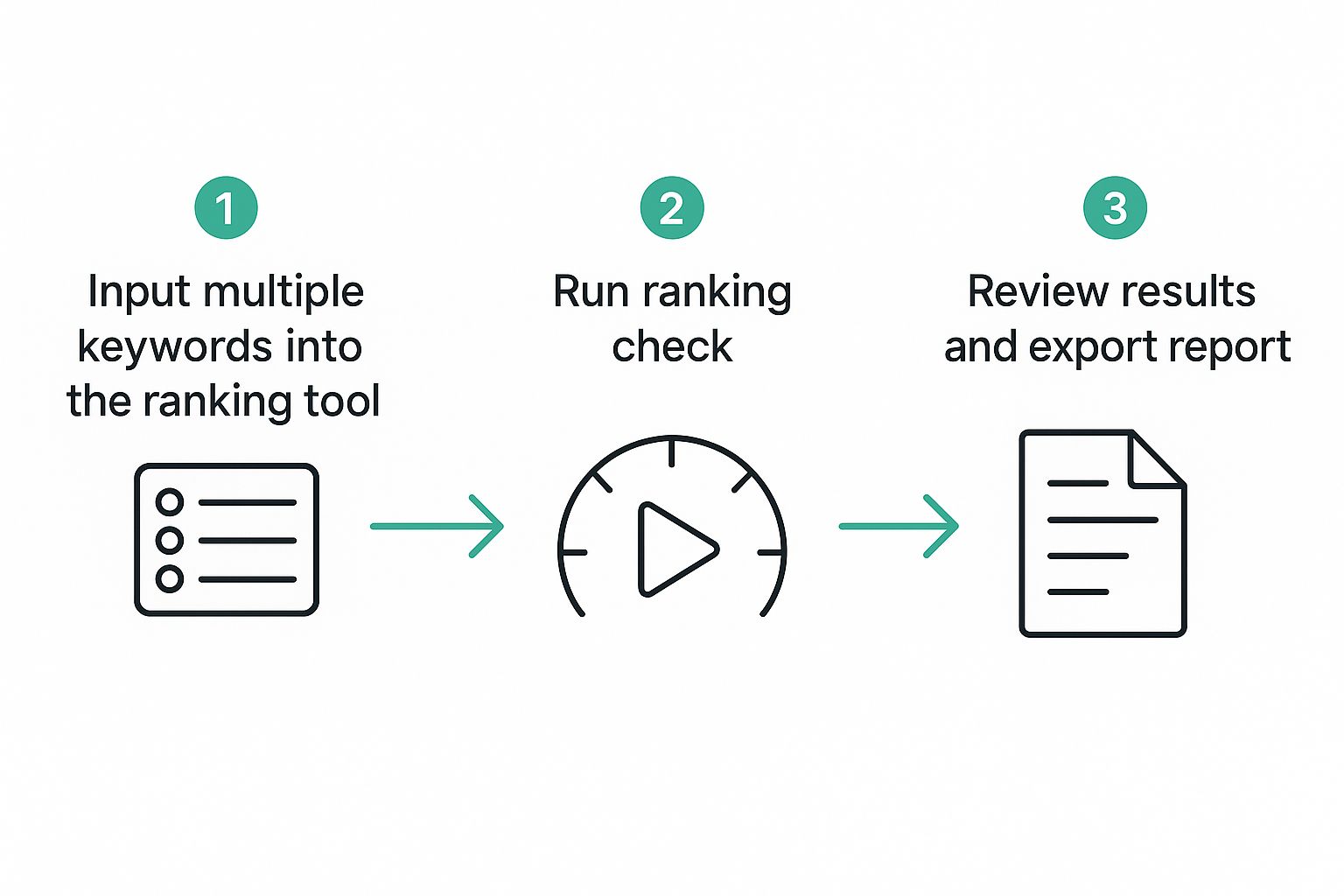
Once you have everything configured, the tool gets to work. You feed it your organized keywords, it does its magic checking the SERPs, and then it hands you back the results for analysis. In a world where Google handles over 8.5 billion searches daily and a staggering 94% of web pages get zero traffic from Google, a properly set up project is your best weapon.
Turning Ranking Data Into an Actionable Game Plan
Collecting all this ranking data is the easy part. Honestly, anyone can do that. The real magic happens when you can look at those numbers and actually see a clear path forward. When you check rankings for multiple keywords, you're not just collecting data points; you're gathering battlefield intelligence. It's time to stop just watching the scoreboard and start making plays.
Think of the reports you get from a tool like RankHub as a treasure map. You just have to learn how to read it. This means spotting patterns, catching problems before they blow up, and finding those juicy low-hanging fruit opportunities that can give you a quick, meaningful boost.
Hunt for Your 'Striking Distance' Keywords
My absolute favorite place to start digging is on page two of Google's results. Why? These are your "striking distance" keywords. These are the queries where Google already thinks your page is pretty relevant, but it just needs a little extra push to get over the finish line and onto page one where all the action is.
Let's be real: pushing a keyword from position 87 to 53 is a footnote in a report. But moving from position 12 to position 7? That’s a game-changer for your traffic and leads.
Dive into your keyword list and filter for everything that’s consistently sitting between positions 11 and 20. These are your golden opportunities. A few simple tweaks can often be enough to bump them up:
- Go back and tighten up the on-page SEO of the ranking URL.
- Add a few powerful internal links from your site's stronger pages.
- Refresh the content with new stats, info, or examples.
- Embed a new video or a sharp-looking infographic to increase engagement.
Dig In and Diagnose Ranking Drops
Seeing a keyword tank overnight can definitely cause a little panic. I get it. But your historical ranking data is your best friend here. Instead of freaking out, you can use the data to start asking the right questions.
Key Takeaway: The goal isn't just to see what changed, but to figure out why. Was it a big Google algorithm update everyone's talking about? Did a competitor just launch an incredible piece of content? Or, oops, did you accidentally break something on your own page?
Having that history lets you build a solid theory and take targeted action instead of just wildly guessing what went wrong.
Uncover Sneaky Cannibalization Issues
Here’s a classic SEO headache that’s almost impossible to spot without tracking a wide range of keywords: keyword cannibalization. This is what happens when two or more pages on your own site are fighting each other for the same keyword. To Google, this just looks messy and confusing, and it can hurt the rankings for all the competing pages.
Your rank tracker makes this super easy to spot. Just filter your report by a single keyword. If you see the ranking URL flipping back and forth between two or three different pages on your site... boom. You've got a cannibalization problem. The fix is usually to consolidate the best parts of the content onto one "master" page and then redirect the others to it.
Spotting Your MVP Content
On the flip side, your data is fantastic for finding your winners. By grouping your keywords into topics or content clusters, you can quickly see which articles or service pages are your heavy hitters in organic search. This tells you exactly where to double down.
This is especially powerful when you look at longer, more specific searches. Think about it: long-tail keywords (phrases with 4+ words) make up a staggering 70% of all search traffic. Even crazier, super-long queries of 10-15 words get 1.76 times more clicks than simple one-word searches. If you want to dive deeper, check out these insightful SEO stats that show the power of long-tail keywords.
To really get the most out of your rank tracking, you have to know what the data is telling you. Here’s a quick guide to interpreting some common scenarios you'll see in your reports.
Interpreting Common Ranking Fluctuations
Understanding what different changes in your rank tracking reports could mean and the appropriate action to take.
| Observation | Potential Cause | Next Step |
|---|---|---|
| A keyword slowly climbs a few positions. | Your recent on-page tweaks or new backlinks are starting to work. | Keep building on that momentum. Look for more internal linking or content enhancement opportunities. |
| A page suddenly drops 20+ positions. | This could be a technical issue (like a noindex tag) or a penalty from a Google update. | Run a technical audit of the page immediately. Check Google Search Console for manual actions. |
| Rankings are "dancing" up and down daily. | This is common for new content as Google tests its position, or it can signal a volatile SERP. | Monitor for a week or two. If it doesn't stabilize, analyze the top-ranking competitors for intent. |
| The ranking URL keeps changing for a keyword. | Classic keyword cannibalization. Two or more pages are competing. | Decide which page is the best fit, consolidate content, and use a 301 redirect on the other page. |
| A whole cluster of related keywords dropped at once. | Likely a core algorithm update that re-evaluated your site's topical authority. | Analyze the SERPs for the main keywords in the cluster. See what type of content is now winning. |
Seeing these patterns helps you move from just reacting to proactively managing your SEO.
Ultimately, turning your reports from a list of numbers into a strategic roadmap is what separates good SEO from great SEO. For a deeper dive into this process, check out a practical guide to turning data into actionable insights.
Making Rank Tracking a Core Part of Your SEO Rhythm

Let's be honest, your rank tracker shouldn't be a dusty tool you check once a month. It needs to be the beating heart of your entire SEO strategy. The data you get from it should drive every single decision you make, from the next blog post you write to the technical fixes you push to the top of your list.
When you consistently check rankings for multiple keywords, you build an incredibly powerful feedback loop. It's a simple, repeatable process: analyze the data, make a change on your site, and then check your tracker to see what actually happened. This rhythm is the real secret to getting sustainable growth, not just one-off wins.
This habit stops you from flying blind. You’re no longer just guessing what Google wants; you’re using cold, hard data to guide your efforts.
Turning Numbers into Actionable To-Dos
The real magic happens when you connect a number in your rank tracker to a specific task on your to-do list. It’s about making the data tangible.
Here are a few real-world examples of how this plays out:
- Shape Your Content Calendar: See a group of related keywords hovering on page two? That's your cue. It’s time to either refresh the main article or build out some supporting content to create a stronger topic cluster.
- Spot Content Decay: If you have a former all-star page that's slowly bleeding rankings, it's begging for an update. This is a clear signal to go in, add fresh stats, and update the information to make it competitive again.
- Discover Internal Linking Opportunities: Find a page on your site with high authority? Don't let that juice go to waste. Use it to send internal links to other pages targeting keywords that are "striking distance" from page one. It’s one of the quickest wins out there.
My personal rule of thumb? I never even start a content brief or a technical audit without looking at our rank tracking data first. It’s the single best way to make sure we’re spending our time on things that will actually move the needle.
Guide Your Technical SEO Audits
Don't forget that your rank tracker can also be a fantastic canary in the coal mine for technical issues. If you see an entire category of pages suddenly drop off the face of the SERPs, it’s probably not a content problem.
A sudden, widespread drop often points to something deeper. Maybe a developer accidentally pushed a 'noindex' tag live, or you're having serious crawlability issues. Your rank tracker is your early warning system, helping you spot these fires before they scorch your traffic. It turns a vague "our rankings dropped" panic into a focused investigation, saving you tons of time.
Got Questions About Tracking Your Keyword Rankings? We've Got Answers
Even with the best tools in your corner, tracking keyword rankings at scale can bring up some tricky questions. It happens to everyone, whether you're just starting out or have been doing this for years. Let's dig into some of the most common head-scratchers I hear all the time.
How Often Should I Really Be Checking My Rankings?
For most businesses, checking your keyword rankings daily is the way to go. I know it might sound like a lot, but the search results can change on a dime. Daily check-ins let you catch new trends, see the immediate impact of a Google update, or spot a technical glitch before it turns into a disaster.
Waiting a whole week to check means you're working with old news.
Think about it: if one of your most important pages suddenly fell off the first page, would you want to find out today or a week from now when the damage is already done? Daily tracking gives you the power to react quickly.
Should I Track Mobile or Desktop Ranks?
This is a classic question, and the answer is simple: you absolutely have to track both. People search differently depending on the device they're using. A search for "best running shoes" on a desktop is probably for research, but that same search on a phone often means someone is looking to buy right now.
If you only look at one, you're willingly ignoring a massive chunk of your audience. You could be crushing it on desktop but be completely invisible on mobile—a huge problem you wouldn't even know you had.
My Two Cents: When I see a big gap between mobile and desktop rankings for the same keyword, it's a major red flag. It usually points to a specific problem like a poor mobile user experience, slow page speeds on phones, or a competitor who has simply done a better job optimizing for the mobile SERP.
Help! My Rankings Are All Over the Place. What's Going On?
First, take a breath. A little bit of fluctuation, or "rank dancing," is totally normal. This is especially true for new pages as Google tries to figure out where they fit. But if you're seeing constant, wild swings across a bunch of your keywords, it could be a sign of a deeper issue.
Here are a few common culprits:
- A Competitive Niche: The search results for your topic might just be super volatile, with everyone constantly jockeying for the top spot.
- Keyword Cannibalization: You might have multiple pages on your site competing for the same keyword. Google gets confused about which one to show and ends up swapping them in and out.
- Weak Content: If your page doesn't really nail what the user is looking for, Google will test it, see it doesn't perform well, and drop it.
When you see persistent fluctuations, your first move should be to study the pages that are ranking consistently. Figure out what they're doing right and how they're satisfying user intent. From there, you can go back and improve your own content.
Building a strong strategy starts with picking the right keywords from day one. To get that part right, our guide on keyword research best practices can help you build that solid foundation.
Ready to stop guessing and start getting data you can actually use? RankHub dives into your entire site to uncover your most valuable keyword opportunities in minutes, not hours.
More from Our Blog
7 Content Writing Tools That Boost Your SEO Rankings
Discover the top 9 SEO content writing tools to automate drafting, optimization, and publishing. Boost rankings with AI-assisted workflows.
Read more →
Zoho Marketing Automation Explained: Is It Right for You?
Compare Zoho Marketing Automation vs HubSpot on pricing, features, ease of use, and automation depth. See which wins for small teams and solo founders.
Read more →
Looking for an SEO Company? Here Are Your Best Options
Compare top SEO companies, AI platforms, and agencies. Find the best fit for your budget, from $49/month tools to full-service retainers.
Read more →