
Let's be honest, finding low-competition keywords is about finding the path of least resistance to Google's front page. It's a strategy that focuses on search terms people are actually using but that aren't being swarmed by massive, authority-stacked websites. This is how smaller sites or new blogs can get a foothold and start seeing real traffic, fast.
The Hidden Gold in Untapped Keywords
Everyone wants to rank for the big, flashy keywords. But the real SEO pros know that the smartest wins often come from the queries everyone else is ignoring. Targeting these less-trafficked terms is how you outmaneuver the competition, get quicker rankings, and pull in visitors who are ready to take action.
Think of it as finding a secret entrance to the party while everyone else is stuck in line at the front door. It’s a shift in mindset—moving away from chasing huge search volumes and instead focusing on capturing a specific, motivated audience. Much of this comes down to understanding what are long tail keywords and using them to sidestep the crowds.
Why Less Competition Means More Wins
It's like fishing. You could go to the most popular, overfished lake and compete with a hundred other boats for a few bites. Or, you could find a quiet, stocked pond where you're the only one casting a line.
A keyword like "content marketing" is that crowded lake—insanely competitive. But something like "social media content plan for real estate agents"? That's your private pond. The search volume is lower, but the person typing that in has a very specific problem they need to solve. They're a much warmer lead.
This is why I always tell people to start here. You build momentum. You get some early wins. You establish a bit of authority before you try to take on the 800-pound gorillas in your industry.
The game isn't just about getting clicks; it's about getting the right clicks. Low-competition keywords are a direct line to people who know exactly what they want, and those are the visitors who convert.
When you're trying to figure out which keywords to go after, it helps to see the trade-offs. Here’s a quick breakdown of what you can expect when targeting high- versus low-competition terms.
High vs Low Competition Keyword Strategies
| Metric | High Competition Keywords | Low Competition Keywords |
|---|---|---|
| Effort & Resources | High (Extensive content, many backlinks) | Low to Medium (Focused, quality content) |
| Time to Rank | 6-12+ months, sometimes years | 1-3 months is very achievable |
| Traffic Type | Broad, often top-of-funnel | Highly specific, often bottom-of-funnel |
| Conversion Rate | Generally lower | Generally much higher |
| Required Authority | High Domain Authority is almost a must | Can rank with low or new Domain Authority |
As you can see, the path to faster, more tangible results often runs through those less-traveled keywords.
How to Spot Your Opening
The trick is to find search terms where people are looking for answers, but the content that's currently ranking is just… weak. You're looking for signs of opportunity, like:
- Outdated blog posts from 5 years ago.
- Random forum threads or Quora answers on page one.
- Articles that only skim the surface and don't really solve the searcher's problem.
This is your signal to jump in.
Check out this screenshot. It shows a keyword with a decent number of monthly searches but a low keyword difficulty score. That’s the sweet spot.

This is exactly what you're hunting for—a gap in the market. When you see this, your job is simple: create a piece of content that is ten times better than what's currently there. Fill that gap, and you’ll be rewarded with traffic.
Building Your Initial Seed Keyword List
Before you can uncover those hidden gem, low-competition keywords, you need a solid starting point. This initial list of ideas—what we call seed keywords—is the foundation for everything that follows. I see it all the time: people just throw generic industry jargon at the wall to see what sticks. But the best seed keywords? They come straight from the horse's mouth—your audience.
The whole goal here is to get out of your own head and think like a customer. What words are they actually typing into Google? What phrases do they use when they talk about their problems? When you start listening to their language, you gain an almost unfair advantage.
Tap into Your Customer’s Mind
Your customers are leaving breadcrumbs all over the place. You just have to know where to look. Instead of trying to brainstorm in a vacuum, start digging into the places where these conversations are already happening.
- Customer Support Tickets: What are the most common questions your support team gets day in and day out? The exact phrasing people use in those tickets is pure gold.
- Online Communities: Spend some time lurking in subreddits, Facebook groups, or niche forums where your ideal customers hang out. Look for the posts that start with "How do I..." or "Can anyone recommend..."
- Competitor 'People Also Ask' sections: When you Google a competitor's article, check out the PAA box. Google is literally telling you what other related questions searchers have.
This isn't just about grabbing a list of words; it's about deeply understanding the why behind the search. You're looking for their pain points. If you feel like you need a refresher on the basics, our guide on how to do keyword research is a great resource to have open while you work.
A Real-World Bakery Example
Let’s say you run a local bakery. A lazy seed keyword list might just have "cupcakes near me" or "local bakery." Sure, that's a start, but it's exactly what every other bakery is targeting.
But what happens when you actually listen to your audience? You start to find much better ideas.
I was scrolling through a local parenting group on Facebook the other day and saw a mom ask, "Where can I find a bakery that makes nut-free birthday cakes for toddlers?" Boom. Right there, you have a rich, intent-driven seed keyword to explore that your competitors probably aren't even thinking about.
That one simple question opens up a whole new world of potential seed keywords that most people would have completely missed. This is how you build a list that leads straight to those low-competition wins.
Think about the ideas that spring from that single post:
- nut-free kids cakes
- allergy-friendly bakery
- custom toddler birthday cakes
- first birthday cake ideas safe for allergies
Every single one of these is miles better than just "local bakery." They tap into a genuine customer need, which is the perfect launchpad for finding keywords you can realistically rank for. Your initial list doesn't need to be perfect, but it absolutely has to be grounded in the real language your audience uses.
Let SEO Tools Do the Heavy Lifting
Your seed list is a solid starting point, but now it's time to really open up the throttle. This is where we plug those initial ideas into a powerful keyword tool like RankHub and let it work its magic, turning a handful of concepts into hundreds, or even thousands, of potential keywords.
Think of your seed list as a rough treasure map you sketched on a napkin. A good keyword tool is like a high-tech satellite scan of that same area—it fills in the topography, marks hidden caves, and puts a big, glowing "X" over spots you never would have found on your own. It spots patterns and connections at a scale that's just impossible for a human to replicate.
Let's say you're a fitness blogger and one of your seed keywords is 'home workout.' Pop that into a tool, and it instantly explodes into a massive list of related phrases, long-tail variations, and super-specific questions people are actually asking Google.
How to Filter for Low-Competition Gold
Okay, now you have a giant, overwhelming spreadsheet of keywords. Don't panic. The real skill is in filtering this list down to the gems. This is my go-to process for cutting through the noise fast.
First, I always apply a Keyword Difficulty (KD) filter. For a newer site, or if I'm trying to get some quick wins, I'll set the maximum KD to 20. This is your most important first step—it immediately weeds out the hyper-competitive terms and leaves you with keywords you have a realistic shot at ranking for.
Next, I look at Search Volume. It’s easy to get fixated on keywords with huge monthly searches, but that’s often a mistake. I'll typically set a minimum search volume of 50 or 100. This gets rid of the absolute duds but keeps all those juicy long-tail keywords that are less competitive and often convert better.
This long-tail strategy is incredibly effective. Did you know that over 92% of all keywords get fewer than 10 searches per month? That’s a staggering number, and it shows where the real opportunity lies. It’s also why 36.3% of SEOs say they spend most of their time on keyword research—it’s just that important. You can dig into more stats like this by checking out the full SEO statistics report here.
Don't Just Look at Numbers—Understand Intent
Beyond just difficulty and volume, you have to get inside the searcher's head. What do they actually want when they type something into Google? This is called user intent, and modern SEO tools make it so much easier to figure out.
They usually break it down like this:
- Informational Intent: People are looking for answers. Think "how to," "what is," or "why does" queries. Perfect for top-of-funnel blog posts.
- Commercial Intent: The user is in research mode, comparing products or services. These keywords often include terms like "best," "review," or "vs."
- Transactional Intent: Someone is ready to buy. These searches include words like "buy," "coupon," "discount," or "for sale."
Here’s a quick look at how a tool like Semrush's Keyword Magic Tool lets you sort and filter by these exact metrics, which is a massive time-saver.

As you can see, you can group a giant list by topic or intent, giving you a clear path to building out your content strategy.
Going back to our 'home workout' example, applying these filters would instantly surface some amazing, low-competition opportunities like:
- 'best apartment-friendly workout equipment' (KD 12, Commercial)
- 'quiet cardio exercises for late night' (KD 9, Informational)
- 'at home dumbbell workout plan pdf' (KD 15, Transactional/Informational)
This filtering stage is where the magic really happens. It’s not about finding the most keywords; it’s about finding the right keywords—the ones that perfectly match what your audience wants and what you can realistically rank for.
Diving into the SERP: How to Manually Vet Your Keywords
Metrics like Keyword Difficulty (KD) are a great first pass. They help you sift through a giant list of possibilities and pull out what looks promising. But that's all they are—a starting point. To really find the low-hanging fruit, you have to roll up your sleeves and manually dig into the Search Engine Results Page (SERP).
Honestly, this is the step that separates a hopeful SEO from one who actually gets results.
Relying only on a tool's difficulty score is a bit like buying a car without taking it for a test drive. The SERP shows you the reality of the situation—it's the ground truth for what Google thinks searchers want and who it trusts to deliver the answers.
What to Look for on Page One
When you pop your keyword into Google, you're not just glancing at the top 10 links. You're putting on your detective hat. Your mission is to find weaknesses, gaps, and cracks in the armor of the pages that are currently ranking.
Fundamentally, you're trying to figure out who you’d be up against and whether they're even doing a good job.
This flow chart gives you a bird's-eye view of the whole process, showing how this manual check is the final, critical piece of the puzzle.
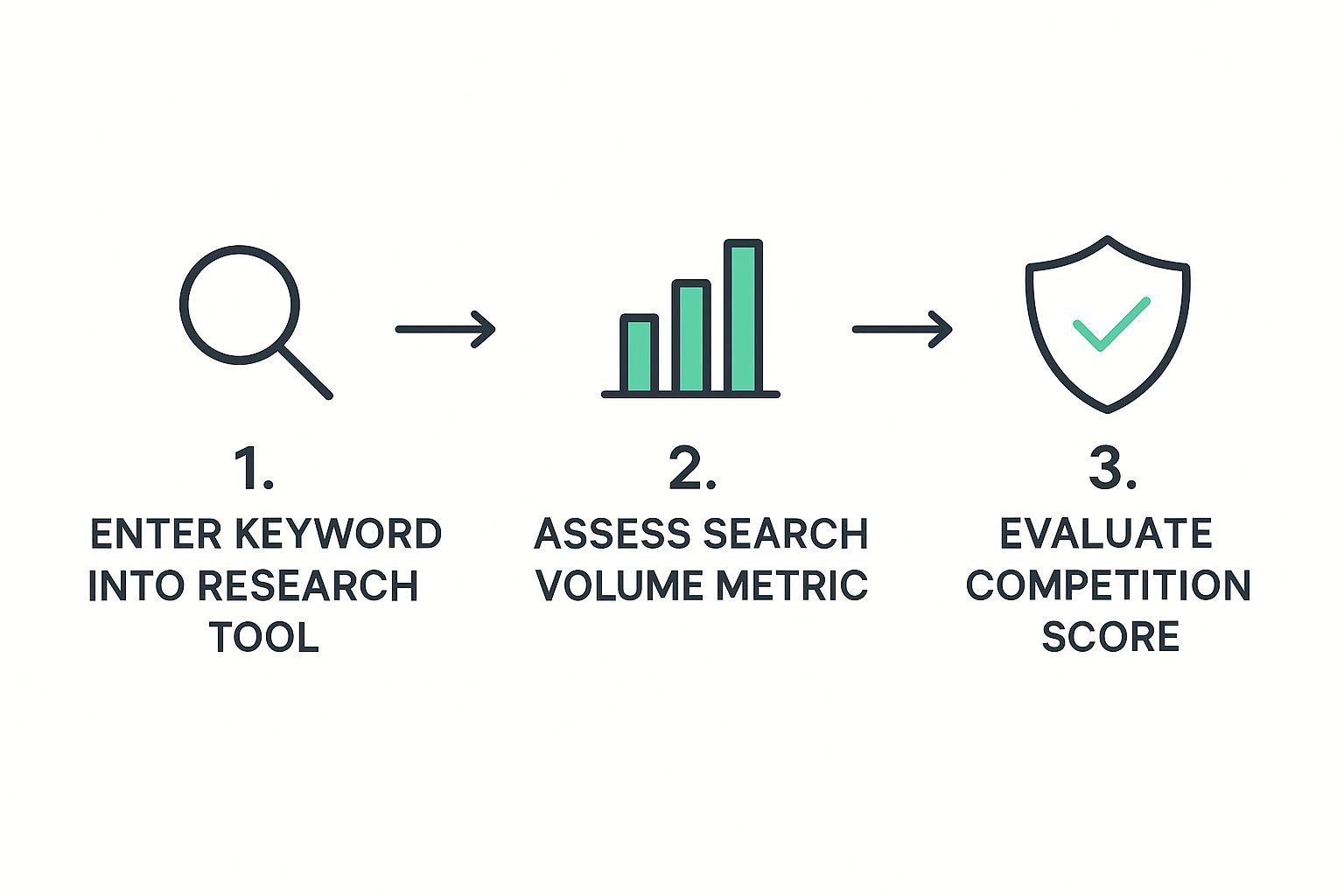
As you can see, once you've found a keyword with some search volume, sizing up the competition is what comes next.
I like to treat this as a quick, methodical audit. It's easy to get sidetracked, so having a mental checklist helps keep the process consistent for every keyword you evaluate.
Here are the green lights I'm always searching for—the signs that scream "golden opportunity":
- Weak Content: Are the top results thin, poorly written, or just barely scratching the surface of the topic? Perfect.
- Outdated Articles: Seeing dates from 2-3 years ago is a fantastic sign. It means no one has bothered to create a better, more current resource.
- User-Generated Content: If you see forum posts from places like Reddit or Quora ranking high, that's a massive signal. It tells you Google is desperate for a real authority on the subject and can't find one.
- Low-Authority Sites: The SERP is dotted with sites that have a low Domain Authority (DA) or Domain Rating (DR). If they can get there, you probably can too.
On the flip side, some red flags should make you hit the brakes, even if a tool tells you the keyword is "easy." If you're a newer site and you see page one dominated by household names like Wikipedia, Forbes, or the biggest players in your industry, you're signing up for an uphill battle. For a much deeper look at this process, our guide on how to analyse competitors' keywords is a great resource.
A low KD score might get a keyword on your shortlist, but seeing three forum posts on page one is what gets it on my content calendar. That's the signal that Google is actively searching for a better answer.
Spotting Search Intent Mismatches
Sometimes the weakness isn't the quality of the content itself, but its format.
Does your keyword sound like someone wants a step-by-step guide, but the top results are all product pages trying to make a sale? Bingo. That’s a search intent mismatch.
For example, a search for "how to build a garden bed" that returns a bunch of e-commerce sites selling pre-made kits is a clear opening. People are looking for a DIY tutorial, and Google is serving them shopping links.
Spotting these mismatches is your chance to swoop in with the exact type of content searchers are looking for but can't find. That gives you a massive advantage right out of the gate.
Figure Out Which Keywords Will Actually Make an Impact
Alright, you've done the hard work and have a solid list of low-competition keywords. That’s a huge step, but don't just dive in and start creating content. The next move is crucial: prioritizing this list with a sharp, strategic eye. Just going after the keyword with the highest search volume is a classic rookie mistake, and it's a fast track to wasted effort.

Real impact comes from tying your keyword choices directly to your business goals. You need a simple, effective way to score each opportunity based on what actually matters. We're talking about business relevance, the searcher's intent, and realistic traffic potential. This is how you make sure your content plan attracts the right people—the ones who are likely to become customers—not just random clicks.
Look Beyond Volume to Find Business Value
Let’s walk through a real-world example. Imagine you're running a company that sells project management software. You've uncovered two promising, low-competition keywords:
- "free project management templates" (Informational intent, 900 monthly searches)
- "best project management software for small teams" (Commercial intent, 250 monthly searches)
On the surface, "free project management templates" seems like a no-brainer. It has more than 3x the search volume! But hold on. The intent behind that search is purely informational. People are looking for a free download, not to buy software. Sure, you might capture an email address, but they aren't in a buying mindset.
Now, look at the second keyword. "Best project management software for small teams" is pure gold, even with lower volume. The person searching for this has their wallet out, so to speak. They have a problem and are actively comparing solutions. Ranking for this term will bring in visitors who are much closer to making a purchase, making every single one of those clicks incredibly valuable.
This is the secret to smart prioritization. It’s not about the sheer quantity of traffic you can attract, but the quality. A keyword that brings in five qualified leads is infinitely better than one that brings in 500 visitors who bounce and never think of you again.
To help with this, you can use a simple scoring system to rank your opportunities objectively.
Sample Keyword Prioritization Scorecard
Use this simple scoring system to objectively rank your keyword opportunities based on the metrics that matter most to your business.
| Keyword | Monthly Volume | Business Relevance (1-5) | Commercial Intent (1-5) | Final Score |
|---|---|---|---|---|
| "free project management templates" | 900 | 2 | 1 | 1,800 |
| "best project management software for small teams" | 250 | 5 | 5 | 6,250 |
By multiplying the volume by your relevance and intent scores, you get a much clearer picture of true potential. The "lower volume" keyword is actually the bigger opportunity.
Connect Keywords to Your Customer’s Journey
To really nail this, you have to think about where each keyword fits into your customer's journey—are they in the awareness, consideration, or decision stage? This simple framework helps you build a well-rounded content strategy that guides potential customers from their first casual search all the way to a final purchase.
For instance, our own research into commercial keywords shows that some industries are hotspots for valuable, low-competition terms. Software-related keywords make up about 38.4% of a top 100 list we analyzed, with Financial Services following at 21.5%.
When you understand where a keyword fits, you can create the perfect piece of content to meet the searcher's needs in that exact moment. For a deeper dive into this, check out our guide on keyword research best practices. This kind of strategic mapping is what turns a basic keyword list into a powerful roadmap for winning new customers.
Common Questions About Keyword Research
Even when you have a solid keyword research process down, a few questions always seem to pop up. Let's dig into some of the most common ones I hear, because getting these details right is what separates a good SEO strategy from a great one.
What Is a Good Monthly Search Volume?
This is the big one, and the honest answer is always the same: it completely depends. There's no magic number that works for every single website. The real trick is to stop obsessing over raw volume and start focusing on relevance and user intent.
For a B2B software company, a keyword with just 50-100 super-specific monthly searches can be a goldmine if those searchers turn into high-value clients. On the flip side, a consumer-focused blog might need to aim for terms in the 500-2,000 search range to build enough traffic to matter.
A keyword with 100 searches that brings in five qualified leads is way more valuable than one with 5,000 searches that attracts people who aren't a good fit. It’s always quality over quantity.
Ultimately, a "good" volume is whatever is realistic for your site to rank for and valuable enough to be worth your time. Don't ever dismiss a low-volume keyword if the search intent is a perfect match for what you do. Those are often the easiest wins and can lead to incredible conversions.
How Long Does It Take to Rank?
Ah, the million-dollar question. How long it takes to rank depends on a few big things: your website's overall authority, how good your content is, and how truly "low-competition" the keyword is. It's definitely a marathon, not a sprint, but you can see movement faster than you might think.
Here’s a rough timeline of what to expect:
- For a newer site: If you nail your on-page SEO, you could see your article pop into the top 20-30 within a few weeks. Actually cracking the top 10 for a low-competition term? That'll likely take 2-4 months.
- For an established site: If your site already has some authority and a good backlink profile, you can rank in the top 10 much faster—sometimes in as little as a month.
The single biggest factor you can control here is the quality of your content. Your goal should always be to create something that is just flat-out better, more helpful, and more thorough than anything else on page one.
Are Long-Tail Keywords Always Low Competition?
There's a very strong link between the two, but it’s not an iron-clad rule. Long-tail keywords—those longer, more specific phrases—naturally get fewer searches. Because of that, fewer people are usually competing for them.
But here's the catch: as more SEOs get savvy, even some long-tail keywords can get crowded. Think about a long-tail phrase with huge commercial intent, like "best CRM for real estate agents." You can bet that will have a ton of competition from big software review sites and the CRM companies themselves.
This is precisely why that final step of manually checking the SERP is so important. You can't just assume a long-tail keyword is an easy win. You have to get in there and actually look at the search results to be sure.
Ready to stop guessing and start finding high-value keywords you can actually rank for? RankHub uses AI to analyze your website and deliver a tailored list of low-competition opportunities in minutes. Skip the spreadsheets and endless filtering—find your next big win today at https://www.rankhub.ai.
More from Our Blog
Zoho Marketing Automation Explained: Is It Right for You?
Compare Zoho Marketing Automation vs HubSpot on pricing, features, ease of use, and automation depth. See which wins for small teams and solo founders.
Read more →
Looking for an SEO Company? Here Are Your Best Options
Compare top SEO companies, AI platforms, and agencies. Find the best fit for your budget, from $49/month tools to full-service retainers.
Read more →
Marketing AI Tools Compared: Which Delivers Real Results?
Compare top marketing AI tools for SEO content creation. See pricing, features, and which tool fits solo founders, SMBs, and marketing teams.
Read more →