Analyse Competitors Keywords for SEO Wins
Learn how to analyse competitors keywords to uncover hidden SEO opportunities. Our guide gives you actionable steps to boost rankings and drive traffic.

Ever feel like your competitors are always a step ahead in the search results? It’s not a secret formula or some kind of magic. It's almost always the result of a smart strategy, and a huge part of that is knowing exactly what their audience—which is also your audience—is searching for.
When you start to analyze competitors' keywords, you’re essentially getting a peek inside their marketing playbook. It lets you see what’s working for them so you can reverse-engineer their success and find your own path forward.
Why Competitor Keyword Analysis Is Your Secret Weapon
Let's get real. Diving into your competitors' keyword strategy is one of the smartest moves you can make. It takes the guesswork out of your own SEO and content plans.
Find Golden Opportunities in Their Content Gaps
Think of it like this: when you map out all the keywords your competitors rank for, you’ll inevitably find topics they're hitting that you've completely overlooked. These aren't just random blog post ideas; they're proven concepts that are already pulling in the right kind of traffic.
By spotting and filling these content gaps, you're not just creating something new. You're strategically moving in on an audience segment your competitor has already done the hard work of validating for you.
Sharpen Your Entire SEO Game
This kind of analysis isn't just about grabbing a few new keywords to target. It has a ripple effect across your entire SEO approach. You'll start to see:
- The money-making terms: Pinpoint the exact phrases that are driving sales for them.
- Their core content pillars: Understand the main topics they've built their authority around.
- How your audience talks: Get a feel for the specific questions and language your customers actually use online.
This level of insight is no longer a "nice-to-have." The competition for eyeballs is fierce. The global SEO services market is expected to rocket to $106.9 billion in 2025, and with Google owning over 82% of the search market, you have to be strategic to win.
Getting a handle on a comprehensive competitor analysis framework is the first real step. It gives you a structured way to turn a mountain of data into a clear, actionable plan, ensuring every piece of content you create has a purpose from day one.
Pinpointing Your Real SEO Competitors
First things first: before you can dive into what keywords your competitors are using, you need to know who you’re actually up against in the search results. It’s a classic mistake to assume your main business rival is also your top SEO threat. They often aren’t the same.
The company you compete with for sales might be a ghost on Google, while a small blog you've never heard of is eating your lunch when it comes to traffic.
It really boils down to two kinds of rivals you need to keep an eye on:
- Direct Competitors: These are the obvious ones—the businesses selling similar products or services. If you’re an online store selling hiking boots, another hiking boot store is a direct competitor.
- Content Competitors: This is where it gets interesting. These are the websites, blogs, or even big media outlets that are creating content for your audience. They might not sell a thing, but they can easily dominate the search results for the informational keywords your potential customers are typing into Google every day.
Think about it like this: a local bakery’s direct competitor is the other bakery down the street. But their content competitors? That could be a popular food blogger who ranks for “best sourdough recipe” or a major publication like Food & Wine with a roundup of the best local bakeries. You've got to watch out for both.
Finding Your True Search Rivals
The best way to figure out who’s really competing with you for clicks is to let the data do the talking. A great starting point is to plug your own domain into an SEO tool like RankHub. It will crunch the numbers and show you which other domains consistently pop up for the same keywords you're trying to rank for.
Here’s a look at what this might look like inside RankHub, where it shows you keyword overlap and your top search rivals.

A report like this cuts right through the guesswork and gives you a clear picture of who is actually winning the traffic you want.
Your goal here is to create a tight, focused list of 3-5 key SEO competitors. Don't try to boil the ocean by analyzing every single site. That’s a surefire way to get overwhelmed. A smaller, more targeted list lets you do a much deeper, more useful analysis. This focused approach is a cornerstone of learning how to do competitor analysis in SEO the right way.
Pro Tip: Don't just obsess over the big, household names in your industry. I've often found that smaller, niche-specific blogs are sitting on a goldmine of low-competition keyword opportunities that the major players completely ignore.
Once you have this list, you're not guessing anymore. You have a solid, data-backed foundation to start the real work: digging into their keyword strategies to find gaps and opportunities you can exploit. This clarity is everything.
Extracting and Organizing Your Competitors' Keywords
Alright, you've got your list of top SEO competitors. Now the real fun begins. It’s time to move from simply knowing who you’re up against to digging deep into their keyword strategy, piece by piece. Tools like RankHub are perfect for this, letting you pull a complete list of every single keyword a competitor ranks for.
But let's be honest, getting that data is the easy part. You’ll end up with a massive, chaotic spreadsheet that feels more overwhelming than helpful. The real magic happens when you bring order to that chaos. Your job is to transform that data dump into a clear, actionable roadmap for your own content. And as you get started, it's smart to stick to proven keyword research best practices to make sure your work pays off.
Think of it like sorting a giant pile of LEGOs—you need to group them by color and shape before you can build anything cool.
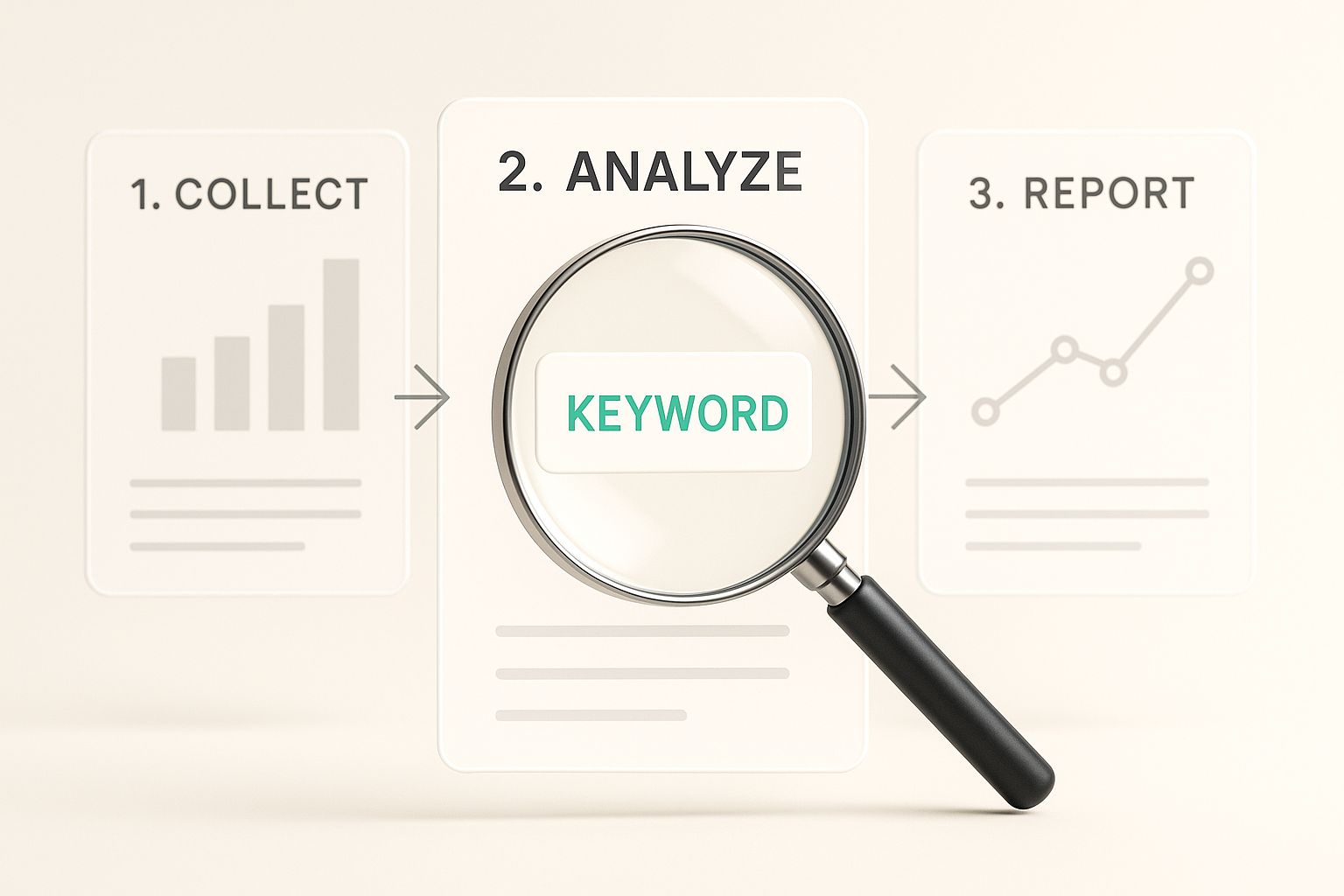
The whole point is to turn a list of raw data points into categorized opportunities. This makes it so much easier to figure out what to do next.
Creating Actionable Keyword Buckets
To truly analyse competitors keywords, you need to segment them. I like to call this creating "keyword buckets." It’s a simple filtering process that cuts through the noise and highlights the genuine opportunities.
Here are the three most valuable buckets I always start with:
- Low-Hanging Fruit: These are keywords where your competitor is on the board but not dominating—think rankings from position 6 to 20. The topic is clearly relevant, but there's an obvious opening for you to swoop in with better content and steal the spot.
- High-Intent Commercial Terms: This bucket is pure gold. It’s where you’ll find keywords with strong buying intent, like phrases that include "buy," "pricing," "service," or specific product names. These are the terms people use when their wallets are out.
- Content Gap Gold: Honestly, this is the most exciting category. It contains all the keywords your competitor ranks for that you have zero content about. Every keyword here is a proven topic that your shared audience is searching for—a bright, flashing sign telling you exactly what to create next.
The goal isn't just to find keywords; it's to understand the story the data tells. A well-organized list reveals your competitor's content pillars, their transactional focus, and, most importantly, where they are leaving the door wide open for you.
Structuring Your Analysis for Clarity
Once you've got your buckets figured out, a simple spreadsheet is your best friend. Seriously, don't overcomplicate it. Just create columns for the keyword, its monthly search volume, the competitor's ranking position, and the "bucket" it belongs to. This setup makes the data instantly scannable and helps you prioritize at a glance.
For example, you might spot a keyword in your "Content Gap Gold" bucket with a search volume of 2,000 per month where your rival is sitting at #4. Boom. That’s a high-priority target right there.
This methodical approach turns a jumbled list of terms into a strategic action plan. It allows you to systematically pick off the opportunities that will actually drive meaningful traffic and growth for your business.
Essential Tools for Competitor Keyword Analysis
While a spreadsheet is great for organization, you first need the right tool to pull the raw data. Different platforms have their own strengths, so choosing one that fits your needs and budget is key.
Here’s a quick rundown of some of the most popular options for this kind of analysis:
| Tool Name | Best For | Key Feature for Analysis | Price Point |
|---|---|---|---|
| RankHub | All-in-one content and SEO workflow | Automated keyword clustering and content gap identification | $$ |
| Ahrefs | In-depth backlink and keyword data | "Content Gap" tool to compare multiple domains at once | $$$ |
| Semrush | Comprehensive market and keyword research | "Keyword Gap" analysis and historical ranking data | $$$ |
| Ubersuggest | Beginners and small businesses | Easy-to-use interface and competitive overview reports | $ |
No matter which tool you land on, the goal is the same: get accurate data on what your competitors are ranking for. From there, your real strategic work can begin.
From a Mountain of Data to a Strategic Goldmine
Alright, so you’ve got a massive list of your competitors' keywords. That's a solid first step, but right now, it’s just raw material. The real magic happens when you start interpreting that data—transforming all that noise into a clear signal that actually guides your SEO strategy.
This is where we move beyond just collecting data and start asking the right questions. What keywords are actually sending them good traffic? Which of their pages are doing all the heavy lifting in search results? And, my personal favorite, where are they dropping the ball?
Think of this as moving from reconnaissance to building a battle plan. You're about to create a prioritized list of exactly where to focus your own content and optimization efforts for the biggest impact.
Finding Their Content Pillars by Spotting Keyword Clusters
Instead of getting lost in a sea of individual keywords, the first thing I always do is group them into themes. This is a total game-changer.
Let's say you see a competitor ranking for dozens of similar phrases like "beginner hiking gear," "best hiking boots for flat feet," and "waterproof hiking jackets." Boom. You’ve just uncovered one of their core content pillars: hiking gear.
These clusters show you the big-picture topics that Google sees them as an authority on. It’s a direct look into the foundational subjects they’ve built their entire SEO presence around.
This isn't just about finding keywords to snipe. It's about mapping out their entire content ecosystem. This lets you make a crucial decision: do you try to compete head-on, find a unique angle they missed, or pivot to a topic they've completely ignored?
Sizing Up the Real Opportunities with Key Metrics
Now that you have your clusters, it's time to dig into the numbers and find the low-hanging fruit. Not all keywords are created equal, so a few key metrics will help you decide where to strike first.
Here's what I focus on:
- Search Volume: This is your potential audience size. It's easy to get mesmerized by huge numbers, but trust me, a keyword with 500 targeted monthly searches often brings in more business than one with 50,000 generic searches. Intent is everything.
- Keyword Difficulty (KD): Most tools give this score on a 0-100 scale, estimating how tough it'll be to crack the first page. If you're not a huge authority site, hunting for keywords with a KD below 30 is a fantastic way to build momentum.
- Competitor Ranking Position: Look for keywords where your rivals are stuck on the bottom half of the first page or the top of the second (positions 6-20). This is the sweet spot. The topic is clearly working for them, but their hold on it is shaky.
Your goal is to find that perfect trifecta: solid search volume, manageable difficulty, and a topic that’s a perfect match for what you do. That’s how you find the quick wins.
Pinpointing Their Weaknesses and Your Openings
This is the most exciting part for me—finding what your competitors aren't doing well. You're essentially looking for gaps in their armor.
Hunt for high-volume keyword clusters where their content is thin, outdated, or just plain unhelpful. Maybe they have a killer article on "best running shoes" but completely whiffed on "best running shoes for trail running." That’s your opening.
This kind of detailed analysis is what it takes to break into the most valuable real estate on the internet. Consider this: 70% of all clicks go to the top five organic results. Getting into that zone is non-negotiable for serious growth. And with organic search driving around 53% of all website traffic, the stakes are incredibly high. (You can dig into more of these vital SEO statistics on SERanking).
By sifting through their keyword list and holding it up against their actual content, you can build a roadmap for your own success. This isn't guesswork; it's a data-backed plan that will guide every article you write and every page you optimize.
Using AI for Faster and Deeper Analysis

Let’s be honest, nobody enjoys manually sifting through thousands of competitor keywords in a spreadsheet. It’s slow, mind-numbing, and it’s way too easy to miss the good stuff. This is exactly where AI tools come in, not just to make the process faster, but to find insights a human would probably overlook.
AI is completely changing the game for competitor keyword analysis. Instead of just dumping a massive list of terms on you, it digs much deeper. It can figure out the subtle nuances of what a searcher actually wants, group keywords into smart topic clusters for you, and even suggest what kind of content will work best for a specific query.
Moving Beyond Simple Keyword Lists
Old-school tools are fine for exporting raw data, but they leave all the heavy lifting to you. Modern AI platforms like RankHub are designed for interpretation. They can crunch huge amounts of keyword data in a blink, spotting semantic connections and new search trends that show you where the market is heading.
This isn't just about saving time—it’s a real strategic edge. It lets you see the entire forest of your competitor's content strategy, not just the individual trees.
AI essentially becomes your strategy partner. It connects the dots between keywords to show you the core content pillars and customer journeys that are making your competitors successful. It turns a boring spreadsheet into a 3D map of opportunities.
Uncovering Hidden Long-Tail Opportunities
One of the best things AI does here is find those amazing long-tail keywords. It's no surprise that by 2025, the global AI market is expected to reach $190 billion, and a big piece of that is for marketing tools that can nail user intent and pinpoint these super-specific, high-converting phrases.
AI algorithms are smart enough to see patterns in search data that reveal long-tail queries with low competition but super high buying intent. These are the gems your competitors have likely missed. For a deeper dive on this, check out our guide on how to use AI for SEO.
A few things AI-powered tools do incredibly well:
- Automated Clustering: They can instantly group thousands of keywords into logical topic clusters, giving you a clear roadmap for what content to create.
- Predictive Analysis: Some tools can even forecast the potential traffic and ranking difficulty for a keyword before you write a single word.
- Intent Recognition: AI can accurately tell you if a search is informational ("how to"), commercial ("best of"), or transactional ("buy now"), which helps you focus on what really matters.
If you want to get even more efficient, checking out some of the 5 Best AI Tools To Help Businesses With SEO can make a huge difference. This isn't about a robot taking your job; it’s about giving yourself analytical superpowers so you can make smarter decisions, faster.
Got Questions? We've Got Answers
Let's tackle some of the common questions that pop up when you're getting started with competitor keyword analysis. Think of this as your quick-start guide to clear up any confusion and get you moving.
How Often Should I Actually Do This?
Honestly, a deep dive every quarter is the sweet spot for most businesses. This gives you enough time to see real trends emerge without getting bogged down in the daily fluctuations of search rankings.
That said, if you're in a hyper-competitive space, you might want to do a quick check-in on your top 3 rivals every month. This helps you stay agile and pounce on new opportunities before they become saturated.
Think of it like this: a retail brand will probably do its big quarterly analysis, but you can bet they’re checking things more frequently in the run-up to Black Friday. The same goes for any seasonal business—it just makes sense to keep a closer eye on things during your peak seasons.
Here’s a simple rhythm to consider:
- Quarterly Deep Dive: Go wide. Look at your competitors' entire keyword profile and identify major content gaps.
- Monthly Pulse Check: Go narrow. Focus on your top 3 competitors and any new, high-value keywords they’re starting to rank for.
- Weekly Spot-Check: Keep an eye on your most important, highest-traffic pages to catch any sudden drops or surges.
What's a "Keyword Gap" and Why Should I Care?
A keyword gap is simply the list of search terms your competitors are ranking for, but you aren't. It’s a goldmine. It points you directly to topics and phrases your shared audience is actively searching for—topics you’ve completely missed.
This means you can find low-hanging fruit and create content that has a built-in audience.
Filling a keyword gap is like serving a dinner guest their favorite dish—you already know they're going to love it.
We saw one company boost its organic traffic by 27% in just three months, purely by focusing on filling its most obvious keyword gaps. It’s that powerful because it:
- Shows you exactly which content to create next.
- Ensures your content plan is based on proven audience demand.
- Saves you from wasting time on keywords that are a long shot.
So, Should I Just Copy-Paste Their Keywords?
Please don't. Blindly copying a competitor's keyword list is a recipe for being a pale imitation. Your goal isn't to be just like them; it's to be better.
Instead, use their keyword list as a source of inspiration. See what topics they're covering, then find an angle they missed or a question they didn't answer thoroughly.
Over time, you'll start to see patterns. You can adapt their high-level concepts into your own unique content that actually reflects your brand and expertise. By putting your own spin on things, you build authority on topics your rivals are just skimming the surface of.
- Look for long-tail variations they aren't targeting. These often have lower competition and much clearer search intent.
- Find a unique angle. Can you answer a specific question they glossed over? Or maybe add a local or regional twist?
Think of your keyword list as a living document, something you review regularly alongside your content calendar.
The more consistent you are with your analysis, the smarter your content decisions will become.
Keep at it, and you'll see those rankings start to climb.
Ready to outpace your rivals? Discover how RankHub can automate competitor keyword analysis in seconds at https://www.rankhub.ai
More from Our Blog
7 Content Writing Tools That Boost Your SEO Rankings
Discover the top 9 SEO content writing tools to automate drafting, optimization, and publishing. Boost rankings with AI-assisted workflows.
Read more →
Zoho Marketing Automation Explained: Is It Right for You?
Compare Zoho Marketing Automation vs HubSpot on pricing, features, ease of use, and automation depth. See which wins for small teams and solo founders.
Read more →
Looking for an SEO Company? Here Are Your Best Options
Compare top SEO companies, AI platforms, and agencies. Find the best fit for your budget, from $49/month tools to full-service retainers.
Read more →