
A keyword competitor analysis is basically figuring out who you're really up against on Google and what search terms are bringing them all their traffic. This isn't about being sneaky; it's a smart way to validate what actually works with your audience so you can find openings to do it even better. The whole point is to build an SEO strategy based on solid data, not just a bunch of hopeful guesses.
Why Your Competitors Are Your Best SEO Mentors

Trying to build an SEO strategy from the ground up can feel like fumbling around in the dark. You could waste months chasing keywords you think your customers are searching for, only to realize they're not bringing in any real business. Peeking at what your competition is doing gives you a massive shortcut by showing you what already clicks with the people you’re both trying to reach.
Think about it—your competitors have already invested their time and marketing budget to learn which keywords pull in qualified leads. By studying their wins, you get a proven roadmap. This lets you skip the trial-and-error phase and jump straight to creating better content for terms you already know are winners.
Identify Your True Online Rivals
One of the biggest mistakes I see people make is thinking their direct business competitors are their only SEO competitors. The truth is, it's way more nuanced than that. Your real SEO rivals are any website, blog, or platform ranking for the keywords you want to target.
This means you’re likely up against a mix of players:
- Direct Competitors: The obvious ones—companies selling the same stuff you do.
- Content Competitors: Think affiliate blogs, review sites, or industry news outlets that capture your audience’s attention with helpful articles.
- Marketplace Competitors: Huge platforms like Amazon, Etsy, or even Pinterest that often dominate the search results for product-focused searches.
For instance, if you're selling shoes, you're not just competing with other shoe stores. A tool like seoClarity's Research Grid might show you're also competing with Google Images, fashion blogs, and niche marketplaces. Getting this full picture of the competitive landscape is the essential first step. You can dig even deeper with these tips on how to do competitor analysis in SEO.
The goal of a keyword competitor analysis isn't to just copy what everyone else is doing. It's about finding the gaps they've missed, understanding their blind spots, and swooping in on keywords where you can offer something truly better.
At the end of the day, this analysis gives you the hard data you need to actually move the needle on your organic traffic. It helps you shift from a strategy of "I think this will work" to "I know this will work," making sure every blog post and landing page you create has a clear, data-driven purpose.
Finding Your True Search Engine Rivals
Your biggest business rival might not even be on your SEO radar. I learned this the hard way with a major e-commerce client. We discovered their top search competitor wasn't another retailer at all—it was a small, almost forgotten online forum where enthusiasts were deep-diving into product details.
That little forum was quietly siphoning off tons of high-intent traffic because it answered very specific questions better than anyone else. It's a classic example of a critical truth: your real search engine rivals are simply whoever shows up on Google for the keywords you want to own. This group is often a surprising mix of direct competitors, content publishers, and massive marketplaces. If you don't identify this diverse group, you're fighting the wrong battle.
Distinguish Between Content and Product Competitors
The first thing you need to do is build an accurate list of rivals and separate them into logical categories. A tool like RankHub makes this a lot easier. You can plug in your core topics, and it will spit out a list of domains that consistently show up in the search results for those terms.
From there, you can start classifying them:
- Direct Product/Service Competitors: These are the companies selling stuff that's similar to yours. They're going after transactional keywords like "buy running shoes online."
- Content Competitors: This group includes blogs, review sites, media outlets, and affiliates. They often dominate informational keywords, catching users much earlier in their buying journey.
Both of these groups matter—a lot. A direct competitor might steal a sale from you today, but a content competitor can build loyalty and trust with a potential customer months before they’re even thinking about buying.
Identifying Competitor Types and Their Impact
To get a clearer picture, it helps to break down who you're up against. This table is a quick reference for distinguishing between different online competitors and understanding the threat each one poses.
| Competitor Type | Primary Threat | Example | How to Approach |
|---|---|---|---|
| Direct Competitors | Transactional keywords, bottom-of-funnel traffic. | Another SaaS company offering the same software. | Analyze their product pages, pricing, and sales-focused content. |
| Content Competitors | Informational keywords, top-of-funnel traffic. | A popular industry blog or review site. | Audit their content gaps, topic clusters, and backlink strategies. |
| Marketplaces/Aggregators | Broad, high-volume keywords; dominate SERP real estate. | Amazon, Yelp, G2. | Focus on long-tail keywords they ignore; optimize local SEO listings. |
| Indirect Competitors | Solve the same problem with a different solution. | A project management app vs. a simple spreadsheet template. | Target keywords related to the customer's core problem, not just the solution. |
Understanding these distinctions is key. It stops you from applying a one-size-fits-all strategy to a varied and complex search landscape.
A common mistake is getting tunnel vision on direct business rivals. In reality, a high-authority affiliate blog can be a much bigger threat to your organic visibility for top-of-funnel keywords than the company across the street.
Once you have your list of true rivals, it’s time to dig deeper. This means learning how to do content marketing competitor analysis to understand their entire strategy, not just their keywords. This kind of deep analysis helps you see how they're earning their visibility, not just what they rank for.
Ultimately, you want a comprehensive list that reflects the reality of the search results page. This focused list ensures your keyword analysis is based on who is actually winning your audience's attention online, letting you build a strategy to effectively counter them. This clarity saves you from wasting time and money trying to outmaneuver companies that aren't even in your digital weight class.
Decoding Your Competitors' Keyword Strategy
Alright, you’ve got your list of true rivals. Now comes the fun part: the detective work. We're moving beyond just knowing who you're up against and digging into how they're actually winning in the search results. The mission here is to pull apart their keyword strategy, piece by piece, until you can see the patterns, find their weak spots, and uncover opportunities for your own brand.
Think of it like popping the hood on their SEO engine. Are they flooring it with high-octane, high-volume keywords? Or are they quietly cruising past everyone with a super-efficient long-tail strategy? Figuring this out is the first step to reverse-engineering their success and, ultimately, building a better engine for yourself.
Uncovering Their Top Organic Keywords
First things first, you need to pull a list of every single organic keyword your competitor ranks for. In RankHub, this is as simple as plugging in their domain. The tool will spit out a detailed report of all their top-performing terms.
But let's be real, a raw list of thousands of keywords is mostly just noise. The magic happens when you start sorting and filtering this data to find what actually matters. I always start by hunting for their "money" keywords—the ones with clear commercial intent that are actually driving valuable traffic and potential customers.
For example, imagine a competitor in the crowded project management software space. Their keyword list might be packed with broad, top-of-funnel terms like "what is a Gantt chart?" That's fine, but what you really want to find are the keywords that scream "I'm ready to buy," like:
- "best project management software for small teams"
- "Asana vs Trello comparison"
- "project management tool with time tracking"
This is where you can see exactly which terms are driving the most clicks for them. This screenshot from SpyFu is a perfect example of how you can quickly identify a competitor's most valuable organic keywords.

The data laid out here gives you a prioritized list of their biggest SEO assets, showing you exactly where they're winning the traffic game.
Finding the Low-Hanging Fruit
Next up, it’s time to go on the hunt for their vulnerabilities. Just because they rank for a keyword doesn't mean they own it. My favorite tactic is to look for keywords where they’re ranking, but not on the first page. The sweet spot is anywhere from position 8 to 20.
These are your golden opportunities, the "low-hanging fruit." Your competitor has already done the hard work of proving to Google that their domain is relevant for these topics, but they haven't quite stuck the landing. This usually means their content is just okay, not amazing. By creating something far more comprehensive, up-to-date, or just plain better, you have a fantastic shot at leapfrogging them.
A killer keyword competitor analysis isn't just about admiring your rival's strengths. It's about surgically identifying where they are weak. These cracks are where you can wedge your own content in and start siphoning off their traffic.
Having the right tools is non-negotiable for this kind of deep dive. The historical data and trend tracking you get from modern SEO platforms can boost your keyword targeting effectiveness by over 30% in tough markets, which directly translates to more traffic and conversions. If you want to dig deeper, SpyFu's research on keyword competitor analysis offers some great insights. Turning this raw data into a real strategy is what separates the beginners from the pros.
Finding and Winning the Keyword Gap
Knowing what your competitors are ranking for is one thing. But the real gold is in finding the keywords they rank for that you don't. That’s what we call a keyword gap analysis, and it's basically a treasure map pointing you straight to new content ideas and some seriously quick SEO wins.
You're not just looking at one rival, either. A proper analysis means pitting your domain against two or three of your top competitors at the same time. This gives you a much clearer picture, revealing patterns and juicy opportunities you’d otherwise miss. The goal is to find that sweet spot: keywords with good search volume and beatable difficulty that you've somehow completely overlooked.
Pinpointing Your Best Opportunities in RankHub
Inside RankHub, this whole process is a piece of cake. Just pop in your domain, then add up to three of your main competitors. The tool will spit out a visual comparison that breaks down the keyword data into a few key categories.
Your eyes should go straight to the "Keyword Gap" or "Missing" keywords section. This is your hit list—these are the terms sending traffic to your competitors while you’re left out in the cold. But don't just export the list and call it a day. The next step is turning that raw data into a smart, actionable plan.
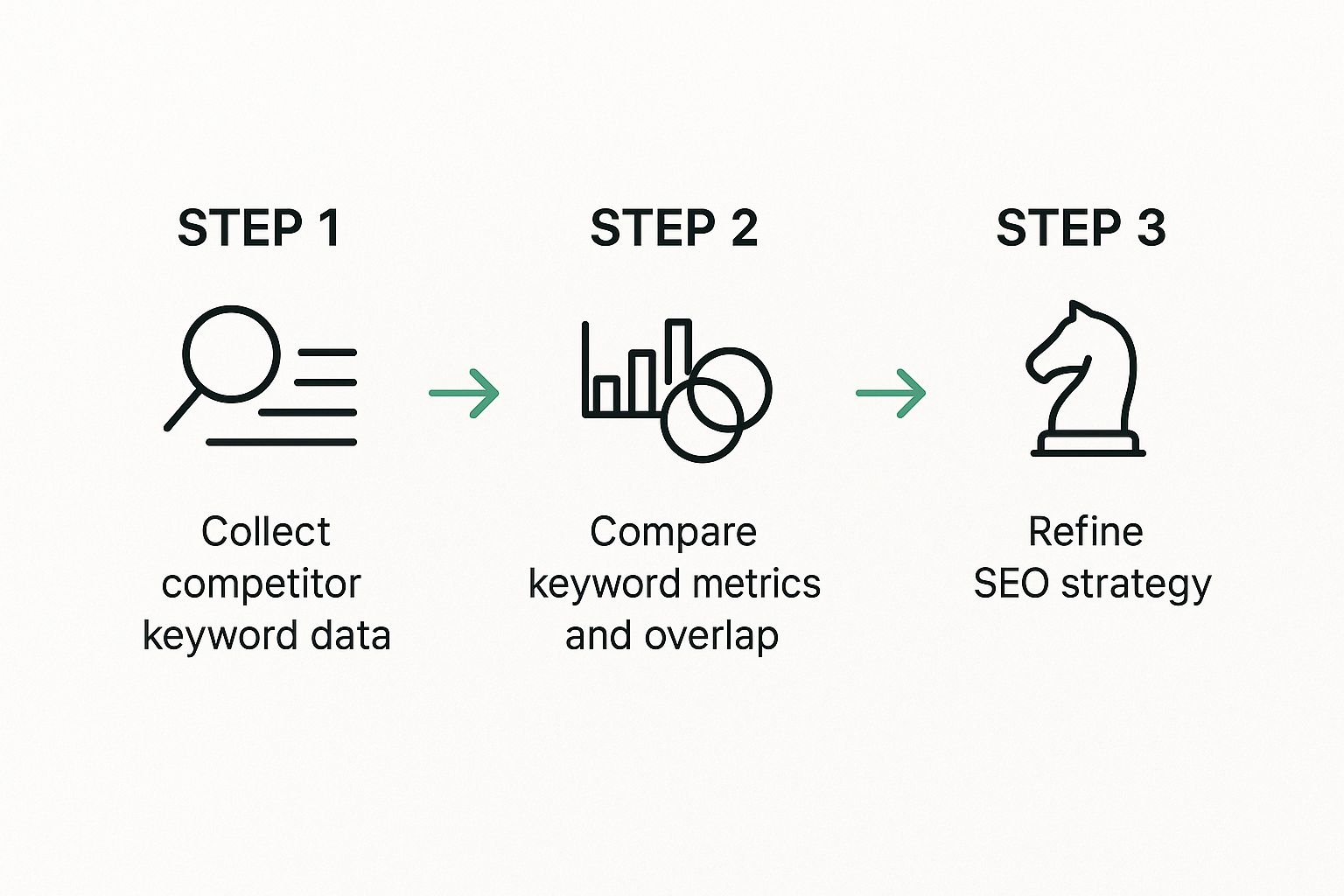
This just shows that grabbing the data is only step one. The real magic happens when you start comparing metrics and let those insights guide what you do next.
Turning Gaps Into a Content Plan
Okay, so you've got your list of gap keywords. Now what? It's time to get strategic. Not every keyword on that list is a golden ticket. You need to vet each one to make sure you’re putting your effort where it will actually pay off.
For every potential keyword, run it through this quick checklist:
- Is it actually relevant? Does this term fit with what you sell, do, and know? Chasing a high-volume keyword that has nothing to do with your business is a classic rookie mistake that only brings in tire-kickers.
- What’s the search intent? Are people looking for answers, comparing options, or are they ready to buy? Figuring this out tells you exactly what kind of content you need to create to satisfy their query.
- Can we actually win? Take a hard look at the Keyword Difficulty (KD) score. If the first page of Google is packed with household names and authority sites, you might want to focus on lower-difficulty terms where you have a fighting chance to rank sooner rather than later.
The point isn't to go after every single keyword your competitors have. It's about being selective. You're looking for the spots where you can step in and do it better—provide more value, answer the question more completely, or bring a unique angle to the table.
Once you’ve cherry-picked your high-priority keywords, it's go-time. You can get way more advanced with this, and our full guide on https://rankhub.ai/blog/keyword-gap-analysis goes much deeper.
With your keywords prioritized, having a killer content creation workflow is crucial. This is what helps your team churn out the awesome articles and pages needed to start claiming those SERP spots. It’s how you turn a simple analysis into a real engine for organic growth.
Tracking Your Share of Search Over Time

One of the biggest mistakes I see people make is treating competitor analysis as a one-and-done task. They'll do a massive deep dive, map out a content plan, and then completely ignore their rivals for the next six months. The problem is, by the time they look again, the whole search landscape has changed, and their hard work is already out of date.
Let's be real: SEO is a moving target. Your competitors are always pushing out new content, a new company might pop up out of nowhere, or a Google update could flip the rankings on their head. Winning means staying on top of these shifts, and that’s where tracking your Share of Search becomes your secret weapon.
What Exactly Is Share of Search?
Think of Share of Search as your market share, but for Google's results page. It's a metric that tells you how visible your brand is for a specific set of keywords compared to everyone else you're up against. It goes way beyond just tracking a few rankings and answers a much more important question: Are you becoming the go-to authority in your space?
Keeping a close eye on this number gives you a real-time pulse on your SEO performance. You can see, clear as day, if your strategy is actually stealing traffic from your competitors or if you're the one being left behind. It’s the ultimate report card for your SEO efforts.
Share of Search is your early warning system. A sudden drop can tip you off to a competitor's aggressive new campaign, while a steady climb gives you the hard data to show your boss that what you're doing is working.
How to Set This Up in RankHub
Getting this running in RankHub is super simple. First, you'll create a project and plug in the core group of high-value keywords you’re determined to own. Don't throw everything in here—focus on the terms that truly define your business and bring in the best customers.
Then, just add the competitors you've already identified. From there, RankHub takes over, constantly scanning the search results for that keyword group. It crunches the numbers and shows you your visibility as a clean Share of Search percentage, mapping it out for you over time.
This isn't just about collecting data; it's about shifting your entire strategy from reactive to proactive. Instead of guessing if your content is making a difference, you'll have a chart that proves it. It's so effective that brands that consistently track their keyword footprint have seen their organic traffic jump by up to 20% in just six months. This kind of insight is what helps you make smarter decisions and stay ahead of the game.
For a deeper dive into this, our guide on how to track keyword rankings has you covered.
Common Questions About Keyword Competitor Analysis
https://www.youtube.com/embed/VPDe8XL7Mh8
Even with the best tools and a solid game plan, you're going to have questions when you start digging into your competitors' keyword strategies. It’s just part of the process. I see teams get stuck on the same few things all the time, so let's walk through them.
Getting these cleared up will help you stay on track, sidestep the usual mistakes, and actually turn all this data into a real competitive edge.
How Often Should I Do This Analysis?
For a full-blown, deep-dive analysis, I’ve found that running one quarterly is the sweet spot. This schedule syncs up nicely with most marketing and content planning cycles, meaning your findings can directly shape your strategy for the next three months. It’s the perfect cadence to keep your efforts relevant.
But don’t just set it and forget it between those big reviews. I always tell people to set up monthly monitoring for their top competitors and their overall Share of Search. This lets you catch new threats or surprise opportunities as they pop up. If you're in a super fast-paced space like e-commerce, you might even want to peek at key metrics weekly.
What If My Biggest Business Rival Is Not My Top SEO Competitor?
This is a great discovery! Seriously, this is one of the most valuable things a keyword competitor analysis can teach you. It means the company you’re always worried about in sales meetings isn't the one eating your lunch on Google.
Your SEO strategy has to be laser-focused on beating the websites that are actually outranking you in the search results. This group often looks a little different than your direct business competitors and can include:
- Affiliate blogs that are reviewing products in your niche.
- Industry news sites that are soaking up all that high-funnel, informational traffic.
- Niche forums or community sites where your target audience is asking questions.
You have to win the battle for eyeballs online against your online rivals. The domains owning the SERPs you want are your real competition here.
The biggest mistake I see is when someone just exports a competitor's keyword list and tries to copy it. 'Copycat SEO' almost never works. The real goal is to figure out their playbook, find the holes, and create something way more valuable where they've left a gap.
Can I Perform Keyword Competitor Analysis for Free?
Sure, you can definitely get a basic look at things for free, but you'll hit a wall pretty quickly. Manually searching your top keywords and using free tools like Google Keyword Planner can give you a rough sketch of the landscape. They're fine for a quick gut check.
But for a truly deep analysis that uncovers keyword gaps, tracks performance over time, and calculates your true Share of Search, you really need a dedicated paid tool. The depth of data and the sheer efficiency you get from a platform like RankHub deliver an ROI that easily justifies the cost for any serious SEO campaign. The time you'll save is one thing, but the hidden opportunities you'll find are what really make it a no-brainer.
Ready to stop guessing and start winning? RankHub gives you the power to conduct a deep keyword competitor analysis in minutes, not hours. See exactly where your rivals are weak and uncover the keyword gaps you need to dominate the SERPs. Try it now and build your SEO strategy on a foundation of data.
Get started with RankHub today
More from Our Blog
Why Your Content Isn't Ranking: The Content Optimization Fix
Master content optimization to boost SEO rankings and engagement. Learn root causes, 5 proven solutions, and prevention tactics for 2024-2025.
Read more →
Digital Marketing Online: Your Complete Roadmap to Success
Master digital marketing online with our comprehensive guide. Learn strategies, tools, and best practices to grow your business in 2025.
Read more →
Beyond Traditional SEO Services: Better Alternatives for Your Budget
Compare top SEO services platforms: RankHub, Outrank, SEObot & alternatives. Find the best fit for your budget, team size & automation needs.
Read more →